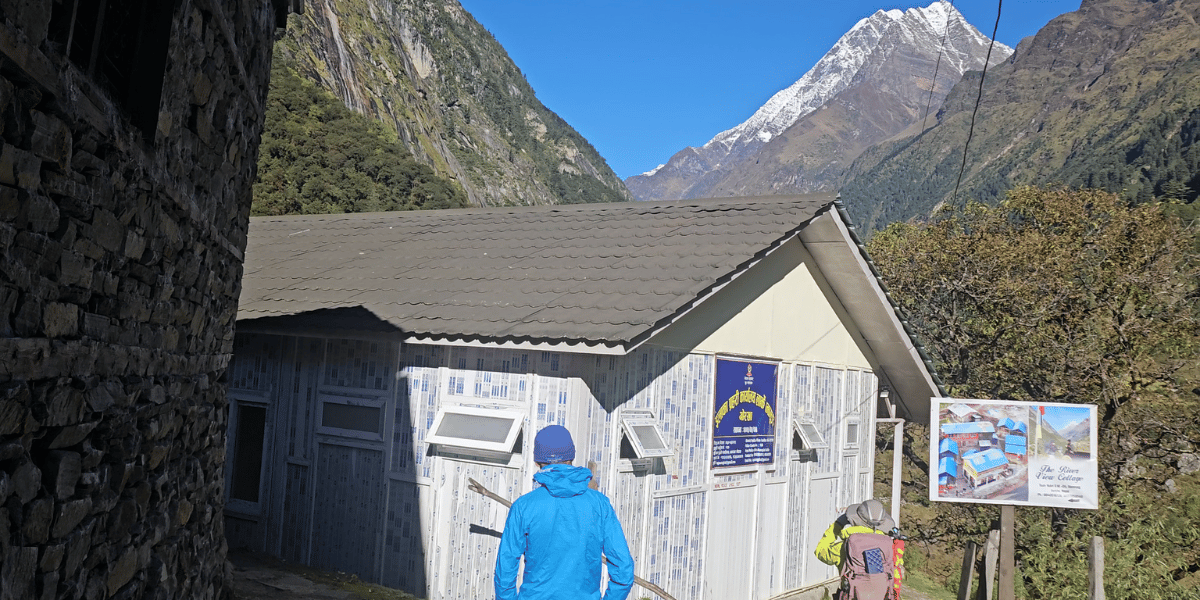
The Manaslu Circuit Trek is a majestic and challenging trekking experience in Nepal that offers beautiful memories for a lifetime. But on a serious note, this region falls within a restricted area. So, before taking any step on your journey, you need to understand that special permits are required!
Particularly speaking, you need four major permits: MCAP (Manasu Conservation Area Permit), ACAP (Annapurna Conservation Area Permit), MRAP (Manaslu Restricted Area Permit), and Chumnubri Rural Municipality Permit.
These permits are important part of your packing list. They are meant for your own safety and security, along with the conservation and preservation of the culture, tradition, and biodiversity of this mountain region.
The Manaslu permit costs differ based on nationality and season. And the collected fee is mainly used for local community development and cultural preservation. Besides just the entry fees, you’re also charged separately for filming, documentary work, and collecting scientific research materials.
Too much confusion? Worry not! Here on this blog, I’ll be sharing every detail about the permits required for the Manaslu Circuit, its cost, and how the validity dates work.
For the Manaslu Circuit Trek, you require two conservation area permits as the trek passes through the Manaslu Conservation Area and the Annapurna Conservation Area.
And since Manaslu is a restricted region, a RAP (Restricted Area Permit) is also required. Lately, even the rural municipality has started collecting additional funds for conservation and development purposes, too.
First, Essential Permit Protocols You Must Know
Before getting into the permit details, here are the official permit conditions you need to be aware of:
- The entry permit is only valid for a single person to enter the conservation area.
- Every trekker should follow the rules set by the National Park and Wildlife Conservation Act 2029 B.S., and the regulations designed under it.
- The trekker should carry the entry permit and RAP throughout the journey and show them to the concerned authorities when needed.
- The conservation area entry fee varies based on nationality, which you can obtain online, but an extra 2.9% is required.
- Double fees are imposed at the checkpoints if trekkers request permits at the checkpoints.
- You’re supposed to follow the Minimum Impact Code, ensuring the right preparations for safety, legality, and environmental friendliness.
Manaslu Conservation Area Permit (MCAP)
The Manaslu region was officially opened for international tourists in the year 1991 A.D. But the craze for tourism in the area only started in recent years.
The Manaslu Circuit Trek has grabbed the most attention, and many hikers even compare it with the Annapurna Circuit and Everest Base Camp treks.
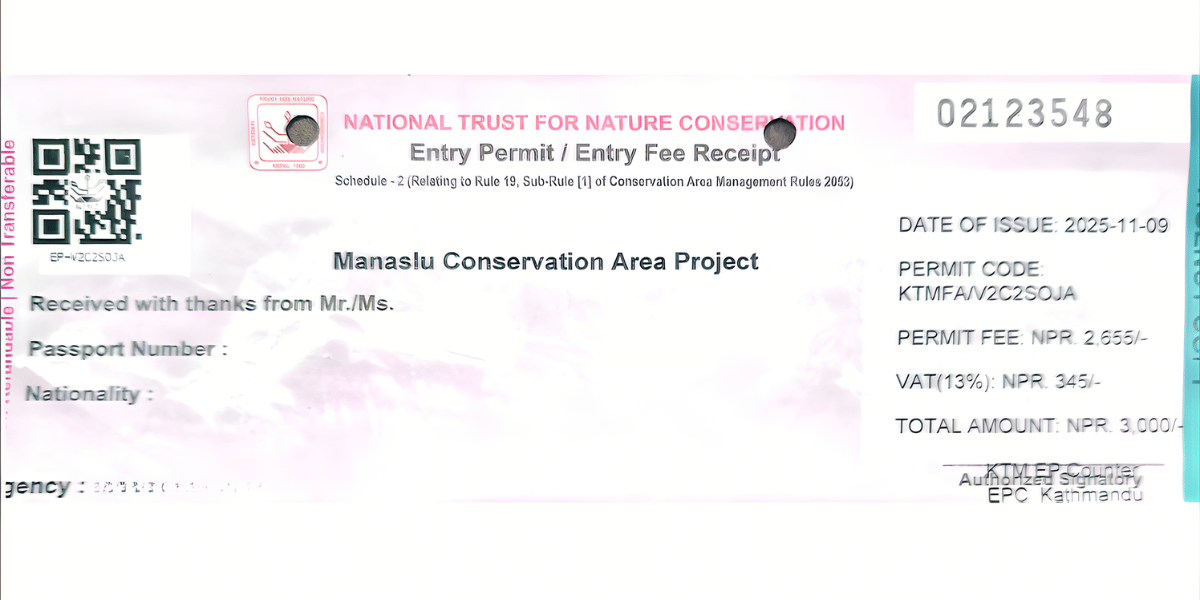
To manage this region, the National Trust for Nature Conservation (NTNC) took over the Manaslu Conservation Area Project in 1998. Since then, a Manaslu Conservation Area Permit has become mandatory for entering the Manaslu region. And the collected fee helps NTNC with:
- Conservation of unique wildlife, culture, and overall ecology.
- Generating income sources and involving local communities as beneficiaries.
- Ensuring border security by controlling access to the restricted areas.
The fees are as follows:
- For SAARC Nationals: NPR 1000
- For International Trekkers: NPR 3000
Manaslu Restricted Area Permit (MRAP)
IMPORTANT: Even a single trekker is now eligible to obtain a restricted area permit (meaning you no longer need a minimum group of two). However, applications must still be processed through a registered trekking agency, and each guide can now accompany a maximum of seven trekkers.
Even though trekking is permitted in the Manaslu region, its fragile ecosystem and unique Nurbi/Tsum culture can be at threat. For that reason, some areas of the Tsum and Nubri valleys within the Manaslu Conservation Area are declared restricted regions.
Basically, the Manaslu Circuit Trek covers the Chumnubri Rural Municipality of wards 1, 2, 3, and 4. And since major places covered in this trekking destination are within the restricted region, you need to obtain a special RAP (Restricted Area Permit) besides just paying the general MCAP entry fee.

This special RAP is issued by the Department of Immigration (DoI), and it’s meant to control the flow of tourists and preserve unique Tibetan traditions and monasteries.
Another important thing to note is that it’s prohibited to trek solo in this region, meaning you must be accompanied by a professional licensed guide. So, it’s very clear that to do the Manaslu Circuit Trek, you’ll need to go via a trekking agency, like Altitude Himalaya ourselves.
The cost of the RAP that covers the region of Chumnubri Rural Municipality (all wards 1, 2, 3, and 4) slightly varies based on season:
- From September to November: USD 100 per person/week and USD 15 per person/day (beyond 1 week)
- From December to August: USD 75 per person/week and USD 10 per person/day (beyond 1 week)
Here’s an example to help you understand:
Suppose you chose the peak Manaslu trekking season of October to trek the Manaslu Circuit, and your itinerary covers 9 days of trekking in Chumnubri Rural Municipality. This means you’ll need to pay:
- USD 100 per person for the first 7 days
- USD 15 × 2 = USD 30 for the next 2 days
This is exactly the case with our 15-day Manaslu Circuit Trek package, which covers 9 trekking days in Manaslu region (after that, you’ll enter the Annapurna CA for two more days).
And if you’re all alone, don’t worry! We even organize Manaslu Circuit Group Join Trek!
You see, Manaslu Circuit isn’t just difficult in terms of trekking, but even getting permits is kind of a headache. But if you’re going with Altitude Himalaya, we solve this problem for you!
Still confused? Contact us directly for your Manaslu Circuit Trek booking, and we’ll make things clear for you.
Chumnubri Rural Municipality Permit
Chumnubri Rural Municipality has recently introduced separate fees as per the authority given by the Local Government Operation Act 2074.

The permit is mandatory for both foreign and Nepalese citizens and can be obtained in Jagat with the following fees:
- For foreigners: NPR 1000
- For Nepalese citizens: NPR 200
This collected amount will be used on the conservation and development of the Manaslu Conservation Area, including tourist safety, waste management, wildlife control, construction of new and alternative foot trails, road and bridge maintenance, water supply construction, shelter construction, sign boards, maps, tourism-related trainings, and environmental protection.
Good News: The same permit will work for Tsum Valley Trek too, as this one covers all the wards of the Chumnubri Rural Municipality.
Annapurna Conservation Area Permit (ACAP)
Many of you might be surprised with this, but the thing is that even the Annapurna Conservation Area Permit is a must when doing the Manaslu Circuit Trek. This is because you’ll enter the Annapurna region upon crossing Larke Pass (Larkya La Pass), and that region’s permit is separately needed.
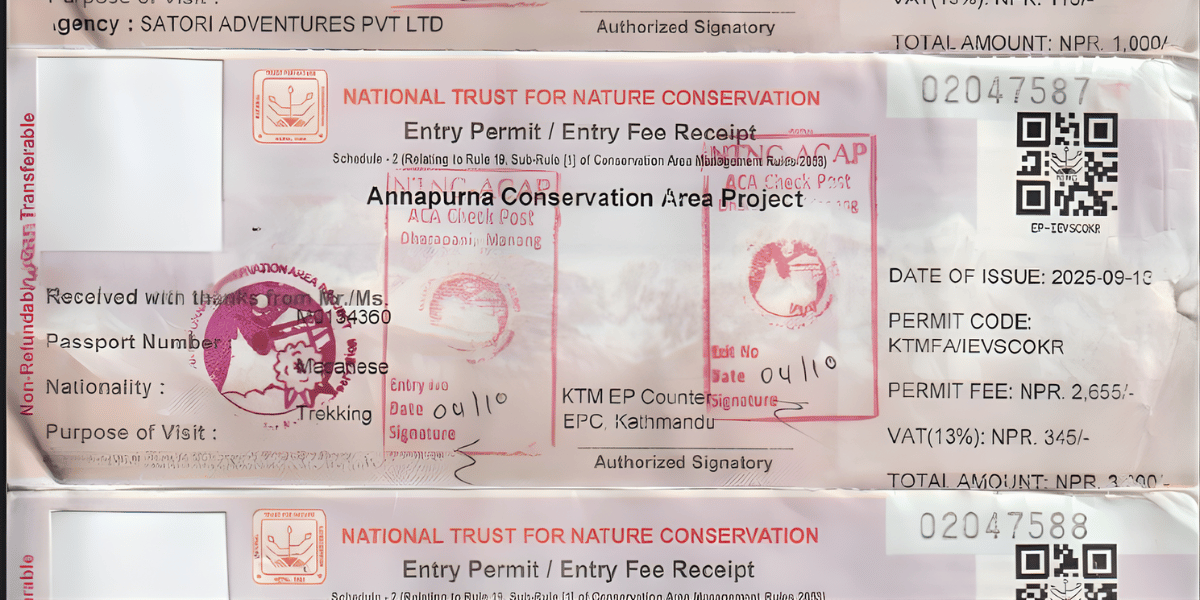
You see, the only use of the Annapurna Conservation Area Permit is for the exit part of the trek, where you’ll generally spend one or two nights (in Bhimthang and Tilche). There’s a checkpoint in Dharapani, where you’ll have to show this permit.
The fee is the same as ACAP:
- NPR 1000 for SAARC Nationals
- NPR 3000 for international trekkers
TIMS Card (Is It Necessary?)
This is a major question our team at Altitude Himalaya encounters. To make it very clear, the TIMS (Trekkers Information Management System) card isn’t mandatory like it was in the past.
The major use of TIMS, introduced by the Nepal Tourism Board (NTB) and the Trekking Agencies Association of Nepal (TAAN), is to keep records and itineraries for the safety of trekkers. But since you’ll be accompanied by a professional licensed guide, they shall handle this all on their own.
Still, if you’d like to get one for safety, you can surely obtain it yourself or through trekking agencies like us and pay the following fees:
- NPR 1000 for SAARC countries
- NPR 2000 for other nationalities
Currently, the government of Nepal is monitoring possibilities to launch an alternative digital model to replace the physical TIMS Card. We are hopeful that this will be introduced soon and will help manage trekkers’ information much better.
Tsum Valley Trek Permits
Trekking in the Tsum Valley is another popular activity in the Manaslu region. The place is widely known as the hidden happiness of the Himalayan region. And just like the Manaslu Circuit Trek, it is another protected and restricted area.
For this trek, you need the following permits:
- MCAP (Manaslu Conservation Area Permit): The same one required for the Manaslu Circuit Trek.
- Tsum Valley Restricted Area Permit: One that covers Chumnubri Rural Municipality wards 3, 6, 7, obtained from the Department of Immigration in Nepal
- Chumnubri Rural Municipality Permit: The same one required for the Manaslu Circuit Trek.
So, if you’re planning the Manaslu Circuit Trek with Tsum Valley combined, you’ll need all the permits of the main trek along with this additional Tsum Valley Restricted Area Permit.
Additional Permits
An important thing to note is that the Conservation Area permit, RAP, and rural municipality permit won’t cover every activity. You’ll need to get separate permits for different purposes from distinct departments:
- For documentary and filming, you have to obtain special permits from the Ministry of Information and Communication and should also be approved by the NTNC.
- Hunting is prohibited in the Manaslu Conservation Area. So, you won’t be able to do it here.
- Some monasteries also take additional permits, which can be paid directly upon your visit there.
- And before collecting any scientific specimens, you must obtain approval from the NTNC.
Note: The same permits cover you for the longer treks like Manaslu-Annapurna Circuit and Manaslu-Annapurna Three Passes too!




 Bhishu Acharya