Have you ever been to a place where history lives quietly alongside everyday life? A place where history is not just preserved, but centuries-old traditions come into practice? If you haven’t, then Dattatraya Square is what you are missing!
As you walk east of the Durbar Square of Bhaktapur, you’ll pass through the historical landmark and cultural neighborhood, leaving the crowd behind.
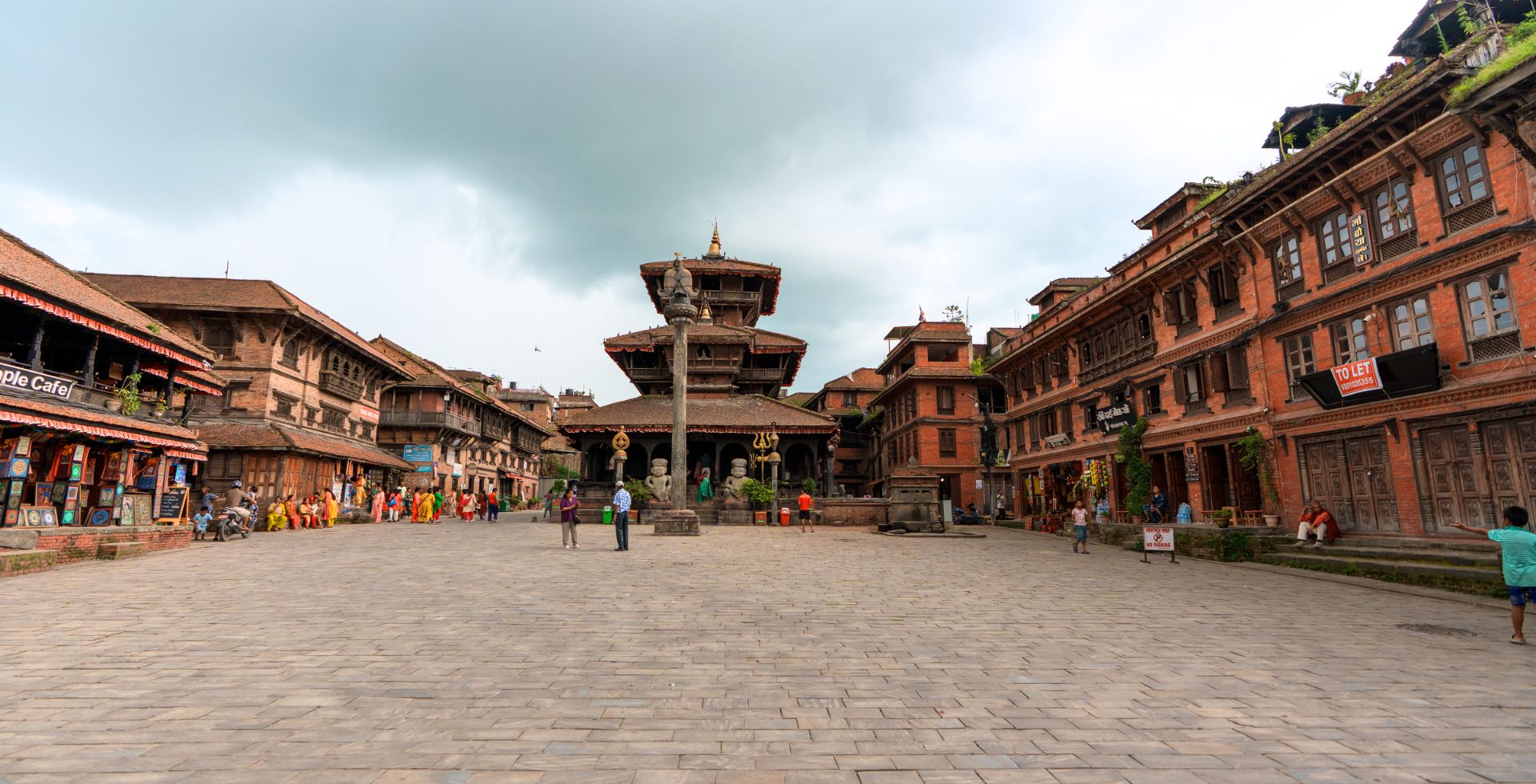
After passing a stone-paved alley, you will enter a peaceful courtyard. And that is Dattatreya Square, where culture, history, and life are all combined harmoniously.
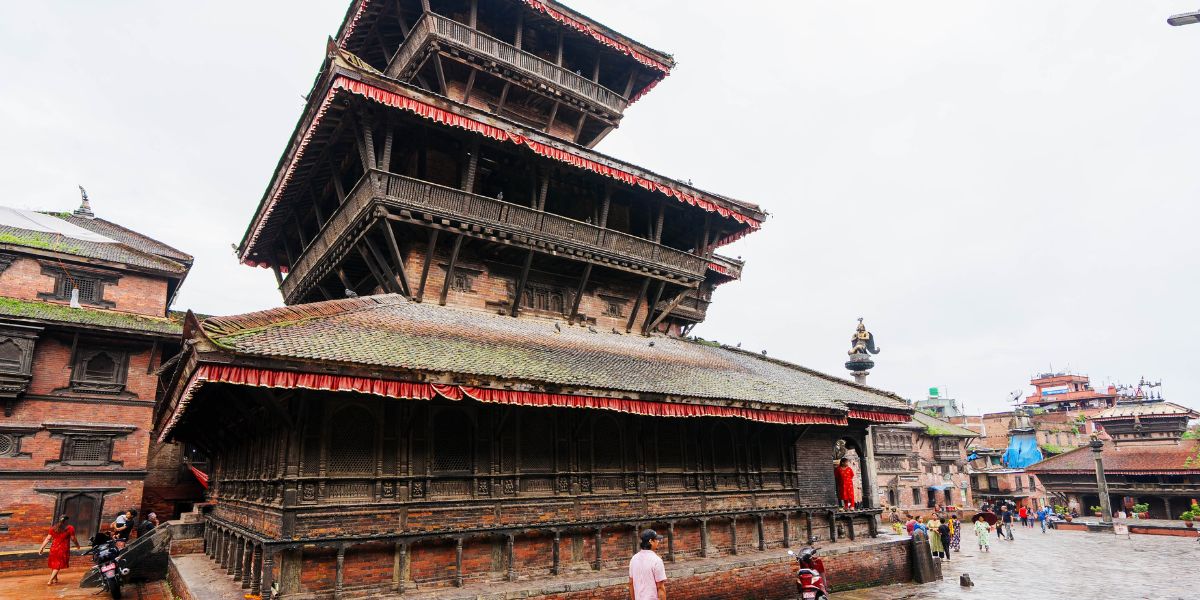
The main attraction of Dattatreya Square is a centuries-old Dattatreya Temple with three-tiered pagoda roofs along with its finest woodcarvings, dedicated to Lord Dattatreya.
Besides the Dattatreya Temple, this square consists of a few cultural heritage spots, including the Peacock Window, Wood Carving Museum, Brass and Bronze Museum, and many others.
This square is one of the major attractions of Bhaktapur, which has great historical and cultural significance. It displays living heritage and its finest craftsmanship. Along with that, it offers you the chance to explore from the historic temples to ancient courtyards and folklore to current living standards.
Here’s a detailed blog on Dattatreya Square before you plan your visit here!
Quick Facts on Dattatreya Square
|
Meaning of Dattatreya
|
Datta (given) and Atreya (descendant of the sage Atri)
|
|
Location
|
Bhaktapur Municipality, Bhaktapur District, Bagmati Province [Eastern part of Bhaktapur Durbar Square area]
|
|
Coordinates
|
27°40'24.5"N 85°26'06.9"E
|
|
Also Known As
|
Tachapal Tole (Tachupal Tole)
|
|
Main Attractions
|
- Dattatreya Temple
- Garuda Column
- Bhimsen Temple
- Wood Carving Museum
- Brass and Bronze Museum
- Peacock Window
|
|
Major Occasions
|
- Dattatreya Jayanti
- Bisket Jatra
- Gathemangal
- Gunla Festival
|
|
Main Deity
|
Lord Dattatreya (manifestation of Brahma, Vishnu, and Shiva)
|
|
Architectural Style
|
Ancient Newari architecture
|
|
Entry Fee (included as a part of the Bhaktapur Durbar Square entrance ticket)
|
- Foreign Nationals: USD 18
- SAARC Nationals: NPR 500
- Chinese Nationals: NPR 500
- Nepalese: Free
|
|
Best Time to Visit
|
Early morning (6 to 8 AM) or Late Afternoon (4 to 6 PM)
|
History of Dattatreya Square of Bhaktapur
Dattatreya Square offers ancient folklore along with its fine architecture. Every carving, narrow alley, and stone shrine echoes its story.
It also shows the vibrancy of local life, where artisan workshops, traditional houses, and different cultural and traditional practices coexist.
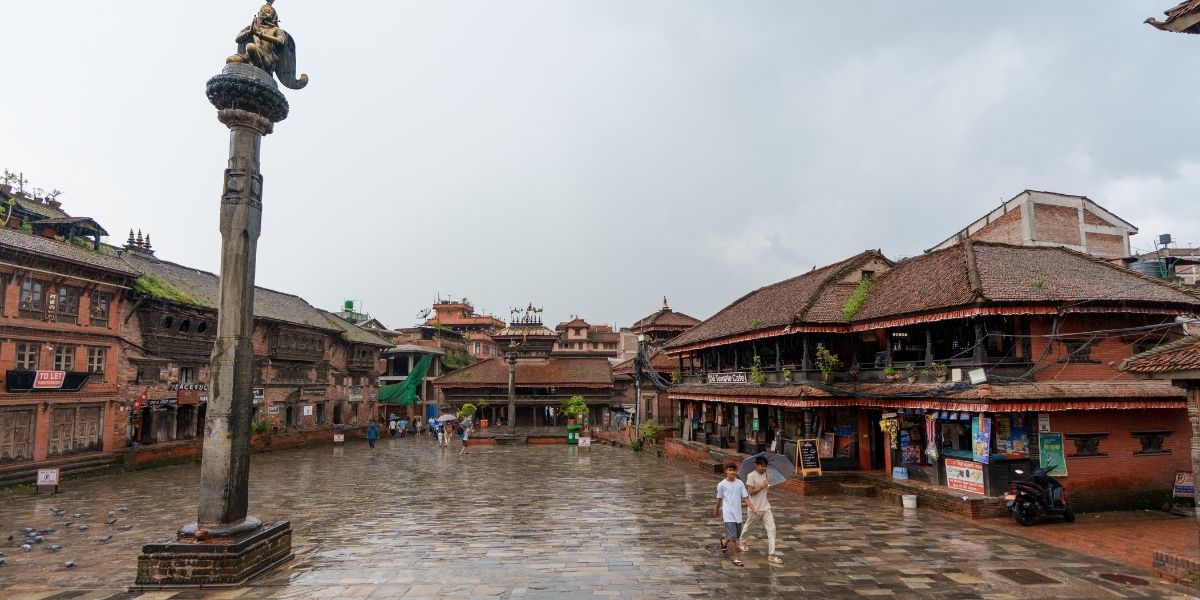
The surrounding area of the Dattatreya Square shows years of cultural and architectural development. The more you see the details of the architecture, the more you learn about the square!
|
Time Period
|
Events / Development
|
|
1470 A.D.
|
A single-storeyed sattal (resthouse) was established during the reign of King Yaksha Malla for Shiva ascetics at the place where Dattatreya Temple stands today.
|
|
Late 15th Century
|
Somewhere after the resthouse was constructed, Gosain Gurubaksha Giri founded Pujari Math.
|
|
1486 A.D.
|
- King Raya Malla reconstructed the sattal structure and opened it to the general public.
- Pujari Math came under the care of Indian Naga Sadhus (up to 1763 A.D.)
|
|
1495 A.D.
|
King Raya Malla added more stories to make the sattal structure more attractive.
|
|
1548 - 1560 A.D.
|
- King Vishva Malla added an overhanging balcony, more statues, wood carvings, and other decorative elements.
- Pujari Math was also reconstructed during this period (documented after a severe earthquake).
|
|
Note: There’s no historical evidence when the resthouse was turned into the Dattatreya Temple, but historians claim that this transformation happened either during the reign of King Vishva Malla (1547 - 1560 AD) or King Jitamitra Malla (1673 - 1696 AD).
|
|
1763 A.D.
|
- King Ranajit Malla removed the Naga Sadhus due to their administrative inefficiencies, and the Giri family was appointed as the Mahanta in Pujari Math.
- The same year, he changed the major structures of math.
|
|
1769 A.D.
|
(Presumed) King Jaya Prakash Malla of Kantipur and Tej Narasimha Malla of Patan took shelter in Dattatreya Temple after fleeing from their respective kingdoms when King Prithvi Narayan Shah invaded the valley.
|
|
1934 A.D.
|
The infamous Nepal-Bihar earthquake damaged Pujari Math's walls and drainage systems.
|
|
1969 A.D.
|
Dr. Franz Joseph Roieder visited Nepal and granted 100,000 German Deutsche Marks to restore Pujari Math as a token wedding gift to the then Crown Prince Birendra Bir Bikram Shah Deva on behalf of West Germany’s government.
|
|
1972 - 1974 A.D.
|
Pujari Math restoration was completed, and the Woodcarving Museum (part of the National Art Gallery) was established here. This successful restoration led to the foundation of the 1973/74 Bhaktapur Development Project.
|
|
1979 A.D.
|
Dattatraya Square within the Bhaktapur Durbar Square premises was enlisted in the UNESCO World Heritage Site along with seven other monument zones of Kathmandu Valley.
|
|
25th April, 2015 A.D.
|
The Gorkha Earthquake caused minor damage to the temple but heavily damaged the nearby National Woodcarving Museum and local shrines.
|
|
2016 – 2020 A.D.
|
The Department of Archaeology carried out a major restoration project. Local craftsmen restored the heritage using original materials and traditional methods.
|
The Origins of Tachupal Tole
Dattaraya Square is located on the eastern side of the Bhaktapur Durbar Square, in the Tachupal Tole.
The name “Tachupal” is derived from the Newar language, and it means “Grand Rest House”. Back then, this square was an important trade route connecting the Kathmandu Valley with Tibet and India.
Tachupal served as the social and political center of the city long before Bhaktapur’s royal seat shifted toward the larger Durbar Square. It became the key stop for pilgrims, merchants, roaming aesthetes, and travellers on their way to Kathmandu.
Even today, locals sit on the steps of the temple in the evening while the youths gather over a cup of chiya (tea).
History of Dattatreya Temple
By the 15th century, Bhaktapur had entered its golden age under King Yaksha Malla (the last ruler of Nepal Mandala, before the valley was split into three separate kingdoms).
The Dattatreya Temple is said to have been built in 1427 or 1428 A.D. by King Yaksha Malla. According to historians, it was first built as a public rest house (Sattal or Dharmashala) for traveling pilgrims and merchants. Later, a shrine was built by the then-king in memory of an Indian Yogi who died here while returning from his pilgrimage.
After King Yaksha’s death, King Raya Malla (who became the king of the independent nation, Bhadgaon) reconstructed the structure and made it accessible to the general public.
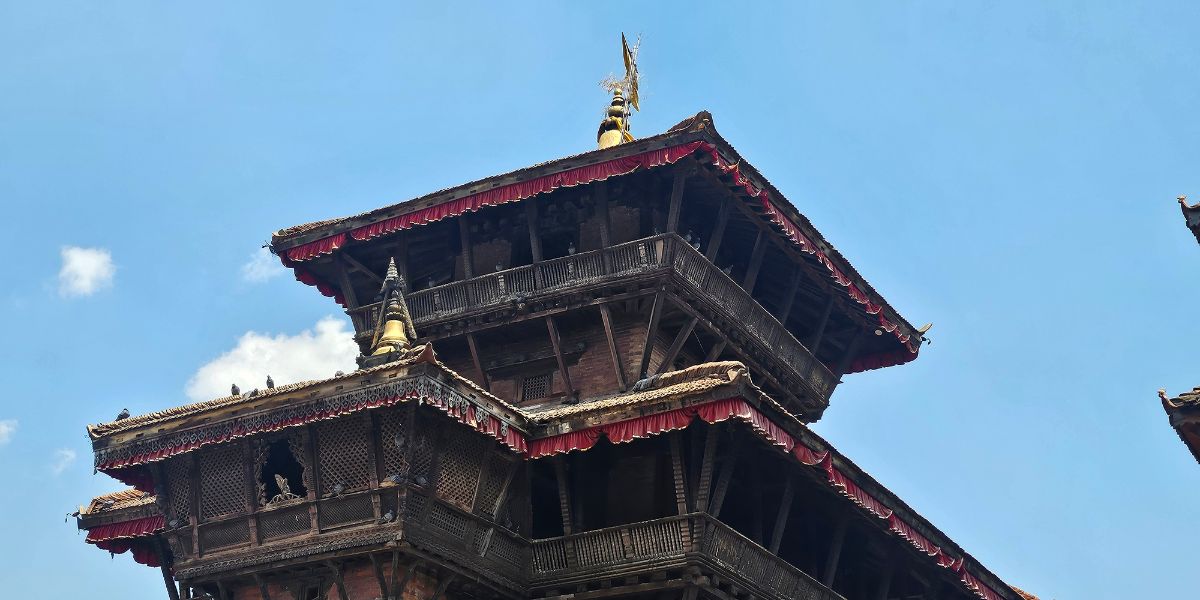
Afterwards, it was converted into a temple dedicated to Lord Dattatreya during the reign of Vishva Malla (1547-1560 AD) or Jitamitra Malla (1663-1696 AD). The exact date is still not historically verified.
This temple is often compared to Kasthamandap (a historic wooden pavilion in Kathmandu Durbar Square), as both these temples are believed to be built using timber from a single tree.
Moreover, Dattatreya Temple is one of the very few Hindu temples in Nepal dedicated to Lord Dattatreya, a composite deity of Brahma, Vishnu, and Mahesh (Shiva). Legends even claim that it was built on a former island within a small pond.
The temple itself is uniquely crafted, and the intricate woodcarving is what gives it a more symbolic and cultural meaning.
The pillar of Garuda, the conch, the chakra, and two soldiers (Jaimal and Patta) are here and depict many historical beliefs along with the religious significance.
Present Day Dattatreya Square
Dattatreya Square has stood through the reign of Malla kings, destructive earthquakes, lively festivals, and generations of people who have called it home. The square remains the same as it has always been!
These are the major attractions you’ll find in Dattatreya Square today:
- Dattatreya Temple as its central landmark
- Bhimsen Temple at the opposite end
- Pujari Math now converted to Wood Carving Museum
- Chikanappa Math converted to Brass and Bronze Museum
- Privately owned Peacock Shop and The Paper Factory
- A number of rooftop restaurants, local shops, private thangka painting galleries, etc.
What Does Dattatreya Really Mean? The Three-in-One Deity
Lord Dattatreya, one of the most divine figures with a unique frame of three faces, six hands, and a body, is worshipped at the Dattatreya Temple, located in one of the world heritage sites, Bhaktapur Durbar Square.
The exquisite wood carvings of the temple reveal the impressive craftsmanship and the artistic heritage of the locals.
This unique form of Lord Dattatreya sparks enough curiosity, and the story adds even more to it!
While I mention the story, the curiosity on Who is Lord Datttatreya? And what is the story behind the name of the temple? might be circling your head. Well, you must have heard of the temple of a single god, but the Dattatreya Temple… it's different!
It is dedicated to Lord Dattatreya, who is said to be the manifestation of the Trimurti: Lord Brahma (the creator), Lord Vishnu (the preserver), and Lord Shiva (the destroyer).
As you learn more about his birth, preachings, and gurus, you will know that the temple is not built just to honor the Trimurtis; it is made to respect the idea that “wisdom is born from unity”.
The Birth of Lord Dattatreya
The name Dattatreya is composed of two Sanskrit words, Datta meaning “given or bestowed” and Atreya meaning “Descendant of sage Atri”. Together, the name means “the one given to sage Atri”.
Several Hindu scriptures, such as the Bhagavata Purana, Markandeya Purana, and Brahmanda Purana, talk about the birth of Lord Dattatreya as the son of sage Atri and his wife, Anusya.
These texts also associate him with the holy trinity: Brahma, Vishnu, and Mahesh, but the stories differ from each other. Let’s deep dive into each one.
Popular Anecdote
A very popular version of the story is that the wives of the holy trinity became curious about the chastity of Anusuya and asked their husbands to test her virtue.
Then, the three gods disguised themselves as monks and visited Anusuya while Sage Atri was away. They asked her to feed them while she was unclothed.
Although this request put her in a dilemma, she completed it without compromising her chastity. She turned them into infants using her spiritual power and fed them.
After the completion of the quest, pleased by the unwavering virtue of Anusuya, three gods came into their true form and blessed the couple with a son in the form of Dattatreya, with three heads of the Trimurti.
Markandeya Purana
In the Markandeya Purana, the story begins with a Kausika Brahmin who suffers from leprosy and is a loathsome man. However, his devoted wife always treats him with deep reverence. To her, taking care of him was a sacred duty.
Despite his disease, the Brahmin saw a woman and got attracted. He demanded his wife visit her, so she carried him on her shoulders to fulfill his wish.
On their way, he feared thieves in the dark and mistakenly pushed sage Mandavya, who got extremely angry and cursed the Brahmin that he would die before the sun rose!
Hearing this, the devoted Brahmin’s wife used her power of chastity to stop the sun from rising again and disrupted the normal order of the whole world.
To fix things, the gods appeared in front of Anusuya and asked her to solve the crisis. Anasuya successfully pursued the Brahmin’s wife by promising her to restore the life of her husband.
As promised, the Brahmin’s wife lifted the curse, and the sun rose. Her husband also died as a result of the curse of Mandavya, but this time Anasuya saved his life and restored him to health and youth.
Then, the pleased gods offered her a boon, and she asked Brahma, Vishnu, and Shiva to become her sons. And Soma, Dattatreya, and Durvasa were born as their divine manifestation.
Bhagavata Purana
According to the Bhagavad Purana, the intense penance performed by Sage Atri impressed the three gods, which led him to get the boon of obtaining a son equal to the holy trinity.
As a result, Anusuya gave birth to three sons: Datta, Durvasa, and Soma, who represent the incarnations of Lord Vishnu, Shiva, and Brahma, respectively.
And even in the Dattatreya Temple of Bhaktapur, instead of a single idol of a deity, the left, middle, and right parts of the temple are occupied by the three images of Datta, Durvasa, and Soma.
Brahmanda Purana
The story that this purana provides starts with Sage Mandavya and the devoted woman, Silavati.
The sage, engaged in silent meditation, was wrongly accused of helping robbers. Then, he was taken to the palace and was ordered to be killed by piercing his body with a trident. He was seated on the tip of the trident.
Silavati, carrying her husband Ugrasravas on her shoulder, passed by Mandavya. That’s when Ugrasravas started scolding Mandavya, which angered him. Mandavya cursed Ugrasravas that he would die before sunrise.
To protect her husband, Silavati also cursed the sun not to rise the next day. This led to disorder in the world. The gods had to approach the Trimurtis for a solution, but none of them could find one. So, the Trimurtis went to Anasuya for help.
Then, Anasuya helped the gods by persuading Silavati to take back the curse. This resolved the cosmic crisis, which pleased the Trimurtis.
Delighted with the resolution of the crisis, the Trimurtis provided her a boon, and she asked the Lord Brahma, Vishnu, and Shiva to be born as her sons. Her wish was granted, and Dattatreya was born as the manifestation of Mahavishnu. Likewise, Durvasa and Chandra were born as the manifestations of Shiva and Brahma.
Lord Dattatreya as a Teacher: Who Learned from Nature
Based on the aforementioned three Puranas, Dattatreya is regarded as a deity born from the boon of the supreme trinity. But if we regard Hindu philosophy, Dattatreya is more remembered as a Guru of Gurus, “Adi Guru,” as he was the primordial source of spiritual knowledge and the Guru Principle. He is the first Guru to promote divine knowledge and propagate it.
What’s fascinating about Dattatreya is not his divinity but the way he learned!
Dattatreya had self-awareness, and he didn't depend only on a single human guru. He observed nature and treated life itself as his teacher.
Dattatreya learned from 24 different gurus, among whom many were elements of nature, animals, and ordinary beings.
He learned from 5 Natural Elements, 3 Celestial Bonds and Forces, 9 Animals, Birds & Insects, and 7 Human Beings & Objects. They are described below:
5 Natural Elements
Walking alongside nature, Dattatreya learned patience, detachment, virtue, power, and attributes from it:
- The Earth (Prithvi) taught him how to bear a burden without complaint.
- The Wind/Air (Vayu) had taught him to flow through life without being bound.
- He learned purity from flowing Water (Jala).
- Inner strength and transformation from Fire (Agni).
- Sky/Space (Aakash) represents that all the qualities and activities of the body cannot contaminate the real self.
3 Celestial Bonds and Forces
By looking up above in the sky, he learned the variations, jealousy, and the hardships that one could encounter no matter how large they are:
- Moon (Chandra) taught him that one’s self does not change even though there are physical changes, just like the waxing and waning moon.
- Sun (Surya) taught him not to be possessive and to take only what is necessary.
- He learned to remain calm despite countless challenges, just like Ocean (Samundra).
11 Animals, Birds & Insects
From the gifts of nature, in every step he took, Dattatreya learned delight, bane, control, spellbinding tune, awareness, creation, and transformation all along while being around it with focus:
- Pigeon taught him that one should not hold on to excessive attachment and possessions that can lead to destruction.
- He learned not to chase after pleasures anxiously like the Python. One should restrain oneself and accept whatever they get.
- Moth taught him not to be attracted to something that could destroy you.
- To be moderate and take things from many sources is what he learned from honeybees.
- Elephant (Gaja) taught him that lustfulness is dangerous.
- He learnt that captivating music could also be dangerous from the Deer.
- Fish made him aware of what could happen if he did not control his tongue.
- When the spider made its web, it illustrated to him the cycle of creation and destruction in the world.
- Serpent/Snake taught him to live independently instead of having an unnecessary attachment to permanent houses.
- Possessiveness brings suffering, and peace is found only if one lets go of the possessiveness, as taught by the Osprey bird (Kurara), as he came to peace once he let go of the meat that everyone was fighting for.
- When Bhringi (a wasp species) trapped a caterpillar in its nest and started buzzing, the caterpillar started thinking, out of fear, that it was also one of them. This deep focus of the Caterpillar taught him that one can attain whatever they want if they deeply focus and meditate on it.
5 Human Beings and Their Experiences
Although he is said to be a combined incarnation of Lord Vishnu, Shiva, and Brahma, he was not at all arrogant and learned many things from ordinary human beings:
- He learned from the story of a courtesan named Pingala that the true beginning is when we stop having endless expectations.
- A child’s innocence left him open to the world without ego.
- The arrow-maker’s deep immersion made him notice how one-pointed concentration can remove distractions and help you maintain focus.
- The activity of Young Maiden made him understand that too much company could also create a distraction.
- The honey gatherer taught him that the accumulation of wealth could lead to theft or robbery.
After studying about Dattatreya, you’ll realize that if we are able to view this world with our minds wide and free, the entire world shall become our teacher!
Dattatreya Temple: The Heart of the Square
This beautifully preserved pagoda style temple with the intricate details that reflect the skills of Newari craftsmen introduces you to the unheard ancient stories.
Every single carving of the area shows how art, architecture, and tradition came together in Kathmandu’s history.
The Dattatreya Temple of the Lord Dattatreya brings together devotees following Shaivism, Vaishnavism and the worshippers of Brahma.
The stone pillar in front of the temple with a Garuda statue (Vehicle of Lord Vishnu) signifies the presence of Lord Vishnu.
Also in the holy months of Shrawan and Poush, the temple is filled with the devotees of Lord Shiva.
Architecture and Design
The three-storied pagoda-style structure of the Dattatreya temple makes a huge impression and captures your mind from the entrance of this square!
All the brick, beams, and carvings are well planned and well structured to ensure that the temple is functional as well as artistic.
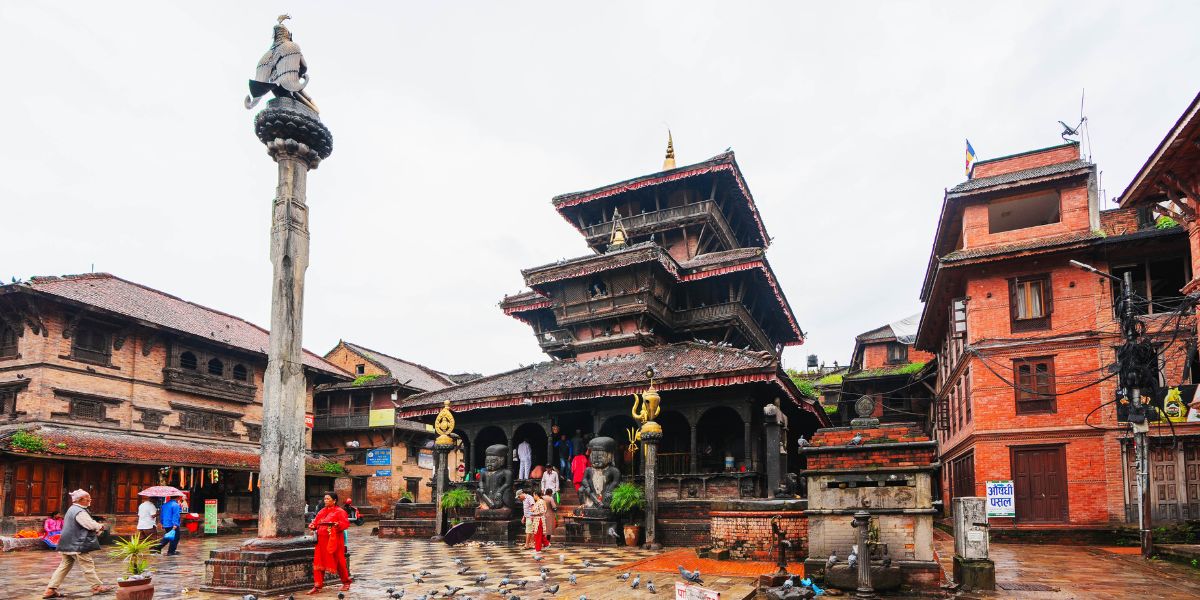
The timber framing and the wide overhanging roofs of the temple help it to resist the earthquakes and protect the walls and carvings from the blazing sun and heavy rainstorm.
This temple faces the west side and is built on a square plan, with an equal number of pillars on each side.
The tiers of the temple gradually decrease in size, which improves the temple stability as well as symbolizes the spiritual path to the divine world from the earth.
Originally, the structure of the Dattatreya Temple was a Mandapa (open-pillar hall) that served as a resting place for pilgrims, traders, and wandering ascetics.
The central space was later enclosed to form the Garbhagriha (innermost sanctum), transforming the sattal into the temple.
Later in 1849 A.D, several changes were made to the temple. The original symmetry of Sattal was destroyed with the addition of a porch (covered structure at the entrance of a building) and a cupola (dome-like structure that sits on top of the roof) on the west side.
The handmade brick (Dachi Appa), the traditional Jhingati roof tiles, the finely carved Ga Jhya lattice window, and the torana above the shrine combine functionality with artistry.
A richly carved Tundal (wooden strut) made of Sal wood supports a wide overhanging roof. Instead of leaving the structural element plain, the artisan created sculptures of gods, celestial beings, mythical creatures, musicians, floral motifs, and protective figures.
This combination of architecture with sculpture makes Dattatreya Temple a fine example of the Malla-period Newar pagoda architecture.
Erotic Carvings: Why Are They Here?
The temple’s most interesting artistic features are its erotic carvings on certain struts and panels. These carvings suggest that intimacy is a natural part of life and is not something shameful.
These erotic carvings are more than just decorations! Art historians believe these carvings symbolize fertility, creation, and prosperity.
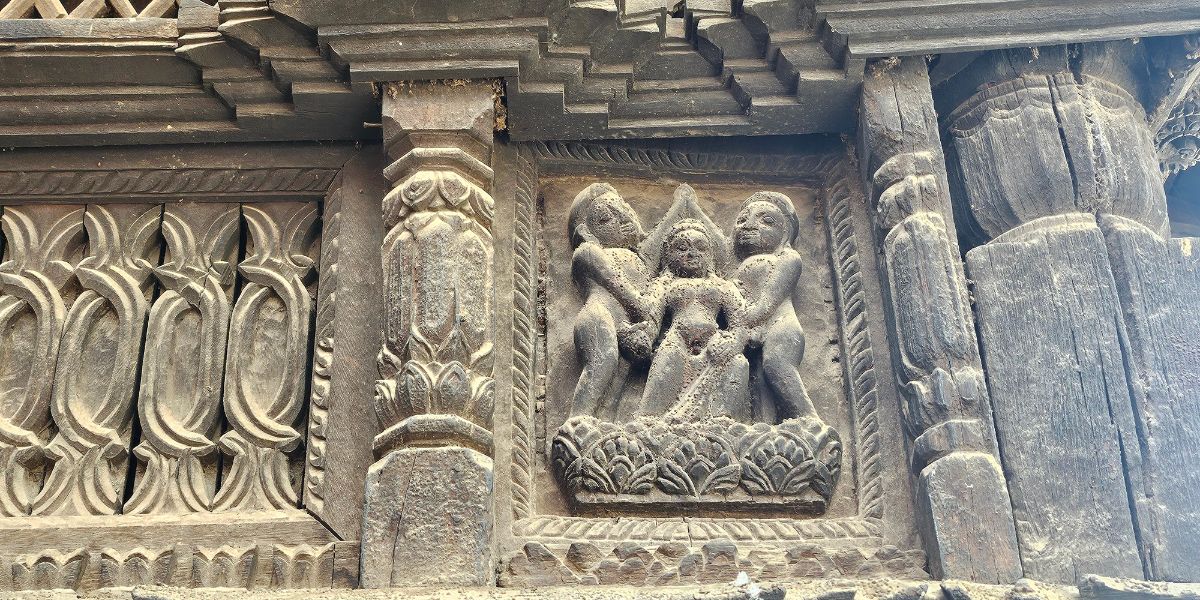
According to the tantric concept, they represent the concept of the union of male and female energies.
The placement of these erotic carvings outside the temple highlights the belief that devotees should leave their worldly desires outside before entering the inner sanctum with pure devotion.
A famous local belief holds that these erotic carvings used to serve as a visual guide to the Kama Sutra in the past. This allowed young adults to learn about human relationships and sexuality when they reached maturity.
The Legend of the Single Tree
Like many ancient temples of Nepal, Dattatreya also has its own legend. As per legend, the entire temple of Dattatreya was made of the wood from one sacred tree alone.
The Kasthamandap Temple of Kathmandu Durbar Square has a similar origin story to the Dattatreya temple, as it is also believed to be made up of a single tree.
It’s indeed mysterious when you think that each column, each plank, and the whole structure of the temple were made of a single tree!
It may be true that such things actually happened or just that they are folk tales, but these kinds of tales give the temple another level of charm.
Guardian Statues
Before reaching the temple, you’ll see guardian statues standing at different positions around the temple.
The Statues of Jaimal and Patta
Two legendary Rajput warriors, Jaimal and Patta, can be seen on either side of the stone staircase leading to the temple entrance.
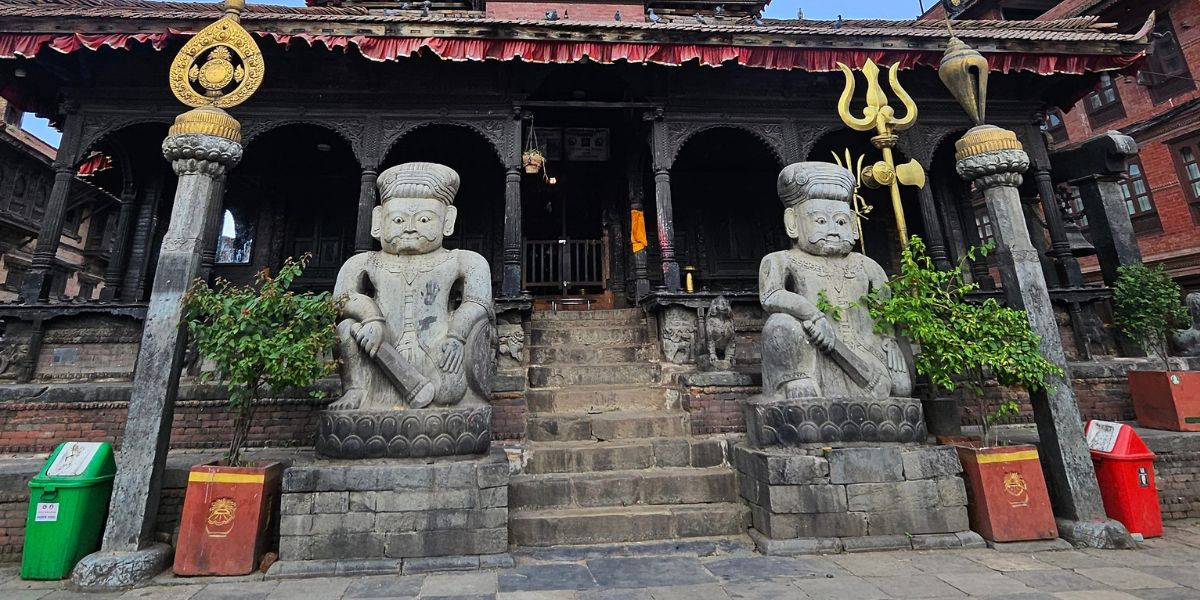
They also guard the Nyatpola Temple, standing on the first tier (lowest plinth) in Taumadhi Square.
Their powerful forms and detailed carvings tell a story from a distant past. These guardian statues represent great strength and the responsibility to protect the temple and its worshippers.
Alongside these statues, two monoliths mounted with Chakra and Shanka can also be seen.
Stone Lions
Take a look up the temple stairs; you will spot two stone lions standing at the back, almost hidden from sight. One lion stands on the left side while another stands on the right side.
These two fierce lions with wide eyes, open mouths, and muscular form are symbols of divine power and royal authority.
The Pillar of Garuda
On the opposite side of the Dattatreya Temple, a tall pillar can be seen with Garuda on top (the divine vehicle of Lord Vishnu) bidding “namaste”.
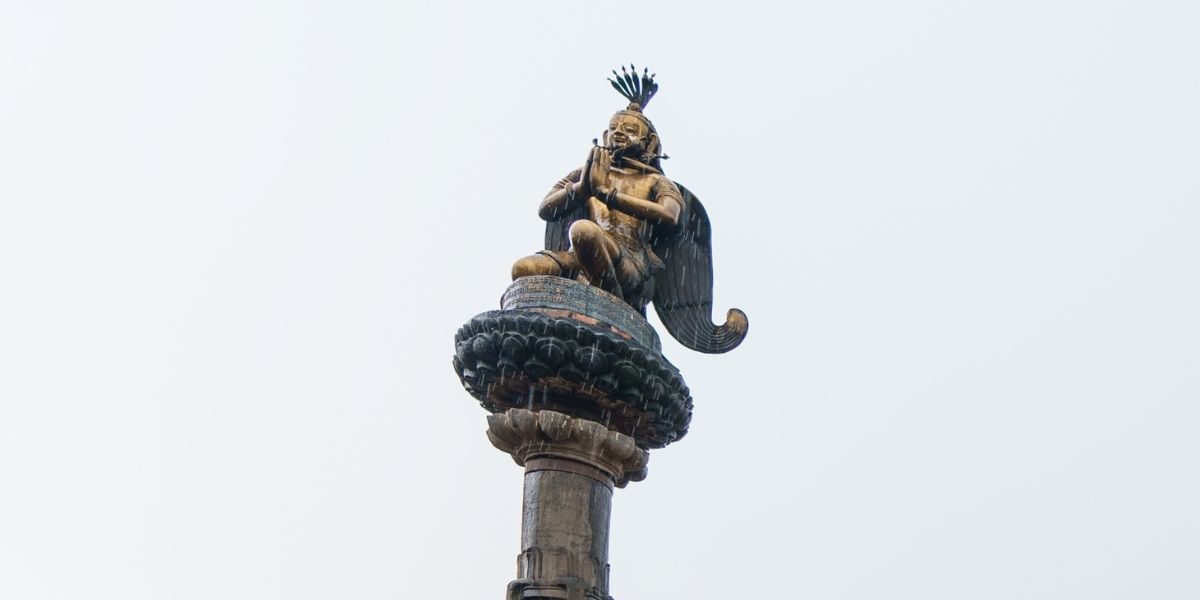
What’s so unique about the statue is its face. Originally, the statue was dedicated to the monk Dev Narayan Giri.
But according to Hindu tradition, a mortal can never be placed above a god. Because of this belief, the figure was carved as Garuda instead.
The Garuda serves as a spiritual guardian, which shows the temple’s deep connection with Lord Vishnu.
Important Festivals and Rituals Around Dattatreya Square
With the fragrance of the scented incense and the echoing sound of the temple bell across the square, every visitor feels a warm welcome to the Dattatreya Temple.
Every morning and evening, the main pujari (priest) of the temple performs worship (Nitya Puja) of Lord Dattatreya.
Devotees are allowed to offer the flowers, incense, and oil lamps only after the completion of the daily ritual as a symbol of deep devotion and respect.
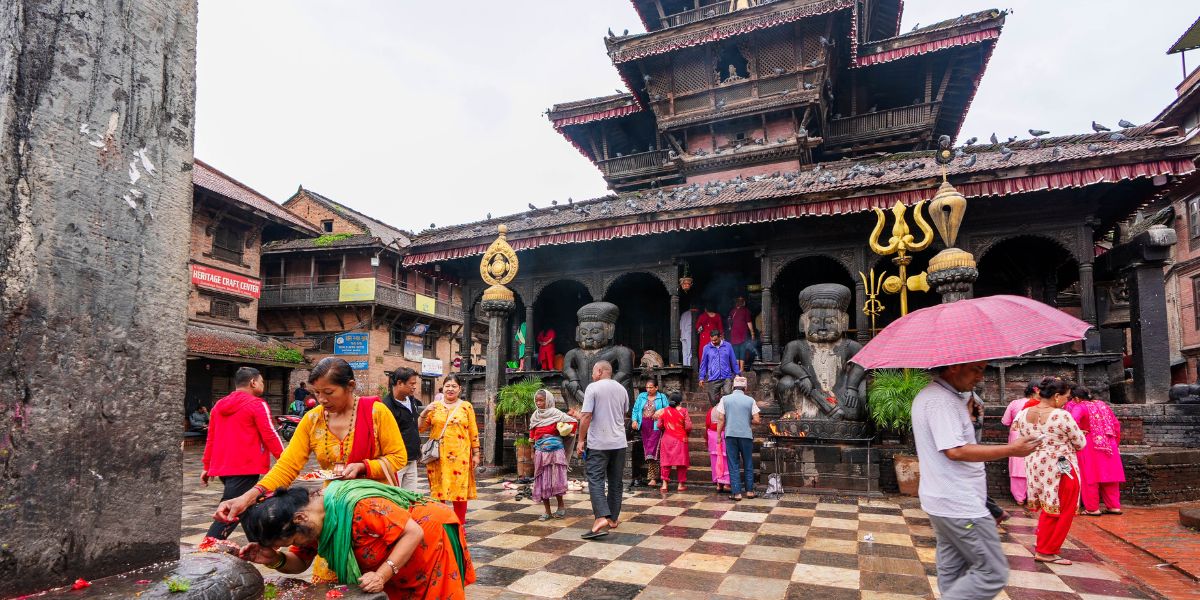
Many significant festivals are celebrated in Dattatreya Square, and some of the major ones are below:
Dattatreya Jayanti
One of the major festivals celebrated in the Dattatreya Square is Dattatreya Jayanti. It falls on the full moon day of the Hindu month of Mangsir/Margashirsha (November - December).
As the name suggests, this festival is wholeheartedly dedicated to Lord Dattatreya. During this festival the priest performs the special puja, different from the daily ritual, and recites the sacred hymns.
Maha Shivaratri
Another major occasion is Maha Shivaratri, which translates to “Great Night of Lord Shiva.” It usually falls on Falgun (February-March), on the 14th day (Chaturdashi) of the dark fortnight (Krishna Paksha).
On this day, people gather around the Dattatreya temple seeking blessings from Lord Shiva throughout the day and night.
Haritalika Teej
The square turns red and green during the festival of Teej as female devotees dressed in sarees gather at the temple. Both married and unmarried women visit the temple on this day.
This festival falls in Bhadra, usually August-September. Since the Dattatreya Temple has a strong association with Lord Shiva, it is one of the popular destinations for Teej celebrations.
While married women seek blessings for the long life and prosperity of their husbands, an unmarried woman seeks blessings for a suitable husband.
Gai Jatra
Gai Jatra is celebrated in the month of Bhadra (August-September).
During this festival, memorial processions honoring deceased family members pass through or near Dattatreya Square.
Traditionally, children are dressed as cows and are included in the processions to help guide the departed souls to the afterlife.
The traditional music, performances, and processions bring the square to life and create a lively atmosphere while preserving the cultural tradition of remembering loved ones.
Bisket Jatra
One of the famous New Year festivals of Bhaktapur, Bisket Jatra, is celebrated in the month of Chaitra-Baishakh, which usually occurs in mid-April.
Bisket Jatra brings different bursts of energy to Dattatreya Square. The celebrations include traditional performances, the chariot pulling of Bhairav and Bhadrakali, and the raising of Yosin (Lingo).
Beyond that, in Dattatreya Square, the chariots of Goddess Brahmayani and Goddess Maheswari are also processed on the seventh day of the 9-day Biska Jatra.
Many crowds gather around the square, and the festival displays vibrant vibes of Bhaktapur’s living Newari traditions!
Navadurga Naach (Nava Durga Dance)
One of the most unique festivals celebrated in Dattatreya Square is Navadurga Naach, a sacred mask dance that is performed according to the Newari Traditional Calendar.
This festival is celebrated throughout the year, not just in a single day. Beginning from the Dashain (September-October), it ends around Bhagasti or Bhalbhal Ashtami (June-July).
The Navadurga Troupe performs this ritual dance wearing masks that represent the nine forms of the goddess Durga.
As the historians say, it began from the era of King Bhuwan Malla to combat famine and welcome prosperity.
Other Festivals and Rituals
Along with these annual festivals, the temple remains crowded in the holy month of Shrawan. Every Monday throughout Shrawan, devotees come to offer water, flowers, and bel leaves in honor of Lord Shiva.
Even on a regular day, the temple is alive with daily Bhajan and Kritan. These devotional hymns remind visitors that Dattatreya Square is not a monument of the past but a sacred place where tradition lives on!
The Dattatreya Square is also crowded on Khame Jatra, which is celebrated on the ninth day of Dashain (Navami).
The Historic Mathas of Dattatreya Square
After exploring around the Dattatreya Temple, you’ll notice a big brick building sitting quietly to the east of the temple.
That building is Pujari Math, which has now been converted into the Wood Carving Museum. Its story shows another side of Dattatreya Square. Let us get into it.
Pujari Math
Pujari Math dates back to the 15th century and was built around the same time as the Dattatreya Temple.
Famous for its Peacock Window and outstanding wood-carving, the Pujari Math is the finest example of traditional Newari architecture.
History of Pujari Math
The Pujari Math is believed to have been constructed by Gosain Gurubaksha Giri (a wealthy Sanyasi trader from India) during the reign of King Yaksha Malla as a resthouse.
It was used as the residence for the Mahanta, who was responsible for the management of the activities related to the rituals and functions of the Dattatreya Temple.
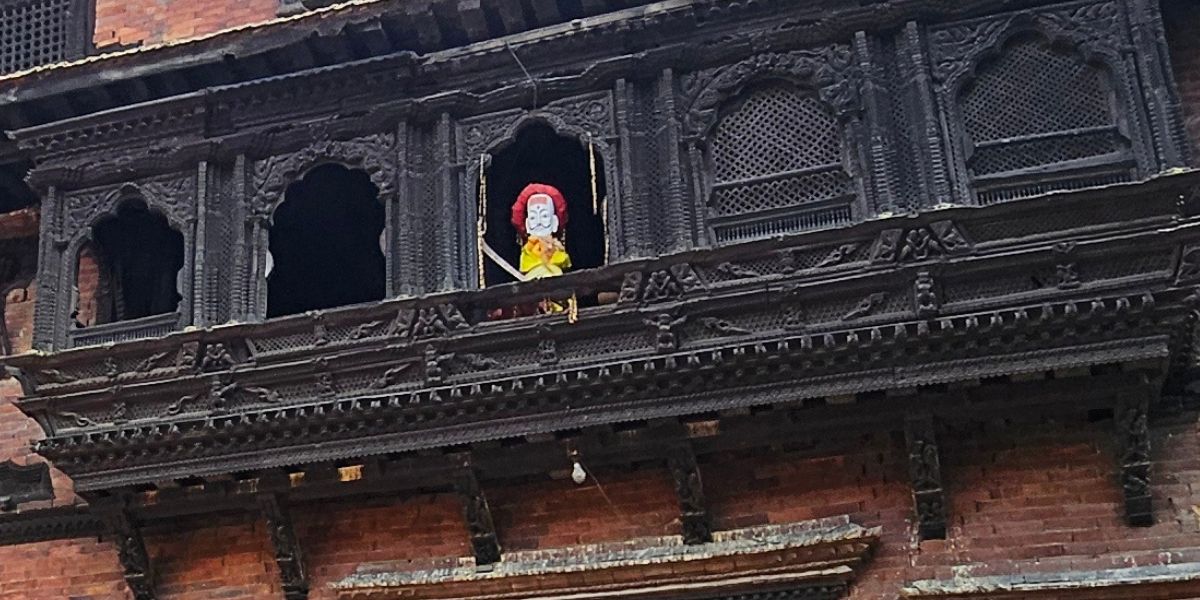
It is believed that after earning a fortune in Tibet, Gurubaksha returned to Nepal and used much of his wealth to construct the Math.
The building was later called “Pir Math,” referring to the Founder Math, as priests from the other eleven maths would offer their ritual offerings here.
Architecture of Pujari Math
Honestly, the beauty of this math extends far beyond the Peacock Window. The four-storeyed building, built with brick and timber, is arranged around three open courtyards, giving a spacious and well-ventilated layout.
All these courtyards are decorated with richly carved windows and pillars. Many of the windows in the Math are built like little balconies. This type of layout reflects typical traditional Newari architecture.
On the north-east of Math, the main entrance is decorated with detailed woodcarving. The door frame is layered with a decorated line featuring a small carved figure of Lord Shiva at its center.
Above the doorway, the Garuda looks down with its claw grasping two nagas (serpents), with its body twisted in two opposite directions.
The doorway is also decorated with the sun and moon, the Ashtamangala (eight auspicious symbols) at its center. There are also figures of Lord Vishnu with the river goddesses Ganga and Jamuna and two Bhairavas at its base.
The whole building, including its layout, windows, and entrance, is an expression of artistic excellence. It makes Pujari Math one of the finest surviving examples of Newar architecture in Nepal.
Restoration and Conservation
Being one of the oldest Maths in Bhaktapur, the original structure of Pujari Math has changed a lot over time.
The carved window, doorway, and pillars we see today are centuries old. The present form of Pujari Math was shaped during the reign of the last Malla ruler, Ranjit Malla.
The devastating Nepal-Bihar earthquake caused severe structural damage to the building. Only urgent repairs were made during that time, leaving it in a fragile and half-repaired state for a decade.
In 1970, during the wedding of Crown Prince Birendra, Dr. Franz Joseph Roieder from West Germany visited Nepal and granted 100,000 German Deutsche Marks to restore the Pujari Math.
Proper restoration took place only in 1971-72, when a team of German architects spent a year working on building and training local craftsmen. In 1972, the restoration was completed with a formal handover.
This pioneering project laid the foundation of the Bhaktapur Development Project and marked the start of large-scale heritage conservation in the city.
Today, Pujari Math is recognized as the Wood Carving Museum with the objective of preserving the rich tradition of woodcarving in Nepal. We’ll get into this in detail later!
Chikanappa Math/Chikanphale Math
One of the historic maths surrounding Dattatreya Square, Chikanappa Math, stands behind the Dattatreya Temple.
The name of the math is associated with its traditional construction using oil-soaked bricks (Teliya Bricks) that convert to Chikan, which means oil, and Appa, which means Brick in Newari.
Previously, this math was used as a traditional priest’s residence and a rest house for travelers.
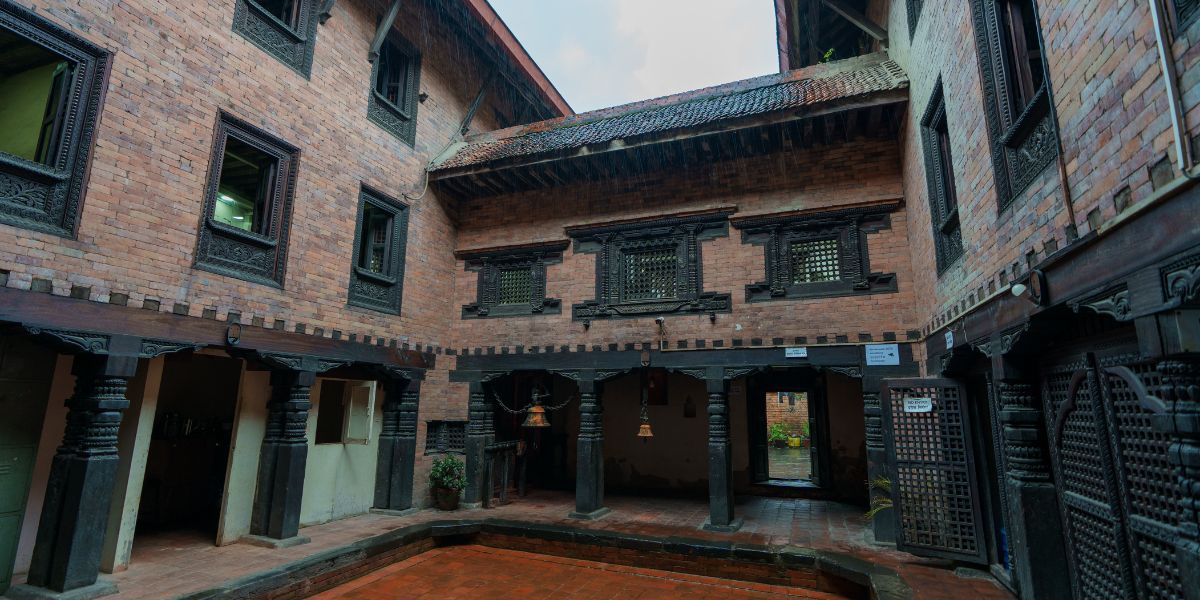
But today, it houses the Brass and Bronze Museum, where you can observe the traditional ritual vessels, ceremonial lamps, and other metal objects that offer a glimpse into the metalworking tradition.
Sithu Math
Sithu Math is known for its elegant Sanjhya, a traditional three-part Newari window, with its balanced proportions and detailed carvings.
According to an inscription preserved inside the monastery, it was established in 1843 A.D by Mahanta Gopal Puri Gosai.
The name Sithu Math is derived from its location, Sithu, in the Tachapal area. The Math is under the care of the Puri Community.
Dathu Math
Dathu means “middle” in Nepal Bhasa, and as this Math lies between the other two Math (Sithu and Taja), it is known as Dathu Math.
Famous for its magnificent Biman Jhya (a beautifully carved projecting balcony window), it reflects the architectural traditions and the craftsmanship of the historic Bhaktapur.
In Nepal Sambat 835, Dathu Math was established by Kameshwor Puri on the day of Bhadra Shukla Saptami. After his death, he was buried inside this math, and a Shiva Linga named Kameshwor Mahadev was installed.
Taja Math
Well known for its Surya Jhya (a window shaped like the sun), Taja Math is one of the important maths around the Tachapal area. The name Taja means tallest, and this Math is considered the tallest Math in the Tachapal area.
Mahanta Dev Giri established Taja Math in Nepal Sambat 830 on Falgun Shukla Saptami.
Sithu, Dathu, and Taja Math, the historical Math located at the southwestern corner of Dattatreya Square, show typical Newari architecture. Standing side by side, each Math is distinguished by its beautiful window, giving it a separate identity.
Pulanchotha Math
The second most important Math after Pujari Math in the Tachapal area is Pulanchotha Matha. In Nepal Bhasa, the term Pulanchotha means "old storey".
Pulanchotha Math was believed to have been constructed by Queen Ganga Devi, the wife of King Vishva Malla. Since Queen Ganga was a follower of Vaishnavism, she dedicated Pulanchotha Matha to Lord Vishnu. But it also houses other idols beyond those of Vishnu.
Also known as Ganga Math, this math is decorated with Shanjhya, Pasuka Jhya, and Akhi Jhyal. Pulanchotha Matha is well known for its unique architecture, as it is the only Math with an extra window raised above the roof.
Godawari Math
Godawari Math, located near Salan Ganesh Temple, dates back to the 18th century. The Math was used as a residence for the priest and the caretaker of the temple.
Although a local shop occupies most of the building today, its architectural features are still preserved. The carved window, door, and supporting strut decorated with floral and religious motifs still display Bhaktapur artisans' outstanding skills.
Bardali Math
Another historical Math located in the same cluster of Maths in Dattatreya Square is the Bardali Math. It lies between Pulanchotha Math and Godawari Math, making a row of traditional Newari buildings.
The name Bardali Math comes from the Nepali word Bardali, meaning balcony in English. The Math is characterized by its unique architectural feature, a finely carved projecting wooden balcony beneath the roof.
Peacock Window: The Mona Lisa of Nepal
After Pujari Math, a highly detailed carved window can be seen, which honestly feels too good to have been made by hand. The more you look, the more interesting it becomes!
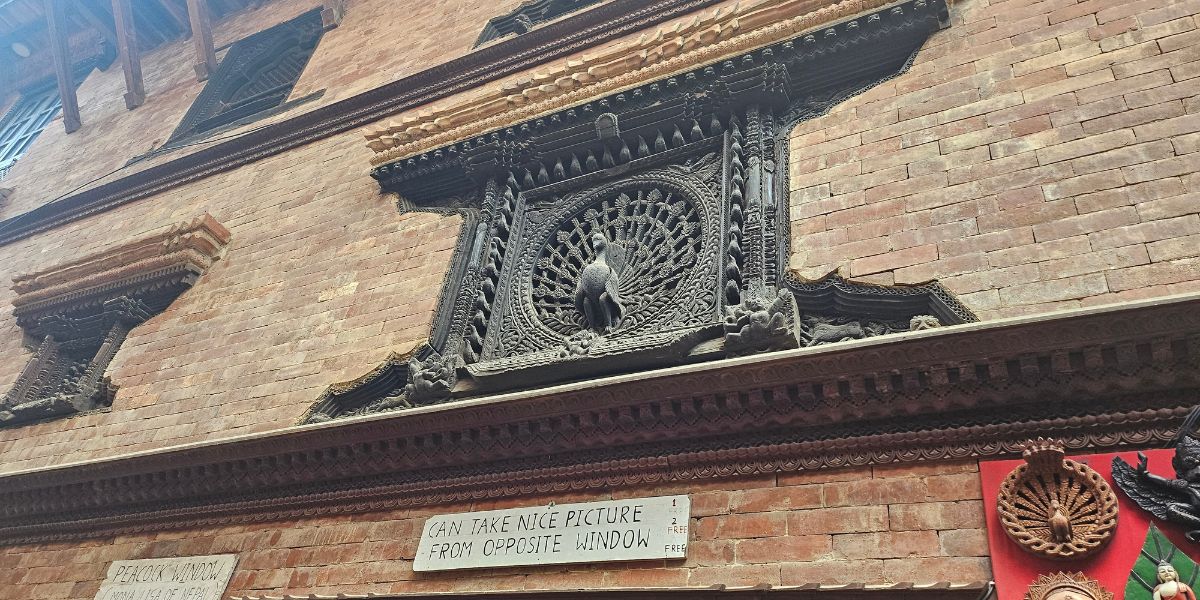
The Peacock Window, locally known as Mhekha Jhya, is located on the eastern side of the Pujari Math. The majority of scholars date the Peacock Window back to the 15th century. However, the precise year of construction remains unknown to this date.
Architecture and Design
At the center of the window is a beautifully carved Peacock, which stands out with its three-dimensional shape. The elegant curve of the neck, the fine crest, the expressive eyes, the layered wing, and the finely textured feathers were carefully carved by craftsmen.
The peacock’s elegant tail spread out to form a circular lattice of windows. The open lattice allows fresh air and natural light to enter the room while also maintaining privacy. This shows how the Newar artisans combined beauty with practicality!
On inspecting the Peacock Window closely, you’ll notice that the peacock was surrounded by more details. It is placed on beautiful floral patterns and curling vines that soften the geometric character of the whole window.
Multiple small birds are positioned around the peacock, which creates visual movement. The nagas (serpents) are coiled together to form a circle around the peacock to fill the space and to add symbolic depth to the composition.
The carvings are symbolic as well. The peacock symbolizes beauty, purity, and prosperity. The nagas symbolize protection, fertility, and harmony with nature.
Why Is It Called the "Mona Lisa of Nepal"?
The peacock window is one of the early advanced wood-carving techniques that were mastered by Newari craftsmen.
All the detailing of the window was handmade using traditional equipment such as chisels, adzes, and a wooden mallet.
The Peacock Window is as famous as Leonardo da Vinci’s Mona Lisa. This 15th-century masterpiece is appreciated across Nepal by both the foreign and national visitors for its traditional Newar wood-carving technique and its intricate craftsmanship. Hence, it’s nicknamed “The Mona Lisa of Nepal”.
Where Can You Find the Peacock Window, and Why Does It Matter?
Replicas of the Peacock Window can be found in various sizes to decorate houses, restaurants, and offices. Customers can also buy the Peacock Window from a handicraft shop or order the custom-made window from a craftsman.
But the original Peacock Window remains on the eastern side of the Wood Carving Museum. It has not been relocated, unlike other historical carvings for preservation, and visitors are allowed to admire this masterpiece.
The Peacock Window has survived centuries of harsh weather and multiple earthquakes. Conservation authorities have focused on preserving the original timber while maintaining it using traditional restoration techniques.
You can’t just gaze at the Peacock Window as just another architectural feature. Each feather, each flower, and even a tiny carving represents centuries of tradition, patience, and extraordinary skill.
Peacock Window is recognized as the finest example of Nepalese woodcarving, thanks to its detailed, complex craftsmanship and balanced composition.
Museums in Bhaktapur Dattatreya Square
Beyond its religious perspective, the Dattatreya Square is a living museum of Bhaktapur’s art. Every restored museum and monastery preserves the city's rich tradition through woodcarving, metalwork, and even handmade paper.
Exploring these museums made me realize that the ticket offered far more than access. It was a passage to centuries of craftsmanship and culture that have been preserved for future generations.
National Wood Carving Museum
The National Wood Carving Museum is Nepal's finest museum, located inside the historic Pujari Math.
After the restoration in 1972, the Pujari Math was converted into the National Wood Carving Museum.
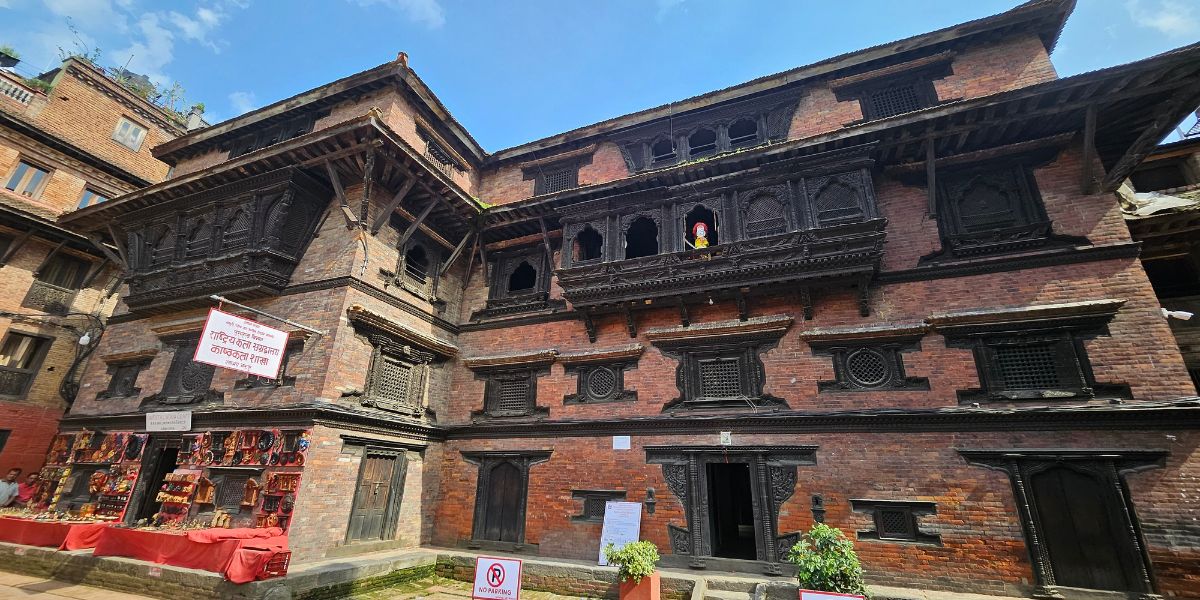
The Math, which once served as a residence for the Mahanta of the Dattatreya temple, now preserves the country’s rich tradition of wood craftsmanship.
What's Inside the National Wood Carving Museum?
The museum houses an impressive collection of traditional wooden artwork from medieval Nepal.
Upon exploring, you’ll see beautifully carved Newari windows, elegant wooden pillars, and highly decorated balconies. The roof struts with intricate floral carving also feature Hindu and Buddhist deities along with mythical creatures.
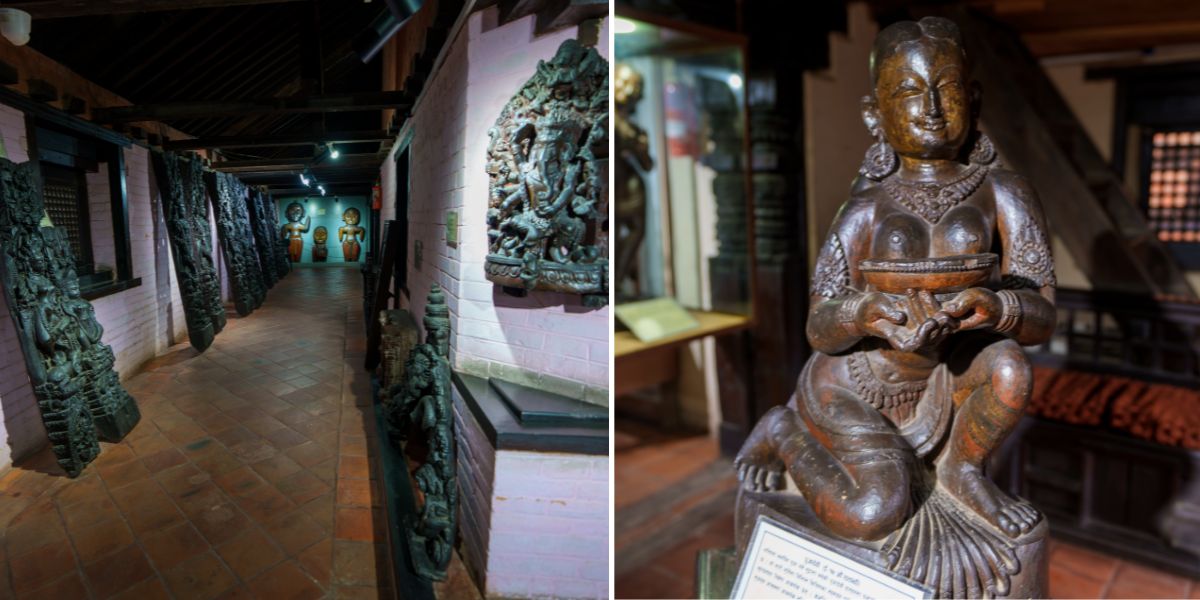
The museum’s finest treasures include beautifully carved panels showing Mara Vijaya, Arya Tara, Pooja Devi, and Viswaroop.
All the detailed decoration and expressive forms on wooden artifacts demonstrate the skill of medieval Newari craftsmen. The carving on the door, window, pillar, and roof shows the close relation between art and faith in medieval Nepalese society.
Why Visit the National Wood Carving Museum?
You can see more than just the beautiful wooden art while visiting the National Wood Carving Museum. It is a chance to discover how this artistic heritage has shaped Bhaktapur for centuries.
Aside from artistic values, the pieces in the Wood Carving Museum also reflect the religious beliefs, the cultural aspects, and the spirituality of the Newar community.
The National Wood Carving Museum is one of the most important efforts to preserve the traditional Wood Carving heritage.
Whether you’re a history enthusiast, an architecture lover, a student, or just a traveler, a visit to the National Wood Carving Museum can provide one of the most meaningful experiences for all!
Opening Time and Entry Fee
Thinking of visiting Bhaktapur's best museums after checking out Dattatreya Square?
You will need to purchase a separate National Art Museum ticket at the ticket counter inside the museum complex (at either the National Wood Carving Museum or the Brass and Bronze Museum). It’s easy and takes just a few minutes.
Ticket payment can be made through both cash and online methods as per one’s convenience. However, international tourists are recommended to carry NPR cash, as digitized solution for payment isn’t yet available (or allow your guide to handle this part).
About the entry fee for the museum:
|
Visitor Category
|
Entry Fee (per person)
|
Camera Fee (photography)
|
Camera Fee (videography)
|
|
Foreign Citizen
|
NRs. 150
|
NRs. 100
|
NRs. 200
|
|
SAARC Citizen
|
NRs. 50
|
NRs. 75
|
NRs. 150
|
|
Nepalese Citizen
|
NRs. 25
|
NRs. 50
|
NRs. 100
|
|
Nepalese Student
|
NRs. 10
|
NRs. 50
|
NRs. 100
|
About the opening and closing times for the museum:
|
Period Time
|
Opening and Closing Hours
|
Ticket Counter Hours
|
|
Magh 16 to Kartik 15 (Thursday-Monday)
|
09:00 AM to 05:00 PM
|
09:15 AM to 04:30 PM
|
|
Kartik 16 to Magh 15
(Thursday-Monday)
|
09:00 AM to 04:00 PM
|
09:30 AM to 03:30 PM
|
Notes:
- One museum ticket allows entry to all museums under the Bhaktapur Museum network, including the National Art Museum, National Wood Carving Museum, and the Brass and Bronze Museum.
- The museums remain closed every Tuesday and Wednesday, as well as on government-declared public holidays.
Brass and Bronze Museum
The Brass and Bronze Museum stands opposite the National Wood Carving Museum in Dattatreya Square. The museum is dedicated to preserving and exhibiting Nepal’s rich heritage of brass and bronze craftsmanship.
Traditionally known as Chikanappa Math, this building was originally constructed as a living quarter for the priest and pilgrims. The building was named Chikanappa because it was constructed using traditional Dachi Appa bricks and stones.
The Brass and Bronze Museum reflects the importance of metalwork in the daily life of Newari households.
The collection includes sacred objects used in the temple, such as Kalash, Diyo, Temple bell, and incense stand. Meanwhile, everyday metalwork and artifacts like traditional water vessels and household utensils used by both common households and royal families are also featured in this museum!
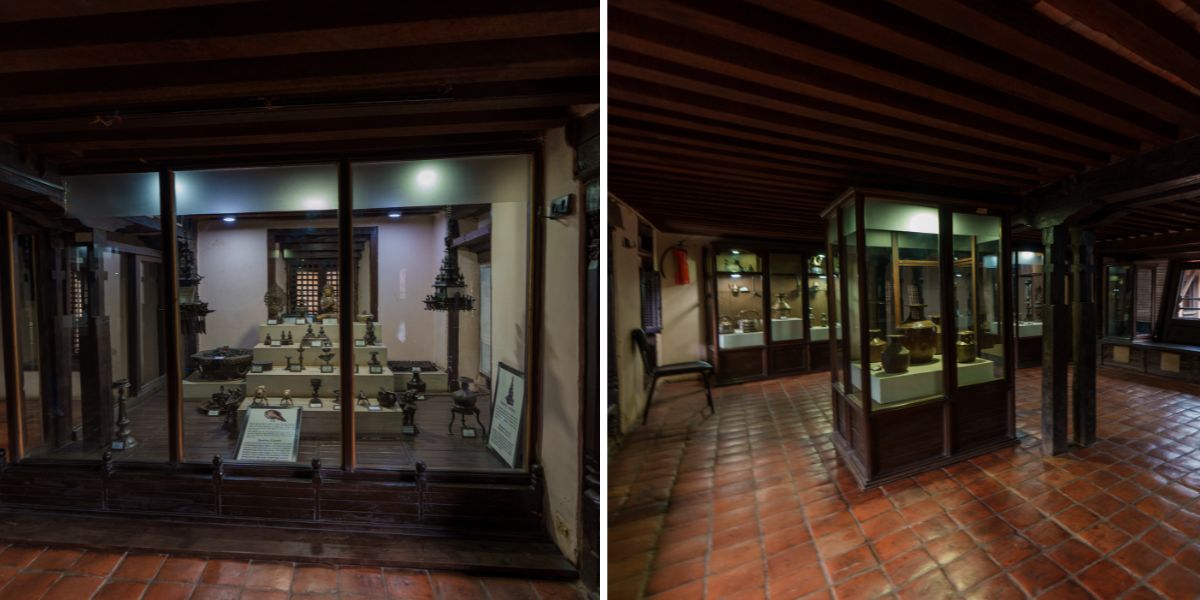
The brass and bronze statues of Hindu and Buddhist deities are the major highlights of the museum. All the artifacts showcased in this museum date from the 17th century to the 20th century.
The Peacock Shop (aka The Paper Factory)
The Peacock Shop, just across from the famous Peacock Window and a short walk from Dattatreya Square, is a traditional handmade paper workshop. It is owned by Ram Narayan Prajapati, who often helps the visitors and shows them around the workshop.
Your journey starts on the ground floor, where a variety of handmade paper products are displayed. Notebooks, greeting cards, lampshades, gift boxes, bookmarks, and many other decorative crafts are kept for sale.
While continuing your journey, you’ll realize that the building is much more than a paper factory. It also serves as a small museum, housing a remarkable collection of centuries-old wooden sculptures and historical artifacts.
Walking through the workshop, you’ll also come across many remarkable pieces that are rarely mentioned in guidebooks or online sources (paintings, wood carving collections, etc.).
What's Inside the Paper Factory?
When you look from the outside, the Peacock Shop looks like an ordinary shop that sells paper materials. But the farther you go inside, the more stunned you’ll become!
When you enter the shop, you’ll be welcomed by the nostalgic smell of the old books. On the top floor of the shop, you may find a team working on the final stage of a paper production process. And the roof is likely filled with sheets of paper waiting to be dried out in the sun.
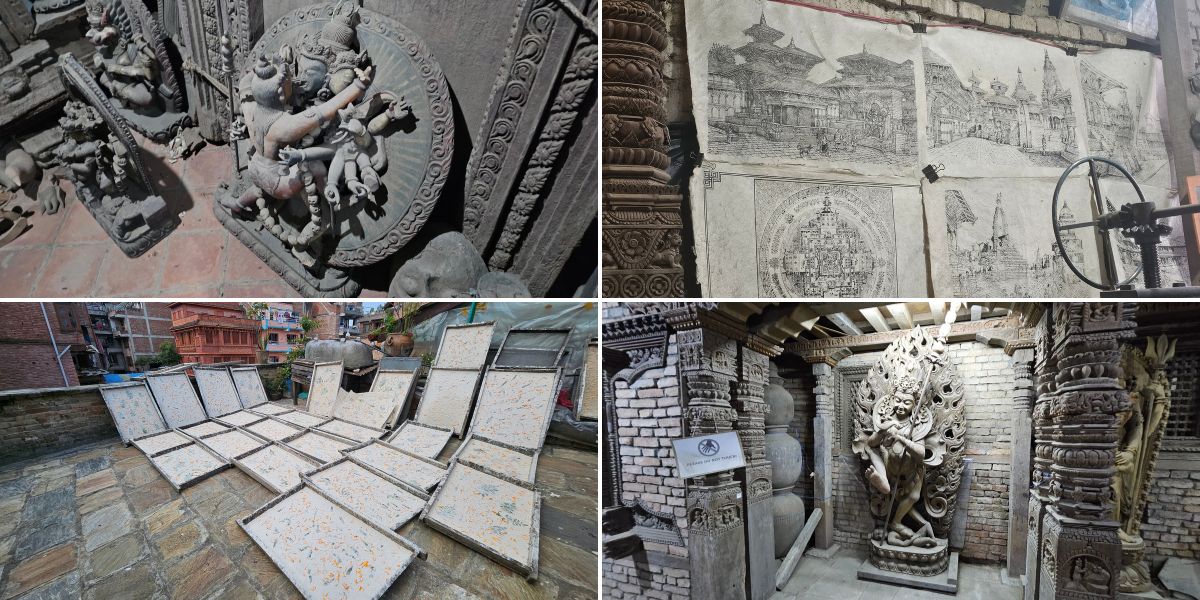
Those paper sheets kept dry are made from the bark of the Lokta plant (Daphne Bholua), which is boiled until the fibers become soft. Then, these softened fibers are beaten thoroughly using a beating machine until they form a fine pulp. The pulp is then spread onto traditional wooden frames to turn into paper sheets.
After drying the sheets completely, the artisan uses natural dyes to tint the paper. Various types of paper products with beautiful designs are created through printed designs and handcrafted patterns.
While visiting the paper production area, all the raw materials, tools, and machines used to produce the paper can be seen around.
The paper factory premises not only show the paper production area but also showcase many centuries-old wooden statues and sculptures of Buddhist and Hindu gods.
There are also beautifully carved wooden structures with intricate designs, which can be used for decorations in modern times.
Things to Do and Hidden Gems of Dattatreya Square
When you reach the Dattatreya Square, don’t just stop at the main square. Some of the unforgettable and astonishing experiences begin when you wander into the narrow lanes behind it.
Once you step away from the crowds, you will be welcomed by the quiet courtyards, traditional workshops, and small shrines that are hidden in between the old Newari houses.
Some places reveal centuries-old craftsmanship, and some only give a glimpse of the daily lives of the locals. As you walk, you may hear the sound of wood being carved, spices being ground, and the locals immersed in their daily conversations.
There are no signs telling you what you have found or where to look. All these hidden spots are what you find for yourselves, simply by getting a little lost.
Traditional Wood Carving Workshops
As you make your way through the narrow lanes around Dattatreya Square, the noise of chisels pounding gradually becomes louder.
Skilled craftsmen can be seen working carefully in small family workshops. The traditional hand tools are used to make intricate designs on windows, doors, temple struts, and decorative panels.
It is interesting to see how a simple piece of wood gradually changes into a detailed work of art.
Bhimsen Temple
Bhimsen Temple, a peaceful shrine dedicated to Lord Bhimsen, god of trade, strength, and prosperity, is less than 100 m away from the Dattatreya Temple.
Although this temple is less well-known, it is still a worthy landmark of the square. The pagoda design and elegant wooden carving details are what make it an iconic spot.
The local shopkeepers pray here before opening their shops. It is a tradition that has bound business and faith together for generations.
Traditional Courtyards
Behind the entrances are peaceful Bahals and centuries-old Buddhist monasteries, known as Bihars. These communal spaces have served as sites of worship, learning, and community gathering for years!
You can find quiet residential neighbourhoods, where ancient chaityas, stone sculptures, prayer wheels, and small shrines are also positioned.
Some of the viharas and Mahavihars that you can visit around the Dattatreya Square are Muni Vihar, Dipankar Vihar, Pasu Mahabihar, Prashanasil Mahabihar, Manjuvarna Mahavihar, etc.
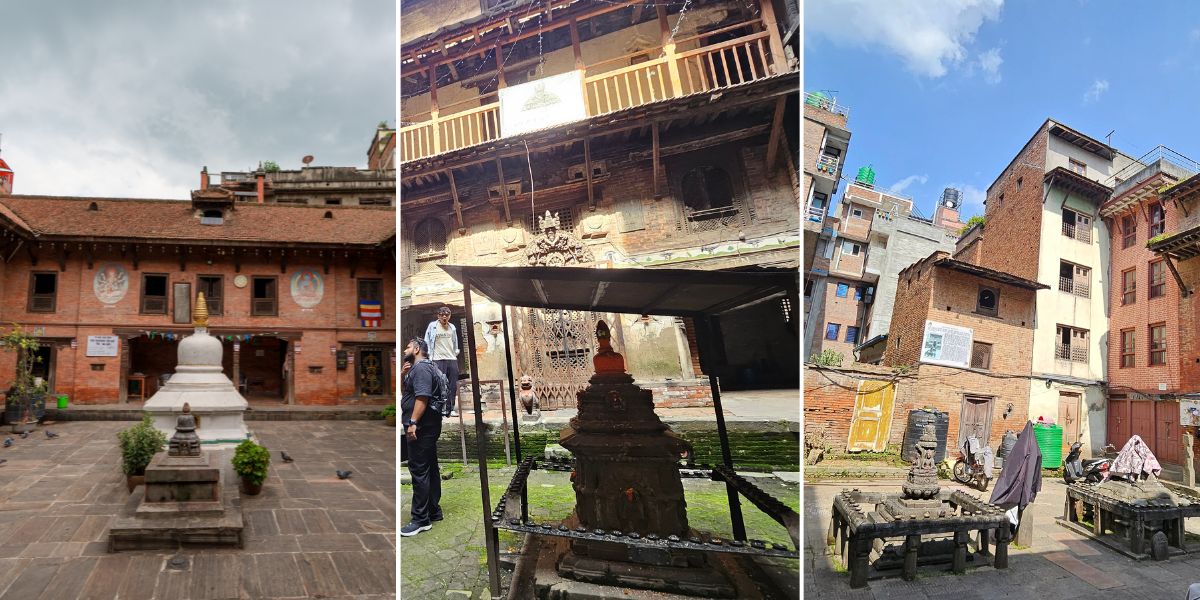
These Bihars and Mahabihars, along with the courtyards (Bahals), provide a rare glimpse into the spiritual and social life that still lives in the old streets of Bhaktapur.
Nanee, a traditional open courtyard that is hidden beyond the grand temples of Dattatreya Square, offers another sight into Bhaktapur’s traditional Newari life.
After walking away from the busy square, stepping into Nanee can make you feel like you have discovered a secret courtyard that is frozen in time.
Taste Bhaktapur's Signature Delicacies: Juju Dhau and Bara
After hours of exploring, you can try the famous Juju Dhau and freshly prepared Bara before leaving.
The rich, creamy buffalo milk yogurt served in a traditional clay pot lives up to its reputation as the “King of Yogurt”. After all the walking, the cold and sweet yogurt is perfect to end your Dattatreya Square trip.
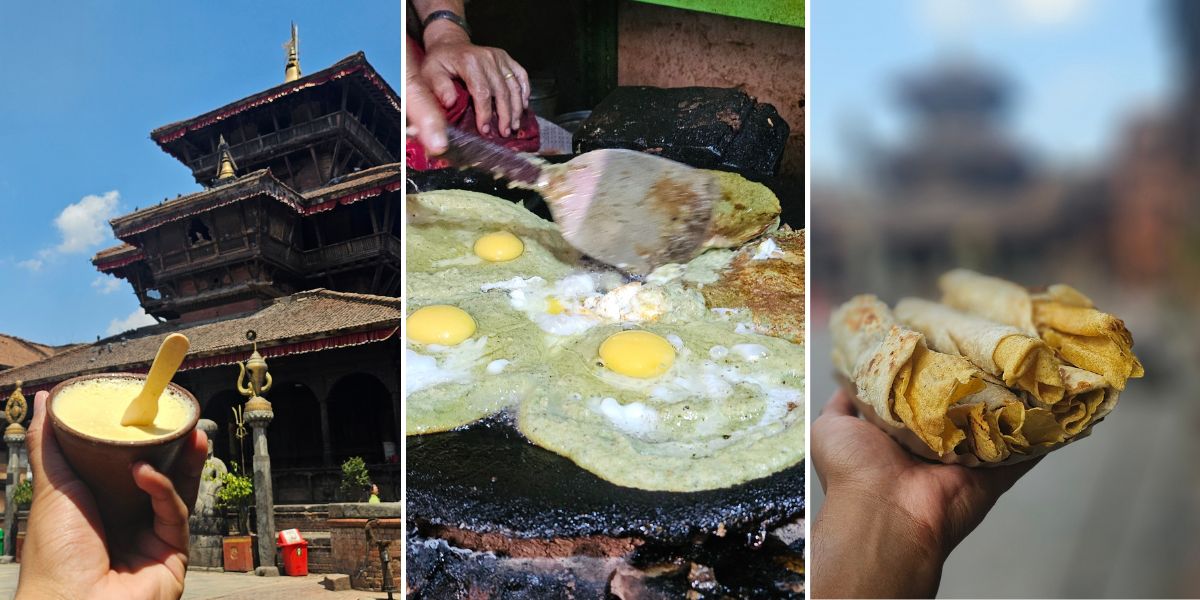
And the warm lentil pancake (Bara) is a delicious local snack that offers a simple, unforgettable taste of authentic Newari flavours.
You may get many options in the food items to try, but these two (Juju Dhau and Bara) are top picks. It is a memorable way to sample the city's Newari culinary traditions.
Experience Daily Life
As you walk through the street, you’ll realize that you’re not just looking at a museum piece. Many families run wood carving workshops from the same houses their grandparents worked in.
The wood carvings are done mainly by the artisans belonging to the Sikami (Silpakar) community. They do most of the woodwork here, like carving windows, temple doors, and roof struts.
It’s not just the wood, either. Just a few streets away are brass and bronze casters, Paubha painters at work on canvases, and potters molding clay pots as their families have been doing for generations.
People come and buy handmade pieces directly from the artisans, and that income is important to families here!
The municipality has also begun funding the renovation of old wooden buildings within the UNESCO heritage zone. This has kept some craftsmen occupied and given younger generations a reason to stay (instead of choosing to go abroad).
How to Reach Dattatreya Square?
Reaching Dattatreya is easier than expected, and the walk itself is one of the best parts of the visit.
While doing the walking tour of Bhaktapur, you’ll get past courtyards and the everyday life of the locals there. And that’s what you’ll miss if you go in a taxi!
From Three Different Squares
There are two ways to reach Dattatreya Square from the other three squares: one directly from Durbar Square and the other going through Taumadhi Square.
You can choose any one, but it depends on the time you’ve left to spend in Dattatreya Square:
- If you choose to walk from Bhaktapur Durbar Square, then you can go east following Mako Galli and to Golmadhi, reaching Dattatreya Square within 15 minutes. [Maps Link]
- But if you want to go to Taumadhi Square and then move to Dattatreya, then it takes about 15-20 minutes. But it also depends on how much time you spend exploring Taumadhi Square. [Maps Link]
- It is also possible to go directly from Pottery Square either by going through Taumadhi Square via Mako Galli or through Bolachhen-Yachhen Road, passing via Naag Pokhari within 15-20 minutes.
Directly from Kathmandu
If you’re planning to visit Dattatreya Square directly from Kathmandu, then you can opt for a public bus.
Catch a bus from Ratnapark, which lets you off near Thulo Byasi Bus Stop, aka Byasi. Then, you can walk about 700 m for 10 minutes through the Bhaktapur old city to reach the Dattatreya Square [Maps Link].
I would recommend that visitors choose transportation according to their comfort. To reach Thulo Byasi Bus Stop from Ratnapark, it takes nearly 45 minutes (or more depending on traffic), covering a distance of approximately 15 km.
If you are taking a taxi, then using a ride-sharing app, you can get off near Tachapal and walk the rest of the way down the old lanes.
Opening Time and Entry Fee for Dattatreya Square
Before visiting Dattatreya Square, it's useful to know the entry fees and opening hours. Visitors, particularly international tourists, are required to purchase a ticket at the main checkpoint.
Since Dattatreya Square is part of the Bhaktapur Durbar Square complex, the same ticket can be used to enter here.
Although Dattatreya Square is open 24 hours, the ticket counter operates from 6:00 AM to 7:30 PM. Here are the necessary details:
|
Visitor Category
|
Entry Fee (per person)
|
|
Foreign Nationals
|
USD 18
|
|
SAARC Nationals
|
NPR 500
|
|
Chinese Nationals
|
NPR 500
|
|
Nepalese
|
Free
|
Notes:
- Children under the age of 10 are free to enter Dattatreya Square regardless of nationality.
- This ticket covers all the squares of Bhaktapur, including Pottery Square, Taumadhi Square, and Durbar Square.
- International visitors planning multiple visits can extend their ticket by up to 7 days. For multiple entries beyond 7 days, visitors can apply for a special visitor pass at the Tourist Information Center in Bhaktapur Durbar Square.
Tips For Visitors
While visiting Dattatreya Square, it’s not just about roaming around and observing the attractions. It’s about living, enjoying, and making keen observations on each and every place you stop at.
Here are a few practical tips that will help you get the most out of your trip.
- Visit the square either in the early morning or in the evening time because the lights are softer and the place is more quiet, which is the best for photography.
- Keep the entry ticket of the Bhaktapur Durbar Square safely with you. While going from one square to another, you may need to show it if the officials ask for it.
- If you wish to take something in the memory of the trip, then purchase handmade items, Lokta paper products, pots, and other handmade souvenirs from the local craftsmen.
- As the heritage site journey is a walking tour accompanying the brick streets, narrow alleys, and uneven stone, make sure to put on comfortable footwear that could last you for a whole day.
- Take time to wander beyond the main square. You’ll be able to discover many new things such as artisan workshops, peaceful courtyards, and centuries-old monasteries tucked away in the surrounding alleys.
- Pause to admire the intricate carvings on the temple, and if you like to know what it is all about, ask a local (or your guide).
- Stay aware of your surroundings while passing through the narrow lanes, because bikes and cycles could pass through those lanes.
- You can even extend your cultural journey and explore other squares of Bhaktapur in a single day. In fact, you may even choose to visit Madhyapur Thimi and Changu Narayan, which are other attractions of this district. Contact us for such cultural tours, and we’ll design an itinerary that best suits you!
Final Thoughts
Dattatreya Square, the courtyard of art and tradition, preserves the historic temples and exquisitely carved windows as an impressive example of Newar craftsmanship. It is a place that takes you back to the ancient period.
Here, the history is displayed behind the museum glasses and temples and also in the centuries-old tradition followed by the locals in everyday life.
As you step into Dattatreya Square, you can find the masterpieces of wood carvings in every corner. When you enter the alleys, ancient courtyards, and traditional maths, you’ll not only see impressive artworks but also experience an eternal living heritage.
If you’re visiting Bhaktapur, don’t just go for the famous landmarks. Explore and live every other possible experience!
If you are willing to know more about the old tales and are planning to visit Bhaktapur to experience its heritage, we at Altitude Himalaya can help it happen.
We will be pleased to guide you and help you know more about ancient culture and traditions. So, contact us, and we’re ready to take you to Dattatreya Square along with other Bhaktapur destinations!







 Shubhana Lama