Did you know that Nepal is about 56 years and 8 months ahead of the Gregorian Calendar (AD)? This is because people here follow the Hindu Bikram Sambat Calendar, also known as the Nepali Calendar. So, the Nepali New Year falls around mid-April every year.
And every year, a huge celebration known as Bisket or Biska Jatra is celebrated to welcome the new year. Celebrated for 9 days, Bisket Jatra begins four days before the Nepali New Year.
Celebrated mainly by the Newar community, the main celebration and rituals take place in different parts of Bhaktapur, one of the core cultural sites in Kathmandu Valley. But Bisket Jatra is not just a festival, it is a communal event that brings joy and togetherness among the people.
The festival begins with a massive tug of war over the chariots of Hindu deity, Lord Bhairavnath (and there’s also another chariot of Bhadrakali). On the ninth day, the deities are placed back in their own temples, marking the end of the Jatra.
However, the festival also symbolizes the victory of good over evil, and this is marked by the downfall of the lingo (Lyosin Dyo) on the fifth Day. The lingo is erected on the fourth day of the festival, the last day of the year, and also signifies the transition into a whole new year.
Each day is equally significant, and some of the most renowned celebrations that take place during Bisket Jatra are Sindoor Jatra at Madhyapur Thimi and tongue-piercing jatra of Bode.
If you came here hoping to learn about Bisket Jatra, then you have reached the right place (or the right blog). From basic information about locations and timings, to the significance and rituals of each day, we have made sure that this comprehensive blog answers all the questions that you have regarding Bisket Jatra.
Who Celebrates This Festival?
Bisket Jatra is celebrated all over Nepal mainly by the Newar Community. While the main venue of the celebration is Bhaktapur, Newar communities outside the Kathmandu Valley also celebrate it in their respective regions.
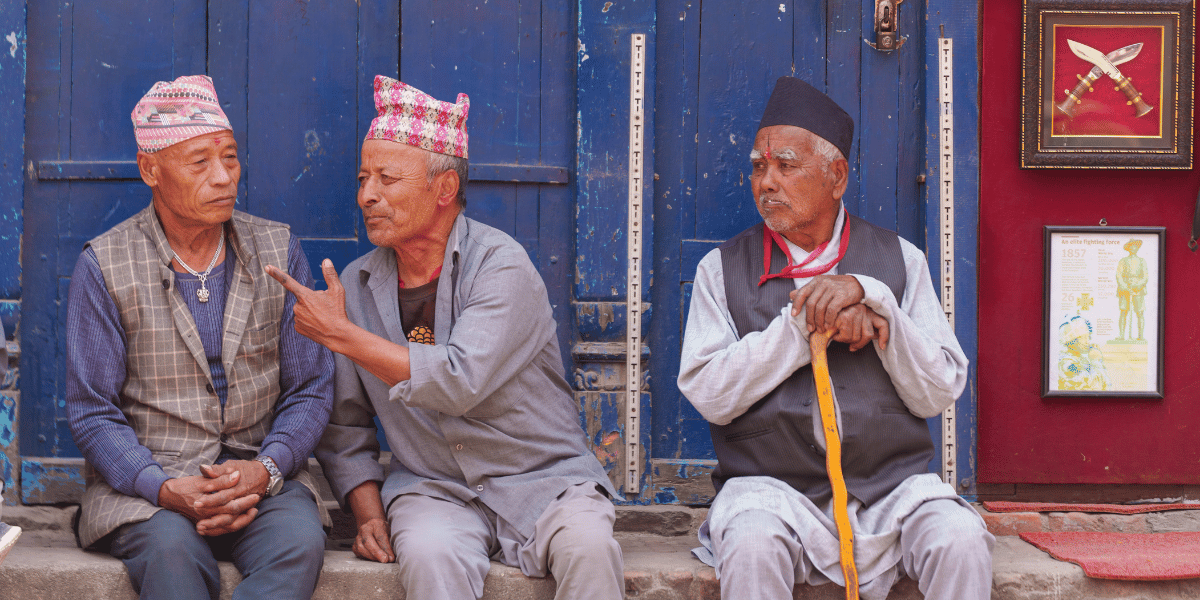
But that does not mean that celebration is only limited to the Newar people. If you visit Bhaktapur during Bisket Jatra, you will notice that among the thousands of people, many do not even belong to the Newar community.
One of the main reasons is the fact that the majority of the Nepalese population practice Hinduism. And Bhairav is one of the most revered manifestations of Lord Shiva in Hinduism. So this naturally pulls Hindu devotees to the jatra.
Another reason could be the coinciding date of the jatra with the Nepali New Year.
Here is a disclaimer about Nepali people: They never say no to a celebration. So it makes sense for people from different ethnicities and religions to visit Bhaktapur and participate in the celebration. If anything, Bisket Jatra is a beautiful reflection of unity and kinship among the people of Nepal.
When is Bisket Jatra Celebrated?
Bisket Jatra starts exactly 4 days before the Nepali New Year according to the Bikram Sambat calendar. This means, the fifth day falls on the New Year. Given that the celebration lasts for 9 days, the Jatra officially ends on the 5th of Baisakh every year.
Bisket Jatra was first introduced by King Jagajjyoti Malla who ruled in the early 17th century. Being an age-old tradition, the massive celebration of Bisket Jatra every year shows the essence of historical continuity in the Newar community.
If you get to visit Bhaktapur during Bisket Jatra, you will find that this is one of the festivals that youths are equally involved in. Various youth clubs work together to ensure that the jatra is celebrated in an organized and safe manner.
Why is Bisket Jatra Celebrated?
There is a famous myth about the Prince who slayed the snakes that appeared out of a Princess’ nostrils. So in Newari language (Nepal Bhasa), Bi means Snake and Sika means Slay, suggesting victory over the snake.
And there is another myth related to the time when Bhaktapur was under the reign of King Shivadev. Facing the attacks of Kirants, the king reached out to a tantric named Shekhar Acharya (or Sekhar Achaju), who transformed himself into a tiger, gathered more tigers and helped Bhaktapur defend itself against the Kirants.
His wife, who was amazed by his powers, asked him to transform himself into a python. However, out of her fear, she failed to transform her husband back into a human and ended up turning into a python herself. So, it is said that the king started erecting the lingo to honor the couple.
Many people tend to connect these folklores with the purpose of celebrating Biska Jatra. But the actual meaning of Bisket is deeper than this with an entirely different context.
Furthermore, the festival has been referred to with different names throughout historical records.
Meaning of Bisket or Biska Jatra: What Historical Records Say
For instance, between 808 Nepal Sambat (NS) to 818 NS, the historical records written during the reign of Jitamitra Malla and Bhupatindra Malla, the festival has been written as ‘Viskyat Jatra’.
But in the records of Bhaktapur Taumadi Tol written around 561 NS under the reign of Yaksha Malla, the celebration is called Vishwayatra. The same has been written in the Malla Dynasty’s ‘Barshakriti’.
Additionally, over time, the festival has been given different names like Bishwadhvajyotanam, Vishwajatra, Vishwasankranti, Biskat, and so on. Now these records tell us one thing, maybe the meaning is not related to the myth at all.
Based on these historical records, many cultural scholars and historians suggest that Bisik is instead a synonym for Vishwa Ketu, referring to the dual flag that is hoisted on the lingo. It also strengthens the arguments that the name is directly related to Lord Bhairav, and not the ancient folklore.
The two sides of the dual flag are known as Vishwadhwaja and Veerdhwaja, and are known to be the symbol of Bhairav and Shakti. And the process of erecting the pole itself symbolizes the union of Bhairav and Bhadrakali, or Shiva and Shakti.
With changes in pronunciation and civilization, the name came to be pronounced as Biska, and it totally makes sense for the people to link it with the myth. But, this explanation gives us more clarity that the word Biska is actually a synonym to the Sanskrit word ‘Vishwa Ketu’.
The Legends of Bisket Jatra
Every great festival has a great story behind it. Well, Bisket Jatra has two main ones, and both deserve to be told properly.
The Kirat Legend: The Tantric Python Couple
This is the older of the two legends, and it is also the more historically plausible one.
The story goes back to the reign of Licchavi King Shivadeva II, when the Kirant people (an ancient indigenous group from Nepal's eastern hills) began launching raids on Bhaktapur.
The king, desperate for help, sought guidance from the goddess Vajrayogini at Sankhu. She directed him to a powerful tantric master named Shekhar Acharya, who had the special ability to transform himself using some magical rice grains.
Tantric Shekar Acharya agreed to help. And for that, he transformed himself into a tiger and summoned an entire army (of tigers) from the surrounding forests. This drove the Kirants away, saving Bhadgaon and its people.
Now, here is where the story turns fascinating. After this victory, the tantric's wife was deeply curious about his unique shapeshifting abilities. So, she asked to see him in the form of a python!
He agreed, transforming himself and handing her the rice grains so she could transform him back. But when she saw the enormous python before her, she panicked.
She dropped the grains and ran away, and in her fear and confusion, she accidentally ate the grains herself. Guess what? She, too, became a python!
Both of them, now stuck in python form, went to the open ground near the Bhadrakali shrine (the very place that would later become Lyosingkhel) and took their own lives.
When the king learned what had happened, he was overwhelmed with grief for the great guru and his wife.
He ordered that every year on the last day of Chaitra, their bodies would be commemorated by erecting a tall wooden pole, the lingo, at Yosingkhel. Two long banners would be attached to its top to represent the couple.
That annual pole-raising ceremony became, over centuries, the heart of what we now call ‘Bisket Jatra’ or ‘Biska Jatra’.
The Legend of Cursed Princess
This is the legend most people know, and honestly, it is easy to understand why it stuck.
In ancient Bhaktapur (once called ‘Bhadgaon’), a powerful king had a beautiful daughter. Every man who married her was found dead the following morning!
It turned out that while the princess slept, two threads emerged from her nostrils, which transformed into large, venomous serpents that killed each new husband through the night.
The king tried everything for his daughter’s successful marriage. He even offered half his kingdom to anyone willing to solve the mystery. Many young men tried but sadly died.
One day, a brave young man arrived from outside Bhadgaon and volunteered to marry the princess. He was visited beforehand by an old woman (who was actually Goddess Bhadrakali in disguise). She gave him a single piece of advice: "Stay awake after the princess falls asleep."
And he did exactly that! He stayed awake the whole night and to his surprise, he saw how two serpents came out from the princess's nostrils. Thanking Goddess Bhadrakali for her advice, he drew his sword and fearlessly killed both before they could attack.
In the morning, everyone was surprised to see the young man alive. Well, the curse was finally broken and the king was overjoyed. He raised/displayed the two dead serpents on a tall pole at the open ground near Bhadrakali's shrine.
The entire kingdom celebrated, and this became Bisket Jatra, and the young man became the new king of Bhadgaon!
Agricultural and Seasonal Importance of Bisket Jatra
It is no coincidence that this festival falls in Mid-April, which is the moment the agricultural calendar turns in Kathmandu Valley. The soil needs to be prepared for the monsoon planting season, which will arrive in about two months.
The farmers of Bhaktapur (who have always made up the majority of the population) need two things above all: timely rainfall and protection from disasters.
Bhairav, the main god throughout Bhaktapur's religious traditions, is worshipped as the god of sky (Akash Bhairav) and the sun (Martanda Bhairav). He is often equated with Indra, who is the Vedic deity of rain and thunder.
The thunderclaps are called ‘Bhairavnaad’ (the voice of Bhairav) in local tradition, and lightning is called Bhairav na mukh agni (the mouth-fire of Bhairav).
Pleasing or honoring Bhairav at the solar new year, through the most elaborate community ritual (like the Bhaktapurians do), is believed to be one of the best ways to pray to him for upcoming good rains and a good harvest.
Also, there is a belief that whichever direction the top of the lingo leans toward will receive more rainfall that year (and accordingly better agricultural output).
While it may sound superstitious, this was how the farming communities used to predict weather in the past (when no forecasting method was available).
Bisket Jatra as a Living Cultural System
While there’s always a big crowd during the festival, it is not actually staged (until recent times, when different organizations have started to organize modern events).
Biska Jatra runs entirely on an internal social architecture that has functioned for over a thousand years without a government department, an event management company, or the tourism board.
The mechanism behind it is Newar’s Guthi system, and understanding it even briefly transforms your experience as a visitor.
Every element of Bisket Jatra, from the selection and transport of the lingo tree to the midnight collision of the chariots, is assigned to a specific Guthi (traditional Newar community institution).
Each Guthi has specific hereditary membership. You are born into your Guthi responsibility the same way you are born into your family:
- The butcher community (Kasai) performs the ritual sacrifice
- The Shilpakars are responsible for building the chariots
- The Manandhars tie the Betal Bhairav idol in the Bhairav’s chariot and tying the ropes of the chariot and the lingo too
- The Jyapu farmers tie and start the process of pulling the chariot ropes and manage much of the festival logistics
- The Kusle musicians play the ceremonial Muhali Baja (often depicted as the "God-waking" instrument),
- The Prajapati potters provide the ritual clay vessels and provide drinking water service during the jatra
- The Chitrakars decorate the chariots, paint sacred symbols, and create ritual banners (dhwaja)
- Brahman, Joshi, and Karmacharya are the priestly groups that conduct the religious rituals
- Other communities that are equally involved: Pode and Jangam
None of them are volunteers in the modern sense. They are performing their inherited cosmic duty. Now that you understand this, we’re sure that this changes the energy of everything you witness!
You see, what you are watching during Bisket Jatra is not only a performance. But rather an operating system for a community that has been running uninterrupted for centuries!
Where is Bisket Jatra Celebrated? Day-by-Day Breakdown
While Bisket Jatra is celebrated in Bhaktapur, the exact venues differ according to the days of the jatra.
What’s more interesting is the fact that different jatras can fall on the same day. For this reason, you must know well about the days and the jatras so that you can plan your visit accordingly.
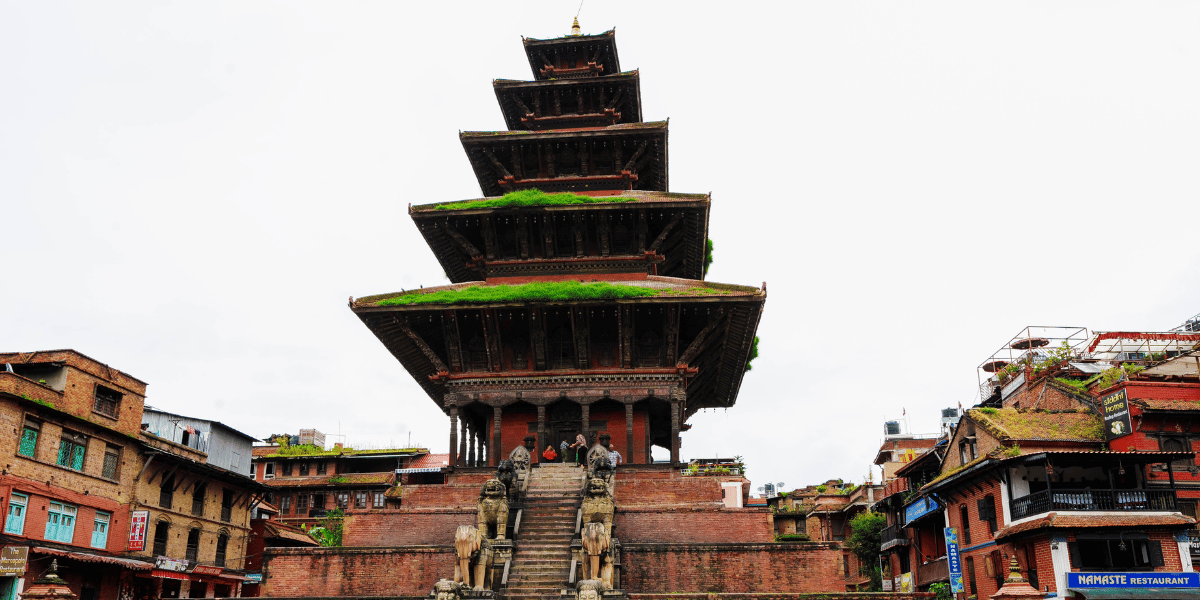
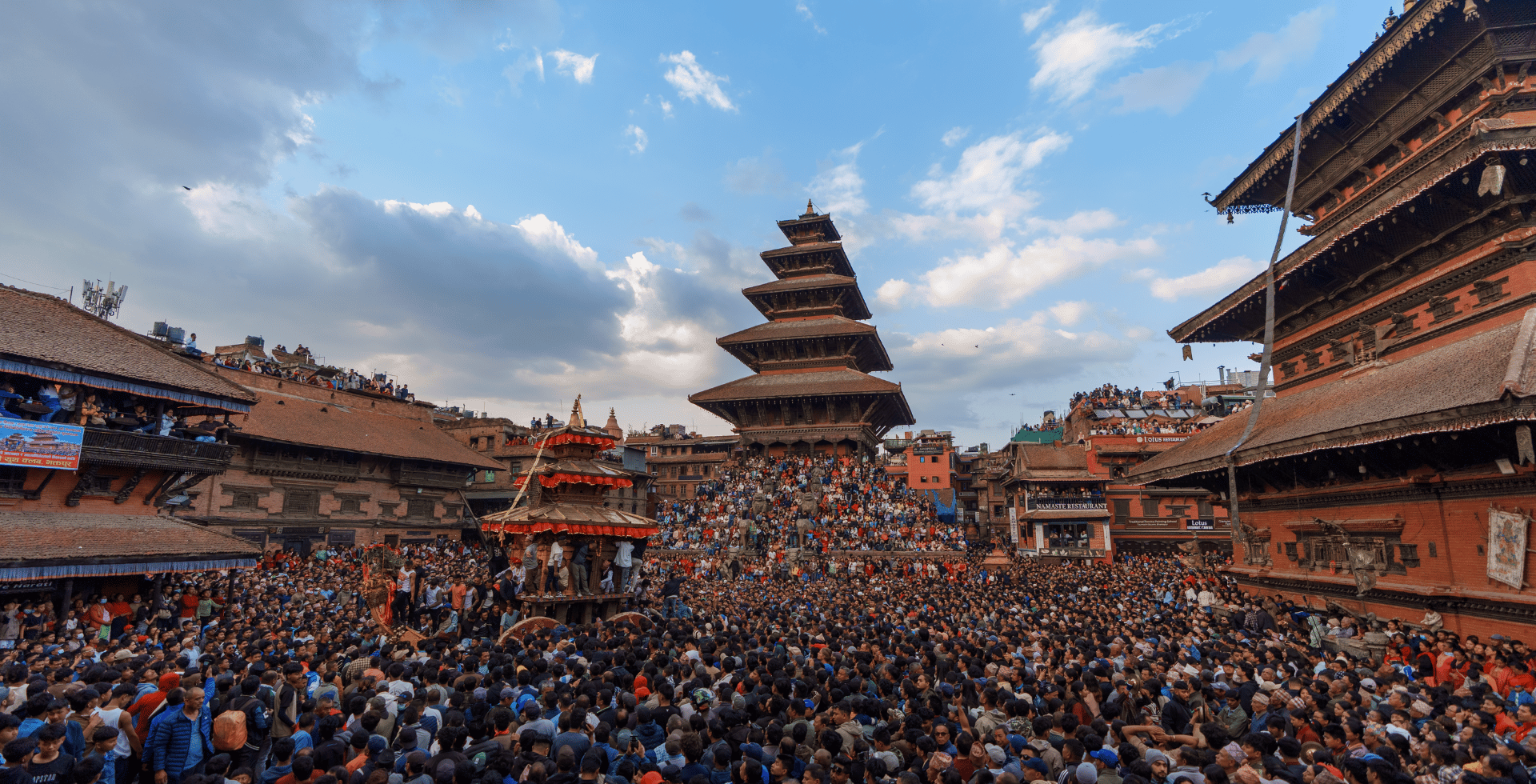
- Day 1: On this day, the iconic tug of war for the chariots of Bhairav and Bhadrakali takes place. This takes place at Taumadi Square of the Bhaktapur Durbar Square, in front of the Nyatapola Temple. Bhadrakali’s chariot is taken to Gahiti.
But before that, there is a huge ceremony known as Dyo Kwa Bijyayegu, when Bhairav is taken to the chariot. This, too, takes place at the Taumadhi Square.
- Day 2: Bhadrakali and her chariot of Bhadrakali are worshipped at Bhadrakali Ajima Dyochen at Gahiti.
In the evening, there is a ceremony known as Lakophetu Sait. During this puja, the Bhairav Naikes (religious leaders) sacrifice a buffalo.
- Day 3: On this day, a ceremony known as Syakotyako is held at Laakulache. On this day, the devotees offer sacrifices to Lord Bhairav.
- Day 4: On this day, the main ritual of the Yosin Dyo takes place. The lingo is erected at Lyasingkhel near Bhadrakali Peeth, which is the main attraction of the entire festival. This procession takes place in the evening.
However, on the same day in the morning, another lingo is erected at Kumale Tole of Talaka village in Bhaktapur. That lingo is known as Jetha Ganesh Lingo. Lastly, in Bode’s Mahalaxmi Temple, another lingo is erected to schedule the date for the tongue-piercing festival.
There is also another jatra known as Murda Khat Jatra, which is related to the folklore about the princess who had snakes in her nostril. The procession takes place to honor the men that were killed by the snakes. This jatra takes place at Bhujingkokha, west of Taumadhi.
At Bhaktapur Layaku Durbar, there is another ritual to worship Goddess Dumajudevi that takes place in the evening. Here, the priests perform various tantric rituals, puja, and offer sacrifices to her. You can also visit Lahi Tole in the afternoon if you want to see Kumari’s chariot.
At Taumadhi Square in front of Bhairavnath’s temple, in the evening, you can also watch the Jogi Chakra Puja. This puja is done for the people who died an untimely death or passed away in a disaster. It is also done for those whose last rites were not completed after their death.
You can also visit Khauma in the evening if you want to watch the Indrayani Tipwa Jatra, it is on the western part of the Bhaktapur Durbar Square.
As you can see, you are not short of options for this day, if you can make it, try attending the Sunga Dyo Jatra at Bishnubir Thimi. However, let me tell you that the biggest attraction is the Yosin Dyo Thanegu which has been mentioned at the beginning of Day 4’s events.
- Day 5: On this day, the main Lingo Jatra comes to an end. In the morning, priests, guthi members, and the locals gather at Lyansingkhel to pray to the lingo, and then the lingo is dropped, also known as Satruhanta Jatra.
The puja ceremony that takes place in the morning hours is locally known as Yosin Dyo Kothegu, and the ceremony also takes place at Chupinghat.
After the lingo is dropped, Dumajudevi Jatra starts at the Bhaktapur Layaku Durbar. While this used to be a big procession observed till Basantapur, these days, the puja is limited to Taleju’s main courtyard. The puja for the Goddess begins early in the morning, known as Jogicha Puja.
Lastly, there is another jatra at Gahiti known as Kha Lwakegu. In this procession, the chariots of Bhairav and Bhadrakali are made to collide. This takes place around midnight.
If you want a quieter morning, you can visit Balkumari Temple to watch the Bishnuvir Jatra come to an end or Charkhandi Temple for Charkhandi Mela. And if you want to escape the crowd of Satruhanta Jatra in the evening, you can visit Siddhikali Temple for Siddhikali Jatra, or Barahisthan for Barahi Tipwo Jatra.
- Day 6: Some of the most anticipated festivals of the Newar community take place on this day. However, as timings are likely to collide, you might only be able to one of the jatras.
At Tachapal, there is a procession of Goddess Mahakali and Goddess Maheshwari.
At Madhyapur Thimi around Balkumari Temple, Sindoor Jatra starts early in the morning.
The tongue-piercing jatra, also known as ‘jibro chhedne jatra’ takes place at Mahalaxmi Temple of Bode, Bhaktapur.
If you are around Bolachhen in the morning, don’t miss the Jayatha Ganesh and Batuk Bhairav rath yatra.
As for the evening, you can stroll from Brahmayani Shrine to Chyamasingh along with the procession of Brahmayani Jatra.
- Day 7: While the chariots of Bhairav and Bhadrakali make their journey through the streets of Bhaktapur, there is another procession that takes place for Goddess Brahmayani and Goddess Maheshwari. This takes place at the Dattatreya Square.
And if you missed the Sindoor Jatra for Day 6, then you can visit Talako in the afternoon for Batuk Bhairav and Jyatha Ganesh Sindoor Jatra.
In case you are close to Khanla Tole, don’t miss the glimpse of Pardeshi Bhimsen’s Khat Yatra.
- Day 8: On this day, Chhuma Ganesh Khat Jatra is celebrated at Chochhen Tol, Bhaktapur. Khat means a wooden platform.
Then there is Dyo Swaga Beyegu, also known as Sagun Jatra. To celebrate this, the locals visit all the deities that have been installed in Bhaktapur since ancient times and offer them offerings of yogurt, fruits, and sweets.
- Day 9: This is the last day of Bisket Jatra, and on this day, a procession named Dyo Thaha Beyegu takes place. This jatra signifies the return of Lord Bhairav to his abode at Bhairavnath Temple of Taumadhi Square.
Make sure to visit Taumadhi Square for the last tug-of-war of Biska Jatra.
The lingo at Kumale Tole is also thrown down on this day, and all the deities are taken back to their respective dwellings.
Based on the information above, you can plan your visit to the jatras as per your convenience and get the deepest understanding of the Newari culture and how their community functions.
For even more details, do read our part 2 of Bisket Jatra that features a complete day-by-day breakdown of the jatras, and our own experiences in this 9-day festival.
Sacred Geography and Protective Deities of Bhaktapur
A festival of 9 days, celebrated mainly to worship Lord Bhairav and Goddess Bhadrakali. But why in Bhaktapur, of all places? Paradise of festivals, Bhaktapur, has been hosting some of the grandest and most sacred festivals and ceremonies since ancient times.
In Newar settlements, every year the people follow the customs of holding “Busadaya Jatra” to honor their guardian protectors. Bhaktapur was once a fertile and economically prosperous land, and the Newars of Bhaktapur worship Lord Bhairav as the regional protector.
But there is a whole different story when it comes to Lord Bhairav’s relation to Bhaktapur. It is said that a long time back, Kashi Bhairavnath visited Bhaktapur to observe the Bisket Jatra.
But the local tantric recognized him based on his distinct build, and tried to capture him and keep him in Bhaktapur. The tantric then cut Bhairav’s head, and to make him stay there, they built him an abode; Bhairavnath Temple.
Main Deities of Bisket Jatra
The four main deities worshipped during Bisket Jatra are:
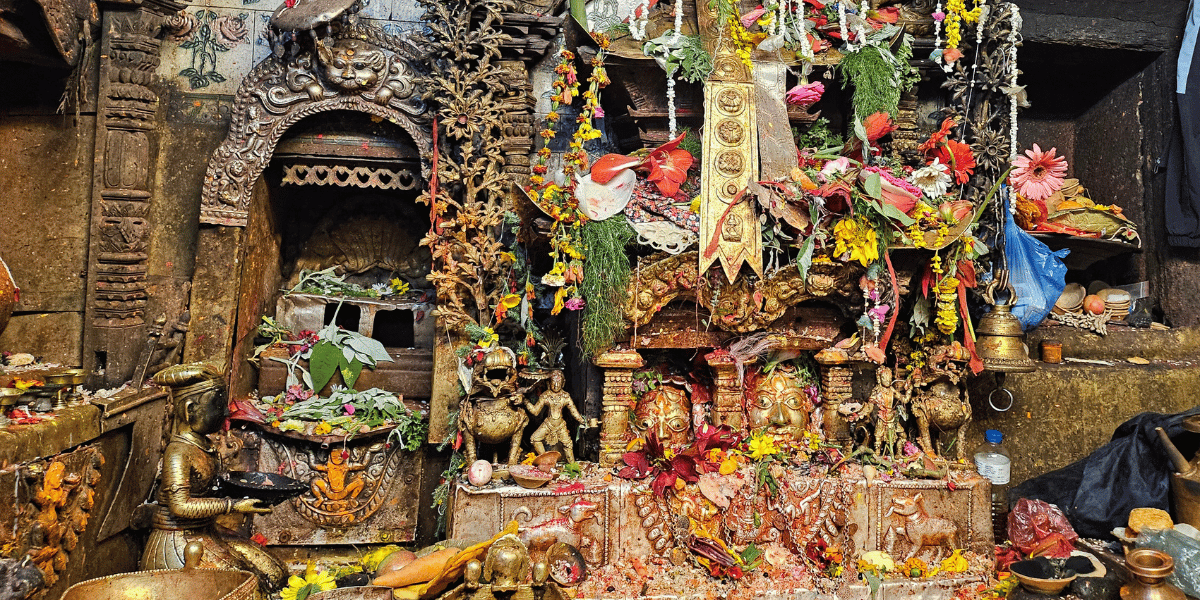
- Lord Bhairav: While many are aware of Bhairav’s journey through Kashi and Kathmandu, Bhaktapur is believed to be one of the most favoured locations by Lord Bhairav.
Aakash Bhairav, the main god of Bhaktapur, dwells in the Bhairavnath Temple of Taumadhi Square. Known as the God of the farmers, Bhaktapur, being an agricultural region, has a large population of farmers. And it makes sense why they consider him the God of Prosperity.
Bhairav is also believed to be the main deity of the Newars of Bhaktapur. One can find him carved in almost all the architectures of Bhaktapur as he is revered as the region’s protector.
- Goddess Bhadrakali: The primordial power goddess of Bhaktapur, Goddess Bhadrakali is believed to be the one who ordered the construction of Bhaktapur.
Apart from being the consort of Lord Bhairav, Goddess Bhadrakali holds the main place among the Ashta Matrikas of Bhaktapur. During Bisket Jatra, you will notice that her chariot is as important as Bhairav’s.
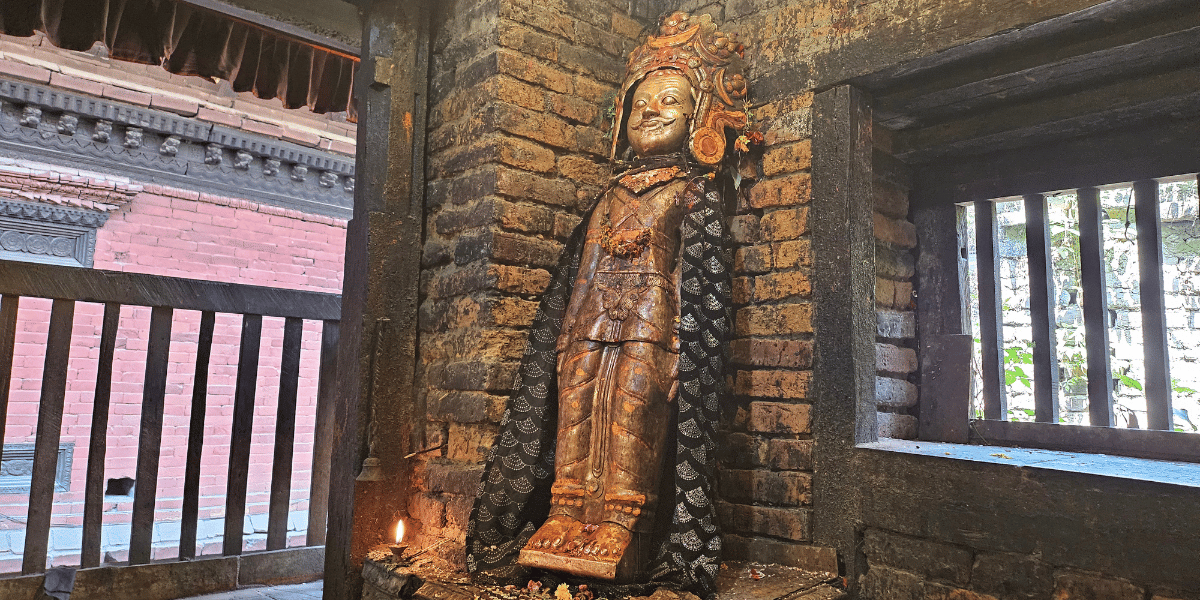
- Betal: Also known as Bir Betal, Betal is always placed on the front of Bhairav’s chariot. He rides the chariot and accompanies Lord Bhairav throughout 9 days of Bisket Jatra and it is said that he guards Bhairav’s destructive power. He is also known as the sacred carrier (vahaan) of Aakash Bhairav.
Worshipped as a living deity, Betal is also believed to be the protector of the country. The locals believe that Betal will accompany Navadurga if a disaster or misfortune ever befalls upon the devotees.
- Ganesh: It is believed that Ganesh has an important position wherever Shiva and Shakti, or Bhairav and Bhadrakali are worshipped. This is because Ganesh is known for removing obstacles, devotees always worship him for a successful ritual.
Prominently known as Ganesha and Vinayaka, Lord Ganesh is the symbol of luck and success. Some of his manifestations that you can find in Bhaktapur are Jetha Ganesh, Chonga Ganesh, Chhuma Ganesh, Inaga Ganesh, and Mulakhu Ganesh.
Look at the table below to find the other Gods and Goddesses who are also worshipped during Biska Jatra:
|
God/Goddess
|
Region of Worship in Bhaktapur
|
|
Indrayani
|
Khauma Tole
|
|
Taleju
|
Golden Gate of Bhaktapur Durbar Square
|
|
Tripura Sundari
|
Tulachhen Tole
|
|
Manakamana
|
Malachhen Gacha
|
|
Barahi
|
Tekhacho Tole
|
|
Mahakali
|
Hitifuse Tole, Lalachhen Tole
|
|
Balkumari
|
Guchchatwa, Tachapal Tole
|
|
Brahmayani
|
Tachapal Tole
|
|
Maheshwari
|
Taha Falcha, Inacho Tole
|
|
Kumari
|
Kwache Tole
|
|
Mahalakshmi
|
Thalachhen Falcha
|
Detailed Ritual System and Ceremonial Practices
The nine days of Bisket Jatra are packed with rituals, many of which happen simultaneously while some other rituals happen way before that! In this section, I’ll walk you through the main ones properly.
Chariot Construction Process
The Bhairav chariot is not ordered from a supplier or assembled from stored parts. Every year, it is rebuilt from scratch, following specifications that have not changed for centuries.
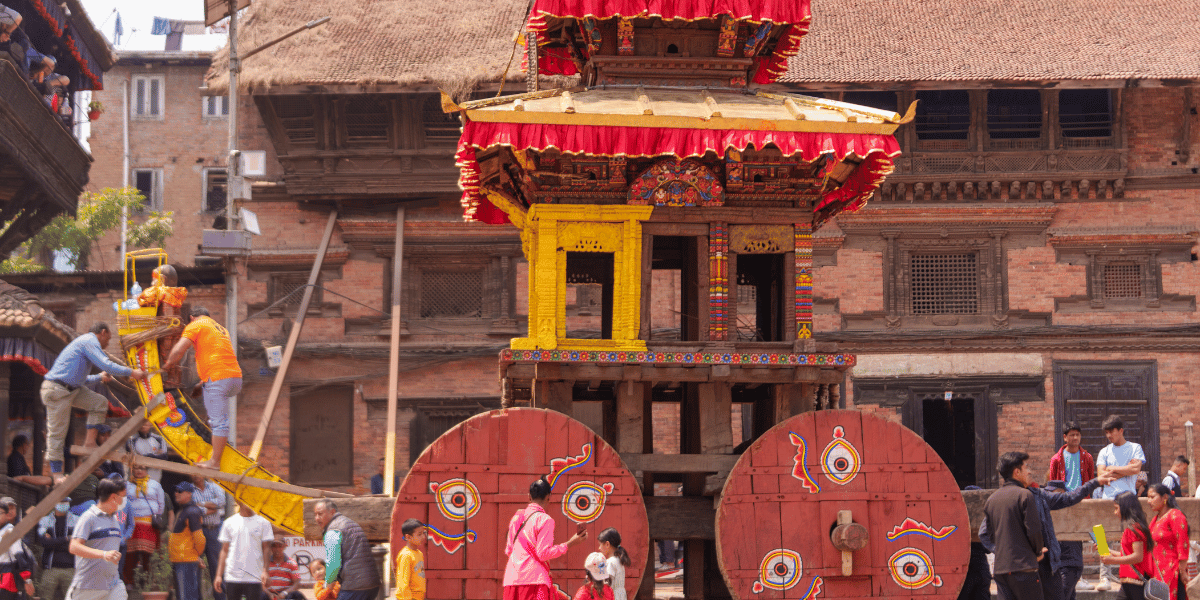
The structure is a three-story, pagoda-style wooden tower that looks like a temple in motion. It is tall enough to barely fit through the widest streets of Bhaktapur, with massive wheels that groan as they turn.
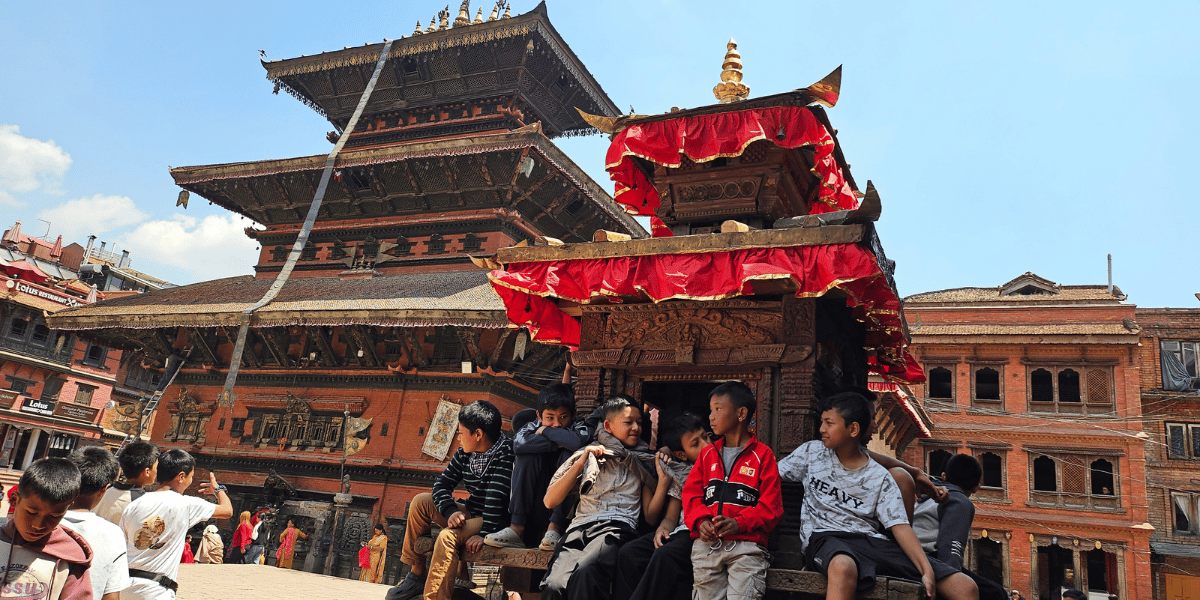
The Bhadrakali chariot, on the other hand, is a slightly smaller two-story version.
What makes the construction ritual is the approach. According to the tantric specifications that govern the festival, the chariot's design follows the geometry of the Sri Yantra, which is the fundamental sacred diagram in tantric tradition representing the cosmos.
The chariot is not just a vehicle, but a moving sacred structure. This is why no mechanical devices, no power tools, no metal fasteners are used in any ritual element of the chariot.
Every joint is secured with cane rope (wanlah). And even every measurement follows established proportional rules!
After the skilled wood artisans (Shilpakar) construct the chariot, the Chitrakar and Pu (painters) community performs the sacred eye-opening ceremony (Chakshudana). This ritual painting of the deity’s eyes transforms the wooden structure into a living divine vessel, officially ‘awakening’ the deity for the procession.
Chariot Procession of Lord Bhairav
The chariot procession is the event that most visitors come to Bhaktapur to witness, and it absolutely delivers!
The morning of the first day begins with the Dya Kwaha Bijyagu puja at Bhairavnath Temple. Once the rituals are complete, the deity is placed in the three-story chariot positioned at Taumadhi Square, right in front of the five-story Nyatapola Temple.
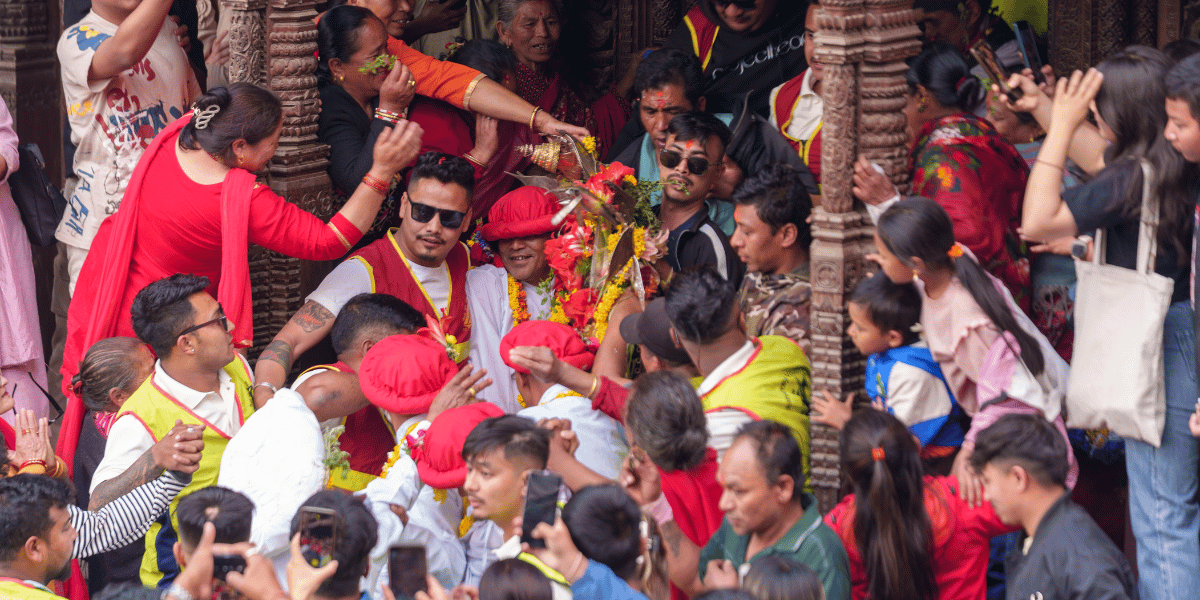
Eighteen specific officials ride inside the chariot in assigned positions:
- the six Bhairav Naike members (including the chief Naike)
- two navigation officers called Mahah from the Chaguthi and Muguthi communities
- the tantric priest (Acharya)
- the astrologer (Joshi)
- the royal sword representative
- and various artisan priests
They are all barefoot! But anyone who has been recently bereaved or is in a state of ritual impurity cannot ride.
Before the chariot can officially move, the royal sword (khada) must arrive. A delegation in traditional ceremonial dress, called Hazilam Guzilam (a specific white-and-red outfit with red and white turbans), travels to the Taleju Palace to receive this sword.
It has to be escorted back to Taumadhi with full ceremony, accompanied by the Muhali Baja. The chariot procession officially begins only once this sword representing sovereign authority is placed inside.
Likewise, two special large packed offering called Jakigwah (traditional rice grains wrapped in copper-leaves) are also escorted before the Bhairav idol is taken to the chariot and placed subsequently on the left and right side.
This relates to a story of Jyapu farmer who brought two perfect rice grains (jakigwah) from his field to offer to Bhairav. It’s believed that these are the same jakigwah preserved till date and brought to the public once every year in Biska Jatra.
Those grains were wrapped in copper leaf and have been kept permanently in the Bhairavnath temple as a symbol of agricultural blessing ever since!
Without the jakigwah and khada, the Biska Jatra cannot start! This tradition reflects an unbroken compact between the ruler and the people that has outlasted empires. Once all the rituals and traditions are followed, the tug-of-war officially begins!
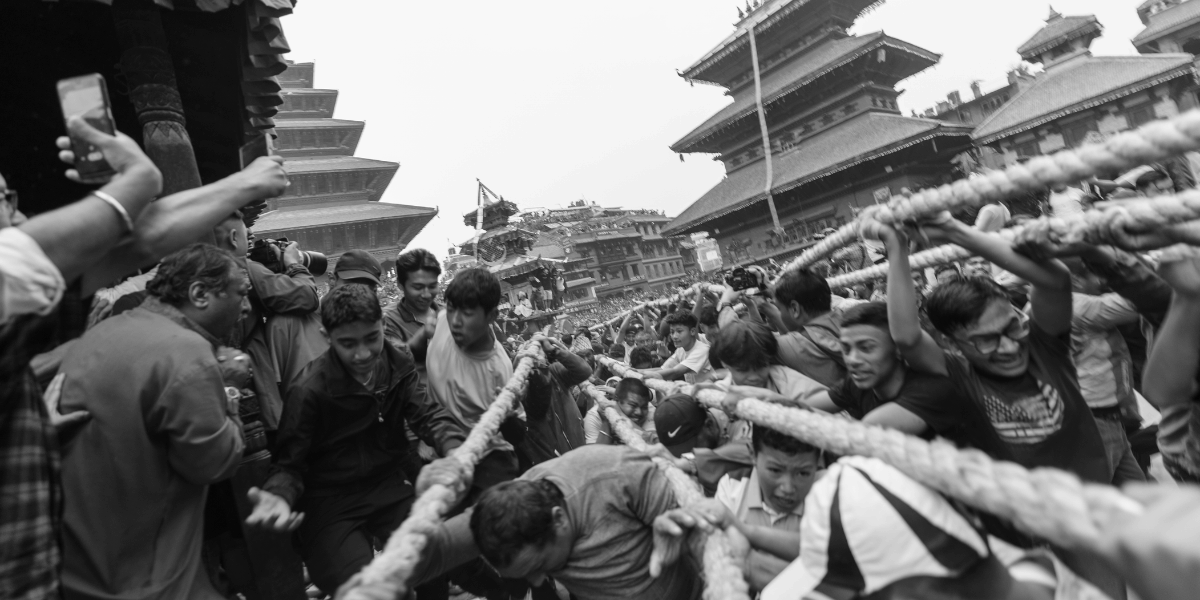
Thick ropes (wanlah) are attached to the chariot. One set leads toward the upper neighbourhood (Thane) and another toward the lower (Kwone). Hundreds of men grip each rope (total of nine, five in front and four at the back).
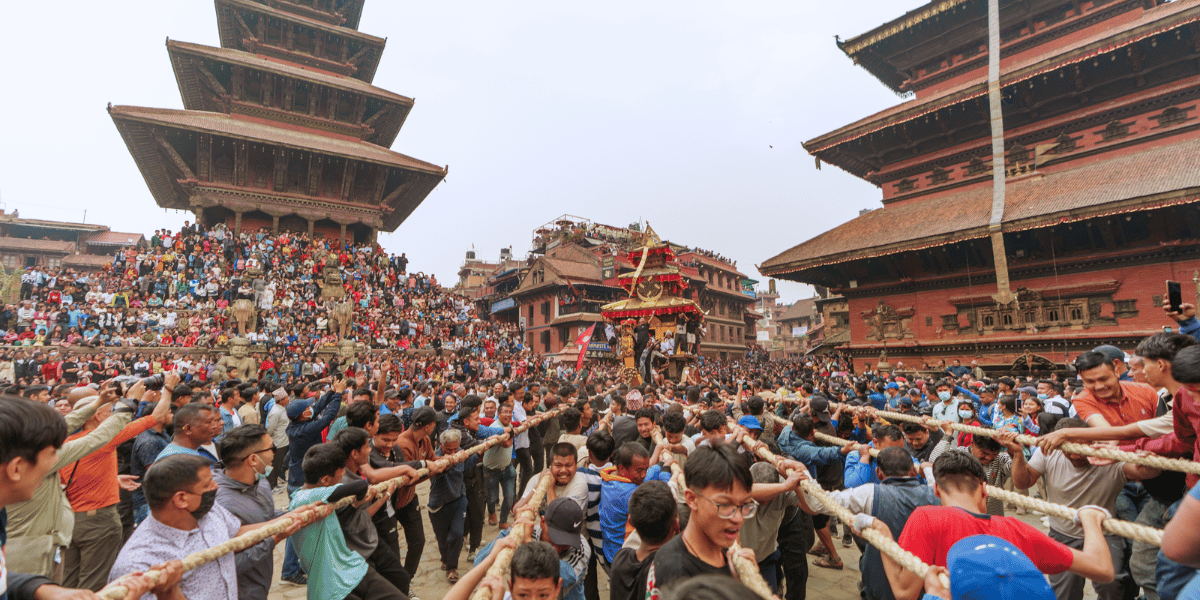
The leaders in each side of the chariot calls out “Hose” and the teams surge shouting “Haise” and then “Haaa!”. The crowd of thousands watching from every rooftop, balcony, temple stairs, and side street creates an atmosphere that is genuinely electric!
Every person in Bhaktapur seems to be either pulling, watching, or cheering. And whichever side wins gets the deity's chariot brought through their neighbourhood first.
If Thane wins, the chariot travels through: Kwachen > Sakotha > Sukuldhoka > Gomari > Inacho > Dattatreya Square.
If Kwone wins, the route goes through: Tamari > Buluncha > Gathkha > Nasamana > Mulakhu > Bansagopal > Tekhaphukhu.
At the end of Day 1, the chariot reaches Gahiti, the designated rest point between Taumadhi and Lyosingkhel.
One practical detail: if the chariot gets stuck mid-route (which does happen), the tantric solution is to prepare Nyambaji (lentil cakes mixed with ritual ingredients) and offer them with specific mantras at the point of obstruction. Then, the chariot is believed to move freely afterward.
Lingo (Yosin) Raising Ceremony
The lingo-raising ceremony happens on the evening of Chaitra 30, the last day of the Nepali year, and it is one of the most visually spectacular events of the entire festival.
The lingo is a straight, round, knot-free pine tree (salla wood) approximately 25 meters (about 82 feet) tall, sourced from a designated forest through a specific ritual selection process.
The tree is transported to Bhaktapur via a riverside route, purified through tantric rituals, and then given "ritual life" by a shilpakar who performs the eye-opening ceremony, transforming the log into a sacred divine form.
The formal raising follows a ten-step sequence. The most important visual step is the wrapping of the lingo's upper section in 32-hand-long (approximately 16-meter) pieces of dark blue cloth, referencing Bhairav's dark blue iconographic complexion. The lingo, in this preparation, becomes Bhairav himself!
Eight thick ropes are used to raise the pole, and those eight ropes symbolise the eight Ashta Matrika goddesses. The local name for this event is Yosin Thanegu in Newari, meaning "the lingo-raising festival."
Two flags, the Bir Dhwaja (Victory Banner) and the Vishwa Dhwaja (World Banner), are attached to the top of the lingo. These are considered as the deity's own flags!
The flags must not become untied or fall midway through the raising. If they do, it is considered an ill omen for the year ahead.
As the lingo rises toward vertical, the assembled crowd cheers and the atmosphere becomes genuinely thrilling. Once erect, the Navadurga goddesses (nine forms of Durga) are believed to descend and reside within the lingo through the night.
Special tantric rituals are conducted at the Taleju Temple, and the night becomes one of continuous worship.
There are two beliefs associated with the raised lingo that locals take seriously:
- First, whoever sees the lingo facing/leaning toward their direction believes that area will receive more rainfall and agricultural abundance in the coming year.
- Second, a young man who successfully climbs to the very top of the lingo and plucks the flower placed there will be blessed with a son.
Lingo (Yosin) Falling Ceremony
The lingo-falling ceremony, called Satruhanta Jatra (Festival of the Enemy's Fall), happens on the evening of Baisakh 1, New Year's Day, and it is arguably the single most emotionally charged moment of the entire nine days!
After a full morning of worship, offerings, and prayers at the erected lingo, the Bhairav priests conduct final tantric rituals as the afternoon draws toward evening.
The ropes are repositioned. The crowd, which has built up through the day, grows quiet with anticipation. Then, slowly, the 25-meter lingo begins its descent.
The moment it touches the ground, the crowd erupts with chants "Satruhanta!". The belief is as clear as it is powerful: whoever witnesses the lingo fall will see their enemies fall.
Seeing this from the ground, with thousands of people around you and the centuries-old buildings of Bhaktapur rising on every side, is one of the best moments of Biska Jatra for sure!
The lingo's falling marks the official commencement of the new year. This also means one cosmic cycle has been completed!
While the lingo was raised to honor Bhairav as the universe's protector, its ceremonial descent acknowledges that the new year has begun under his protection.
Immediately after the lingo is lowered, the Bhairav and Bhadrakali chariots are pulled from their positions toward Gahiti for the midnight event.
The Midnight Chariot Collision
This is the festival's most quietly powerful ritual, and it happens late enough that many visitors miss it entirely. So, our team at Altitude Himalaya urges you to not miss this!
At midnight on New Year's night, the Bhairav chariot and the Bhadrakali chariot are brought face to face at Gahiti and made to collide three times. People throw red abir powder, flowers, and chatamari rice-flour offerings over both chariots as they meet.
The local Newari name for this event is Kha Lwakegu (the chariot-joining/collision festival). Every traditional account interprets this as the symbolic union of Bhairav (sky, masculine energy) and Bhadrakali (earth, feminine energy), the cosmic coupling that brings creation and abundance.
In the tantric worldview that underlies all of Bisket Jatra, this midnight meeting is the ritual heart of everything!
The fact that it happens at midnight, in the oldest part of Bhaktapur, with torchlight and drums and a crowd that has been celebrating all day long, makes it one of the most atmospheric things you can experience in Nepal.
Tantric and Religious Ritual Practices
In the tantric tradition, the relationship between humans and fierce deities like Bhairav involves precise ritual actions, mantras (sacred sounds), yantras (sacred diagrams), specific materials, and exactly timed sequences.
Every element of the Bisket Jatra festival, from the chariot's Sri Yantra geometry to the specific blue cloth on the lingo to the midnight chariot collision is a tantric act, not an aesthetic one!
The Gautami Tantra, an ancient Sanskrit text, is the primary reference for the Vishwayatra rituals. Tantric priests (Karmacharya) and the Taleju temple's own Brahmin priests (Rajopadhyaya) conduct the most sacred ritual sequences.
One of the most striking tantric practices you will witness (or hear about) is of the lingo ritual when the pole gets stuck during transport or erection. Basically, when it cannot be moved despite physical effort, offerings of Nyambaji (lentil cakes with specific ingredients) are prepared and offered with mantras.
The belief is that this addresses a tantric obstruction and allows the work to proceed. Locals who work with the lingo year after year confirm that this works. Well, you can decide for yourself how to interpret that!
The morning of the final chariot day also features a remarkable tantric interaction between the Acharya priest and Bhairav himself.
After the festival is complete, when Bhairav's image is being guided back into his temple, the chief priest blocks the door and scolds the deity.
It’s like a parent scolding a child who has been out playing: "You went out, ate whatever you wanted, slept wherever you wanted, stayed away for eight nights, and now you want to simply walk back in?"
The deity is made to wait before being admitted. This ritual encapsulates something genuinely special about how intimate Bhaktapur's relationship is with its presiding deity.
Ritual Purity, Restrictions, and Sacred Protocols
Bisket Jatra operates under strict rules of ritual purity that the Guthi system enforces with real seriousness.
The 18 officials that we mentioned earlier (who ride in Bhairav's chariot) must be in a state of ritual purity. Anyone who has been recently bereaved, anyone who has been in contact with death or ritual impurity, is excluded from riding.
Also, they have to go barefoot in the chariot, and no one who is wearing footwear is permitted to step onto the chariot's structure.
During the chariot procession, there is one moment that exemplifies how seriously these protocols are taken:
- After the chariot comes to a stop at Gahiti at the end of Day 1, the Betal deity on the front projection faces a specific window of a specific household.
- Whichever direction Betal faces, a member of that household must perform a prescribed ritual at that window.
- The belief is that if this is not done, someone in that family will die.
- So, the household where Betal idol faces has performed this ritual, without exception, every single year for as long as anyone can remember!
The lingo's transport also follows strict rules. If the lingo cannot pass through a specific route, tantric ritual is performed before attempting again. The sequence must be followed in the prescribed order. And no shortcut is acceptable!
Note: Bhairav’s idol is removed from the chariot and transferred to a safe location each day as a security measure to prevent possible theft. And it’s placed back the following day before the next event.
Role of Guthi System in Organizing Bisket Jatra
The Guthi system is the invisible infrastructure that makes Bisket Jatra possible. Without it, the festival would collapse within a generation.
First, let me give you a clear understanding of Guthi: it’s a traditional Newar community institution that functions simultaneously as a religious body, a mutual support organisation, and a governance structure.
Membership in Guthi is actually hereditary, caste-specific, and neighbourhood-based. And each member has to pay dues, contribute labour as well as participate in assigned rituals.
In return, they receive guaranteed funeral rites when they die, participation in community feasts, social standing, participation in festivals (like Bisket Jatra, Gai Jatra, Yomari Punhi, etc.) and a defined place in their community's cosmic order.
When it comes to Bisket/Biska Jatra, the Bhairavnath Guthi organises the Bhairav chariot procession, the lingo ritual, and most of the main Bisket events. Its chief (Naike, specifically mul Naike) holds the position hereditarily.
Likewise, the Bhadrakali Guthi manages the Bhadrakali chariot.
In the same way, specific Guthis manage specific neighbourhood Khajatras (palanquin processions for local deities). Some of these have dedicated land endowments (Guthi Jagga) that fund them.
Others, like the Maheshwari procession in Inacho Tole, have no formal land endowment and depend entirely on community donations. Yet they continue, year after year, because the community chooses to sustain them!
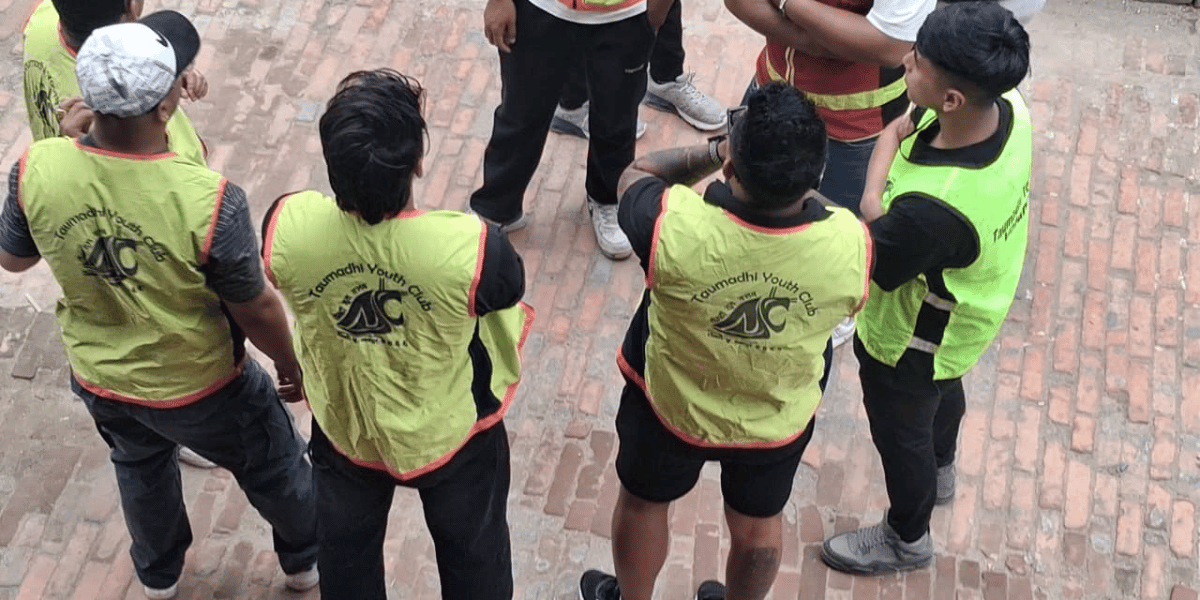
Here is a serious concern worth noting: Since Nepal became a republic and state funding for the Guthi Sansthan (the government body managing Guthi affairs) was dramatically reduced and then effectively withdrawn, many Newari festivals have fallen into financial trouble.
Music, Bhajan, and Ritual Music
Sound is everywhere during Bisket Jatra (or any other jatras performed by the Newar community). And it is not just background music; the music you hear is actually ritual!
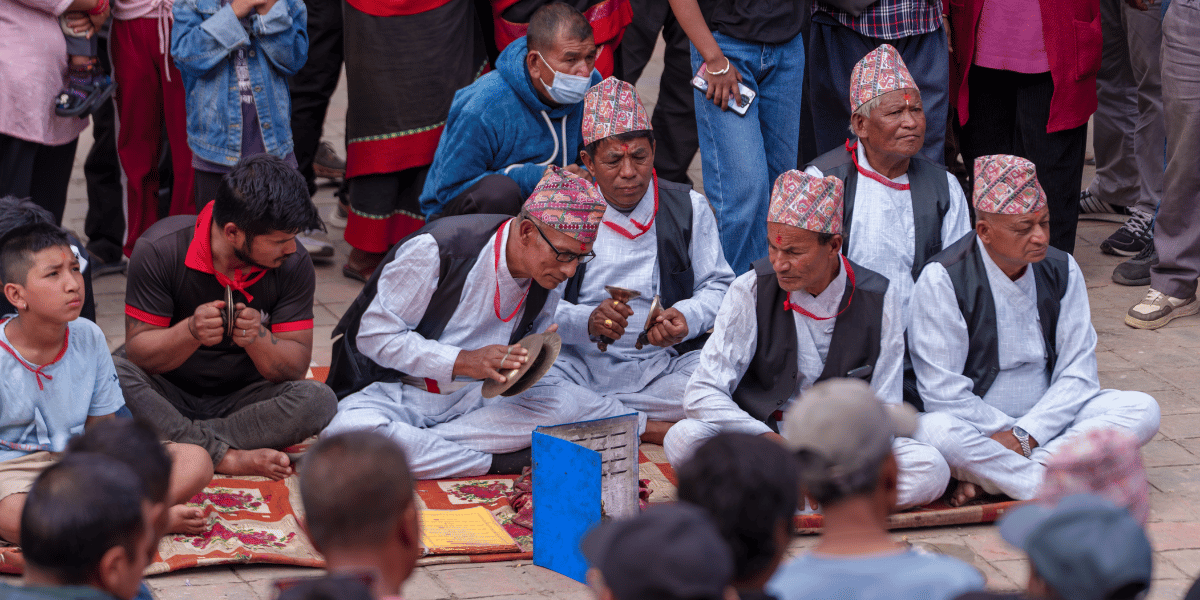
The Muhali Baja is the primary ensemble that consists of five traditional instruments:
- Muhali (a double-reed wind instrument similar to an oboe),
- Tamoucha (a drum),
- Dhol (a larger drum),
- Sanai (another wind instrument), and
- Jhyali (cymbals).
The Kusle caste community is the hereditary player of this ensemble, and they perform whenever the royal sword delegation moves through the city, whenever the chariot is in motion, and at key ritual moments throughout the festival.
The Dhimay drum is the iconic sound of Bisket Jatra more broadly. It is a large, heavy barrel drum carried by a strap over the shoulder and played with two specially shaped sticks. Its deep, resonant boom is audible from long distances.
During the Sindoor Jatra in Thimi (on Day 6), entire parades of Dhimay players form the musical backbone of the procession!
During the neighbourhood Khajatras, you will also hear Dafa music (a bhajan tradition specific to Bhaktapur's Newar community), as well as flute music and chanting.
The combination of Dafa bhajan, Dhimay drumming, Muhali Baja performance, and the roar of thousands of people pulling the chariot ropes creates a soundscape that is genuinely overwhelming and beautiful in Bisket Jatra.
How Bisket Jatra Has Evolved Over Time
Understanding how Nepali festivals has changed over the centuries helps you appreciate what you are seeing in its current form.
And when it comes to Bisket Jatra, its oldest element is the lingo-raising (Vishwadhwaj) tradition, which dates to at least the Licchavi period. The earliest written reference is from a Yaksha Malla inscription at roughly 1441 CE.
But the Licchavi-era documents mentioning Dhwaja Goshthis (banner-raising guilds) and Dhwajamanuya (banner-raising officials) suggest the tradition of raising a banner to celebrate the solar new year goes back considerably earlier, possibly to the 5th-8th century CE.
The Bhairav and Bhadrakali chariot procession was added during the Malla period, likely in the 12th-13th century CE. But the festival took its current grand, nine-day form specifically because of King Bhupatindra Malla, who built the first massive pagoda-style chariot and installed stone-paved tracks in the streets for it to roll on.
After the Kathmandu Valley split into three rival kingdoms: Kathmandu, Lalitpur, and Bhaktapur, a cultural competition intensified between the three cities.
Kathmandu had Indra Jatra. Lalitpur had Rato Machindranath. Bhaktapur needed something equally grand to assert its cultural prestige. The Bisket Jatra, elevated and expanded by successive Bhaktapur Malla kings, including Vishwamalla, Jagajyoti Malla, and Bhupatindra Malla.
The result was the nine-day festival that runs even until today, substantially unchanged in its structure since the 17th-18th century!
What has changed more recently is the funding. The historical arrangement was that the state provided the materials and financial support for the festival. But ever since Nepal became a republic, this state support has been withdrawn almost entirely.
The festival now depends on community donations. Several smaller ritual traditions have quietly faded. This is a genuine concern!
Yet, Bisket Jatra is becoming grander year after year. Its popularity has drawn interest worldwide, and now people come to visit Nepal during the Nepali New Year, particularly to witness this chaotic yet magical Bisket/Biska Jatra.
What to Eat During Bisket Jatra? Best Newari Foods to Try
If you ask any Nepali person for food suggestions during your time in Nepal, they will most definitely bring up Newari cuisine. Spicy, tangy, and all the spices popping at the right amount, Newari cuisine is a delight for your tastebuds.
And what’s more better than trying Newari food in an environment where the culture is on full display. Here are some of the dishes that you must try if you are visiting Bhaktapur during Bisket Jatra:
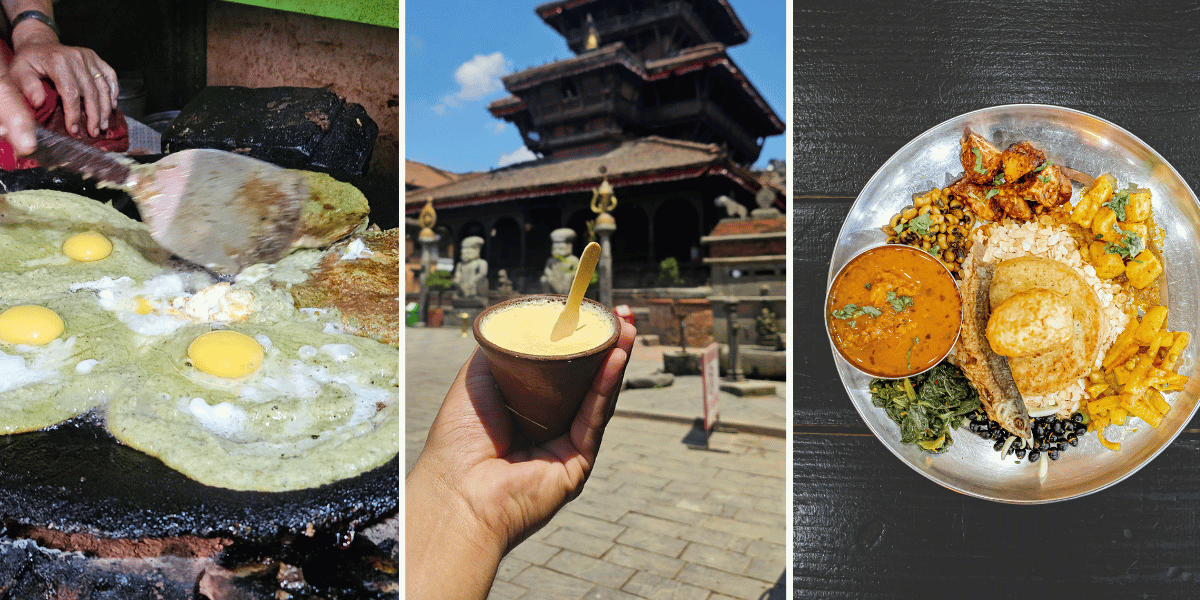
- Chatamari: Popularly known as Newari Pizza in Nepal, chatamari is made with rice flour batter as the base. As for the toppings, you can choose between chicken or buffalo minced meat, along with garlic, egg, coriander, and onions. A quick and tasty snack, ideal for short breaks mid-jatra!
- Samay Baji: I feel like samay baji is daal bhat with a Newari twist. In this Newari platter, you will be served beaten rice with a combination of various vegetarian and non-vegetarian sides.
Expect to see spicy chhoila, crunchy friend soybeans, bara (similar to a pancake, but made with lentil), achaar, and aloo taama (potato and bamboo soot) decorated neatly around the beaten rice.
- Juju Dhau: In Newari language Juju Dhau means “King of the Curds”, and once you get to taste it, you will defend the name with your life. Made in clay pots following traditional methods, this curd is the sweetest and the creamiest curd you will find!
- Yomari: Another Newari delicacy that you cannot miss out on is Yomari. If you have heard about momo, think of yomari like its sweeter version. The wrap of yomari is made from rice flour, and for fillings you have two options: molasses (chaku) and sweet thickened milk paste (khuwa).
Lastly, if you want to raise a glass during the celebration, try out their chhyang (rice wine) and aila, a traditionally distilled alcohol.
Bisket Jatra in Other Places
As it has already been mentioned above that Bisket Jatra is celebrated widely by Newar communities. And for those who do not reside within Bhaktapur, they have their own celebrations in their local settlements.
It has also been mentioned in a few academic papers that the festivals celebrated in Bode, Nagdesh, and Thimi within Bhaktapur are unrelated to the Taumadhi Square’s ceremonies.
This is because the people there worship their own guardian deities, and have separate ceremonies, but given their timings, they are now celebrated entirely as a part of Bisket Jatra.
As for places outside Bhaktapur, Bisket Jatra is celebrated in other regions like Tokha in Kathmandu, Sanga in Kavrepalanchok, Shrikhandpur, and Dhulikhel.
Some places celebrate Bisket with their own khat jatra and flag-hoisting, while celebrations in other places are limited to Khat Jatras of their guardian deities. Let’s see how these festivals are distinct from Bhaktapur's Bisket Jatra.
Thimi and Nagdesh
Bisket Jatra is Thimi and Nagdesh begins on the first day of the Nepali New Year (Baisakh 1). The main goddess of Thimi is believed to be Balkumari, so the festival is also known as Balkumari Jatra.
On the night of Baisakh 1, people gather in front of the Balkumari temple, or other temples near their place. They create a bonfire and feast on samay baji.
After midnight, the idol of Goddess Balkumari is brought out of Layaku Durbar and placed on the khat. During the procession, everyone in the locality joins with a light lamp on their hands, as there is a belief that participation will wash away their sins. The procession ends after the khat reaches Kolakhu Temple.
The next morning, all the idols of deities of Thimi like Balkumari, Siddhikali, Harisiddhi, Mahalaxmi, Narayan, Bhairav, etc, are brought to the courtyard of Balkumari Temple with a huge celebration.
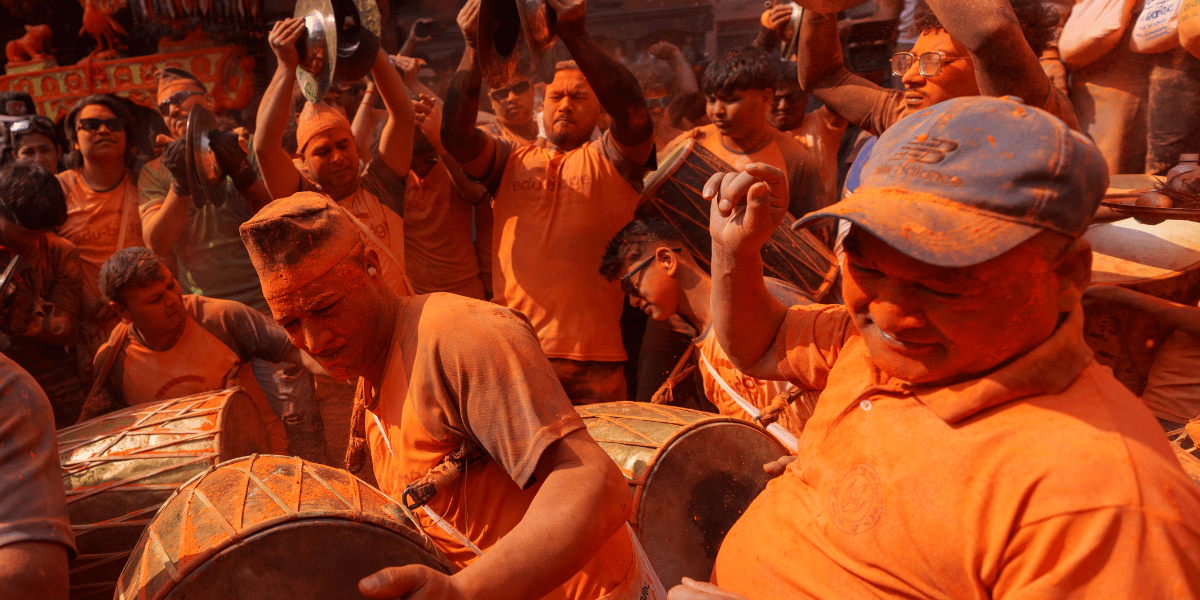
Their khats are decorated with vibrant umbrellas, and once they receive the prasad from Balkumari temple, all khats circumambulate thrice around the temple. During the circumambulation, people throw vermillion in the air, and that is how Sindoor Jatra is celebrated.
On Baisakh 2, people of Nagdesh celebrate Inaya Ganesh Jatra, which is an equally joyful celebration to observe.
Bode
The tongue-piercing festival, Jibro Chhedne Jatra, of Bode is an equally captivating festival that takes place on the 2nd Day of the Nepali New Year (Baisakh 2). However, the preparations for this festival takes place 4 days before the new year.
During the preparation, the members of the guthi worship Neel Barahi and Mahalaxmi. Even in Bode, people erect the lingo on the last day of the year.
To celebrate it, you can observe people feasting and rejoicing to the music. However, the lingo is only let down on Baisakh 5.
There is always someone who is chosen to get his tongue pierced. So the night before the main festival, people set up a bonfire at his locality.
The religious leader meets him to offer him courage for the tongue piercing, and hands him prasad, flowers, and samay baji. After the tongue-piercing candidate eats the food, he fasts the entire day.
On Baisakh 1, you can see the devotees singing hymns while playing their traditional musical instruments early in the morning. This procession is known as Pasta Thayagu. In the evening there is another jatra called Chanhesiya Jatra.
This jatra starts at Lacchitol’s Kumaristhan in Bode. This is when the khat procession of Ganesh, Neel Barahi, and Mahalaxmi takes place around the streets of Bode.
The actual tongue-piercing takes place on Baisakh 2, around 10 AM to 11 AM in the morning. At the courtyard of Ganesh Temple, the leader takes an iron needle that has been soaked in mustard oil for a month, piercing the tongue of the chosen person.
After his tongue is pierced, the person carries a crescent shaped lamp on his shoulders and walks to Bode, taking about 30 minutes to complete the walk. Basically, the jatra ends where it started.
After that, the leader removes the needle from the person’s tongue and applies the soil of Mahalaxmi on his tongue at the spot where it got pierced. The jatra ends and all khat are taken back to their respective temples.
Sanga
Sanga is another ancient Newar settlement, and Nasika Bhagwati is revered there as the guardian deity. Sanga’s celebration of Bisket Jatra is unique in its own way.
The main deities worshipped in Sanga during Bisket Jatra are Bhairav, Kumari, Ganesh, and Nasika Bhagwati. On the eve of Nepali New Year, the idols of Ganesh, Bhairav, and Kumari (the living goddess) are brought out of their original dwellings, and placed in their respective temples.
Then the people worship Nasika Bhagwati. On the same night, the lingo is also erected, similar to Bhaktapur’s Bisket Jatra.
On Baisakh 1, the idols of Ganesh, Bhairav, and Kumari are placed on their respective khats and the khat procession takes place around Sanga. That night, the main priest of the region visits Shwet Bhairav Temple and Nasika Bhagwati Temple to light the lamps.
In the morning of Baisakh 2, the three khats are taken to Dathu Tole’s courtyard. This is when Sanga celebrates their Sindoor Jatra. While Ganesh Khat rests at Dabali, the khats of Bhairav and Kumari are made to collide.
On Baisakh 3, the people worship the idols that they have in their own homes, and on the 4th of Baisakh, the lingo is let down. The people do puja for Ganesh, Bhairav, and Kumari, and send them back to their respective dwellings. And this is how Bisket Jatra is celebrated in Sanga.
Shreekhandapur
Another old Newar settlement, Shreekhandapur’s guardian deity is Shwet Bhairav and he is the main attraction of the Bisket Jatra there. While the lingo is erected in this region as well, one unique thing is that the dual-flag is not hoisted on top of the lingo.
Similarly, the deity is not brought (Dha Kwaha Bijayakigu) out until the lingo is erected. And lastly, both the Hindu priest (Karmacharya) and the Newari Buddhist priest (Bajracharya) are involved in the puja of Shwet Bhairav together.
On the last day of the year, the lingo is erected, and then on Baisakh 1, the Lasakusa (Welcome) Puja of the deities takes place. The main deities worshipped in Shreekhandapur’s Bisket Jatra are Bhairav, Kumar and Ganesh). Note that all three deities are placed on the same khat because all of them were carved on the same metal.
On the second day of the new year, the khat procession takes place, making its way to the regional palace’s courtyard. Once the khat reaches the palace, the sacrifices take place and the people distribute food to the needy in hopes of having their wishes fulfilled.
Once the khat jatra is over, Bhairav is sent back to his original dwelling. On the 3rd and 4th of Baisakh, all the residents of Shreekhandapur make time to visit Bhairav for puja. On 5th Baisakh, after traditional rituals are completed, the people let down the lingo.
Dhulikhel
Bisket Jatra in Dhulikhel, one of the popular hill stations in Nepal, is limited to khat jatras. The lingo is not erected there. The major deities worshipped in Dhulikhel are Bhairav, Kali, Saraswati, Kumar and Ganesh who are always placed on the same khat as they are carved into the same metal.
However, for Mahadev, a separate khat is provided. Bisket Jatra in Dhulikhel starts 4 days before the Nepali New Year, and goes on until the 4th of Baisakh.
For the Dha Kwaha Bijayakigu ceremony, instead of bringing the actual idols, the replicas of the deities made with goja (rice cake) are placed on the khat. As the Kusle community plays the musical instruments, the khat is taken to Kotkhil.
This act is a symbol of invitation to the observers. The last day of the year and the first day of the year is when the major celebrations take place.
On the eve, all the deities are worshipped, placed in their khat, and taken to the Temple of Bhairav in Kotkhil where Navadurga is also present. After the traditional rituals are performed, the sacrifices are made.
On the same night, Samay baji is scattered in the name of the deceased souls as there are three graves near the sacred site. After that, they feast there, which is known as “Kuchhhibhwaya”.
On the first day of the new year, Mahadev and other deities khat jatra starts from Gokhureshwor. As they approach Balkumari, the rituals are performed systematically, and the locals make the khats of Bhairav and Mahadev collide.
Then Bhairav and Mahadev’s Khat Jatra makes its way to Dhulikhel Bazaar, after which they are sent back to their original dwelling, i.e. the head priest’s house.
On the last day of Bisket Jatra, Baisakh 4, both Bhairav and Mahadev are brought down for the last khat jatra. Once again, their khats are collided and that is how the Bisket Jatra in Dhulikhel comes to an end.
Tokha, Kathmandu
Unlike other regions, Tokha’s Bisket Jatra starts on Chaitra Krishna Chaturdashi but the main celebrations start on the eve of the Nepali New Year.
The 3 main aspects of Bisket Jatra in Tokha are: erecting the lingo, khat processions of the local deities, and bathing in the Sapan Tirtha Pond.
On the eve, the guardian deities of the region (Mahadev, Ganesh, Kali, Chandeshwori, and Saraswati) are brought to Chandeshwori Temple. Chandeshwori, Sapan Tirtha Ganesh, and Kali are provided with their own separate khats, and the remaining deities are placed in a dhakki (bamboo basket).
On the 1st of Baisakh, people visit the Sapan Tirtha Pond to bathe there and a fair is organized in the vicinity. Until the 4th of Baisakh, the Khat processions of the deities are carried out.
On the 4th, the deities are bathed in Sapan Tirtha Pond. Then their khat procession circumambulates around the lingo. After this, they are placed back in their original dwellings.
On the morning of the 5th, the lingo is let down, and Tokha’s Biska Jatra comes to an end.
After understanding about Bisket Jatra in different parts of Nepal, we can conclude that this festival is done to honor the guardian deities of the particular regions. The Newar communities do this to ensure that they, their families, and their communities continue to receive divine protection from the Gods and Goddesses.
Tips to Celebrate Bisket Jatra in the Best Way
If you’ve made it till here, then I guess that you are seriously considering attending Bisket Jatra, and this section is going to help you make the best out of this cultural exploration in Bhaktapur.
Best Time of the Day
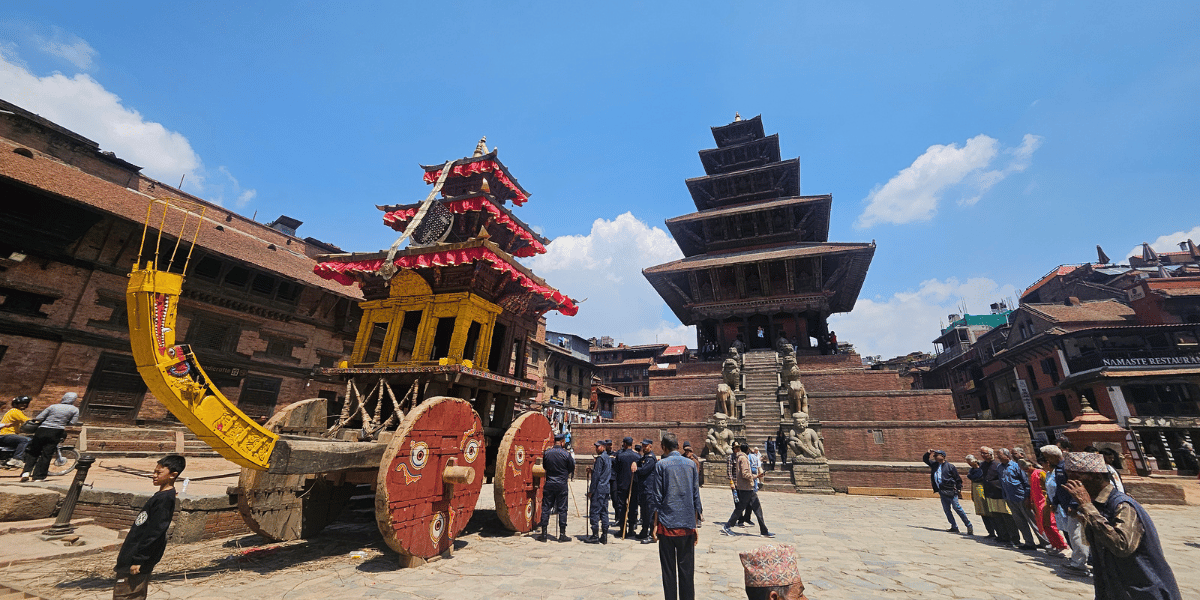
To make the best out of the festival, you need to know which festival takes place at which time. We hope that the sections above have made timings for each of the jatras clearer.
- Bhaktapur is about 15 km away from Kathmandu's city center. Given the traffic, you might want to leave at least an hour before your arrival time.
- If you want to witness the actual tug of war on the first day, then you need to make it to Taumadhi Square before 12:00 PM. This is because the venue hosts thousands of viewers and you do not want to get caught in the crowd.
We reached there at 11 AM and got plenty of time to explore around. By the time the tug of war started, we were back in our seats right above Taumadhi Square. But the crowd is the definition of ‘madness’ in the best way possible, and participating is entirely up to you.
- Thimi is popular for its Sindoor Jatra, while Bode is well-known for the tongue-piercing festival. Unfortunately, both events take place on the same day around the same time.
So pick one of the jatras that you want to attend and reach accordingly. We would suggest that you reach the venue before 10 AM.
- If you want to see the lingo get raised, then that happens in the evening. So make sure to reach Lyasingkhel on time (before 8 PM so that you can watch the puja and rituals).
- If you want to see the lingo let down, then reach Lyasingkhel in the afternoon, around 4 PM. While the timings are uncertain, reaching early is always the best way to engage with the locals and get a deeper understanding about the jatra.
- For the last day of Bisket Jatra, reach Taumadhi Square by 12 PM. As mentioned before, this is the last day when the locals repeat the tug of war. So if you missed it on the first day, then you can make it on the last day!
If you are planning your visit to Nepal around the time Bisket Jatra falls, Altitude Himalaya would be more than happy to host you at the best spot where you can get the best view of the ceremonies!
Best Places to Watch
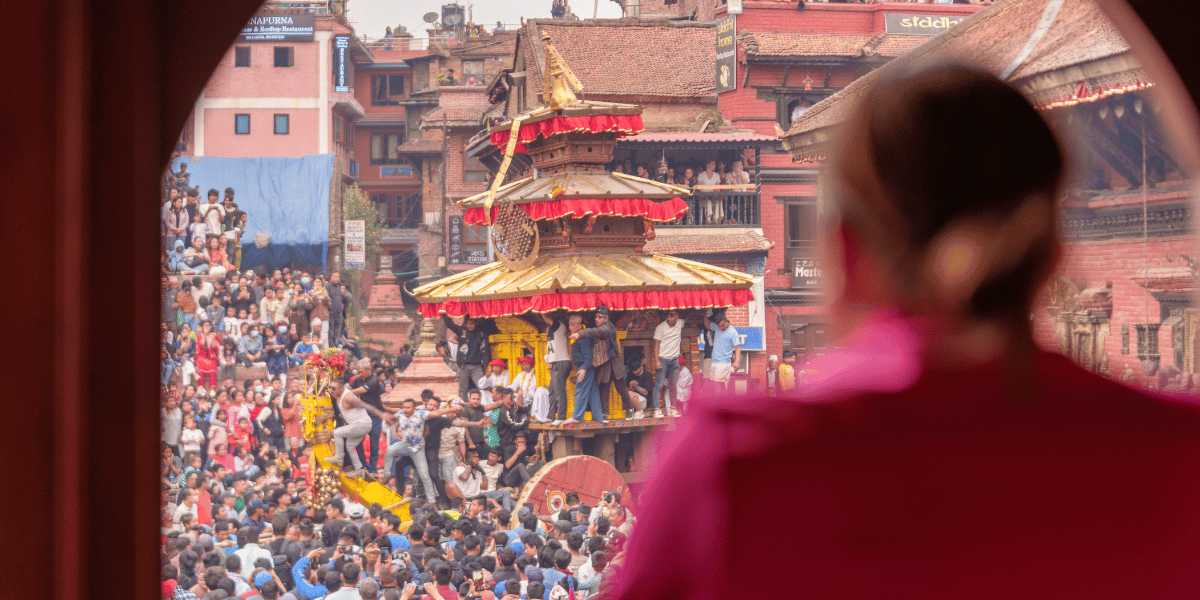
Trust us when we tell you this: there will be thousands of people present to watch Bisket Jatra. So to ensure that you have the best experience with convenience, here are some spots that you can sit at to watch the procession:
- For Day 1, the venue is the Taumadhi Square. The best place to observe the festivities and the processions are the cafes that face the square or the homes of the locals.
We watched the procession from Himalayan Java at Taumadhi Square, giving us the direct view of the Nyatapola Temple and the tug of war. We could also watch the musicians directly from the terrace of the cafe.
- Many say that Sindoor Jatra is quite similar to Holi. However, unlike the colorful palate used in Holi, the Newars only use vermillion during Sindoor Jatra. If you want to play with vermillion and be present at the moment, then you can join the crowd.
But if you want to avoid the crowd and the color, then make sure to book your spot at the cafes in the vicinity that offer you the direct view of Sindoor Jatra.
- The same rule applies for all the jatras. A secluded spot is always suggested to ensure that you feel safe and comfortable.
Note: Since Bisket Jatra is a massive festival for the Newars of Bhaktapur, this festival attracts Nepalese and foreigners to witness the iconic procession. Do not underestimate the crowd. People often book their spots at the cafes about 2 to 3 months prior to the festival.
You can also ask the locals if you can watch the festival from their terraces. However, all the bookings must be done a couple of months before the Jatra begins.
Best Places to Stay
If you want to experience and observe Bisket Jatra at the fullest capacity, then the best option that you have is to stay within Bhaktapur Durbar Square.
While the hotels might not be right next to the venue, they are at a walking distance from Taumadhi Square.
Here are some of the choices for accommodation in Bhaktapur:
|
Hotel
|
Location
|
|
Hotel Heritage Malla
|
Nasamana Square, Bhaktapur Durbar Square
|
|
The Nanee
|
Itachhen, Bhaktapur Durbar Square
|
|
Tulaja Boutique Hotel
|
Yalachhen, Bhaktapur Durbar Square
|
|
Vajra Boutique Hotel
|
Near Uma Maheshwor Temple, Bhaktapur Durbar Square
|
The reason why we are suggesting you to stay in Bhaktapur is because you can witness not only the festival but also the daily lives of the people from a city that was once one of the most economically prosperous kingdoms.
Additionally, you can also watch the rituals of all 9 days, most of which happen early in the morning, or late at night. Late at night, when the crowds return home, make sure to enjoy your quiet stroll on the streets of Bhaktapur Durbar Square.
What to Wear?
Bisket Jatra happens during the spring, and the weather is the most pleasant during this time. So here are some tips regarding clothing:
- Wear comfortable shoes. Bhaktapur Durbar Square is one of the seven UNESCO World Heritage sites in the valley and covers an area of about 6.4 sq. km.
- Although the daytime temperature is quite low, go for clothes made with breathable materials (cotton or linen are quite practical in this case).
- If you are planning on attending Sindoor Jatra at Thimi, then wear clothes that you don’t mind throwing away, because vermillion stains can be tough to wash away.
- Evenings aren’t that cold and the temperature mostly ranges between 10℃ to 15℃. However, you can still carry a light jacket or a shawl just in case you feel cold.
Practical and Etiquette Tips For Visitors
Etiquette is one thing that is appreciated no matter where you travel to. While most of the Nepalese population are used to visitors from all over the world, here are some tips that you can follow during Bisket Jatra:
- Respect the chariot. Rather than a prop for a photoshoot, it is a chariot where the deity dwells. So make sure that you pose appropriately when taking a picture with the chariot.
- Always take off your shoes before entering the temples. Keeping your shoes on is considered extremely disrespectful, and doing so will certainly earn you some glares from the locals.
- Do not eat inside the temples unless you are offered food or prasads.
- If you walk around the streets of Bhaktapur Durbar Square when it’s quieter before the jatra, you will notice food, lamps, vermillion, or rice in the streets or in front of the doorstep. These things are generally placed as offerings, so make sure that you do not step on them.
- If you are taking pictures of someone in particular, especially someone who is carrying out the puja and rituals, make sure that you ask for permission. This is not only about consent, but a lot of times, sacred rituals are not allowed to be filmed.
Photography Tips
Taking pictures and videos in a UNESCO World Heritage Site is one thing, and doing it when you are surrounded by thousands of people constantly moving with the chariot is another thing.
So if you want to capture Bisket Jatra’s essence to its core, here are some photography tips and advices that you need to know:
- Filming inside the temples is usually prohibited, and sometimes, only Hindus are allowed inside the temple. So make sure that you get this cleared before you enter temples in Bhaktapur Durbar Square.
- The drone permit to shoot Bisket Jatra can cost anywhere between $1000 - $1800. Getting a permit can be a hassle because Kathmandu is a relatively small valley and the airport is inside the city. If you want a drone permit, please apply at least 10 days prior to the commencement of the jatra. Please note that the regulations are different for Nepalese citizens.
- The main days of the jatra can last for an entire day, so carry extra batteries and make sure that you have adequate storage for the shoot.
- Sindoor Jatra can be intense with all the vermillion flying around you. If you want to shoot up close, make sure that you have the necessary gears to keep your camera lens safe.
- Sacred rituals and sacrifices are done with strong faith and reverence. So if you are shooting such procedures, make sure to do it respectfully. Do not disturb the activities and avoid using flash.
Jackson Pollock said, “Art is not what you see, but what you make others see.” So if you want to share your shots with us, feel free to tag @altitudehimalaya on Instagram!
Safety Tips
When it comes to safety, Nepal is one of the safest destinations that offer you rich cultural experience with the perfect balance of nature.
It is an ideal destination for solo travellers and backpackers, offering ranges of services, giving options for budget-friendly travellers as well as luxury travellers.
Given the context, safety tips are still needed if you are going to a massive celebration like Bisket Jatra.
- Stay away from the chariot and the ropes during the tug of war. The energy is fierce during the tug of war, and you do not want to get pushed around or stamped by the crowd.
Maintain a safe distance from the chariot. Because, although rare, there have been cases of injuries in the past. For instance, in 2021, 19 people got injured on the first day of Biska Jatra.
- Now that you know that the tug-of-war takes place between two rival neighborhoods of Bhaktapur, Thane and Kwone, it is customary for the residents of these two localities to argue during the tug-of-war.
Although it is a traditional event, every now and then violent clashes occur which the police and security team bring under control. If you witness such conflicts, note that it might not actually be a violent clash. But as a tip, once again, maintain a safe distance.
- If you are trying Newari alcohol for the first time, please drink moderately. Newari drinks are quite overpowering and the drinks are known to have high alcohol to volume.
- Pickpocketting rarely happens during these festivals. But since you can never know where hundreds of visitors come from, it’s always better to stay safe. Carry a secure bag where you have enough pockets to keep your essentials.
- Stay away from the route of the chariot, and if you see a child or an elderly, keep them on the side of your group. If you feel the crowd’s movements escalating, don’t fight against the force. Instead, find an elevated step of the houses nearby or move closer to the walls.
- While Newari people are known for their grand feasts and drinking capacity, if you are drinking, do not take your alcoholic drinks to the open area (Taumadhi Square).
- Bhaktapur is made up of narrow alleys. So it’s always better to reach earlier and figure out the exits in case the crowd gets unbearably large for your liking.
- Generally, policemen are also deployed for the safety of the general public. So in case of emergencies, you can always find a personnel in a uniform to help you out.
When we went there for the Bisket Jatra in 2026, a help desk was set up right next to Bhairavnath Temple at the Taumadhi Square.
Reports on safety have hardly been reported by visitors. But as the saying goes, “Better safe than sorry.”
Booking a Bisket Jatra Festival Tour Package: Is It Possible?
Yes, it’s definitely possible to book Bisket Jatra Festival Tour package from a reliable travel agency in Nepal. In fact, for many visitors, especially those coming from outside Nepal or those with limited time, booking a guided tour for Bisket Jatra is the most sensible choice!
Here is why: the main events of the festival spans nine days across multiple locations (Bhaktapur, Thimi, Bode), involves events at different times of day and night, and many of the most meaningful rituals require context that you simply won't have if you arrive cold.
A knowledgeable local guide or an experienced trekking and cultural tour company can make the difference between watching things happen and actually understanding them.
Well well well, Altitude Himalaya's Kathmandu Photography Tour is an excellent option for those who want a structured Bisket Jatra experience. The tour is thoughtfully designed to bring you to the right places at the right times, with a culturally informed guide who can explain what you are witnessing in real time.
Photography-focused tours are particularly valuable during Bisket Jatra because timing the best light with the best events requires exactly the kind of local knowledge that comes from years of experience.
Now, even if you’re booking a tour from other agencies, look for the following when it comes to Biska Jatra:
- Accommodation inside Bhaktapur (not Kathmandu)
- Coverage of both the main events in Bhaktapur and the Sindoor Jatra in Thimi (or more if possible)
- Evening and night-time access to the lingo events, and a guide with specific knowledge of the Newar cultural tradition rather than a general Kathmandu sightseeing guide.
Also, plan for flexibility! Festival events are tied to ritual timing and astrology, and specific events like the lingo raising can shift by an hour or two depending on the Joshi's (astrologer's) determined auspicious time.
Final Thoughts: Why is Bisket Jatra Worth Experiencing?
We want to be honest with you about something.
Nepal has many festivals. Many of them are spectacular, many are deeply moving, and several are genuinely unique in the world. But Bisket Jatra occupies a different category entirely, and it is not because of scale or spectacle, even though both are present in abundance.
What makes Bisket Jatra extraordinary is that it is a complete, living, self-sustaining civilisation in miniature. The festival runs on a social architecture that has been operating continuously for over centuries!
Every caste has its role. Every neighbourhood has its deity. Every night has its ritual. And none of it exists for your benefit as a visitor. It exists because Bhaktapur is Bhaktapur, and this is what Bhaktapur does.
When you watch the tug-of-war on Day 1, you are watching a theological argument between two halves of a city about whose neighbourhood deserves divine attention first, an argument that has been running since the 12th century at minimum.
When the lingo falls on New Year's evening and the crowd roars, you are standing in a place where the same sound has echoed for generations.
When the two chariots collide at midnight and the red powder fills the air, you are witnessing the same cosmic act that Bhaktapur has enacted every year for as long as anyone can trace.
There is no way to prepare for that fully. And honestly, that is the point!
Come with curiosity and leave the analysis for afterward (just like we did!). Walk the streets before the crowds arrive. And do follow the chariot procession at least once (some time at the end) instead of simply watching it from a rooftop.
Ask questions to the locals: they are proud of their festival and get delighted when visitors show genuine interest!
Well, pat yourself on the back if Bisket Jatra is on your Kathmandu Valley sightseeing itinerary. You've already made a great choice. Now go and let Bhaktapur do the rest!
And if you want to make sure you don't miss any of it, our team at Altitude Himalaya is happy to help you plan the whole thing. We've been doing this long enough to know exactly which moments are worth staying up for!
Hope you enjoyed this article from two of us: our team at Altitude Himalaya is constantly working on to bring you detailed guides on every aspect of Nepal. Stay updated with us for more of such Altitude Chronicles posts and be sure to bookmark this site for future reference!



 Bhishu Acharya