What if you’ve just got a day or two to explore Nepal’s history? And what if we tell you that you get this reflection after passing through the ancient temples, observing the fine wood carvings, crafting pottery of your own, or simply walking through the narrow brick lanes of Bhaktapur?
If you’re already intrigued, then you should absolutely make a plan to visit Bhaktapur! It will surely be one of the best ways to experience the living cultural traditions of Nepal firsthand.
Our Altitude Himalaya Team recently set off for our very own Bhaktapur Cultural Day Tour. We started from the lesser-known Madhyapur Thimi, a traditional town that feels like time has frozen in the days of pottery and ceramics.
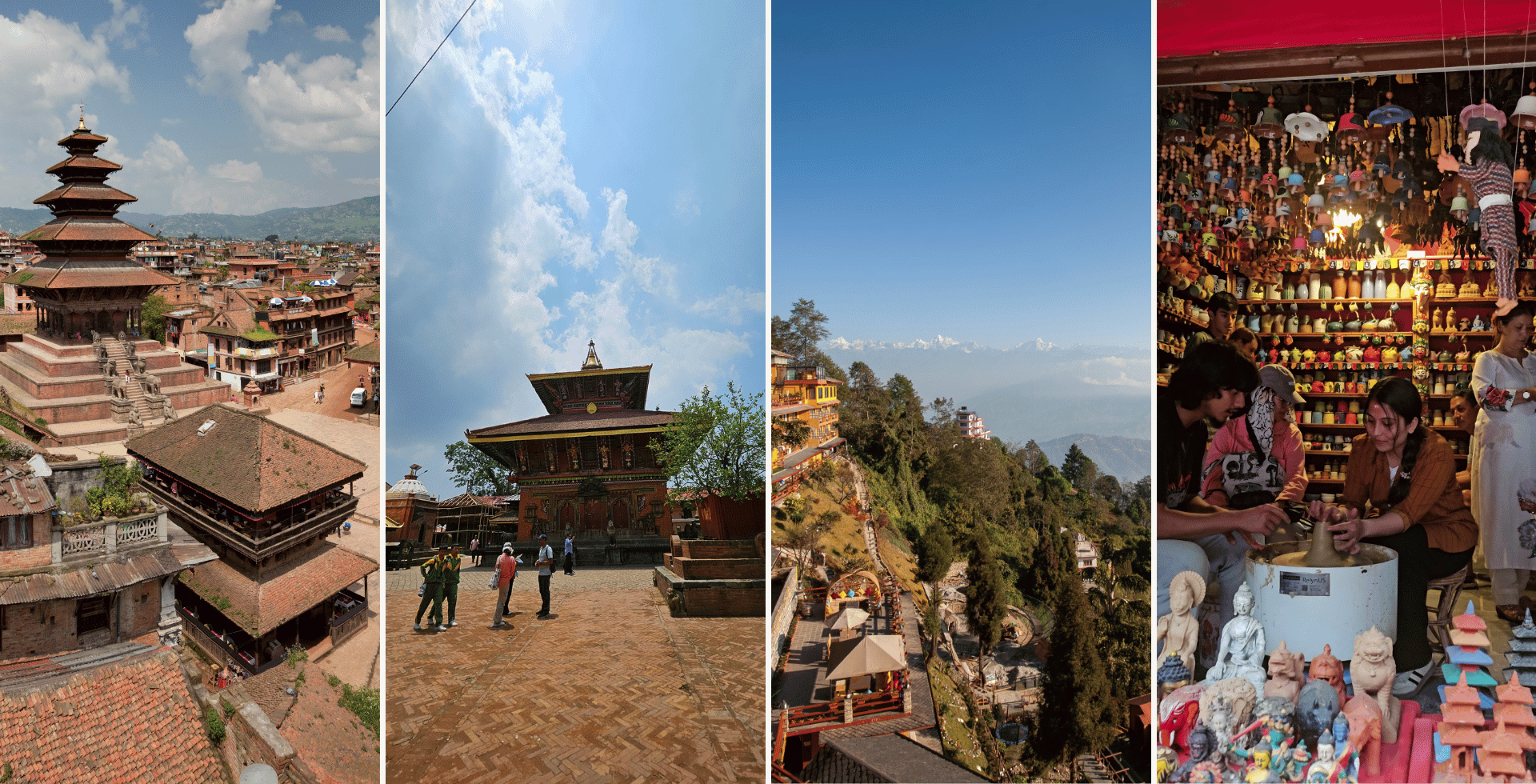
Then, we headed towards the heart of Bhaktapur, Bhaktapur Durbar Square, where we explored the four squares: Durbar Square, Taumadhi Square, Pottery Square, and Dattatreya Square. We visited many historical landmarks, temples, open courtyards, Newari lifestyle, etc., and that’s when we learned that each square carries its own distinct vibe.
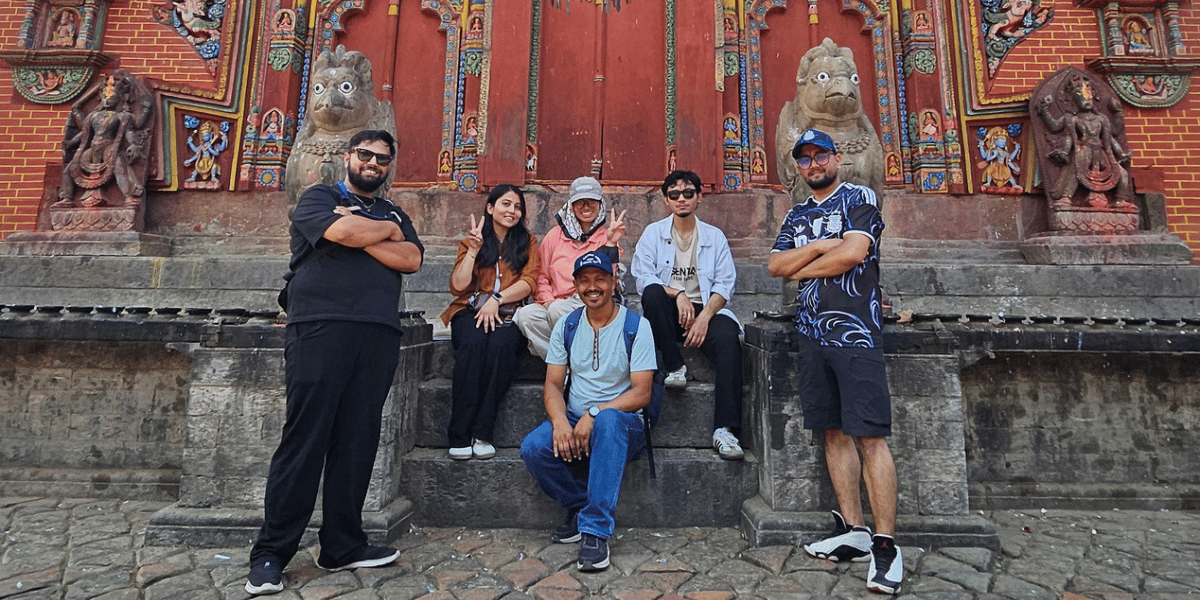
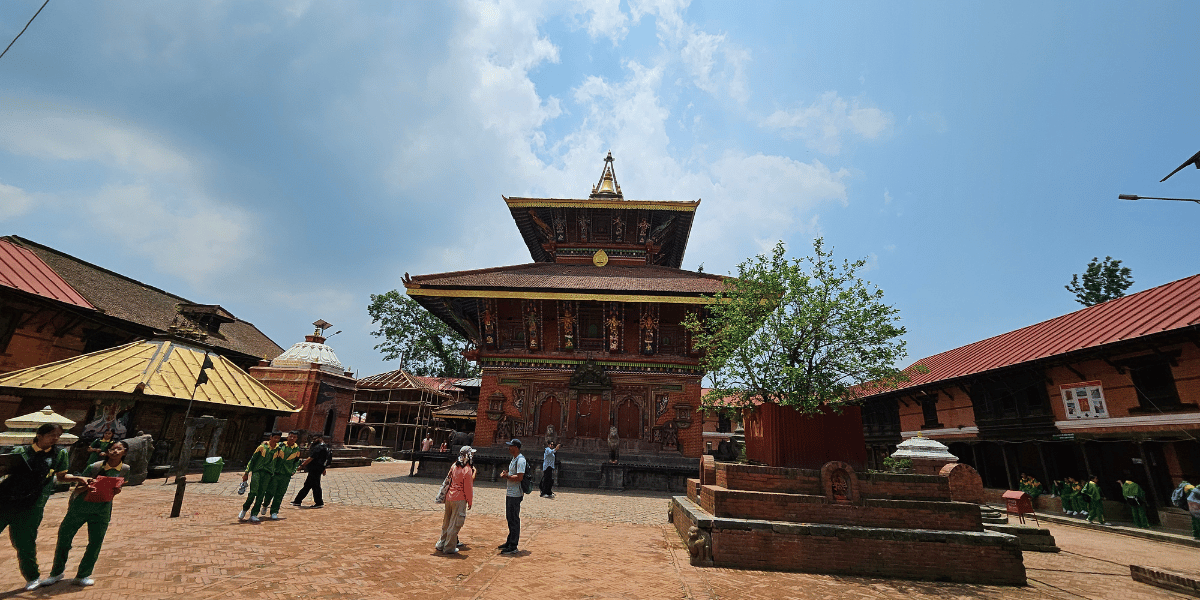
Next up was Changu Narayan Temple, which is one of the oldest and historically important temples in Nepal. We got to admire the peace it holds and observed centuries-old statues, stone inscriptions, and the panoramic view of the Kathmandu Valley.
Beyond that, our plan was also to visit Nagarkot for sunset, but we were so immersed in exploring Bhaktapur and Changu Narayan that we ran short of time. But honestly, if you start early, this is surely possible!
Nagarkot is one of the popular hill stations for its breathtaking Himalayan sunrises and sunsets. You can even choose to spend the night there and wake up for sunrise. And if you plan an extra day, even hiking to Chisapani or other nearby destinations is possible!
Today’s blog won’t be a normal Bhaktapur guide. Instead, we’ll walk you through our own experiences (making it feel like you’re actually roaming the alleys of Bhaktapur) and also share some useful tips so you can plan your Bhaktapur trip accordingly.
In case you loved this blog, know that we already offer a similar Bhaktapur Day Tour package that covers all three destinations (customizable too!).
1-Day Bhaktapur Journey at a Glance
|
Place
|
Route
|
Distance, Duration (approx.)
|
Trip Duration (approx.)
|
Main Attractions
|
|
Madhyapur Thimi
|
Thamel (supposed) > Ratnapark > Jadibuti > Pepsicola > Thimi
[Google Maps]
|
12.5 km, 45 mins drive (depends on traffic)
|
1 hour
|
Thimi Ceramics Factory, Pottery Village, Communal Kilns, Bode and Nagdesh villages, Siddhikali Temple, Nagadesh Buddha Bihar, Balkumari Temple
|
|
Bhaktapur Durbar Square
|
Dattatreya Square
|
Bhaktapur Tourist Bus Park > Thalachhen Tole > Dattatreya Temple
[Google Maps]
|
1 km,
20 to 30 minutes' walk (depends on exploration)
|
1 hr (if you wish to visit the museums), otherwise 30 mins is enough
|
Dattatreya Temple, Bhimshen Temple, Wood Carving Museum, Peacock Window, Brass and Bronze Museum, The Peacock Shop (Paper Factory), Nag Pokhari, Salan Ganesh Temple
|
|
Durbar Square
|
Dattatreya Temple > Golmadhi > Bhaktapur Durbar Square (Layaku)
[Google Maps]
|
1 km, 15 to 20 minutes' walk
|
1 to 2 hours (depends on your visit to Talejusthan and National Art Museum)
|
55 Window Palace, Golden Gate, Taleju Bell, Nrtya Vatsala Temple, National Art Gallery, Siddhi Vatsala Temple, Replica of Chardham (Jaganath, Badrinath, Rameshwor and Kedarnath temples), Yakseshwor Mahadev Temple (Pashupatinath Temple), etc.
|
|
Taumadhi Square
|
Durbar Square > Taumadhi Square
[Google Maps]
|
200 meters, 5 minutes walk
|
2 hours (including lunch break and temple exploration)
|
Nyatapola Temple, Bhairavnath Temple, Betal Temple
|
|
Pottery Square
|
Taumadhi > Bolachhe > Pottery Square
[Google Maps]
|
220 meters, 5 minutes walk
|
30 minutes to 1 hour (including pottery making)
|
Pottery market, Jetha Ganesh Temple, Pottery Training Centers, Thangka Galleries, Traditional Kilns
|
|
Changu Narayan Temple
|
Sano Byasi
(Tourist Bus Park Area) > Mahakali Bus Stop > Byasi - Changunarayan Sadak > Changunarayan Bus Park
[Google Maps]
|
6.5 km drive,
15 to 20 minutes
|
30 minutes to 1 hour (depends on whether you’ll visit the museums)
|
Changunarayan Temple, Chinnamasta Temple, An incomplete elephant statue, Kileshwor Temple, Historical 464 AD Pillar, Garuda Statue, Thangka Painting schools and centres, Changu Museum (private), Living Traditions Museum
|
|
Nagarkot
|
Changunarayan Bus Park > Telkot > Nagarkot Bus Park
[Google Maps]
|
22 km drive, 45 minutes
|
1 - 2 hours (or spend the night for morning sunrise)
|
Nagarkot Geodetic Survey Tower, Sunrise and sunset viewpoints, Buddha Peace Park, Muhan Pokhari, Bojinee Dam, Rani Jhula, and picnic sites
|
Start with a Quiet Morning in Madhyapur Thimi
There are plenty of ways to explore Bhaktapur, and our Altitude Himalaya team has done this more than a few times. As mentioned earlier, in our recent 1-day Bhaktapur trip, we started from Madhyapur Thimi.
The reason was simple: Thimi gives you the quieter, unhurried side of ancient Bhaktapur compared to the other squares that remain crowded throughout the day.
We gathered at our office at Lainchaur and took the inner roads rather than the congested Araniko Highway, following the "puraano bato," the old road to Bhaktapur that predates the former.
Our team of 6 was joined by tour guide Mr. Amir Maharjan, who turned out to be the core of the whole excursion. (We will get into how much a good guide changes your Bhaktapur experience a little later.)
We reached Siddhakali Chowk, the junction where the road splits: one direction towards Thimi, the other towards Bode and Nagadesh. We headed to Thimi that day and held the other two for a separate visit. But honestly, if you can set aside the time, we would strongly recommend not skipping either of them!
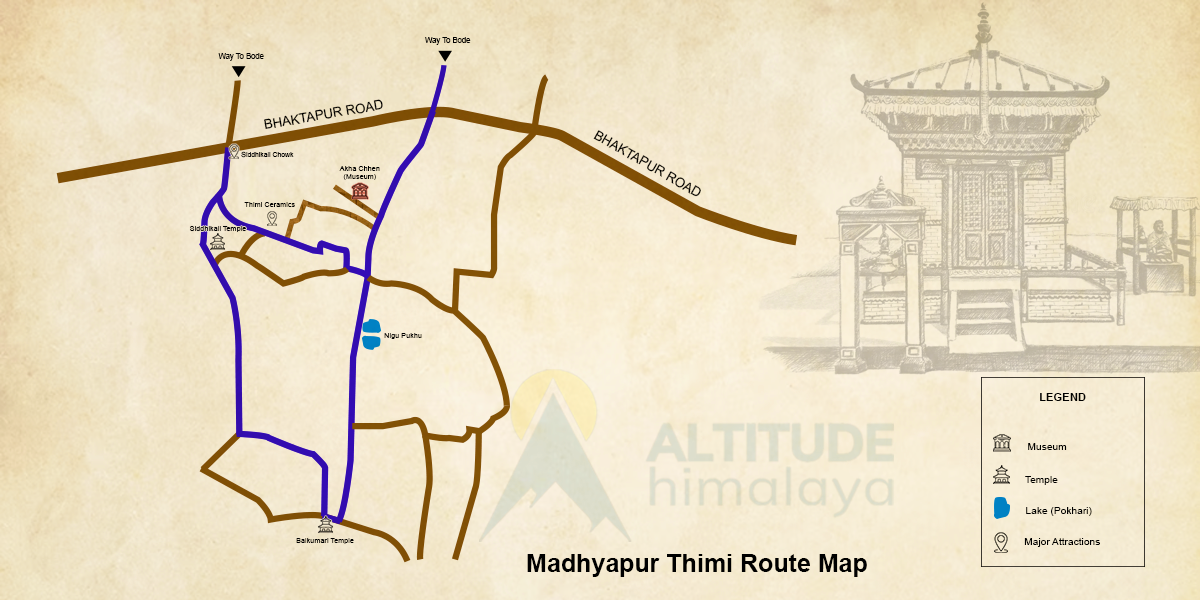
Entering Nepal’s First Ceramics Workshop
First, we crossed small urban farming patches where locals grow green leafy vegetables and alliums (mustard greens, onions, garlic, etc.), and then moved into the older brick alleys.
That is where the sharp, damp earthy smell really sets in, and you start seeing rows of freshly molded clays set out to dry and the beautifully carved wooden windows that line nearly every old building!
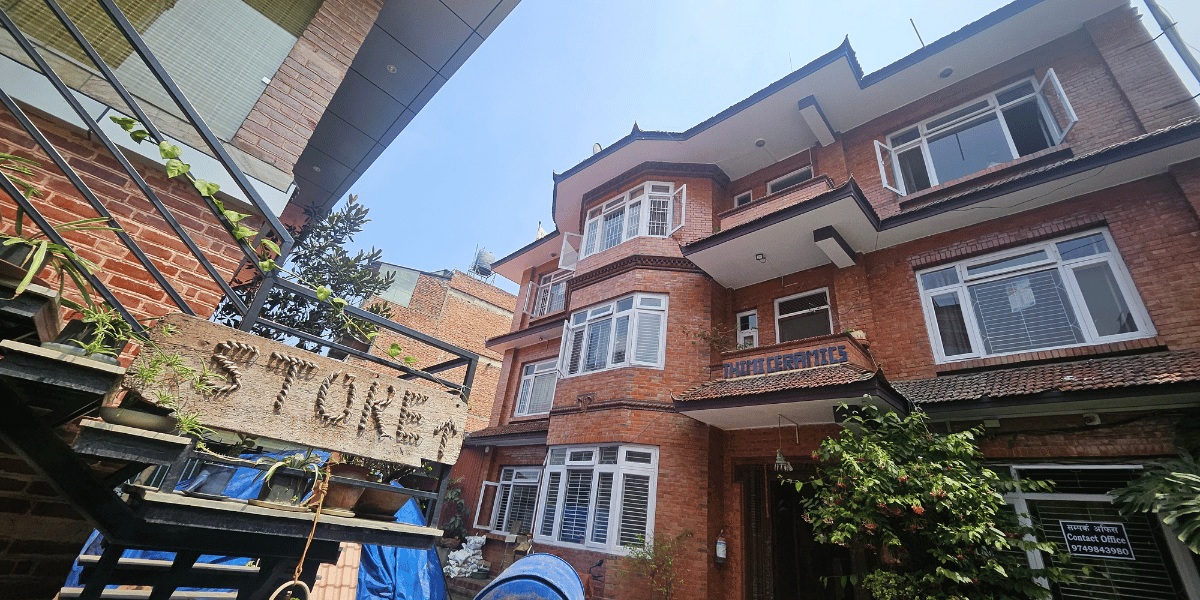
Our first proper stop was Thimi Ceramics. Founded in 1985, it is Nepal's first stoneware ceramics producer. The visit was honestly unplanned, but it ended up being one of the most educational stops of the day.
We got to follow the full process from start to finish: clay centered and shaped on a pottery wheel, pieces left to sun-dry, painted with colored glaze, and then fired in a kiln at 1,250°C!
There’s even a store on the premises that sells everything from dinner sets and coffee mugs to vases, flower pots, and candle holders. If you are looking for a proper souvenir rather than something generic, this is honestly worth browsing before you leave!
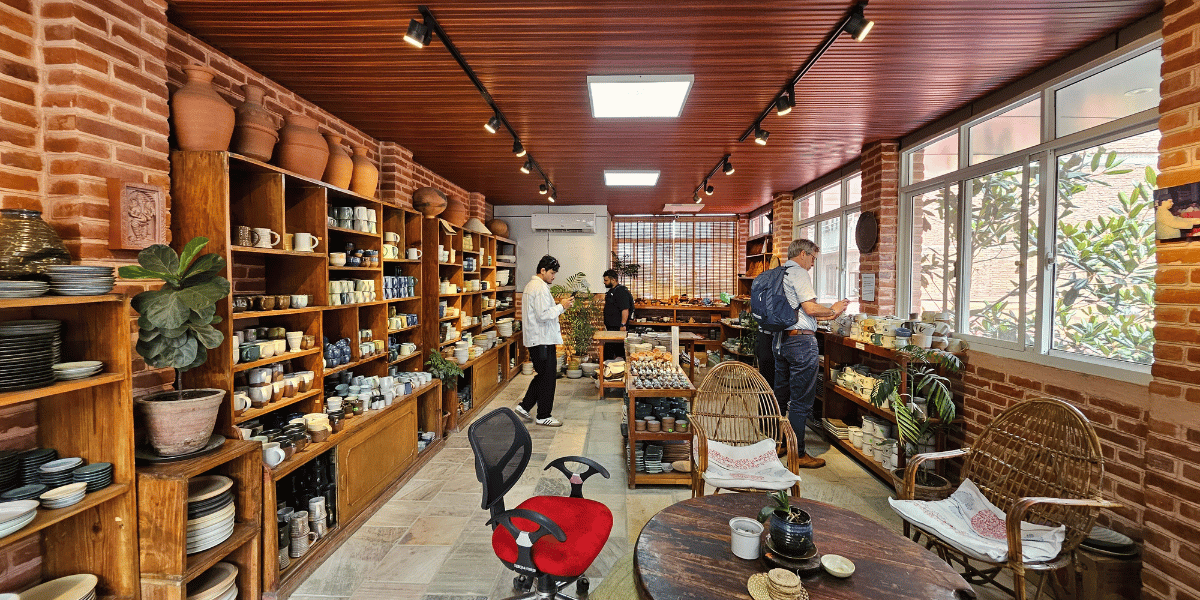
What also surprised us is that Thimi Ceramics ships its products to buyers in Germany, Spain, Italy, Sweden, Denmark, the Netherlands, the US, and the UK.
We later visited the Pottery Square in Bhaktapur and found the two quite comparable as experiences. And there are more such local workshops around the area if you want to explore further.
Exploring the Pottery Village and Daily Life
Many might not know about this: Madhyapur Thimi is actually called the pottery village of Nepal. The Prajapati community here has been making household vessels, clay pots, and ceremonial items for generations, and you can see that in almost every lane you walk through.
After the ceramics factory, we stopped to watch a working kiln where flower pots were being fired.
Walking the brick-paved lanes further, the daily life here quickly becomes the main thing you are paying attention to. Women sit in doorways working the traditional charkha, spinning cotton thread, while rows of freshly shaped pots lie drying in the open sun along every alley you turn into.
Many locals are in traditional Newari dress (haku patasi and daura suruwal). We even picked up a few Newari phrases from our guide along the way, like jojolappa (meaning: hello).
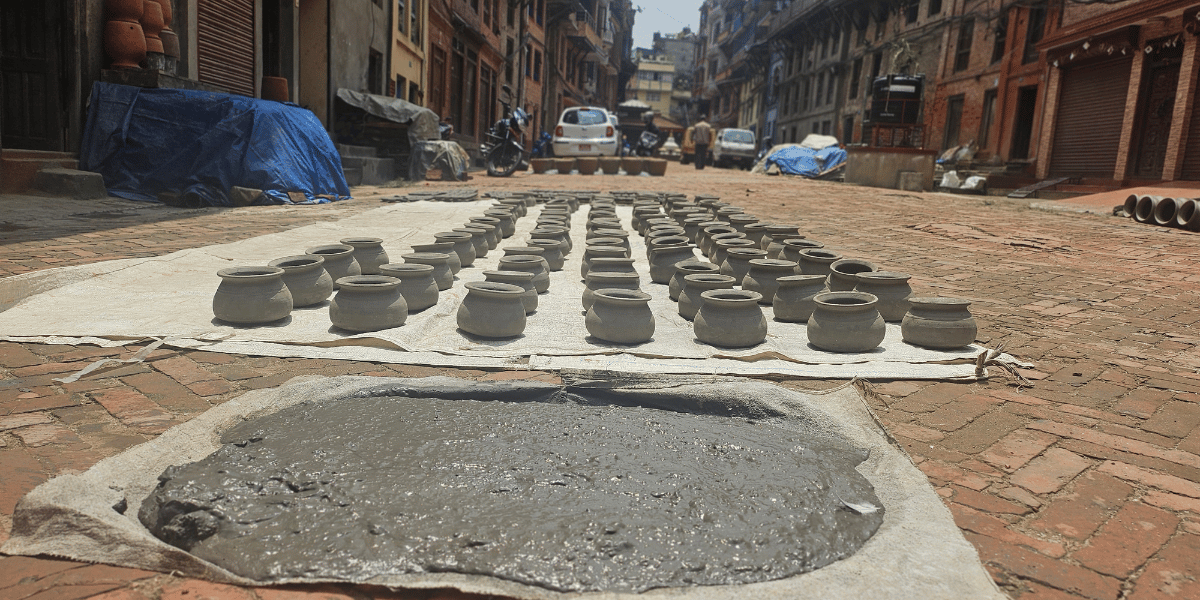
Pottery is not just cultural decoration here either. It has been the economic backbone of this community for generations, and you see that in how seriously the work is taken.
Madhyapur Thimi Beyond Pottery
The town has several ponds dotting the area, the most notable being Nigu Pukhu (aka Dui Pokhari, meaning "twin ponds" in Newari). Built over 300 years ago, the ponds carry deep religious significance for the community, and the carp and rohu fish inside them are considered sacred.
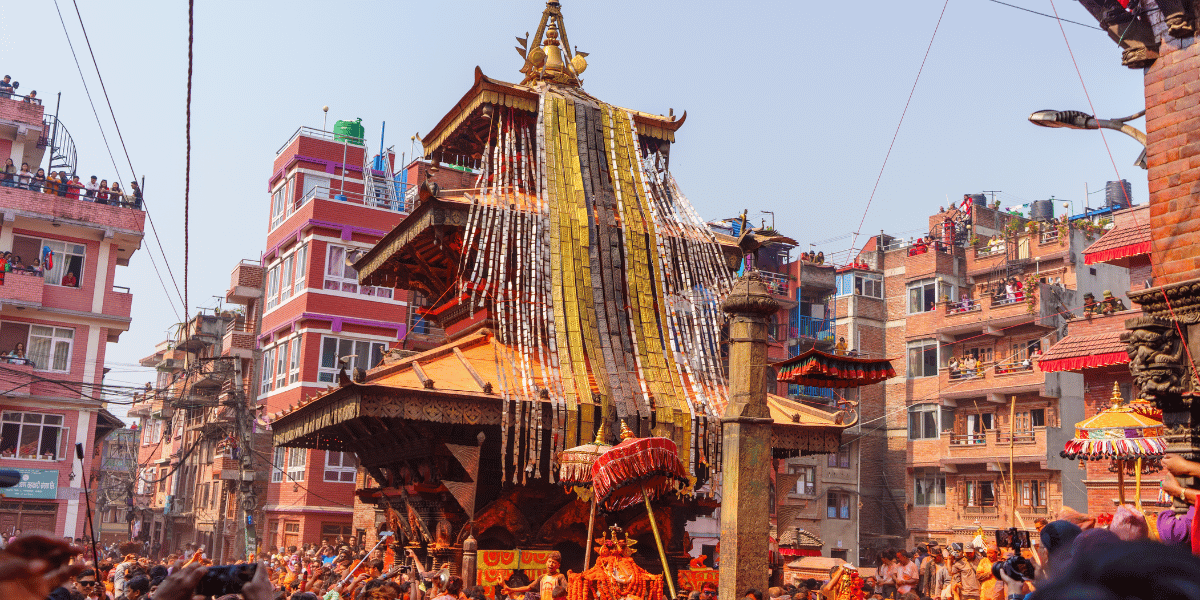
For temples, the ones of highest significance are Balkumari Temple (the primary deity of Thimi) and Prachanda Bhairab. You see, Madhyapur Thimi holds as much religious and cultural depth as any part of Bhaktapur!
And if you have a little extra time, a brief stop at Akha Chen, the local cultural museum, is worth adding to your route.
One thing worth planning around: if your visit falls on Sindoor Jatra (held on Baisakh 2, the day after the Nepali New Year), pottery exploration takes a clear back seat that day.
The whole town turns orange as 32 palanquins of various deities converge at Balkumari Temple, and vermilion powder fills every corner of the air. It is by far the biggest festival Thimi has, and if you are there for it, that becomes the experience rather than the pottery!
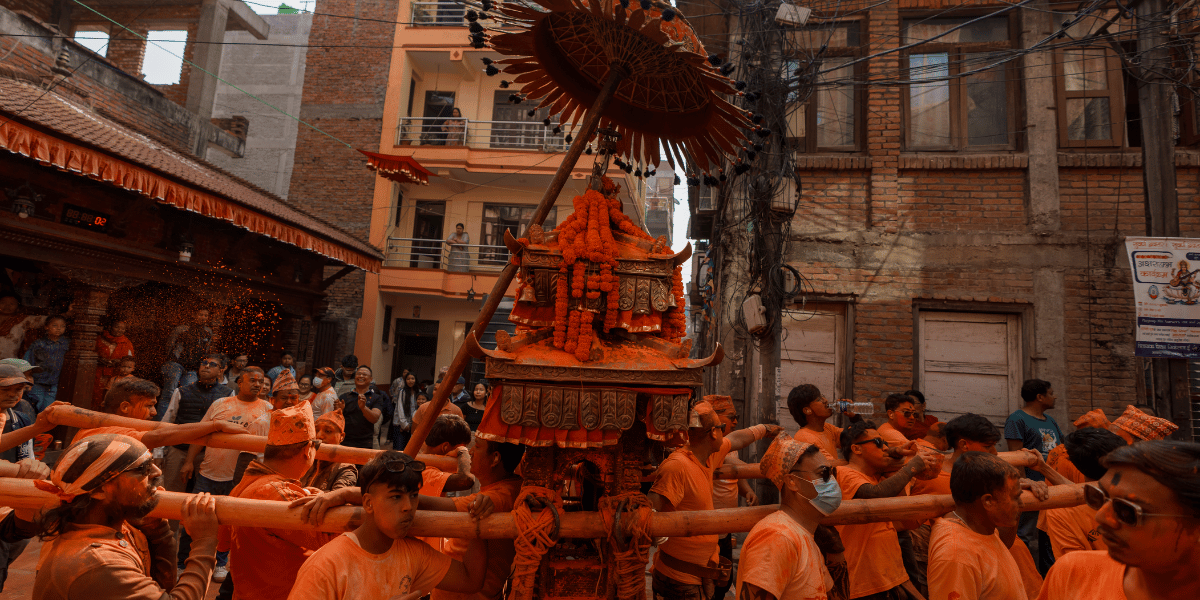
Beyond Sindoor Jatra, Thimi has its own local jatras worth knowing about: the Balkumari Yatra, the Layaku Bhairab dance during Gai Jatra, and its own tongue-piercing festival (called Yenya Punhi Mye Pwa Khanegu Jatra) held after Indra Jatra.
Optional Trips to Bode and Nagadesh
Remember Siddhakali Chowk we mentioned earlier? The other road (that we did not take) leads to Bode and Nagadesh.
Bode is known for its deep-rooted Newari traditions and its Jibro Chhedne Jatra, a part of Biska or Bisket Jatra. During this festival, one member of the Shrestha community spends the entire day with an iron spike through their tongue, circling the village carrying fiery torches.
If you happen to be in the area during Biska Jatra, it is worth planning your visit around this time.
The Kamalpokhari (Lotus Pond) of Bode is another reason to go on any day, calm and genuinely quiet in the middle of everything.
Nagadesh is widely known for ancient temples, traditional agricultural fields, and the Nagadesh Buddhist Bihar for those who want somewhere peaceful to sit for a while.
Fitting all three areas into one day properly is not possible. If you can set aside 2 to 3 days to explore the full stretch of Bhaktapur (historically called Bhadgaon, or Khwopa in Newari), then Bode and Nagadesh should definitely be on your list!
Reaching Bhaktapur Durbar Square
After Thimi Pottery Square, it was time to head to Bhaktapur Durbar Square, continuing on the same Bhaktapur Road. If you're travelling independently, note that this takes less than half an hour by public vehicle or a ride-share car/motorcycle.
Like mentioned earlier, if you would like to book our 1-day Bhaktapur Trip, you're all welcome! We'll include a professional guide in this package who'll take care of your entire logistics.
But that doesn't mean you don't pay attention. Take a peek outside the window, and you're likely to see the open farmland between the settlements and the daily life of the Newars of Khwopa.
Different Walking Routes
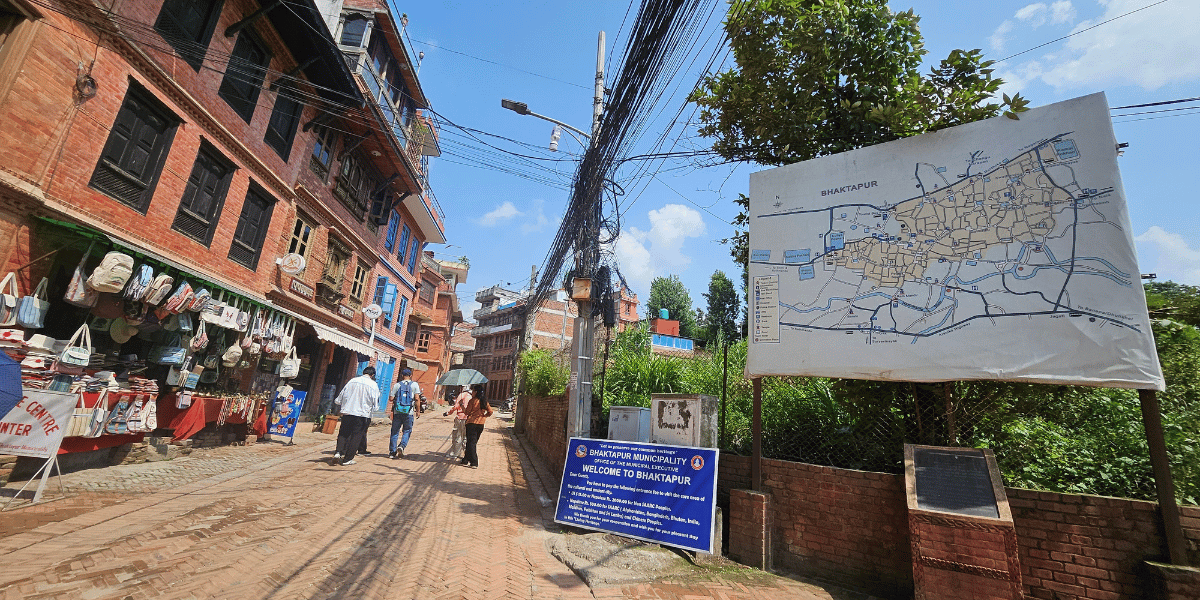
Our guide, Amir, stopped us at Sano Byasi, near the Bhaktapur Municipality office. Unlike other straightforward routes, his plan was to take us through the hidden alleys of Bhaktapur that most tourists have no clue about.
The aim was to reach Dattatreya Square first, as it happens to be the furthest from the other three. Choosing this approach means you get enough time to explore the museums here (unrushed!).
We even passed by multiple temples (primarily of Ganesh), old wells (called Gah), courtyards (called Nani or Nanee), a traditional beaten-rice (chiura) mill, ponds (pukhu), thangka schools, monasteries (vihar), resthouses (pati), stone water spouts (hiti), and other cultural landmarks.
Besides Sano Byasi, there are many different entry spots that take you to different squares:
- Best for Dattatreya Square: While our approach was lengthy, you can start from Mahalaxmi Tourist Counter too, as it's the shortest.
- Best for Durbar and Taumadhi Squares:
- Instead of roaming around the alleys, you can choose the straightforward path from Sano Byasi to reach the Durbar Square area.
- But the most popular spot is the main entrance at Bharbacho, as you get to explore Rani Pokhari and Sidha Pokhari on the way.
- Best for Taumadhi and Pottery Squares: If you’re planning to enter the heritage site from Suryabinayak or nearby places, there are a few tourist checkpoints along the Hanumante River corridor too. A notable one is near Ram Temple. Continuing on this road, you’ll reach Pottery Square. Otherwise, you can choose the Dudhpati-Bharbacho route mentioned above.
Getting Your Entry Tickets
First things first, the ticket you buy covers all of Bhaktapur, not just Durbar Square. That means the same permit covers Taumadhi, Dattatreya, and Pottery squares. Here are the current rates (as of 2026):
|
Nationality
|
Cost
|
|
Non-SAARC Nationals
|
USD 18 (or equivalent NPR based on the exchange rate)
|
|
SAARC Nationals
|
NPR 500
|
|
Chinese Nationals
|
|
Nepalese
|
Free
|
For museum visits, separate fees need to be paid that work for all other museums inside this world heritage site. For instance, if you choose to visit the National Art Museum in Durbar Square, the same ticket works for the Wood Carving Museum as well as the Brass and Bronze Museum.
And yes, don’t forget to collect the informational brochure they give you at the Tourist Information and Service Counter. Even better? Bookmark this article and come back to the section you want to learn more about during the trip itself!
Note: If you're staying in Bhaktapur longer than a day, you can show your passport at the Tourist Information Center, and the same ticket can be extended for up to 7 days at no extra cost.
Temples, Pukhus, Vihars, and Nanis
Before getting further into the walking tour, there is something worth understanding about Bhaktapur as a whole. This is a city where temples, vihars, ponds, nanees, and stone courtyards are present at nearly every turn you take through the alleys.
And between all of these, you will also find ancient ponds with fish and religious significance, stone wells that are still in community use, and carved stones right in front of doorways that most visitors walk right past without knowing what they mean.
Don’t worry! We'll take you through each of them here.
Temples (Mandir)
Known as the “City of Devotees”, Bhaktapur has countless temples, and most are dedicated to either Ganesha or Bhairab, two deities most central to everyday Newa worship:
Ganesha is worshipped here as the lord of beginnings, and the remover of obstacles (Vighnaharta), and no rites or rituals start without first offering to him.
During our trip, Amir made us stop at the first temple we came across, Chhuma Ganesha, and shared an interesting folklore: worshipping here helps you remember things you have forgotten.
Beyond Chhuma Ganesha, you’ll find Ganesha temples scattered at the entrance of every alley! Some other popular ones are:
- Jor Ganesh, Bekhal Tole
- Salaan Ganesh, Dattatreya Square
- Siddhi Ganesh, Luthambu Tole
- Jetha Ganesh, Pottery Square
- Yachhen Ganesh, Thalachhen Tole, etc.
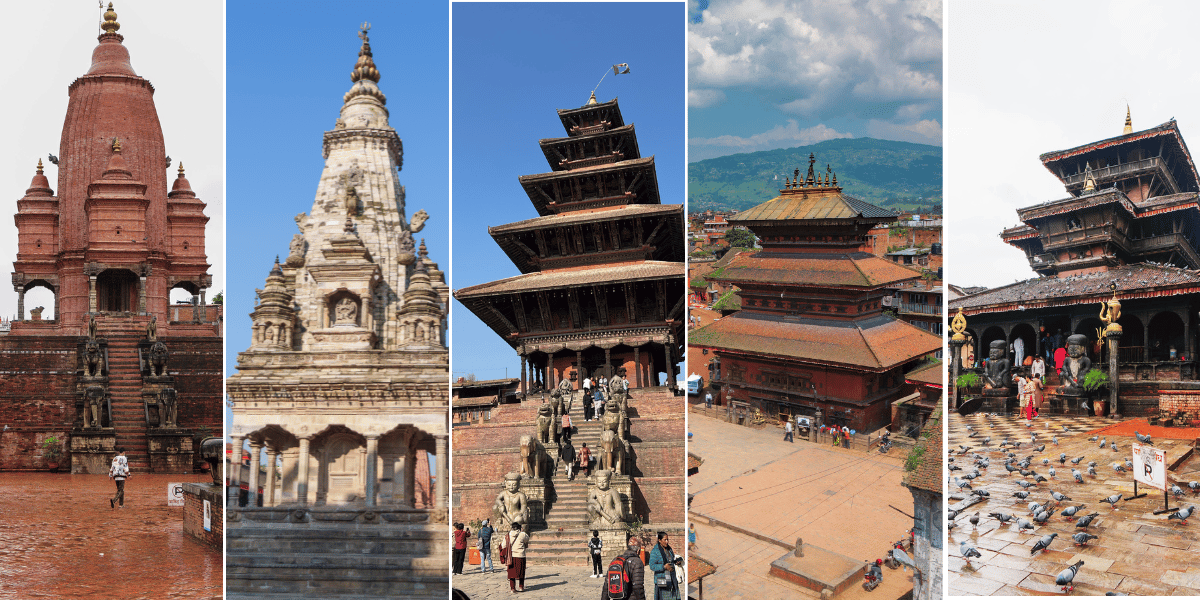
Alongside Ganesha, there are many temples dedicated to Bhairab too, the fierce form of Lord Shiva, who is worshipped as the divine guardian of Bhaktapur.
The main ones worth visiting are:
- Bhairavnath (dedicated to Akash Bhairav / Kasi Biswonath) and Betal (sacred carrier/vahan) temples, Taumadhi Square
- Macho Bhairav Temple, Bhailagaal Tole
- Sweta Bhairav, Bolachhen
Beyond Ganesha and Bhairav, there are many temples devoted to different gods. Here are a few of them:
- Dattatreya Temple, Dattatreya Square: This temple is dedicated to Lord Dattatreya, a single deity who represents the Hindu Trinity (Brahma, Vishnu, and Maheshwor/Shiva).
- Nyatapola Temple, Taumadhi Square: This is a five-tiered pagoda-style temple that’s dedicated to Goddess Siddhi Lakshmi.
- Nrtya Vatsala Temple, Durbar Square: This temple is known for its shikhara-style and also the huge Taleju Bell located right in front of it.
- Siddhi Vatsala Temple, Durbar Square: This is yet another attractive temple with different guards on every other step of the staircase.
- Taleju Bhawani Temple, Durbar Square (restricted): This temple is located inside the Mul Chowk courtyard and thus is currently closed to the general public and foreign tourists.
- Jagannath, Badrinath, Rameshwor, and Kedarnath Temples, Durbar Square: The four temples are widely regarded as a replica of India’s famous Char Dham. They were built by King Bhupatindra Malla for Bhaktapur residents so even those who couldn’t do the original Char Dham Yatra could pay homage here.
- Other notable temples: Til Madhav Narayan Temple, Yaksheshwar Mahadev Temple (Pashupatinath of Bhaktapur), Tileshwor Mahadev Temple, etc.
Monasteries (Vihar and Mahavihar)
Besides temples, we also passed through several vihars (or bihars), which gave us a real sense of the religious coexistence that has always defined this city.
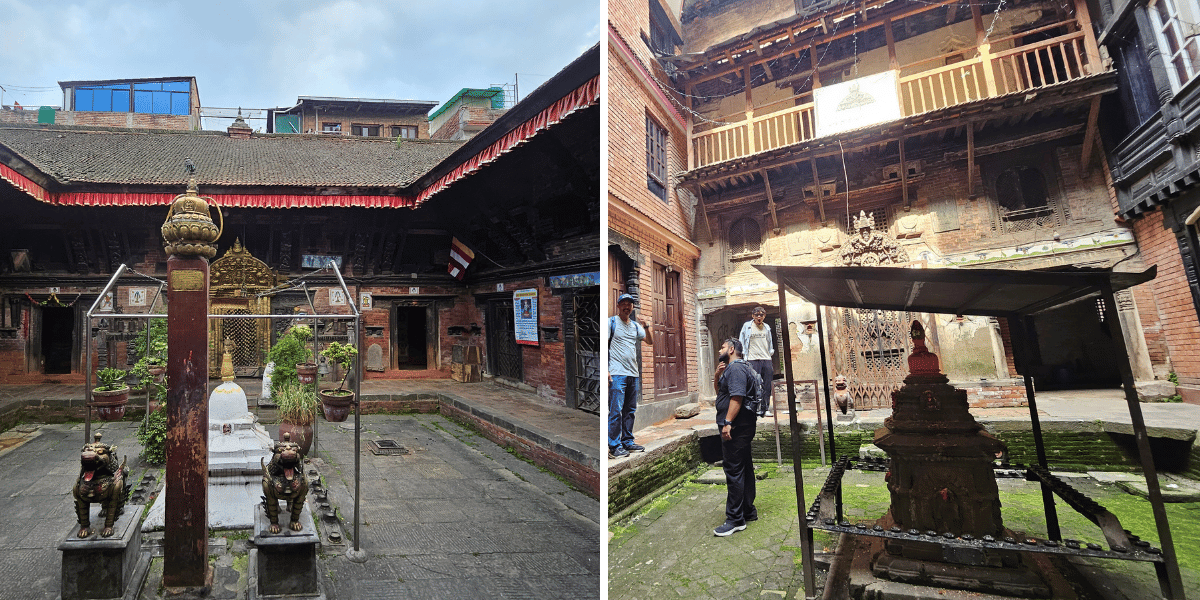
A small thing worth knowing: in ancient Bhaktapur, vihars were divided into two types:
- Bahi (Bahil) functioned more like a monastic school, a place where monks chose to live a simpler, more disciplined life.
- Baha (Bahal) was a community-based monastery where monks continued to maintain the monastery even after marriage.
That distinction still shows in the architecture and feel of these spaces!
A quick fact worth knowing: A vihar is a smaller dwelling place, typically used for housing and meditation by individual monks. On the other hand, a Mahavihar (maha meaning great) is the larger version. That makes it a more formal monastery used for advanced religious education and scriptural studies, usually built around an open courtyard and can house multiple deities.
Bhaktapur has several Mahavihars, among which the most prominent ones are:
- Tum/Tom Bahal (Shree Adipadma Mahavihar): This is believed to be the oldest Mahavihar in Bhaktapur and known locally as Jesthavarna Mahavihar (jestha meaning eldest). It’s located in Tibukche Tol and houses the Shakyamuni Buddha.
- Tadhuchhen Bahal (Chatubrahma Mahavihar): Also called Chatur Varna, it houses two deities: Dipankar and Avalokiteshvara/Lokeshwor. It’s located in one of the popular alleys that connects Durbar Square to Taumadhi Square.
- Inacho Bahal (Indravarna Mahavihar): Located in Inacho Tole, Akshobhya Buddha is the main deity here. However, the bahal also features statues and images of Pragyaparamita, Avalokiteshvara, Avalokiteshvara, and Dipankar Buddha.
- Jhaur Bahi (Mangal Dharmadweep Mahavihar): Located near Golmadhi Temple in Palikhel Tole, this is another monastery whose main deity is Dipankar Buddha.
- Thathu Bahi (Jaykirti Mahavihar): Sits opposite Na Pukhu (Guhya Pokhari) and is believed to date to the Lichhavi era, making it among the oldest in Bhaktapur. The Samyak Daan (a major Buddhist giving festival) is held here. The central deity here is Padmapani Lokeshwora (lotus-holding form of Avalokiteshvara).
- Others: Prashannashil Mahabihar, Manjuvarna Mahavihar, Subarna Mahavihar, Akhandashil Maha Vihar (Akha Baha), etc.
Among the smaller vihars, the ones of particular importance are: Dipankar Vihar (Kwathandau Tole), Muni Vihar (Hanumanghat), Yaan Vihar (Kwathandau Tole), etc.
Here’s an interesting thing we found out during our visit to Dipankar Vihar: the idol had been taken away for repainting. From here, we learned that the idols in vihars undergo sacred restoration, ritual washing, and repainting when a special occasion is coming near or depending on their condition. Note that this doesn’t happen inside the vihar, but rather the deity is temporarily moved out during that period.
Ponds (Pukhu), Stone Water Spouts (Hiti), and Wells (Kuwa)
Ponds in Bhaktapur carry their own history, and visiting them feels quite different from simply looking at an old structure.
One particular pond we visited was Nag Pokhari. The head of the serpent (nag) is visible in the middle of the pond, which feels like it is guarding the area.
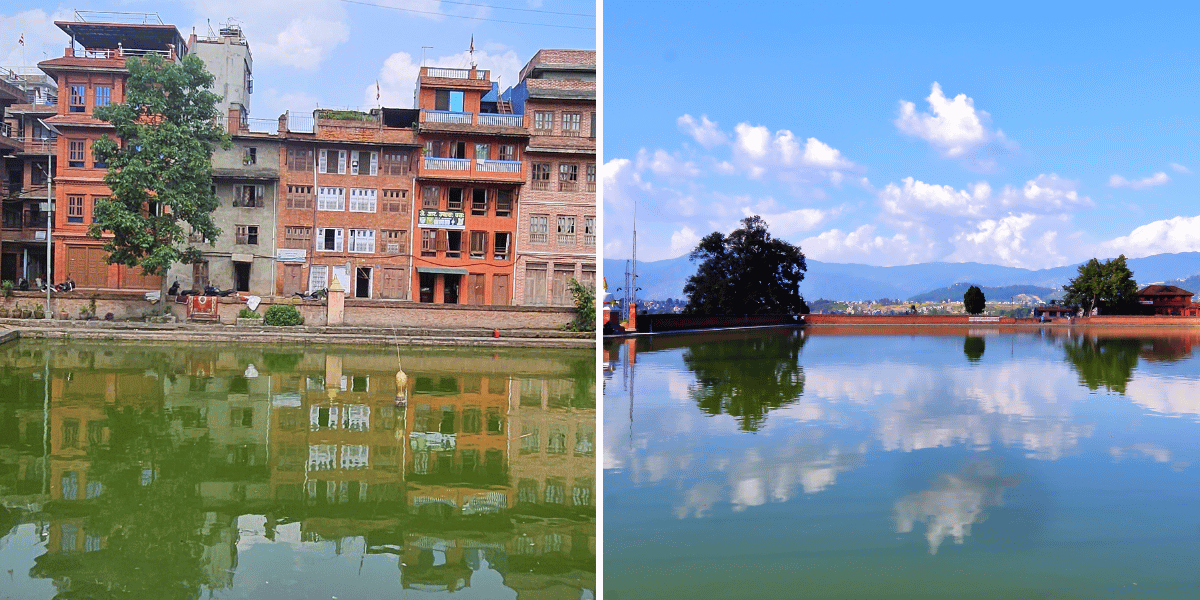
Well, Bhaktapur has several similar small ponds, each serving a religious significance. Here are the main ones:
- Rani Pokhari (Nhu Pukhu)
- Siddha Pokhari (Ta Pukhu)
- Bhajya Pokhari
- Guhya Pokhari (Na Pukhu)
- Bhandar Pokhari (part of Bhandarkhal Chowk where the sacred sword, Khadga of Wankuli Devi, is washed during the Dashain festival)
- Kamal Pokhari (10 minutes' walk from Dattatreya Square)
Also, you’ll encounter traditional stone water spouts (called Hiti or Dhunge Dhara) scattered throughout the town.
Each spout is carved in the shape of a Makara, a mythical crocodile-like creature that is the vehicle of Goddess Ganga. Water flowing through the Makara's mouth is symbolically the Ganga herself flowing into the world.
Sadly, many hitis across Bhaktapur no longer flow today as their source canals are lost to urbanization over time. But a handful are still active and used by locals for washing and ritual purposes.
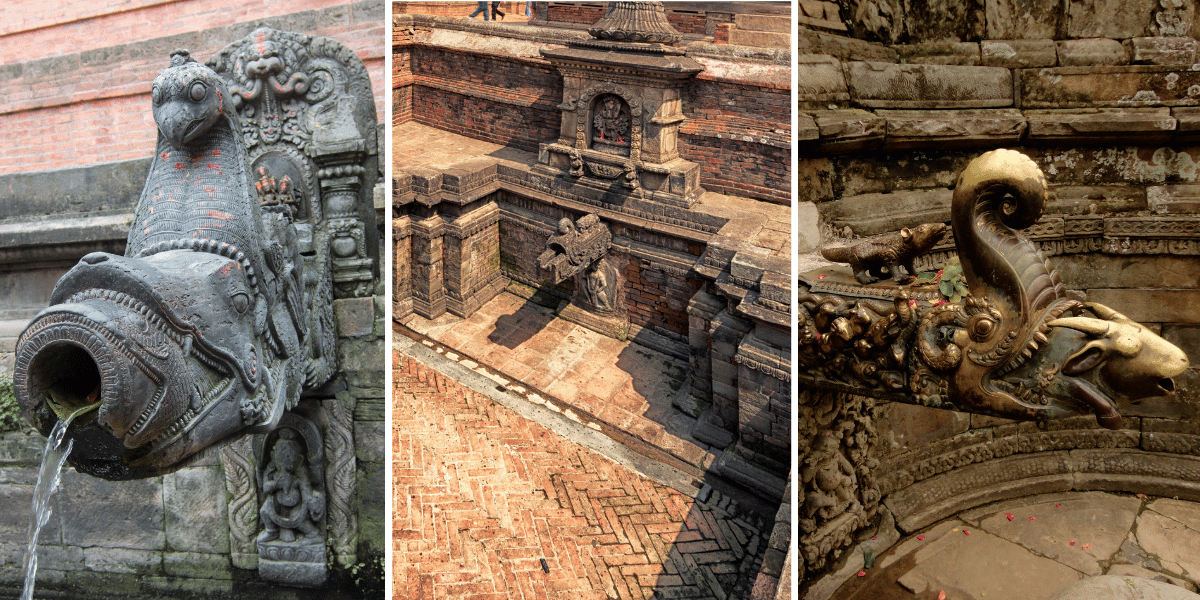
And if you peek at the base of any hiti, you will find one of these two figures:
- Yakshas: Dating to the Lichhavi era (400–750 CE), these represent nature spirits associated with underground water, earth, and fertility. They were placed there as guardians of the water source itself.
- Bhagiratha: The hitis built during the later Malla period (1201–1779 CE) replaced or supplemented the Yakshas with the figure of Bhagirath. His idol there represents the story of how this legendary king-turned-sage performed years of penance to please Lord Shiva and bring Ganga Maa down to earth from heaven.
Above each spout, you will typically find an idol of Narayan or Umamaheshwara, and sometimes, Shiva lingas on either side. So, remember: each hiti is its own small religious complex and is not just a functional tap!
Likewise, you’ll come across some really deep wells (called kuwa) that still function as community water sources in Bhaktapur. They are used and maintained collectively by the people of each tole (neighbourhood).
Nanee or Nani (Courtyards)
Walking deeper into the alleys, Amir introduced us to a word that none of us had come across before: Nanee.
A “Nanee” in Bhaktapur means a small, semi-private courtyard squeezed between clusters of traditional houses, open to the sky, designed so that natural light can reach the interior of homes.
They served as social spaces in the past, where people gathered, children played, and neighbourhood conversations used to happen. Today, many of the Nanee have been privatized and transformed into cafes/restaurants/hotels.
Pikha Lakhu
Going even further into the old residential lanes, something else caught our attention: flat, mound-shaped stones positioned right at the entrance of nearly every Newa household, temple, and vihar, worshipped with vermilion, flowers, and rice grains.
These are called Pikha Lakhu, and they are the symbolic stone of Kshetrapal (often called Kshetrapal Bhairav), the guardian deity of the land and homes. Depending on the household, the stone may be carved with lotus patterns representing Lord Kumar (Kartikeya), Goddess Ganga, or Kshetrapal Bhairav himself.
Amir told us these stones are worshipped at dawn and dusk with flowers, a small light, and uncooked rice grains, with the belief that Kshetrapal keeps family members safe when they leave the house and guards the home when no one is inside.
They also serve a more practical purpose: marking the boundary between the private residence and the public alley.
A Few Other Things You’ll Notice
Walking through Bhaktapur, a few other things will catch your attention that are easy to miss if you are moving quickly:
- Mirrors on temple walls: Those small mirrors hanging on or near the entrance of several temples aren’t kept just for show. There’s a belief among locals that you should see yourself clearly (meaning your true, inner self) before entering the sacred space, because only then can you have a meaningful connection with the deity inside.
- Dabali: The raised stone platforms you'll spot along the wider lanes and squares are called Dabalis, essentially open-air performance stages where dancers perform during Jatras and festivals.
- Pati: The covered rest shelters built into almost every open stretch of lane are called Patis. They were built as pilgrim shelters and still function that way. You will almost always find a few elders sitting here, talking, and observing daily life.
Visit to the Four Squares of Bhaktapur
By the time we reached our first square, Dattatreya Square, it felt like we had already walked a lot. But the real walking tour had only just begun!
Passing through temples and vihars while observing the daily lives of the Bhaktapur Newars, we were finally ready to encounter the main attractions of this UNESCO World Heritage Site.
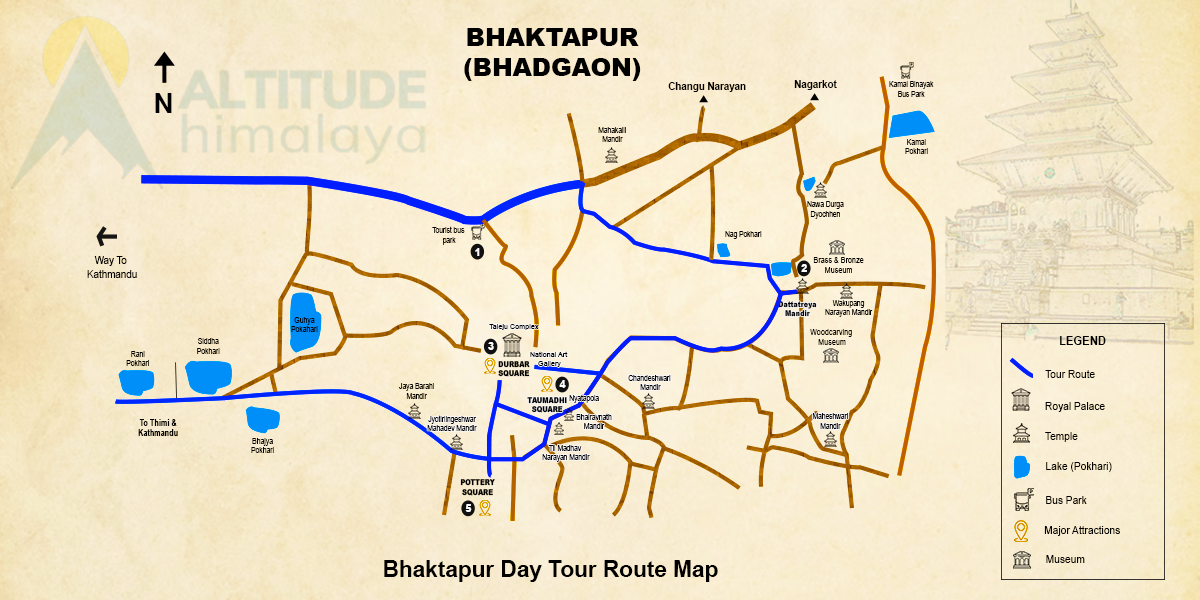
Dattatreya Square: The Oldest of the Four
The Dattatreya or Dattatraya Square in Tachupal Tole takes you to a large courtyard whose centrepiece is the Dattatreya Temple. This is a temple dedicated to Lord Dattatreya, a combined embodiment of Brahma, Vishnu, and Shiva (the Hindu Trinity).
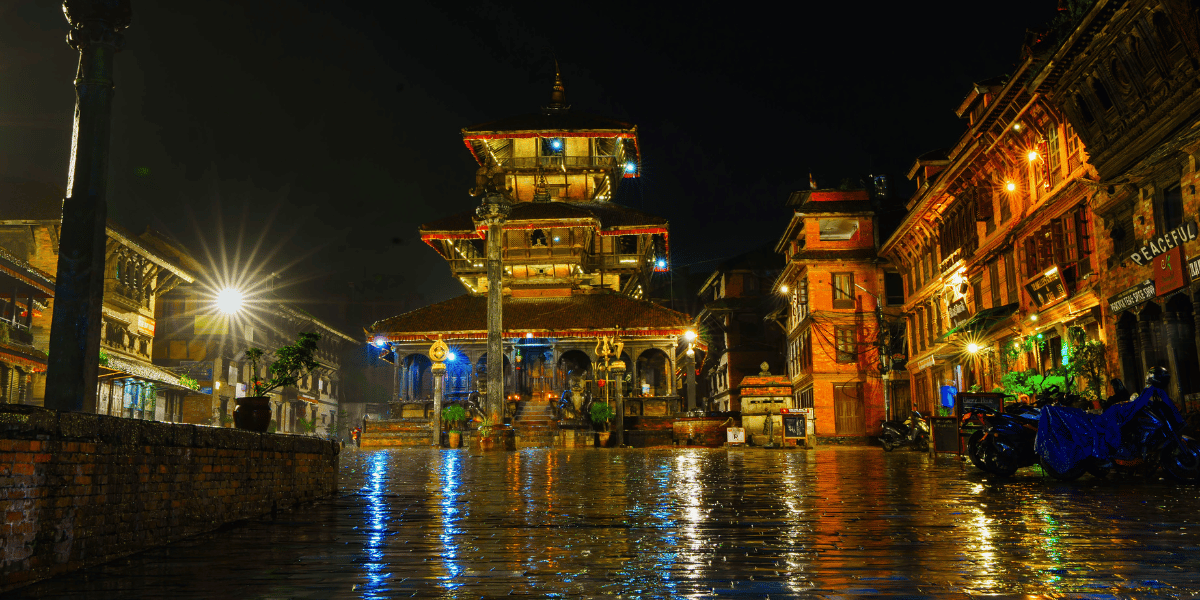
Here are the main attractions of Dattatreya Square:
- Dattatreya Temple: Built in 1427-28 AD by King Yaksha Malla (first as a resthouse/sattal), this three-storey pagoda structure is said to have been carved entirely from the timber of a single tree. The dark-brown woodcarvings cover nearly every surface, including the famous erotic carvings on the struts, a tall Garuda pillar facing the temple entrance, and the gilded torana above the shrine's doorway.
- Statues of Two Wrestlers: The two guarda statues that you see standing at the entrance to the main temple are Jaimal Rathore and Patta Sisodia (Rajput commanders from the 16th century). Legends say they had strength equal to 10 ordinary men and are the same figures you’ll find in Nyatapola Temple too.
- Bhimsen Temple: Opposite Dattatreya Temple, this 17th-century pagoda-style temple is dedicated to Lord Bhimsen, the deity of trade and business among the Newas.
- Wood Carving Museum (Old Pujari Math): It is decorated with some of the most intricate woodcarvings in the valley, housing masterworks like Mara Vijaya, Pooja Devi, Viswarup, and Aaryadevi.
- Brass and Bronze Museum: Located opposite the Wood Carving Museum, this place displays metalware and religious objects from the early 20th century alongside ancient items used by the king and nobility.
- The Peacock Window: This is believed to be a 15th-century woodcarving masterpiece, often called the "Mona Lisa of Nepal," symbolising its divine connection with Lord Kartikeya and associated with good fortune plus prosperity. It’s a part of the Wood Carving Museum but is visible from the main from alley (Jelan Galli) too.
- The Peacock Shop (Paper Factory): Here’s one that many miss - this is a private property of Ram Narayan Prajapati. You can visit right after viewing the Peacock Window and check out both antique woodcarvings and a live demonstration of traditional paper-making.
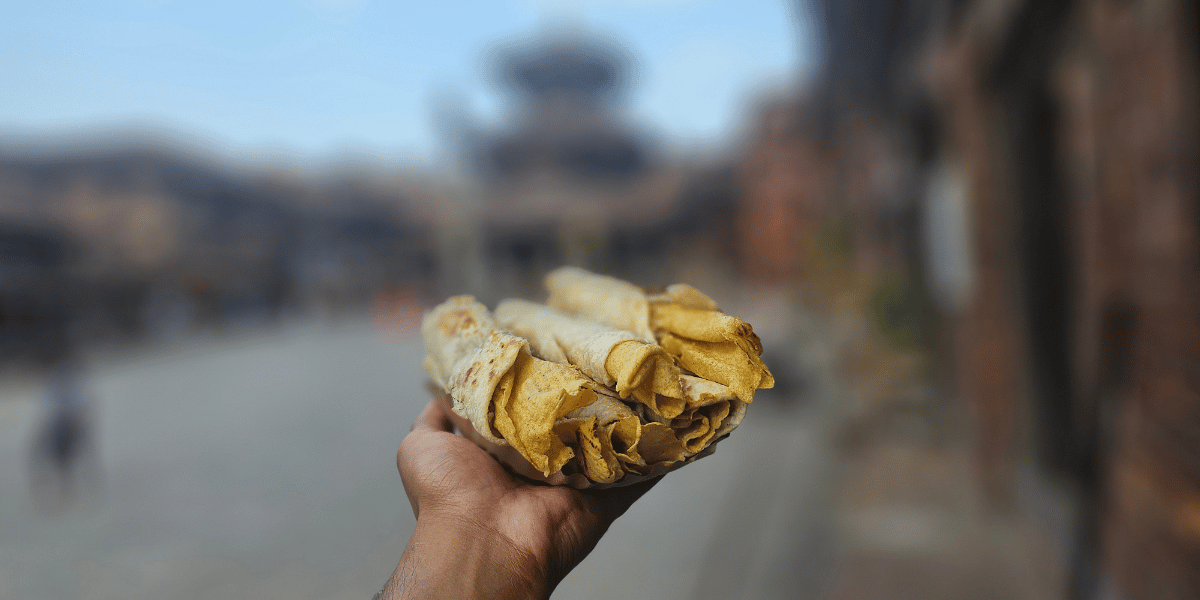
When we arrived at Dattatreya Square, we were very close to noon, and even though a little late, we stopped at a local stall for breakfast. We tried a local delicacy, Haluwa Papad Roll here!
At the temple itself, what stopped us mid-walk were the erotic carvings on the struts. We asked Amir about them and the answer was more philosophical than we expected: the carvings represent the cycle of life and the necessity of reproduction, which is a reminder of worldly duties placed deliberately at the threshold of a sacred space.
It even makes you think about how deliberate ancient builders were, and how much meaning was compressed into the details most visitors walk right past!
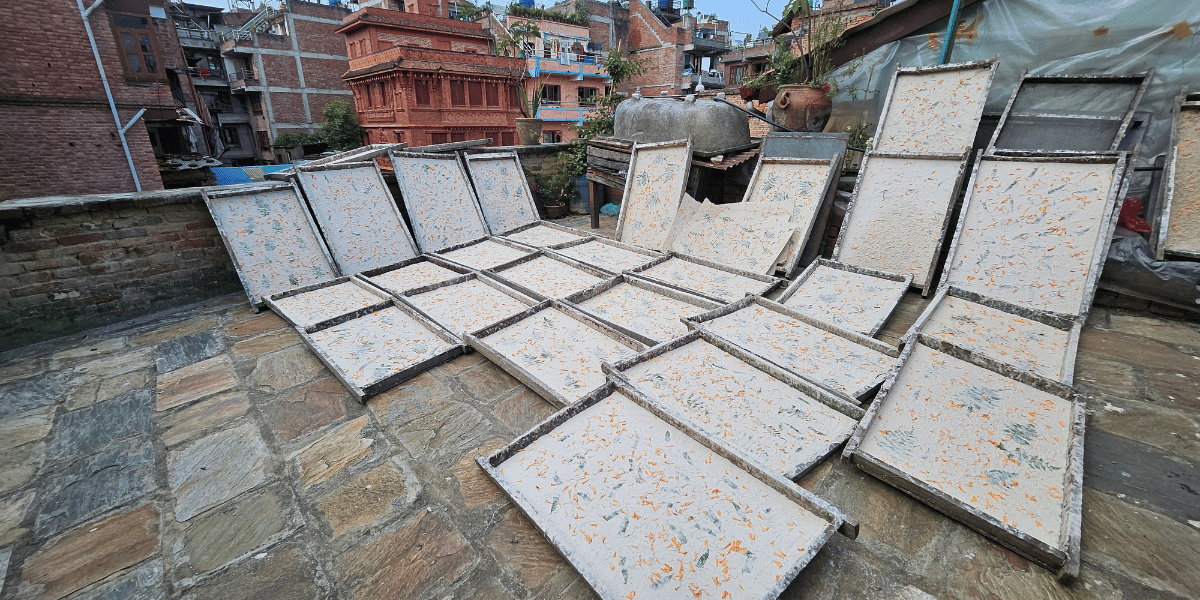
We even entered “The Paper Factory” and skipped the other popular museums that day. But if you have time, both museums are worth the visit.
Walking in, the whole place was dense with books, paper, and Buddhist artwork. There was that particular scent of old books and aged paper that hits you the moment you step inside.
We even got to meet the owner and learn about his passion for the craft. Turns out he had turned his private property into this paper factory, museum, and souvenir shop.
Durbar Square: The Core Area
Following the alleys and pathways from Dattatreya Square (with a stop in Inacho Tole to learn about singing bowls and passing by a local Ayurvedic medicine producer, we entered the main square of Bhaktapur.
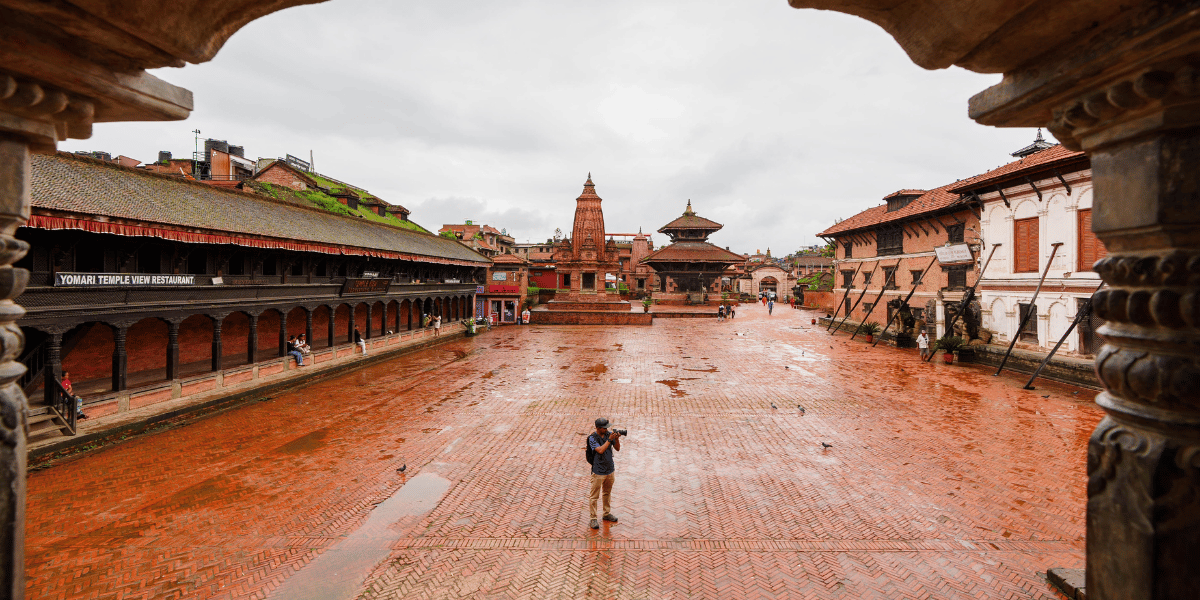
Durbar Square is the core of what remains of the Malla rulers' palace complex from the medieval period. You’re going to find stone art, metalwork, woodcarvings, terracotta, and some of the most impressive art and architecture in the valley that sit within a single compound!
The major attractions here are:
- Golden Gate: The main gold-plated entrance gate, carved with a statue of Taleju Devi (clan deity of the Malla kings). It leads into the Taleju Complex (or Talejusthan).
- Statue of King Bhupatindra Malla: This stands directly in front of the Golden Gate, facing the Taleju Temple with folded hands, as a devotee rather than a king.
- 55 Window Palace: Completed in 1707 AD, this palace is considered a world-class example of woodcarving and Newari architecture.
- National Art Museum: The museum houses Buddhist Paubha (thangka) paintings, palm-leaf manuscripts, stone/metal statues, and more! Specific artefacts include a statue of Tara, murals of Bhairava and Vignantaka, sculptures of Uma-Maheshwori and Seshayi Vishnu, scenes from Krishna Leela, and works depicting the Incarnations of Vishnu, most of the ones dating before the 20th century.
- Nrtya Vatsala Devi Temple: This is a prominent Sikhara-style temple dedicated to Goddess Durga, standing beside the statue of King Bhupatindra Malla.
- Taleju Bell: A large bell placed in front of Nrtya Vatsala Temple, rung to mark morning and evening devotions.
- Replica of Char Dham (Gopinath/Jagannath, Kedarnath, Badrinath, and Rameshwor): Built by King Yaksha Malla for worshippers who can not afford to travel to the original pilgrimage sites in India.
- Sundhara (Golden Fountain): This is a courtyard with a golden fountain from the time of King Jitamitra Malla that still operates to this day. The fountain was actually a part of the former Thantu palace.
Walking through Durbar Square, we learned that at its peak, the palace had 99 courtyards (chowks). But today, fewer than 20 remain!
Most of the surviving ones are inside the Taleju Complex, some accessible to visitors (only Hindus), while others remain restricted.
These are the ones within the main complex: Mul Chowk, Kumari Chowk, Bhairav Chowk, Ji Swon Chowk, Jahran Chowk, Ganesh Chowk, Mahadev Chowk, Dumaju Chowk, Nasala Chowk, Laxmi Bilas Chowk, Tunthi Chowk, Sundari Chowk (with Naag Pukhu), Beko Chowk, Dathu Chowk, Yama Dwar Chowk, Malati Chowk, and Bhandarkhal Chowk.
One statue that is easy to miss if you enter from the western gate, the Statue of Ugrachandi and Bhairav will greet you, which are believed to date to the 17th century.
Taumadhi Square
From Durbar Square, we passed via Chatubrahma Mahavihar before entering the very popular Taumadhi Square, which was the exact spot our Altitude Himalaya team had visited a few months back during the festival of Biska Jatra (read part 1 and part 2 here).
On the way, you’ll also pass by the famous Bara shop, Aamako Bara Pasal. Definitely stop there before moving forward!
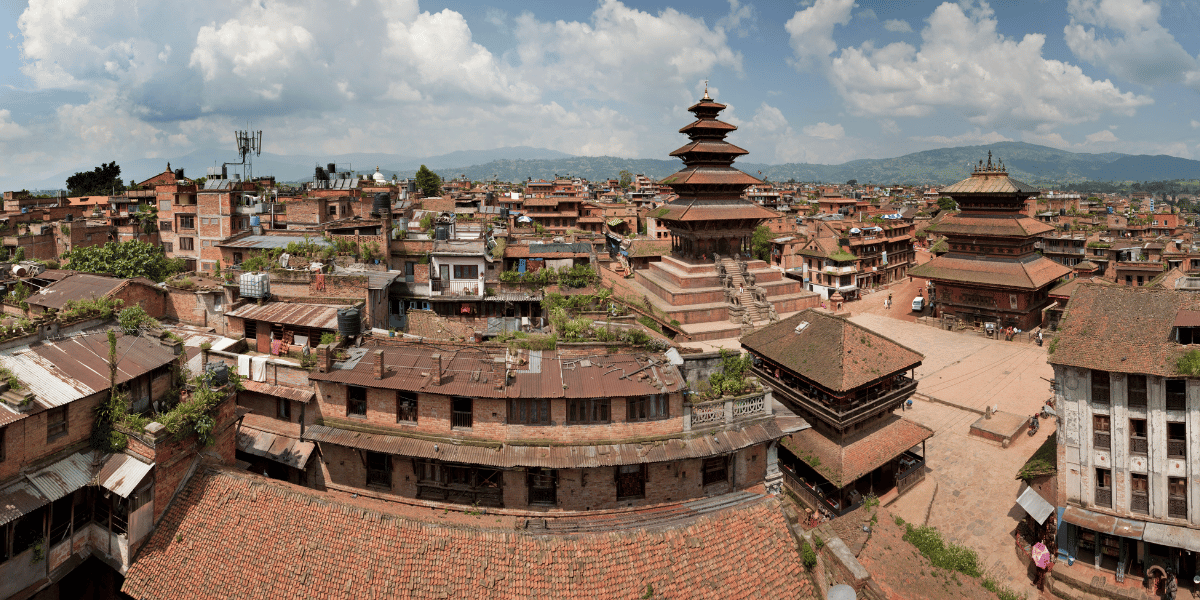
Well, Taumadhi is the best example in Bhaktapur of multi-roofed Newari temple engineering, and it is where the tallest temple of Nepal, Nyatapola Temple, stands.
Here are all the main attractions of this place:
- Nyatapola Temple, Bhairavnath Temple, and Betal Temple; all three are the major temples of this spot (as discussed earlier).
- Golden Spout with Navagraha carvings: The nine planets are depicted around the spout, which is one of the more detailed sites in the area.
- Tilmadhav Narayan Temple: The temple’s name comes from "Til" (sesame seeds) and "Madhav" (Vishnu), tracing back to a merchant in Taumadhi who found his sesame stock never depleted no matter how much he sold, and clearing the pile revealed an idol of Lord Narayan beneath it. Its biggest day of the year is Maghe Sankranti, when the idol is immersed in ghee for four consecutive days, and the ghee collected from the deity's navel on the fourth day is believed to grant wishes, particularly for those struggling with childlessness.
- Tileshwor Mahadev Temple: This is a Shiva temple sitting adjacent to the Tilmadhav Narayan complex, identifiable by the Shiva lingam on a yoni base placed behind a wooden grill at the entrance.
On our trip, Taumadhi Square served as our lunch stop at one of the rooftop restaurants, and we relied mostly on the local Newari delicacies. Honestly, this tole comes with plenty of good food options, from local stalls to proper sit-down cafes.
If you time your day well, this is also a good square to return to at the end of the walk, grab a terracotta bowl of Juju Dhau, and sit with it while observing the crowd.
Our favorite spot? The temple steps at Nyatapola Temple!
Pottery Square
From Taumadhi, we headed to Talako Tole, aka the Pottery Square. This is where Bhaktapur's oldest profession has been kept alive from one generation to the next.
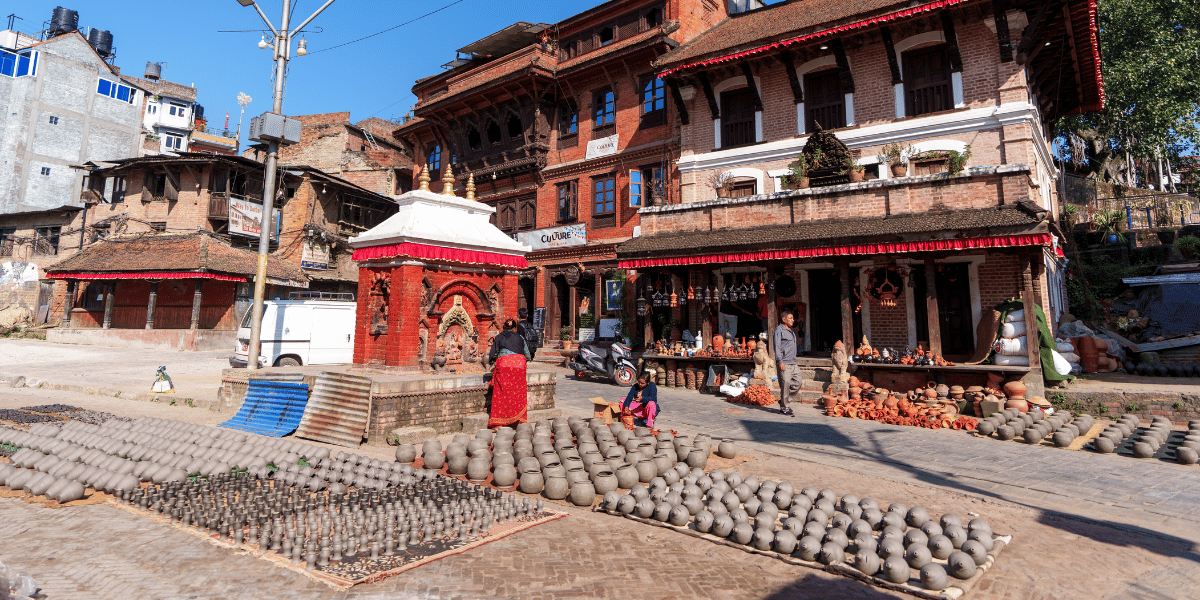
The square is still a working pottery zone, and the live making is the main attraction here, not just the finished products sitting on display.
And guess what? If you want to try pottery-making yourself, you have the option to visit any training centre to make a small terracotta pot yourself (guided by an instructor there).
Also, you have the option to pick from an hourly class to a full month course, with negotiable pricing.
Even one of our team members, Garima, tried pottery making herself! Within just 15 minutes, she was able to craft a small pot and took it home. You can read about her experience in the detailed guide she wrote on Pottery Square here.
Beyond pottery making, here are other attractions of Pottery Square:
- Jetha Ganesh Temple: A two-storey pagoda-style temple built in 1646 AD, where the Prajapatis of Talako Tole worship Jetha Ganesh as Vishwakarma, the deity of skills.
- Gorakhnath Temple: Tucked into the northern part of the square at Taladamfo, this temple is dedicated to Gorakhnath, the sage best known as a disciple of Rato Machhindranath.
- Thangka Painting schools and galleries: Several painting schools and galleries are scattered around the square where you can watch students and artists working on traditional Paubha and Thangka paintings.
Other Squares
Beyond the aforementioned four squares in Bhaktapur Municipality, there are a few more local squares too. These are the notable ones:
- Nasamana Square: Located just northwest of Pottery Square, Nasamana lost most of its temples in the 1934 earthquake and never fully recovered. What remains is a large Garuda statue kneeling in prayer facing the spot where a Vishnu shrine once stood.
- Mathiko Pottery Square (Suryamadhi Tole): This is a second working pottery area, located east of Dattatreya Square. However, it is more like a commercial hub (where you can buy pottery in bulk) and far less touristy than the main Pottery Square of Talako.
- Bhelukhel Square (Yoshin Khel): This square is named after the famous Yoshin Dyo (the tall wooden linga pole) hoisted during Biska Jatra. It’s also home to Bhadrakali Temple. While the place remains calm throughout the year, it becomes one of the most active ritual spaces in the entire town during Bisket Jatra!
Exiting Bhaktapur Durbar Square
Coming back to our story, after Pottery Square, we headed back to Taumadhi Square for a proper lunch break before the second half of the day. We settled into one of the rooftop restaurants and ordered a Samay Baji set alongside the usual Nepali local menu (Mo:Mo: was obviously there too).
If you are doing the Bhaktapur Tour in one day, Taumadhi is genuinely the best place to refuel because your next stop is a separate site altogether.
To exit the heritage area, we took a slightly different route out, passing through Khauma Gate, the main traditional entrance most visitors actually use to enter Durbar Square from the west.
From there, we headed toward Dudhpati, which meant more brick alleys, more nanees, and a few more vihars that you pass without trying.
A practical tip: The ponds, Na Pukhu, Siddha Pokhari, and Bhajya Pokhari, do not require you to walk out to them on foot. Your private vehicle can reach these easily, and that is exactly what we did!
Drive from Bhaktapur to Changu Narayan
The second part of our Bhaktapur cultural tour (to Changu Narayan, about 6.5 km) was now underway via the Bhaktapur-Changunarayan Road.
It was the start of the monsoon (right around Ashar 15, Nepal's National Paddy Day aka Ropain Diwas), when we drove here, and somewhere along the way, we stopped at a stretch of open paddy field where the Jyapus (the traditional farming community of the Newars) were planting rice.
The scene was something like this: people in traditional dress, muddy knees, folk songs, and the kind of collective energy that a paddy field on the first proper monsoon day carries!
We stepped out briefly, had a short conversation with a few of the farmers, and it was one of those moments that reminded us that a Bhaktapur-focused day trip in Nepal goes beyond history. And in no time after that, we were at the Changu Narayan Temple premises.
In case you have an extra day or two, the Bhaktapur to Nagarkot hike via Changu Narayan is a well-regarded option that many trekkers and day-hikers do (can even be extended up to Chisapani). But for most people on a day tour, arriving by two or four-wheeler is the more practical call for sure.
And with that, we had officially entered our third municipality of the day. Madhyapur Thimi in the morning, Bhaktapur Municipality through the afternoon, and now Changunarayan Municipality, home to more than 88,000 people across covering 62.98 sq. km (primarily inhabited by Kshetri and Newa communities).
Exploring Changu Narayan Temple
We parked at the base of the hill, picked up a brochure at the ticket counter, and headed uphill with Amir leading the way as always.
The climb from the parking station to the temple is a 5-to-10 minute walk along a stone pathway lined with handicraft stores, thangka galleries, and local Newari households.
Entry Fee Details
Here are the current entry fees at the ticket counter:
|
Nationality
|
Entry Fee
|
|
Foreign Nationals
|
NPR 400
|
|
SAARC Nationals
|
NPR 300
|
|
Nepalese
|
Free
|
While the temple premises open all week long, tourists can only enter the premises from 7:00 AM to 7:00 PM (during summer months) and 7:00 AM to 5:30 PM (during winter months).
What You’ll Discover Here
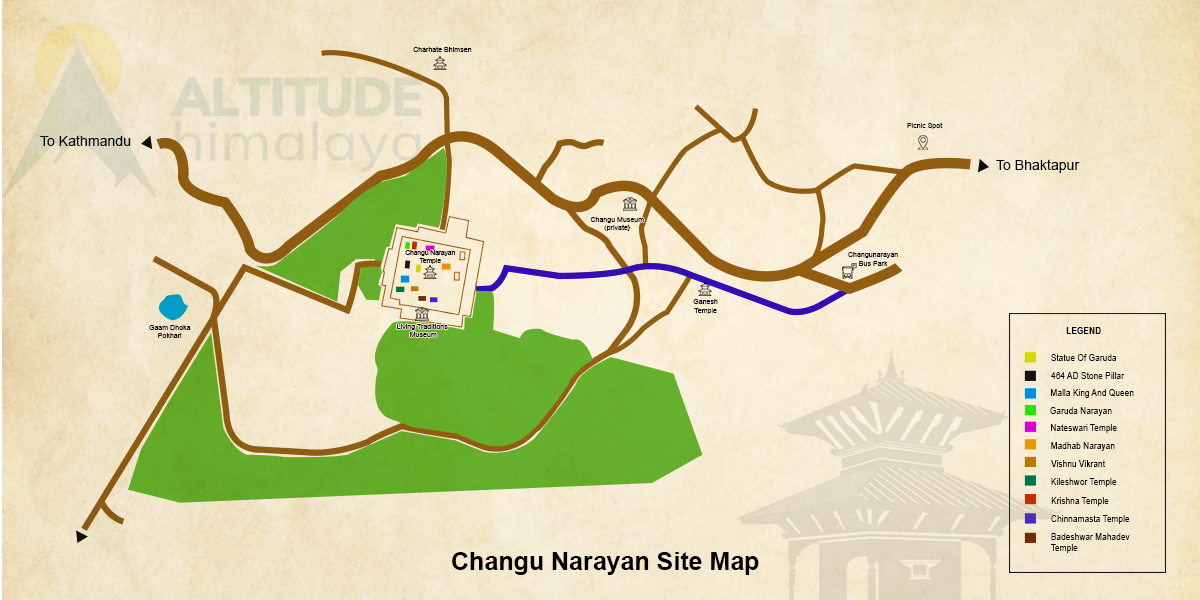
Passing through the main entrance after reaching the hilltop, you step directly into the Changu Narayan Temple complex. The two-storied pagoda temple features a Dhwaja (aka Pata), half rice grain (believed to be from Satya Yuga), along with images of Vishnu incarnations and other idols engraved in its wooden struts.
This was our second UNESCO World Heritage Site of the day, and unlike Bhaktapur's bustling squares, the focus here is almost entirely on the temple compound itself.
Amir took us clockwise through the complex, starting from the left, and here are the main things we watched (and suggest you look out for):
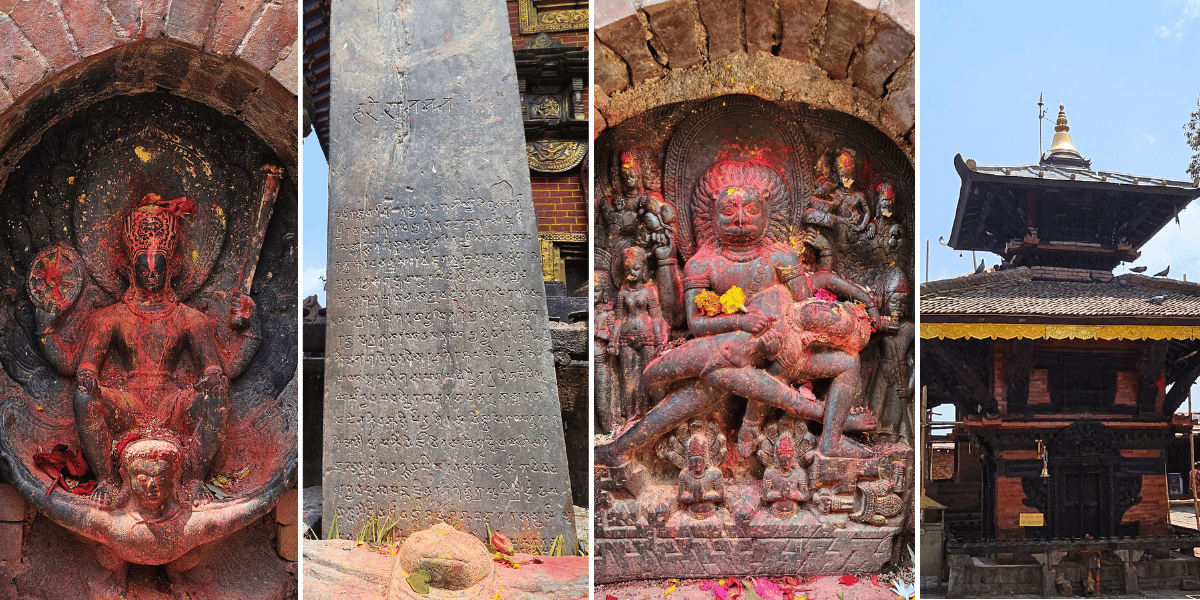
- The Main Temple of Changu Narayan: This is indeed the centrepiece of the complex, which is dedicated to Lord Vishnu. It’s believed to have been founded in the 4th century, with the current structure dating to 1702 after a fire destroyed the original.
- Unfinished Elephant Statue: A legend says the sculptors had to stop work mid-carving because the elephant began to move on its own the moment it started taking its final shape and later started to bleed. There’s also a belief that when you lean your back directly against this statue, you’ll find relief in case you’re having a backache.
- Chhinnamasta Temple: A small temple dedicated to Chhinnamasta, one of the ten Mahavidyas. You’ll also encounter a wall featuring a painting of Mata Chinnamasta in the act of beheading herself and feeding it to her own head, along with her devotees (Dakini and Varnini).
- 464 AD Stone Pillar (Shilapatra): This inscription was erected by Lichhavi King Mandeva I to record his military victories and his devotion to Vishnu. A translated version sits beside it, which makes it much easier to understand what you are looking at.
- Human-faced Garuda Statue: The Garuda at Changu Narayan has a full human face, and it bears the likeness of King Mandeva himself.
- Kileshwor Temple: A small two-storey structure within the compound and one of the oldest on the site dedicated to Lord Shiva. Other Shiva temples here are Badeshwar Mahadev, Somalingeshwor, and Natyeshwor.
- Statue of King Bhupalendra Malla and Queen: Placed facing the main temple with folded hands, in the posture of devotees rather than rulers.
- Other Vishnu Idols: Vaikuntha Vishnu (16th century), Vishworup (7th century), Vishnu Vikrant (7th century), Narasimha (7th century), Chanda Narayan (7th century), Sridhar Vishnu (9th century)
- A few more monuments in the vicinity: Ganesha shrines, Kanti Bhairav Shrine, Madhab Narayan Temple, Krishna Temple, Ashta Matrika Shrines, Bhimsen Pati, etc.
Beyond the Main Temple
Overall, it takes less than 30 minutes to explore the Changunarayan area. After that, we encourage you to visit these museums nearby:
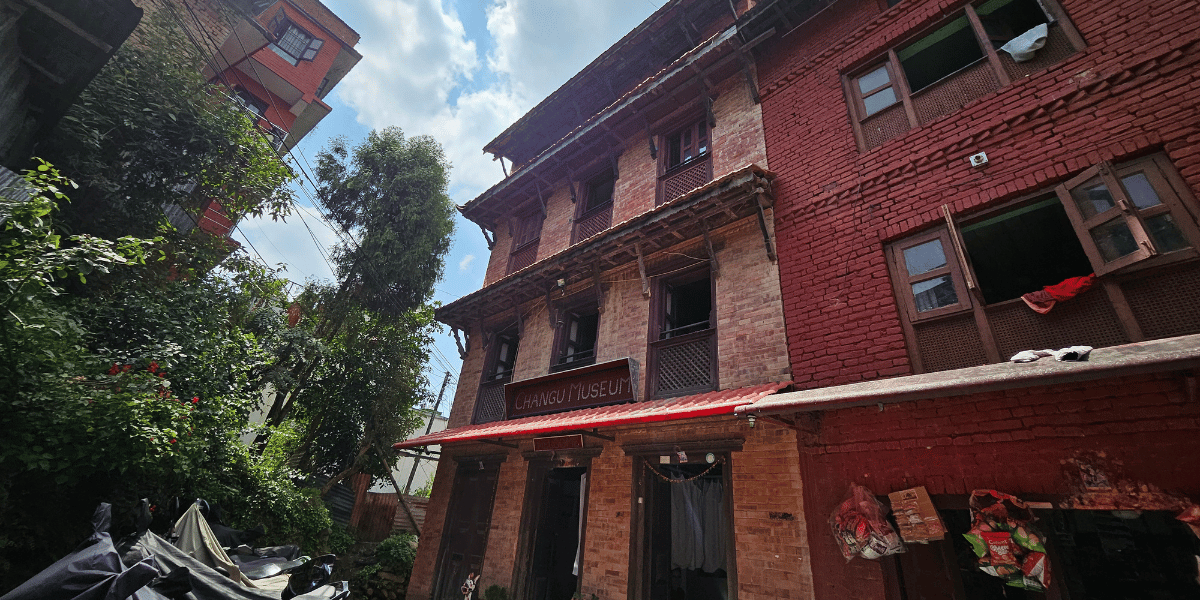
- Changu Museum: This is the one that even we visited. Located on the way to the temple (in Changu-Magam Tol Marga), the museum features traditional Newar household objects, weapons, military objects, coin and note collection, traditional musical instruments, stories of Mandeva (and other kings), and everything else that takes you back in time!
- Living Traditions Museum: Located south of the main temple complex, this is a museum founded by Judith Conant Chase that showcases Nepal’s traditional arts and crafts. It displays Judith’s collection of handicrafts she collected when travelling across Nepal.
In case you have time, see if you can travel to these landmarks, which are also part of the Changunarayan Municipality: Shree Pancha Mahalaxmi Temple, Charhate Bhimsen (about 10 minutes south of the main temple), Changunarayan Park, etc.
Note: These entrance fees to these museums are separate from each other and also not included within the Changu Narayan Temple entry ticket.
A Few More Destinations to Add on This Trip
Bhaktapur is not only about Durbar Square and Juju Dhau. Several worthwhile stops sit within easy reach of Changu Narayan, and depending on how much time you have, you can include one or two in the same day!
Nagarkot
About 10 km from Changu Narayan Temple (approx. 30-40 minutes by road), Nagarkot is the best natural extension of this trip if you want to end the day with a Himalayan sunset!
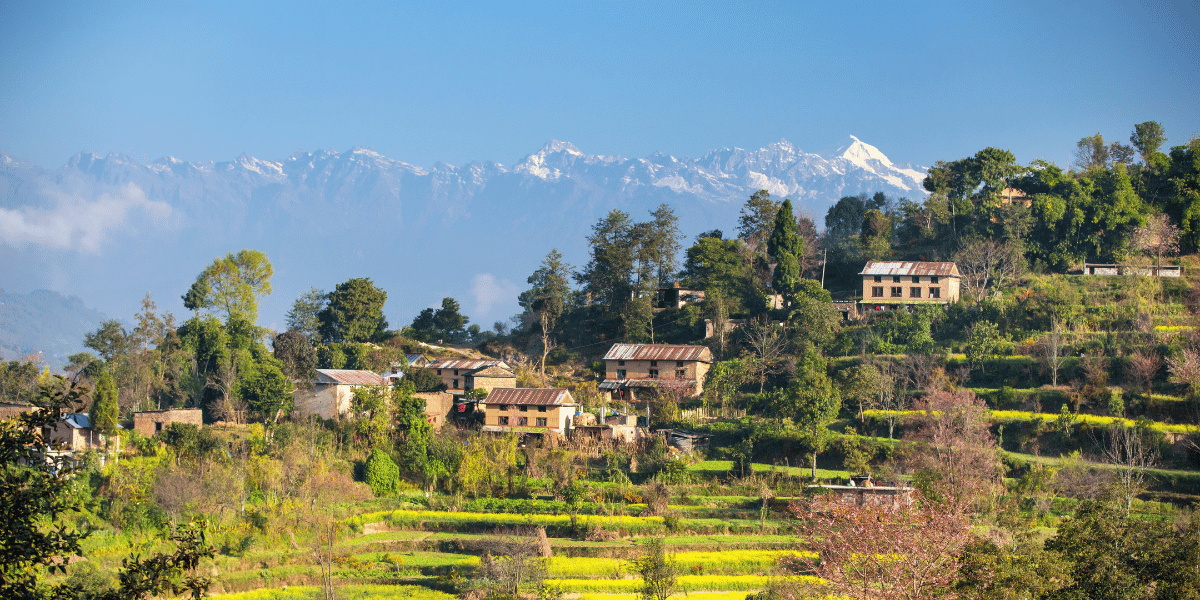
On a clear day, the views stretch from Dhaulagiri in the west to Kanchenjunga in the east.
If you are extending your trip to two days, it is worth spending the night here for both sunset and sunrise. This is possible from multiple viewpoint locations (like the Nagarkot Geodetic Survey Tower) or even from your own resort.
Moreover, there are multiple hiking routes as mentioned earlier. You can start from Chisapani (Kathmandu), Telkot, or Changunarayan. Each route to Nagarkot involves a forest walk through pine trees and valley views on both sides.
Other nearby spots in Nagarkot include Buddha Peace Park, Rani Jhula, Bojinee Dam, Muhan Pokhari, etc.
Doleshwor Mahadev Temple
About just 5.5 km from Bhaktapur Durbar Square, which takes roughly 45 minutes by road, Doleshwor Mahadev Temple carries a significance that goes well beyond its size. It is believed to be the head of Lord Kedarnath!
When the Pandavas tried to catch Lord Shiva disguised as a bull after the Mahabharata war, the bull's head separated and appeared here in Sipadol, Suryabinayak area, while the rest of the body emerged at Kedarnath in Uttarakhand, India.
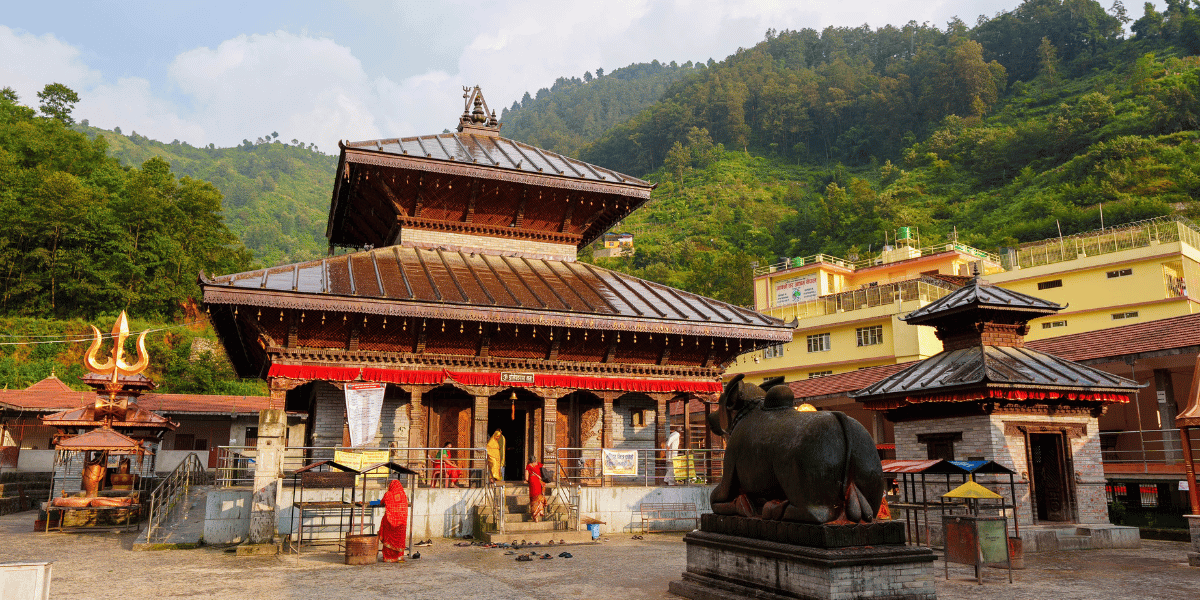
This connection was officially recognised on August 22, 2009, when the head priest of Kedarnath performed a Rudra Abhishek here and unveiled a plaque confirming it.
So, the practical thing is that this temple is quite significant for Hindu pilgrims. In fact, the Char Dham Yatra (involving Kedarnath) is considered incomplete without also visiting Doleshwor and Pashupatinath!
Shree Pancha Mahalaxmi Temple
Located about 7.5 km from Changu Narayan Temple, Shree Pancha Mahalaxmi Temple is dedicated to the five forms of Goddess Laxmi and sits within a complex that includes the Hayagrib Cave (associated with the Hayagriva avatar of Vishnu), the Ramanuj Temple, and the Kamdhenu Gaushala.
The temple itself is well maintained, relatively unbusy compared to the major Bhaktapur sites we mentioned above, and has a calm, welcoming atmosphere. So, it’s definitely a good stop to add if you are already in the Changunarayan area!
Kailash Mahadev Statue
At the border of Bhaktapur and Kavrepalanchok districts in Chittapol, Suryabinayak Municipality, roughly 7.5 km from the Bhaktapur heritage site, stands the world's second-tallest Shiva statue, Kailashnath Mahadev.
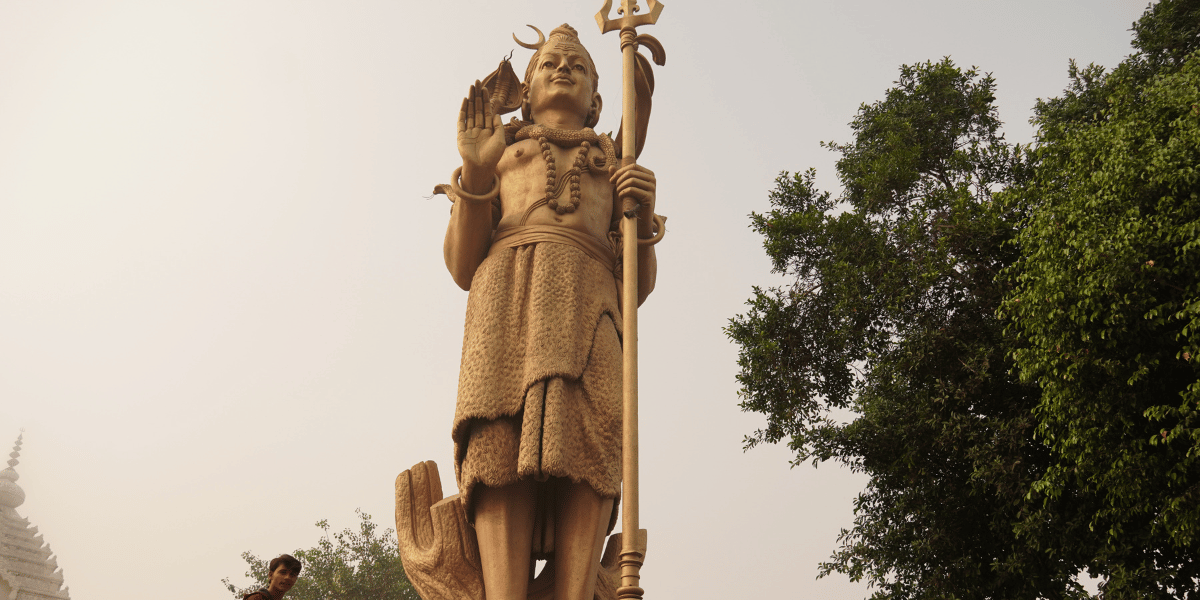
It is 143 feet (43.5 m) tall, built from copper, zinc, concrete, and steel. Kailashnath Mahadev depicts Shiva in a blessing mudra, holding his trident and damaru, garlanded by the serpent Vasuki, with Nandi’s statue beside him and 12 Shiva lingams encircling the base.
The site draws large crowds during Maha Shivaratri and Teej festival, so visiting outside those dates would be much better if you’re seeking a peaceful experience.
Other Attractions in Bhaktapur District
It is honestly impossible to visit every single spot we have pinned in this article within a single day. Many visitors do not even make it beyond Bhaktapur Durbar Square itself, and that is fine.
But what we want to say is that Bhaktapur is not limited to what sits within its heritage zone. Its cultural significance stretches far beyond its own borders, all the way to where it meets Kathmandu, Lalitpur, and Kavrepalanchok.
So if you are a slow traveller wanting to get the most out of this area or simply looking to swap out a few destinations from the one-day tour above, aforementioned tourist destinations are the most worthwhile additions.
And beyond those, a few more options in the southern hills of Bhaktapur worth knowing about:
- Pilot Baba Ashram (approx. 6.5 km from Durbar Square)
- Gundu Hills (approx. 4 km from Durbar Square)
- Suryabinayak Ganesh Temple (3 km from Durbar Square)
Food Options in Bhaktapur: What to Eat and Where?
Bhaktapur is genuinely one of the best places in Nepal to experience Newari cuisine. The food culture here runs deep, and you can find everything from street-side stalls to proper rooftop cafes within the four squares.
Starting with breakfast, these local options are worth trying over the standard cafe menu: Selroti with tea, Halwa Papad Roll, Malpuwa, Gwaramari, Lakhamari, Jerri and Swari, Bara, and Yomari.
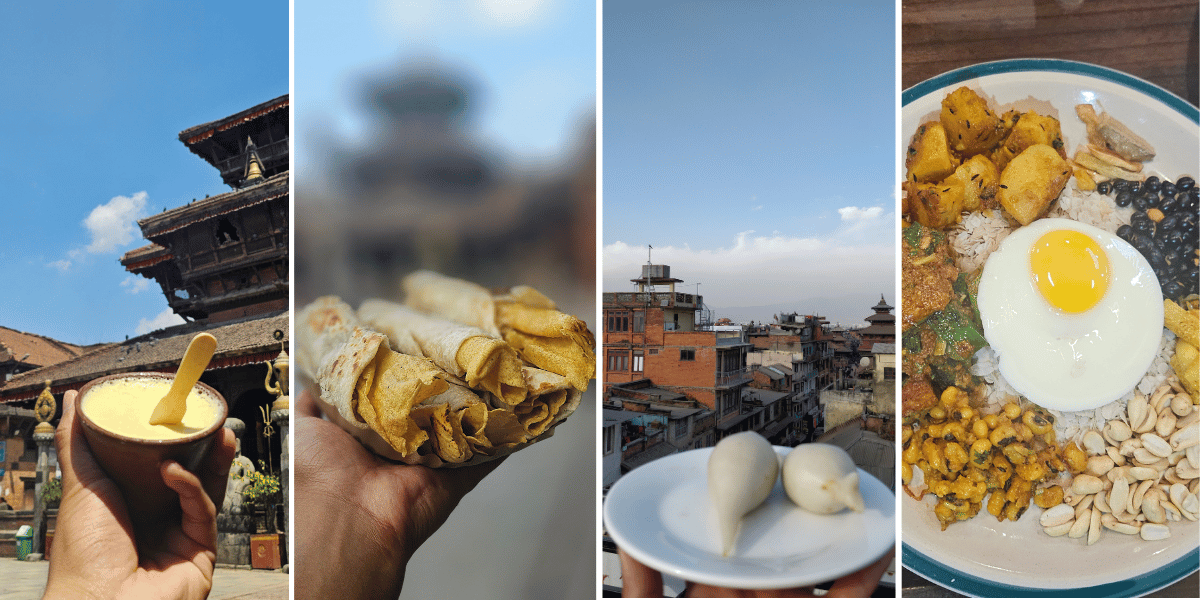
Most of these options are available in small stalls around the squares from early morning!
Moving on to lunch, a visit to Bhaktapur without trying Newari cuisine is a missed opportunity. Ones that are worth ordering are:
- Samay Baji: This is a traditional Newari platter with beaten rice (Chiura), buffalo meat (Chhoila), black soybeans (Haku Musya), ginger (Palu/Aduwa), and rice liquor (Aila). They are symbols of the Pancha Tattva (five elements of creation).
- Chataamari: Known locally as the “Newari pizza”, it is a thin pancake made from rice flour and topped with minced meat, eggs, and vegetables.
- Bara (Wo): Savoury lentil pancakes, served plain or with an egg on top.
- Chhoila: Spiced, grilled buffalo meat. One of those things that tastes better in Bhaktapur than anywhere else.
- Yomari: Steamed rice flour dumplings filled with chaku (molasses) or khuwa. More of a festive item but available year-round at specialist stalls.
- Juju Dhau: Non-negotiable. Get it in a terracotta bowl at Taumadhi Square on your way out.
Other Newari dishes worth trying if you come across them: Kachila (seasoned raw buffalo meat), Kwati (mixed lentil soup), Aalu Tama (potato and bamboo shoot curry), and Sapu Mhicha (buffalo tripe stuffed with bone marrow).
Talking about alcoholic drinks, Aila (distilled rice liquor) and Thon (mildly fermented rice beer) are the traditional ones, commonly served alongside a meal. Non-alcoholic options, like masala tea, lassi, cold drinks, and fresh juices, are also obviously available.
Restaurants/cafes worth knowing about:
- Himalayan Java Coffee, two outlets - Taumadhi and Durbar Square
- Amako Bara Pasal (famous local spot for Bara) near Taumadhi
- CinCin Garden, near Bhajya Pukhu
- Brooklyn Eatery, Durbar Square
- Community at the Nanee, Itachhen
- Baiga Vutoo, Durbar Square
- Gwakhancha, Taumadhi Square
- Swastik Newari Khaja Ghar, Durbar Square
- De Temple Cafe, Dattatreya Square
- The Pottery Cafe and Bar, Pottery Square
Best Time for This Bhaktapur Day Trip
There is no single best month to visit Bhaktapur. This city offers something new across the year: festival season, harvest season, and monsoon each bring something different, and all of them are worth experiencing.
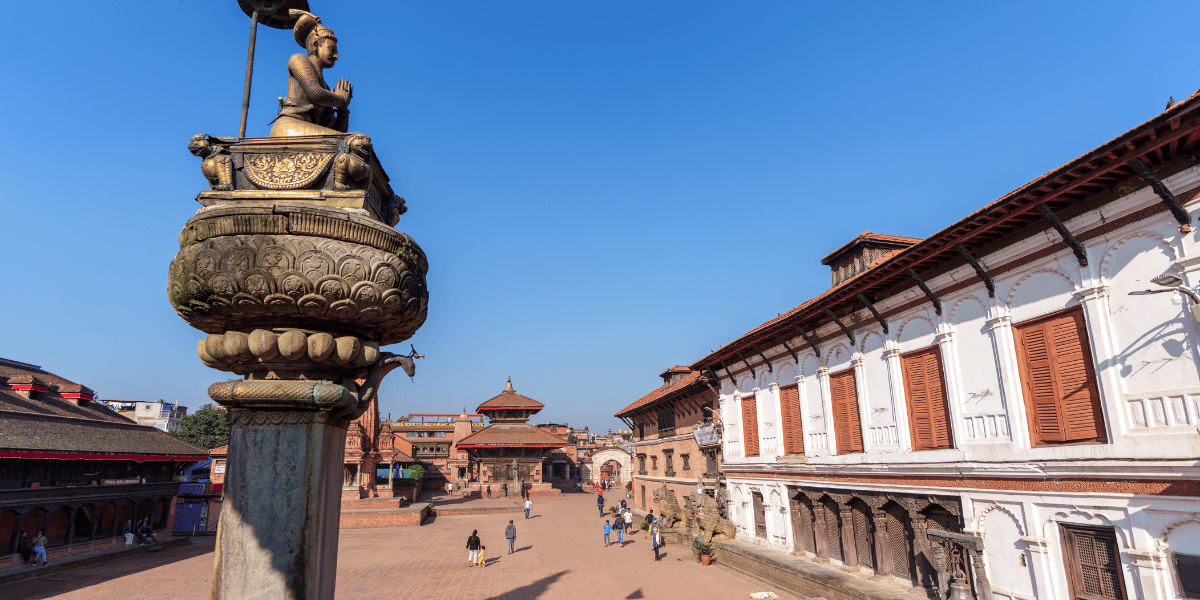
Here is a quick month-by-month breakdown:
- January and February: The quietest time of year. Cold mornings and clear skies make for good photography, and the squares are noticeably less crowded. Mountain views are sharp on clear days.
- March and April: One of the better times to be here (and the entire country too). Comfortable temperatures, lively streets, and festival season building toward Bisket Jatra in April (Bhaktapur's own New Year celebration), where chariots are pulled through the city. If you can time your trip to Bisket Jatra, do it!
- May and June: This is early summer here in Nepal, and you’ll find local markets fill up with mangoes, litchis, and seasonal fruit. The food scene gets livelier, the main squares get busier, and it comes with pre-monsoon heat (but still manageable).
- July and August: Most tourists avoid the monsoon, which means the ones who do visit get a very different Bhaktapur. The paddy fields on the outskirts turn green, the air is clean, and the squares get their quietest version of the year. One particular time you can visit here is during Gai Jatra, a festival honouring those who have passed away, which falls in late August or early September and comes with colourful processions that can make your trip entirely worth it!
- September and October: Post-monsoon, harvest season begins, and the sky clears. Dashain and Tihar festivals bring the squares to life with decorations and people. This is also when Indra Jatra, celebrating Lord Indra and the Living Goddess Kumari, falls. Overall, this is the best time to visit Kathmandu along with spring.
- November and December: Dry, pleasant, and uncrowded time of the year. Good walking weather for a full-day tour (as the sun provides cozy warmth in winter). Yomari Punhi in December, when farmers celebrate the rice harvest, and the traditional Yomari dumpling is made and shared across the community, is worth knowing about if you are visiting that month.
Guided vs Independent Bhaktapur Trip
You can absolutely do the Bhaktapur tour independently. The squares are well-signposted, most attractions are within walking distance of each other, and a basic map from the ticket counter covers all the main stops. But there is a difference, and it is significant.
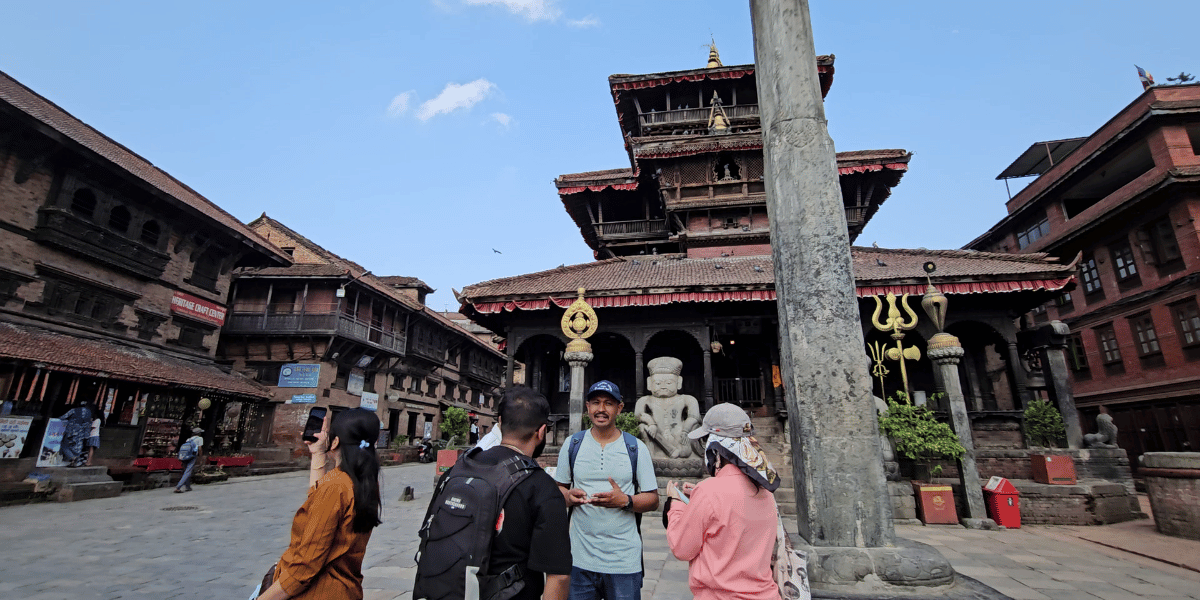
A professional guide does not just show you where things are. They show you what things mean, exactly how Amir added the cherry on top during our own trip!
The erotic carvings on the struts of Dattatreya Temple are easy to photograph and walk past. But when there’s someone like Amir on your side, they become one of the more thought-provoking stops of the whole day!
The Pikha Lakhu stone at every doorway is invisible without context. The Nanees, the hitis, the vihar classification, the folklore behind the ponds: none of these are explained on the signs.
Walking independently, you focus more on navigating than on understanding. You hit the major squares, get the photos, and leave with a surface-level sense of the place.
But with a good guide, the alleys that look identical to tourists open up into something much richer.
Hidden courtyards, local workshops, monks mid-ritual, the chiura mill we passed near Dattatreya: none of that shows up on Google Maps.
It is the same city either way. What changes is how much of it can help you learn about the place and culture.
Tips for Visitors
If you wish to properly explore Bhaktapur, then here are some practical tips to make your experience better, avoiding common mistakes many foreigners do:
- Getting here:
- Leave Kathmandu before 8 AM to avoid the morning traffic.
- Public buses are the cheapest option (NPR 100 to 200), but a taxi or ride-share is more comfortable and gives you more flexibility.
- Also, be sure to carry a small bag to keep your essentials, like sunscreen, power bank, tissues, etc.
- Inside the squares:
- Wear easily removable shoes since you will have to take them off at temple entrances.
- Dress modestly (covered shoulders and knees).
- If rituals or offerings are in progress, step aside rather than walking through.
- Ask before photographing locals, especially artisans.
- Consider buying something from handicraft shops, even if it is a small statue.
- Time to allocate:
- A half-day covers all squares, but with no museums.
- A full day covers all four squares comfortably along with Changu Narayan (even Nagarkot for a brief sunset stop).
- Two days let you do the squares properly on day one and spend day two in other parts of Bhaktapur, which is honestly the better version.
- Early morning and late evening are the best times for both photography and quiet streets.
- Photography:
- Look for good light and emptier angles.
- The brick alleys are genuinely good for photos.
- You’re generally allowed to photograph potters at Pottery Square but asking for consent is always appreciated.
- Golden hour at the squares is worth staying for.
- Museums charge separately for photos and videos that you need to pay upfront.
- But if you’re planning for a professional filming/documentary, you’ll need a local coordinator to process your application at the Ministry of Communication and Information Technology, which will be forwarded to the Department of Archaeology and Civil Aviation Authority of Nepal (if it involves drones). It can be a hectic process, so if you’re planning to do so, just inform our team, and we’ll help you out.
- Money and logistics:
- Carry small-denomination cash. Many stalls and artisan shops prefer this.
- Explore at least one or two narrow alleys that are not on Google Maps (this is again where your guide will help you out!).
- Sit somewhere for 15 minutes at some point and just watch the daily life around you. It is one of the better things you can do in Bhaktapur and costs nothing.
Budgeting for a Bhaktapur One-Day Trip
Here is a rough breakdown of what to expect to spend if you are planning independently (it’s just a rough figure, cost varies based on your spending habits):
|
Category
|
Estimated Cost
|
|
Transport
|
Public Bus: NPR 50 - 100
|
|
Ride Sharing: NPR 1,000 - 1,500
|
|
Permits (entrance and museum)
|
NPR 800 - 4000 (depends on nationality)
|
|
Food (breakfast, lunch, and local snacks/drinks)
|
NPR 2,500 - 3,000
|
|
Shopping (clothing, handicrafts)
|
NPR 2,500 – 3,000 (up to 5,000 if you are inclined)
|
|
Souvenirs (pottery, keychains, handicrafts)
|
NPR 500 – 1,500
|
|
Guide tip (optional)
|
10% of your overall budget would be good
|
Recommended cash to carry: NPR 4,000 to 7,000 per person, depending on your shopping and meal preferences. This is on top of the heritage entry tickets to Bhaktapur and Changu Narayan.
Estimated guided tour cost: Contact us directly, as it can vary based on current pricing and customization options.
Final Thoughts
We hope you enjoyed our story and learned a lot about Bhaktapur after this long read. Now, you probably know why a Bhaktapur day trip is one of the most rewarding ways to spend a day in Kathmandu Valley, particularly because it does not feel like a single type of experience.
In the course of one day, you go from watching clay being shaped in a pottery village to reading a 5th-century stone inscription on a hilltop temple, with enough Newari food and local alley life in between to fill your notebooks!
The main four squares, Changu Narayan, and optional Nagarkot sunset at the end give you a complete picture of ancient trade, religious heritage, living craft traditions, and a Himalayan horizon.
Well, each stop in Bhaktapur is distinct, and that is what makes this particular day trip worth it! If you want to do it right and leave the logistics to someone who knows these alleys well, already do this exact tour. Or you can even pick one of these - Kathmandu Photography Tour (Biska Jatra focused) or Kathmandu Cultural Tour.
But even if you do end up going independently, Bhaktapur is sure not to disappoint you!


 Bhishu Acharya