As our one-day Bhaktapur trip was about to end, our guide handed me a small terracotta pot. It was warm, rough, dried, and earth-colored. Inside of it was yogurt: ivory-colored, thick, dense, and almost set like a pudding. Yes, it was Bhaktapur’s beloved traditional delicacy, Juju Dhau!
We all tried turning the pot upside down to check what happens. And as our guide claimed, it just sat there without flowing, and its shape remained intact!
As I lightly scraped the uppermost layer, it was creamy and sweet in taste. As I continued eating, the taste changed to mild tanginess. And by the end I felt the most refreshing feeling of the day.
The flavour was so good that I bought a big katauro (a clay bowl) of Juju Dhau to take home as a souvenir, one thing that I have always been doing when visiting Bhaktapur since first trying this delicacy.
I can wholeheartedly claim that this yogurt is a must-have when you’re here. And since you’re already reading this blog, I’m sure I’ll be able to make you want to taste it at least once!
Quick Facts About Juju Dhau
|
Name meaning
|
Juju (king) and Dhau (yogurt)
|
|
Origin
|
Ancient city of Bhaktapur dating back to the Malla Dynasty (around the 13th century)
|
|
Main Ingredients
|
- Full-fat buffalo milk
- Brown Sugar or unrefined sugar
- Plain unsweetened yogurt (as starter)
|
|
Method of Preparation
|
Slowly fermented in a porous clay pot using rice husk insulation
|
|
Texture
|
Thick, creamy, dense, and custard-like consistency
|
|
Flavour Profile
|
Pleasantly sweet and mild tanginess
|
|
Serving style
|
Small terracotta cup or clay Katauro
|
|
Cultural status
|
Served in festivals, weddings, and Newari bhoj/feast
|
|
Temperature sensitivity
|
Ferments best in warm climates (especially during summer)
|
History of Juju Dhau
Turns out the origin of Juju Dhau dates back several centuries during the Malla era. Slowly, the traditional taste of Bhaktapur transformed into the modern-day delicacy and tourist delight.
The Malla Legend
There are multiple versions of a local legend claiming the origin of Juju Dhau.
According to a famous local legend, Malla kings of Kathmandu hosted a curd-making competition to find the best one within the valley. The curd makers from Kathmandu, Bhaktapur, and Lalitpur all came with their best products.
When the kings tasted the curd from Bhaktapur, they were impressed by its rich texture, sweet, and creamy flavor. And from that day onwards, it was recognized as Juju Dhau (king of curd/yogurt).
A similar story of a slightly different version claims that Juju Dhau originated even earlier (during 14th-century). It was King Jayasthiti Malla who held a yogurt-making competition, and Bhaktapur’s version came out on top!
The Caste Behind the Traditional Delicacy
Among the Newar community, the Dhaubadel caste was traditionally engaged in preparing Juju Dhau for the Malla kings and their courtiers.
Over generations, curd production was expanded to castes like like Timila, Pakwan, Sainju, Pradhananga, Hada, and Kayastha.
Present Day
Today, there are no social restrictions on who can consume or who can produce Juju Dhau. Most Juju Dhau producers have passed the craft down through three generations, with their hands-on practice rather than a written recipe.
According to a study conducted in 2023, around 60 families in Bhaktapur still make Juju Dhau today, with 48 families registered under the Bhaktapur Juju Dhau Union.
Juju Dhau is no longer made only for royalty, but it still tastes like it was!
How is Juju Dhau Made and What Makes It Unique?
As soon as you taste Juju Dhau, I’m sure you’ll have this question pop into your head: “How could a few ingredients make something so amazing?”
To satisfy your curiosity, I’m now going to walk you through the entire process that hasn’t changed much over the years.
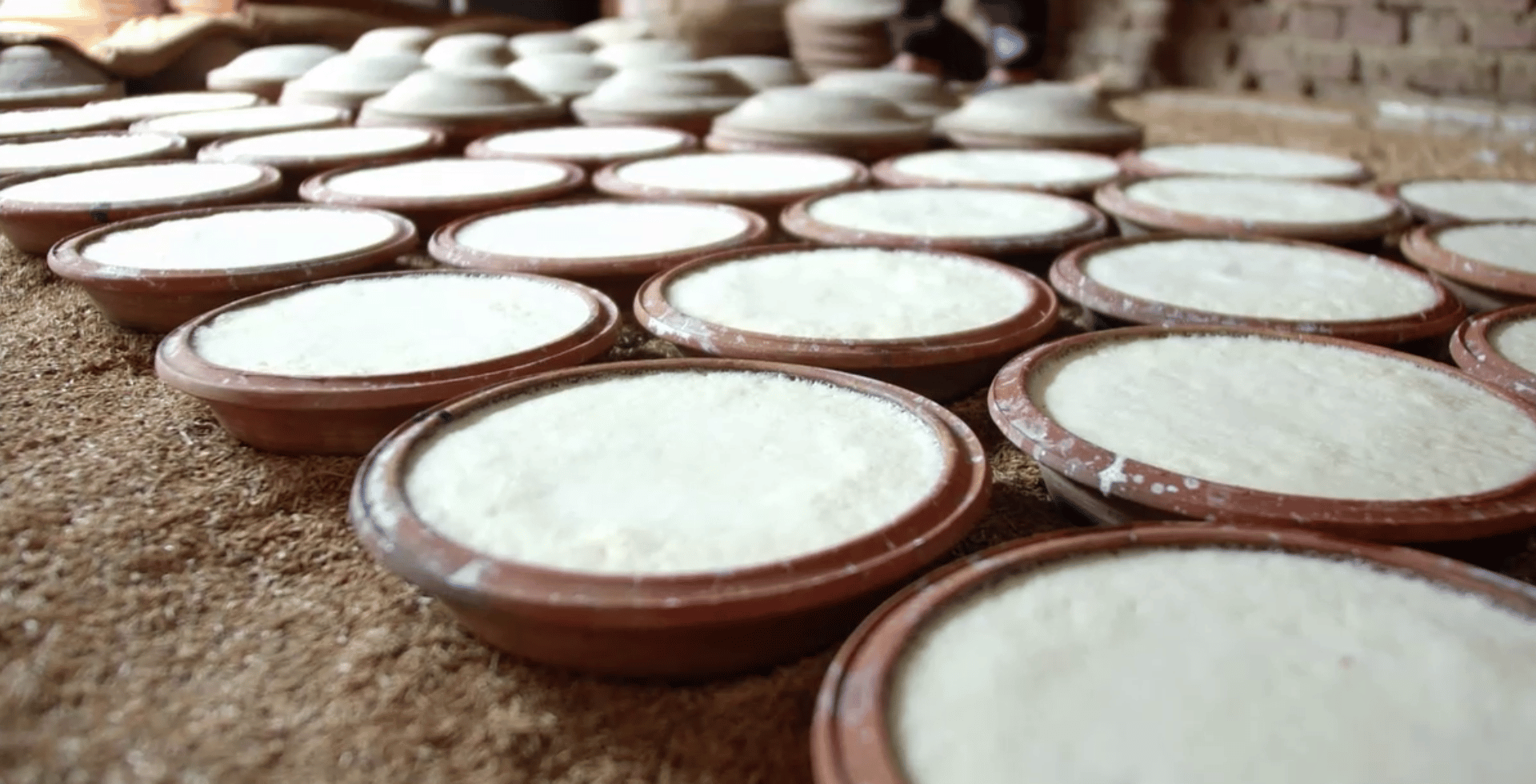
Inside a Juju Dhau-making dairy, you’ll likely find a traditional setup with clay pots sitting on top of rice husks and covered with clothes. Watching the making of Juju Dhau feels like watching people continue a tradition passed down through generations.
Step 1: Choosing the Right Milk
“What milk do they use in Juju Dhau, and what gives it that custard-like density?” From the locals, our team found out that the authentic Juju Dhau is made with fresh Buffalo milk.
The reason is simple: buffalo milk naturally carries more fat and more protein content than cow milk, giving Juju Dhau a custard-like density.
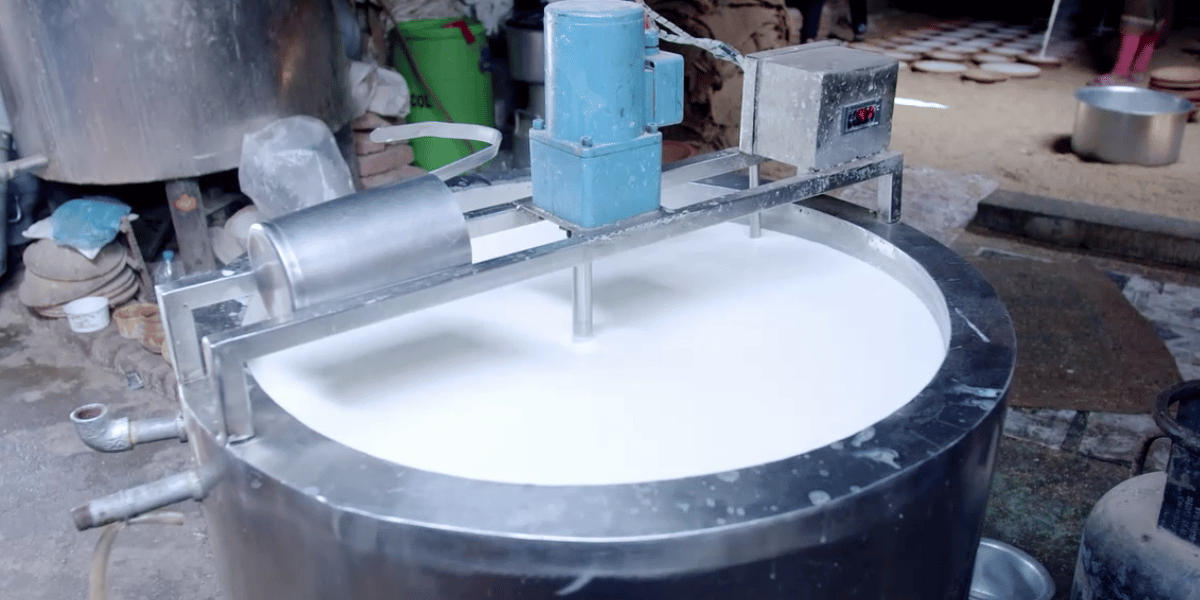
Sadly, the supply of buffalo milk has been steadily declining over the years. Many Juju Dhau makers are forced to use cow's milk even though they prefer using buffalo milk.
Many producers have also turned to powdered milk to keep up their volumes, and some even add caustic soda to prevent bacterial spoilage.
Both compromise the traditional taste and, more importantly, the health value of the product.
If you're buying Juju Dhau and want to experience the real taste, be sure to ask the vendor directly whether they use fresh buffalo milk or not. The good ones won't hesitate to answer for sure!
Step 2: Preparing the Clay Pot
An unglazed clay pot, Katauro, is soaked in water for several hours and then dryed completely before use.
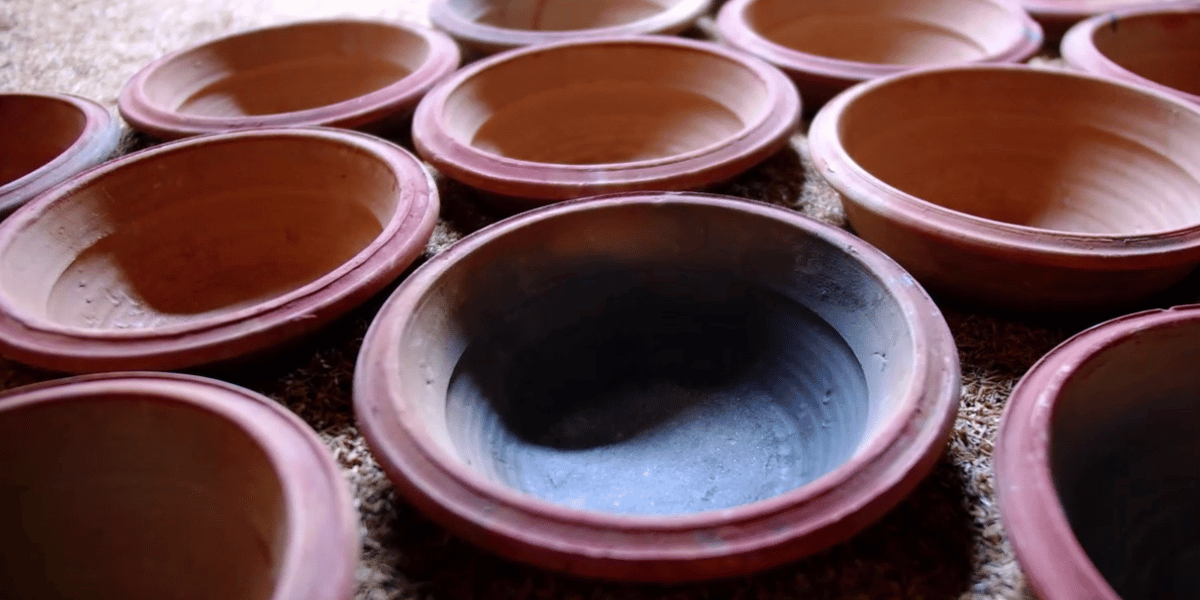
The clay itself matters more! Traditional potters used specific types of clays (called Gathicha, Pancha, Hakucha, and Gija), and this is where Bhaktapur is running into a real problem.
Urbanization has swallowed the clay pits that used to sit close to the city, so potters now transport clay from as far as Sankhu, Panauti, and Dhading, which pushes up costs and, eventually, the price of every pot of Juju Dhau you buy.
Before the milk goes in, the pot, in some cases, is warmed over a fire to remove any remaining moisture.
The next step is to set pots on top of a bed of rice husk or a mattress to hold the heat.
Step 3: The Boiling Process
This step happens in a heavy-bottomed iron pot, called a karahi, over direct heat. Expect around 1.5 hours of constant stirring so the milk doesn't stick or burn.
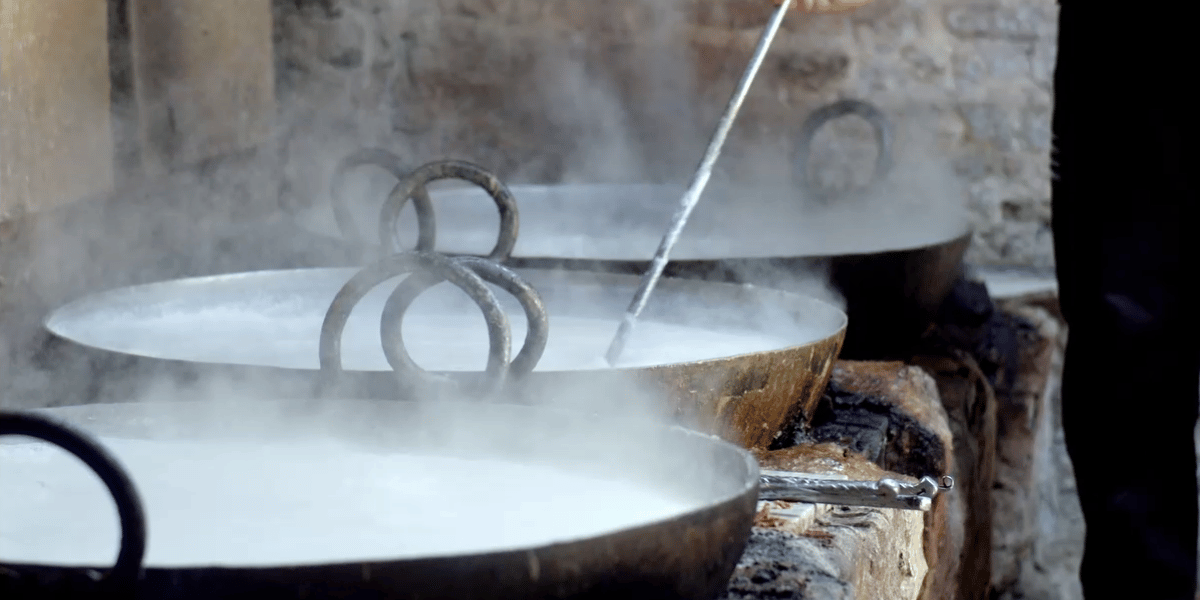
During the boiling process, various spices are added to the milk to enhance the taste. The spices mainly consist of cardamom powder and cloves. Along with that, brown sugar or unrefined sugar is also added to the boiling milk to add sweetness without overwhelming the overall taste.
The milk is sweetened as it boils. For special orders, some producers stir in khuwa (a thickened, reduced milk) along with extra sugar and cardamom powder, which makes for a richer batch typically reserved for celebrations.
Once boiled, the milk is poured into the katauro and left to cool. The pot's porous clay slowly draws moisture out as it sets, which is really what gives Juju Dhau its thick, custard-like body, not the boiling alone.
Step 4: The Fermentation Process
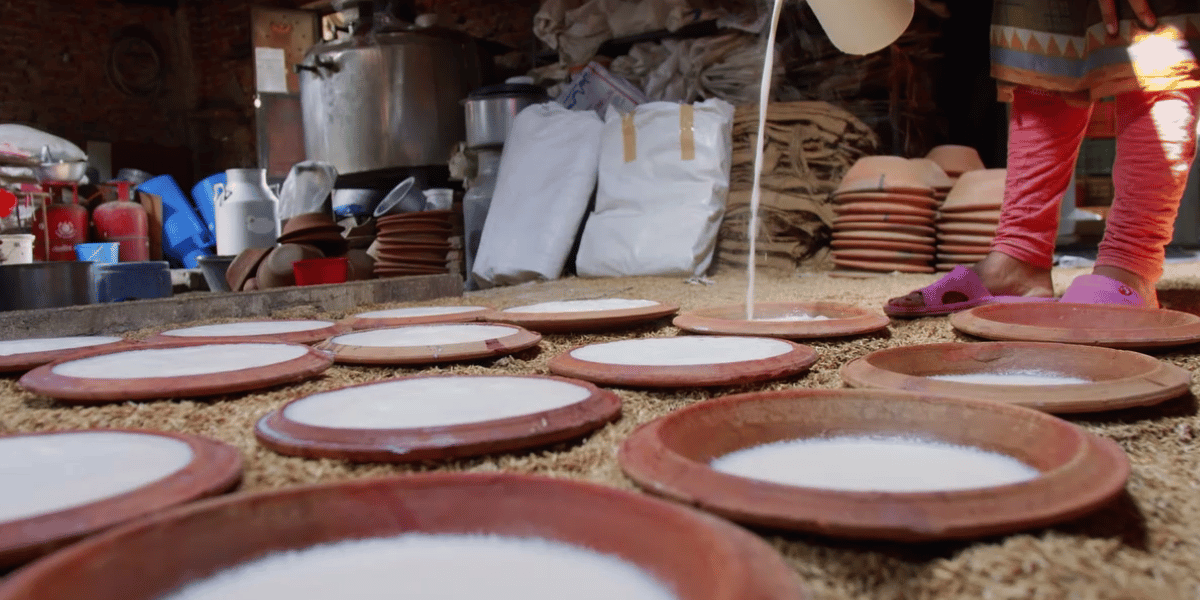
The milk needs to cool to around 42°C before the bacteria can survive and multiply. It's the exact temperature Bhaktapur's curd makers still test for today!
A spoonful of curd from a previous batch (mixed with water), called dahi ko beu in Nepali (dhau pusa in Newari), goes into the pot as the starter culture. This carries the live gut friendly bacteria (mainly Lactobacillus delbrueckii subsp. Bulgaricus, Streptococcus thermophilus, Lactobacillus, and Bifidobacterium) that turn the milk into curd.
The filled pot(s) are covered with an empty katauro placed on top, then set on a bed of rice husk and covered in a thick cotton blanket (locally called tagaeko oddane) to hold the warmth in.
Setting time depends on the weather (about 3 to 4 hours on a warm day and 5 to 6 hours when it's cold). A thermometer is often used these days, but experience matters more, knowing how the milk should look and feel at each stage!
Step 5: Testing
Then, after 4 to 6 hours of fermentation, the final product is a thick, creamy, ivory-white yogurt with a dense texture and a faint caramel note. It is sold and can be eaten straight from the pot it was made in.
Now, the standard quality test of the yogurt is the “upside-down” method. If the cup is lifted upside-down and yogurt doesn't fall down, then it is correctly done.
Juju Dhau vs Other Yogurts
I have tried various types of yogurt my whole life: simple home-made yogurt (Dahi in Nepali), Greek yogurt at the supermarket, and flavored yogurt. But my first taste of Juju Dhau in the alleys of Bhaktapur made me see yogurt differently.
The differences in sweetness, texture, and serving style of yogurts were easy to notice.
|
Factors
|
Juju Dhau
|
Greek Yogurt
|
Regular Yogurt (Dahi)
|
|
Origin
|
Bhaktapur, Nepal
|
Greece
|
Across South Asian countries (India, Nepal, Bangladesh, Pakistan, and Sri Lanka)
|
|
Milk Used
|
Fresh buffalo milk
|
Cow’s milk
|
Cow/Buffalo milk
|
|
Fat Content
|
Very High
|
Moderate to High
|
Low to Moderate
|
|
Texture
|
Custard-thick, very dense
|
Thick and creamy
|
Soft, loose, and pourable
|
|
Fermentation
|
Naturally, in a clay pot using starter culture (a scoop of previous Juju Dhau mixed with water) for several hours.
|
Fermented by mixing milk with live bacterial cultures, then strained to remove whey
|
Natural fermentation for six to eight hours
|
|
Aroma
|
Slightly earthly
|
Mild, neutral
|
Neutral
|
|
Flavour
|
Creamy, Rich, mildly sweet.
|
Tangy, clean, and slightly sour
|
Mild, sour, and thin
|
|
Serving style
|
In the same terracotta cup and clay bowl (katauro) it was made in
|
In a container topped with fruit
|
In a bowl with a meal
|
|
Protein Content
|
Medium (3.5 to 5 grams of protein per 100 grams serving)
|
Very high (8 to 12 grams of protein per 100 grams serving)
|
Medium (3.5 to 4 grams of protein per 100 grams of serving)
|
Greek yogurt is thick, but its clean texture reminds you that something has been removed. That’s where the Juju Dhau fills the void with its naturally rich texture.
The regular yogurt feels like an everyday part of the meal, while Juju Dhau feels like something reserved for special occasions.
So, if you are in Bhaktapur Durbar Square, make sure you try a freshly made pot of Juju Dhau from a local producer. With the first spoon, you will realize this yogurt has a richness unlike anything you've tasted before.
Importance of Dhau (Curd) in Newari Culture
Juju Dhau holds diverse significance in the Newari community. From the birth of a child to his/her death, Dhau (curd) is present.
A Katauro of the Juju Dhau commonly present in weddings, festivals, pujas, and family gatherings not only as food but also as a symbol of blessing, purity, and good fortune.
|
Events / Rituals
|
Ritual Description
|
Symbolism and Cultural Meaning of Dhau
|
|
Religious Offering (Dhaupatu, Jodhaupatu)
|
Curd is placed in a brass/clay pot on a swastika during sacred rituals.
|
The union of Mahadev and Parvati symbolizes male and female energies.
|
|
Blessing Ritual (Dhausagun)
|
The mark of the curd is applied as a blessing mark (Dhau Tika) on the forehead during rituals.
|
Symbolizes prosperity, purity, good fortune, and the brightness of the moon.
|
|
Yogurt Feeding Ceremony (Dhau-baji Nake Wanegu)
|
Yogurt and beaten rice are offered to pregnant women before childbirth by their maternal family
|
Nourishment, protection of the unborn child, safe delivery, life continuity, maternal blessing
|
|
Rice Feeding Ceremony (Macha Ja Nakegu)
|
Curd mixed with rice is fed to the infant for the first time.
|
Growth transition, purity, nourishment shift, beginning of independent eating
|
|
Birthday Sagan (Dhaubaji Distribution)
|
The Dhaubaji (mixture of curd, beaten rice, sesame laddu, pea seeds, and radish) is shared with the community during the child’s birthday celebration.
|
Community bonding, prosperity, goodwill, social harmony, and a child’s future blessings
|
|
Learning & Spiritual Training (Pirane Puja)
|
Dhau-baji paste used by a guru/achaju to complete the music apprenticeship ritual on a metal plate
|
Spiritual blessing, divine protection, continuity of knowledge, artistic sanctity
|
|
Mother’s Day (Ma ya Khwa Soyagu Din)
Father’s Day (Bwa ya Khwa Soyagu Din)
Bhai Tika in Tihar Festival
(Kija Puja)
|
Dhau is served during family honoring rituals and the festive season.
|
Respect for parents, family bonding, auspicious blessings, continuity of lineage
|
|
Newari Feast Conclusion (Newa Bhoj)
|
Curd is served at the end of traditional feasts as the final dish
|
Hospitality, purification, respect for guests, good fortune, social harmony
|
|
Father Death Mourning Period (Baba Swara)
Mother Death Mourning Period (Aama Swara)
|
Dhau is avoided for one year after the father’s death, while milk is avoided after the mother’s death
|
Respect, remembrance, symbolic parental connection, mourning, purity rules
|
Other than these annual or occasional rituals, Juju Dhau is a must-have item during various Jatras like Indra Jatra, Rato Machhindranath Jatra, Bisket Jatra, and many more.
In the Newar community, any curd can be used in every event and ritual. However, many Newars still prefer Juju Dhau over other types of curds available in the market.
At first glance, seeing a Katauro of Juju Dhau next to a Samay Baji set may feel unexpected. But trust me when I say this: the moment your taste buds feel the fiery spices of Chhoila, you’ll reach for the yogurt instead of water.
Moreover, Juju Dhau, a part of local Newari cuisine, has an importance that extends far beyond the ceremonies and rituals in the Newari community.
Where to Try Juju Dhau?
Well, Juju Dhau is found everywhere around Bhaktapur, but experience is just as important as taste. Whether you prefer Juju Dhau in a lively square or in peaceful surroundings, Bhaktapur Durbar Square has got you covered.
Here are some of the best places to try it:
- Durbar Square: You don’t have to search for Juju Dhau while you are at the Durbar Square. Every local dairy here sells authentic Juju Dhau. Durbar Square is home to various landmarks and temples such a Vatsala Temple, Yakchheshwor Mahadev Temple, Taleju Complex, and many more. Observing the intricate detail of the Golden Gate and gazing at every window of the 55-window palace is the best way to enjoy Juju Dhau.
- Taumadhi Square: Enjoying the Juju Dhau after climbing the staircase of Nyatapola Temple is definitely worth every spoonful. Every year during the Gaijatra festival, thousands of people gather in the courtyard of Taumadhi to remember the deceased. The same place is where Biska Jatra’s first day, Dyo Kwa Bijyayegu, is observed. Enjoying Juju Dhau while watching such festivals is a unique experience for sure.
- Pottery Square: Located to the south of Durbar Square, just a few minutes away, lies the Pottery Square. The whole square is covered with sun-dried clayware and offers a rare sight. Buying and eating Juju Dhau from the nearby dairy and watching potters make fresh clayware are the experiences that you won’t find at other squares.
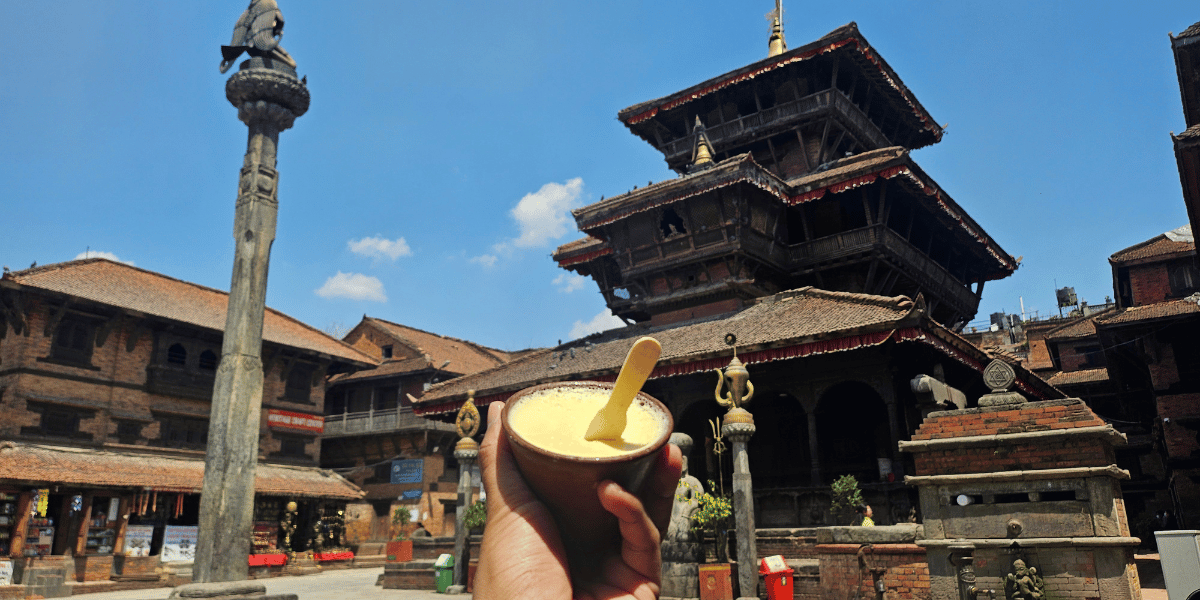
- Dattatreya Square: Wandering around the courtyard and Bahals, and observing the intricate carvings on the temple and walls, is another way to enjoy the Juju Dhau. Don’t forget to visit the museums here!
- Siddha Pokhari and other ponds/pukhus: Siddha Pokhari, one of the biggest ponds in Bhaktapur, is different from other famous sites around Bhaktapur, one of the 7 heritage zones of Kathmandu. The calm and peaceful surroundings of the pond provide relief from the crowds of the square. Spending time with your loved one here while enjoying Juju Dhau is definitely a unique idea!
Beyond Bhaktapur, Juju Dhau is available throughout the Kathmandu Valley, especially in Kathmandu, Lalitpur, Madhyapur Thimi, and Changu Narayan.
However, outside the valley, the availability of Juju Dhau depends on the local distributor, making it less consistent.
Today, Juju Dhau’s presence can be experienced beyond Nepal. Nepalese people living abroad have started making Juju Dhau in various countries like Canada, the USA, New Zealand, Australia, the United Kingdom, etc.
However, the authentic experience and taste of Juju Dhau can be found only at local shops and dairies around the historical square of Bhaktapur!
How Much Does Juju Dhau Cost in Bhaktapur?
What’s really surprising is how affordable the Juju Dhau is. The price of Juju Dhau depends on the size of katauro or the volume you plan to buy.
|
Serving Size
|
Approximate Volume
|
Price
|
|
Small
|
150 ml
|
NRs. 50 - NRs. 100
|
|
Medium
|
300 ml
|
NRs. 120 - NRs. 150
|
|
Large
|
1000 ml
|
NRs. 300 - NRs. 400 (or higher)
|
Note: The price of the product is subject to change by the manufacturer in due course.
Final Thoughts: Why Every Tourist Must Try Juju Dhau?
Lastly, Juju Dhau is not just about the texture or sweetness that makes it a staple of Bhaktapur. It’s also the craft that has been passed down through generations of families and the serving style that has not changed over the centuries!
And if you’re a foodie like me, I’m sure you know that the most helpful way to get a better understanding of the place and culture is through food. Juju Dhau is a perfect example of this!
Each spoonful of Juju Dhau you take gives you a glimpse into the culture and tradition of Bhaktapur that have been preserved for years. Whether you’re walking through the streets of the Durbar Square, resting by Siddha Pokhari, or roaming around the alleys of Bhaktapur, Juju Dhau feels like more than a delicacy!
So, I urge you to try the “king of yogurt" if you’re planning to visit Bhaktapur (whether you’re coming for a photography / culture-focused trip or just a half-day tour). The architecture of the palace and temple will amaze you, but the taste of Juju Dhau will stay with you even after you leave this UNESCO World Heritage Site!













 Bhishu Acharya