Imagine getting a chance to witness an old temple built around the 4th century. Yes, the Changu Narayan Temple of the Bhaktapur district (Changunarayan Municipality) is known as the oldest surviving Hindu temple of Nepal. It houses the one of the oldest known stone pillar inscription in Nepal, dating back to 464 AD.
Changu Narayan is one of the four major Narayans (Char Narayans) of Kathmandu Valley, the others being Ichhangu Narayan, Bisankhu Narayan, and Shesh Narayan. Decorated with multiple colors, several deities and some mythical creatures carved onto the struts, the temple structure looks beautiful and fascinating. And due to its cultural and historical significance, it was listed as a UNESCO World Heritage site in 1979 AD.
Our team from Altitude Himalaya went on a one-day guided trip to Bhaktapur, which also included the Changu Narayan Temple. Find everything from what we learned about the temple, history, and location to facts and myths, as well as the cultural, religious, and historical significance the temple carries in this blog.
Changu Narayan Temple Quick Facts
|
Location
|
Changunarayan Municipality, Bhaktapur District, Bagmati Province
|
|
Elevation
|
1,541 meters
|
|
Founded
|
5th century, during the Licchhavi period
|
|
Listed in the UNESCO World Heritage
|
1979 AD
|
|
Main Deity
|
Lord Vishnu (Narayan)
|
|
Architecture
|
Two-tier pagoda with wood, stone, and metal carvings
|
|
Famous For
|
Oldest Hindu Temple of Nepal
|
|
God Worshipped
|
- By the Hindus as Narayan
- By the Buddhists as Hari Hari Hari Vahan Lokeshwor
|
|
Important Festivals
|
- Harishayani Ekadashi
- Haribodhani Ekadashi
- Changu Narayan Jatra
- Naag Panchami
- Mahasnan
|
|
Main Attractions
|
- Changu Narayan Temple
- 5th Century Garuda Statue
- 464 AD Stone Inscription
- Vishnu Vishwarupa Sculpture
- Chhinnamasta Temple
- Kileshwor Temple
- Shrines of Narasimha
- Changu Museum
- Living Tradition Museum
- Shrines like Shridhar Vishnu, Vishnu Vikrant, Vaikuntha Vishnu, Somalingeswor Mahadev, etc
|
History of Changu Narayan Temple
Before we step into the virtual tour of Changu Narayan, let us explore the remarkable history of the temple over the centuries.
|
Date/Time Period
|
Events
|
|
2nd Century
|
Temple was believed to be present
|
|
Early 4th Century
|
Establishment of the first temple credited to Lichhavi King Haridutta Verma
|
|
464 AD
|
King Mandev (Manadeva) installed the famous stone pillar inscription (Shilapatra)
|
|
Mid-5th Century
|
The beautiful statue of Garuda was built
|
|
7th Century
|
There were several attempts to steal the image of Vishnu Vishwarupa
|
|
7th - 9th Century
|
- The temple grew into a prominent artistic hub.
- The following idols were sculpted:
- Vishnu Vishwarup
- Vishnu Vikrant
- Narasimha
- Chanda Narayan (Garuda Narayan)
- Sridhar Vishnu
|
|
16th Century
|
The idol of Vaikuntha Vishnu was made
|
|
17th Century
|
- Bhupalendra Malla renovated the temple
- Also, established the statue of himself and his queen, Bhuvanlaxmi.
|
|
Early 1700s
|
The temple faced a huge fire that caused great damage to its structure.
|
|
1702 AD
|
The main temple structure was rebuilt after a major fire
|
|
1975 AD
|
A statue of Krishna was stolen
|
|
1977 AD
|
A statue of Kileshwor Mahadev was stolen
|
|
1979 AD
|
Listed as a UNESCO World Heritage Site
|
|
1980 AD
|
A statue of Surya was stolen
|
|
1981 AD
|
The main statue of Changunarayan was stolen.
|
|
1982 AD
|
The Surya sculpture, made from Grey Limestone, was stolen.
|
|
1986 AD
|
A Vishnu sculpture made from stone was stolen
|
|
2001 AD
|
Statues of Kali and Bhairab were stolen
|
|
2015 AD
|
The temple was damaged by a devastating Earthquake in Nepal
|
|
2017 AD
|
Restoration of the temple was completed.
|
|
Present
|
Stands as the oldest Hindu temple in Nepal and welcomes devotees from various places
|
Origin of the Temple: Associated Legend of Sudarshan
Changu Narayan Temple is located on the hilltop of the Bhaktapur district, and it is believed to have originated in the 4th century. This temple is pivotal from every viewpoint, including artistic, religious, cultural, historical, and archaeological.
The site where the temple is located is known by different names like Dolagiri, Dolparvat, Dolasikhar, Chapakaranya, Champapur Mahanagar, and Changu. Among them, the name ‘Changu’ is the most well-known.
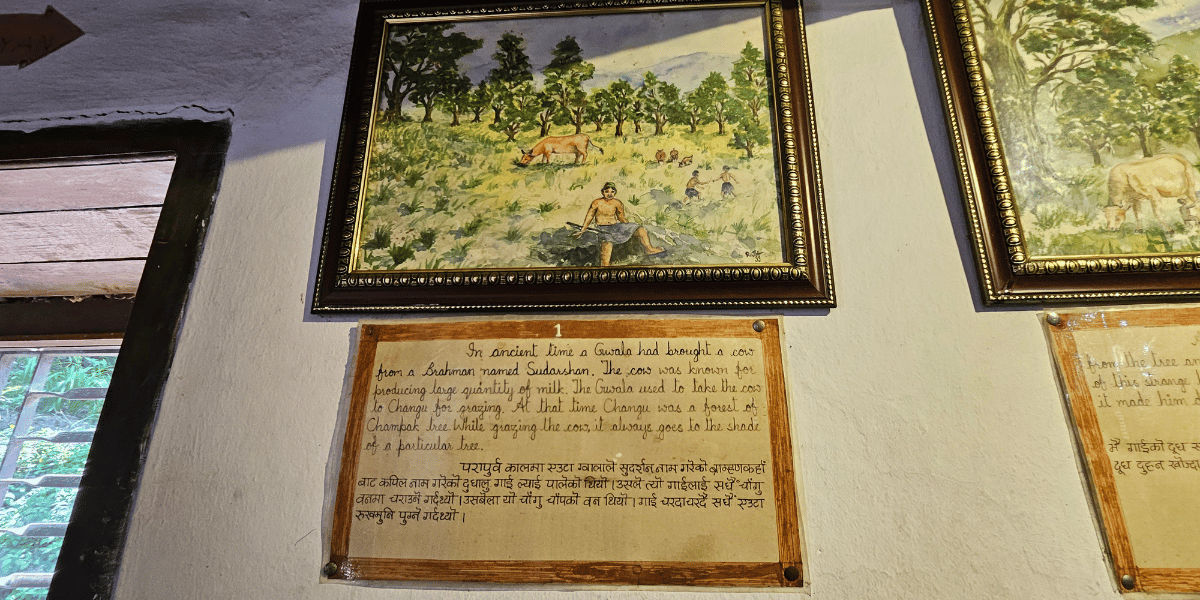
There is an old myth about the origin of Changu Narayan. Long ago, there was a Brahmin named Sudarshan, and he used to rear a cow. The cow was known for producing a large quantity of milk.
A cattle herder (Gwala) used to take the cow to graze near the Michelia Champaca (Champa) forest every day. At that time, Changu used to be a forest of Champak trees.
Suddenly, the cow stopped producing milk, and it made it difficult for the Gwala to bring milk to the Brahmin. So, he went to Sudarshan and informed him about this incident.
After hearing this, Sudarshan was surprised and was also angry, and he decided to find the reason behind it. So, he himself went to graze the cow.
When both Gwala and Sudarshan were keeping a close eye on the cow, they saw that it went to the shade of a particular tree. As soon as the cow reached there, a black-skinned child came out of the tree and sucked all the milk.
Sudarshan thought that such a strange occurrence could only be done by an evil spirit. So, all of a sudden, the Brahman, in his outrage, took an axe and started cutting the tree. When doing so, fresh human blood came out, and he felt as if he were committing a crime.
Exactly at that moment, Lord Vishnu emerged from the tree and assured them it was not their fault. Lord Vishnu explained that they didn’t commit a crime; instead, they made him free from his sins.
He explained that long ago, there was a war between him and the demons. In this war, he killed the son of Brahmini Sumati by mistake. Thus, Shukracharya, the demon’s guru, cursed Vishnu that one day a Brahmin would behead him.
Then, Lord Vishnu told Sudarshan that he would reside at the same place and asked him to offer daily worship. So, Sudarshan built a temple in the name of Vishnu, which is now known as Changu Narayan Temple.
Besides this, there is also a legend that says: Sudarshan and his cowherd followed their cow into the forest and saw a black-skinned child drinking milk. Sudarshan thought the child was an evil spirit and struck him with an axe, and the boy himself transformed into Lord Vishnu, who was freed from the curse.
King Mandeva and the 464 AD Stone Pillar
Mandeva I, aka Mandev or Manadeva (404 - 505 CE), was a proficient, wise, and brave king of the Lichhavi dynasty of Nepal. He had a strong passion for art and architecture, was an educationist, and was also a profound administrator.
He was also religious and a huge devotee of Lord Vishnu and also worshipped Goddess Shakti, Lord Shiva, and Lord Buddha.
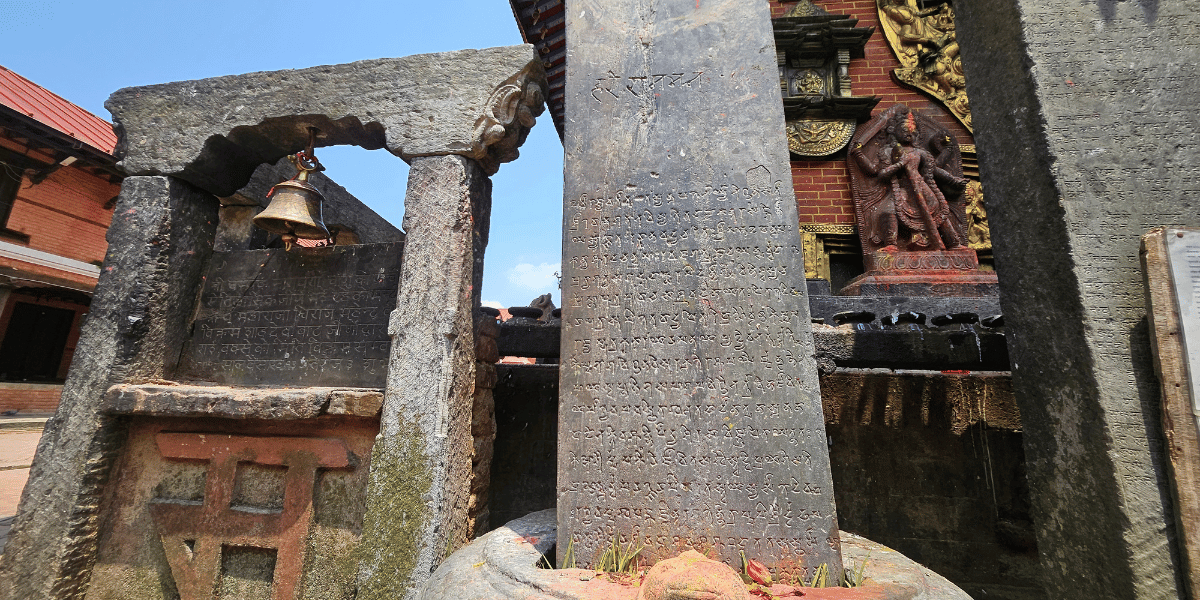
In fact, King Mandeva was the one who installed the oldest and most famous stone inscription (Shilapatra) in the Changu Narayan Temple, dating 464 CE.
This is a stone pillar that is 10 ft high and is composed in classical Sanskrit verse and written using the ancient Lichhavi script (a variant of the Brahmi/Gupta script family). In the inscription, there is detailed information about the king’s military victories, family lineage, and devotion to his mother.
It also mentions that King Mandeva I had visited Changu Narayan with his mother and donated land for this temple.
On top of the stone pillar, there is a massive lotus supporting a chakra that reflects strong elements of Vaishnavite iconography.
Also, after winning battles in the eastern and western parts of his kingdom, he donated a Garuda statue here. According to historians, Mandev himself was the inspiration for the human-like figure of the grand sculpture that features a broad chest, curly hair, wide eyes, and an ever-smiling expression.
Malla Period Renovations
Throughout history, different dynasties ruled Nepal; several expanded and maintained the Changu Narayan Temple.
During the Malla period (1201-1769 AD), the temple experienced several major restorations and renovations. The temple was repeatedly damaged by earthquakes and fires. The temple we see today reflects the rebuilding efforts of the royal patrons and monarchs.
Major Malla-period renovations at Changu Narayan:
|
Date (in AD)
|
Royal Patron / Monarch
|
Events
|
|
1507 - 1523
|
Devaki Devi, Granddaughter of Raya Malla of Bhaktapur
|
Restoration work on the temple started in 1507 after a devastating earthquake in 1505 AD.
|
|
1547 - 1560
|
Vishva (Bishwa) Malla, King of Bhaktapur
|
The temple was destroyed by fire in 1547, and Vishva Malla undertook the reconstruction, which was completed around 1560.
|
|
1585
|
Queen Ganga Devi (Gangarani)
|
She renovated the temple structure.
|
|
1694
|
Queen Radhilakshmi or Radhe Lakshmi
|
It is found in some records that she helped in the 1694 restoration.
|
Shah Period
After the Malla period, the Shah period followed (1769 - 2008 AD). Unlike the Malla period, the Changu Narayan temple did not witness any major reconstruction or transformation. The temple surviving today is the structure rebuilt during the late Malla period.
From 1769 AD, the Changu Narayan Temple came under the administration of the unified Kingdom of Nepal, under the Shah rulers. During this period, routine maintenance of the temple, replacement of deteriorated elements, and continued support for roof materials whenever necessary were conducted.
Therefore, during the Shah period, the temple remained unchanged architecturally, but maintenance was carried out for preservation.
Earthquake Damage and Restoration
Throughout history, Changu Narayan has been damaged by earthquakes several times, and restoration projects have also been undertaken to preserve it.
|
Year
|
Earthquake Damage
|
Restoration Work
|
|
1255 AD
|
Historical chronicles record that the great earthquake occurred in 1255. It affected many temples in Kathmandu
|
The extent of damage and reconstruction is not documented.
|
|
1505 AD
|
Several severe damages in the temple.
|
- The earliest restoration was done by Devaki Devi (Granddaughter of Raya Malla).
- Final restoration was completed in 1523.
|
|
1934 AD (Bihar-Nepal Earthquake)
|
- Cracks in Masonry Walls
- Deterioration of the roof
|
The Government of Nepal carried out the repair and reconstruction.
|
|
2015 AD
|
- Kileshwor Mahadev Temple’s all corners and the north-west wall of the ground floor had fallen.
- Minor damage to the roof of the Statue of Bhupalendra Malla and his wife.
- Stone Stele: slightly tilted to the southwest
- Stone Frame With Bell: The top of the stone post was broken
- Chinnamasta Temple: The 2nd Gajur from the left was tilted back
- Rest Houses (Sattal): Upper parts were completely damaged
- Changu Narayan Temple:
- Corner cracks on all façades, most critical on the western side (nearly in a state of collapse).
- Stepped cracks above the entrance gate and between tundals.
- Corner walls were heavily damaged.
- The wooden ladder had damaged the roof.
- Gajur was tilted.
|
Reconstruction work was carried out and completed in November 2017 AD.
|
Modern Era and UNESCO Heritage Site Recognition
As you read above, the Changu Narayan Temple faced several major fires and earthquakes. But after the reconstruction and restoration, the Changu Narayan Temple stands proudly today at its original site, blessing all the devotees.
Also, it is recognised as one of the seven protected monument zones within the Kathmandu Valley UNESCO World Heritage Site since 1979 AD because of its outstanding value and the distinctive historical, artistic, and cultural importance it carries. The other six monument zones are: Bhaktapur Durbar Square, Patan Durbar Square, Kathmandu Durbar Square, Swayambhunath Stupa, Boudhanath Stupa, and Pashupatinath Temple.
Well, the temple represents the continuity of the ancient religious traditions, Newar architecture, sculpture, and conservation practices of Nepal. Because of its historical value, the temple has become a treasured monument. It is not only a religious site for Hindu devotees but also a symbol of Nepal’s ancient civilization.
Entry Fees and Opening Hours
As Changu Narayan is a World Heritage Site, you need to pay a certain amount as an entry fee for a visit. The Changu Narayan entry fees are different for SAARC and non-SAARC nationalities. Here are the details:
|
Category
|
Amount
|
|
Nepalese
|
Free
|
|
SAARC Nationals
|
NPR 300
|
|
Non-SAARC Nationals
|
NPR 400
|
Regarding opening hours, the Changu Narayan Temple remains open throughout the week (Sunday to Saturday). However, the timings are different based on the season:
- Summer: 7:00 AM to 7:00 PM
- Winter: 7:00 AM to 5:30 PM
Note: For Nepalese, the temple opens from 4:00 in the morning.
How to reach Changu Narayan?
Whether you are planning to travel from Kathmandu, Bhaktapur, Nagarkot, or a nearby destination, reaching Changu Narayan Temple is easy. I will list out the options:
From Thamel
There are two ways to get there if you are staying in Thamel or nearby areas:
-
By Public Bus
Firstly, go to Ratnapark or Bagbazar. You will find public buses to Changu Narayan. Make sure to ask and confirm the drivers. Within 1.5 to 2 hours (depending on the traffic), you will reach Changu Narayan Bus Station. After getting off the bus, you need to walk about 10-15 minutes to reach the temple premises.
-
By Taxi/Ride Share
You can directly book a taxi or a bike from any ride-sharing app if you prefer a convenient journey. You can reach Changu Narayan within 50 minutes to an hour (depending on your location) or a little bit more if there is traffic.
From Bhaktapur
It is around 7 kilometers from Bhaktapur, so you can take a taxi as a convenient option, or you can get a public bus from Kamalbinayak and reach within 25-30 minutes. And, if you love walking, you can hike from Bhaktapur and reach Changu within 1-2 hours.
From Nagarkot
Changu Narayan is about 10 kilometers from Nagarkot, and you can take a taxi or private vehicle for a hassle-free journey. Occasionally, you can also find public buses heading to Ratnapark via Bhaktapur. You can catch that bus and get off at Bhaktapur and board another bus to Changu.
Besides the buses, Nagarkot-Changu or vice versa is a popular hiking route, so you can walk through pine forests, small villages, enjoy beautiful scenery, and reach Changu Narayan within 2.5-3 hours.
Walking Tour of Changu Narayan Temple
Now that you know about Changu Narayan, it’s time to explore the area. Let’s begin the walking tour:
- Start your visit from the parking area.
- Get a ticket from the ticket counter near the parking area. Also, ask for a brochure, which will make it easier for you to learn about the idols.
- Walk through the traditional Newar settlement towards the stone stairway.
- Climb the stairs to reach the temple entrance.
- You can explore cafes, restaurants, clothing stores, stone and crystal galleries, wooden items, paintings, etc., on the way.
- Enter the temple premises through the main entrance gate.
- Take a left from the main gate and check out the unfinished stone elephant sculpture (more about this below).
- Then, go around the temple (clockwise), stopping at each major temple and idol, including Chhinnamasta Temple, Vaikuntha Vishnu, Vishworup, Vishnu Vikrant, Narasimha, Kileshwor Mahadev, etc.
- Now, head towards the main Changu Narayan Temple. Exactly in front of it, you get to see the statue of Bhupalendra Malla with his wife inside a protective cage, a big statue of Garuda built by Mandev, and the Shilapatra.
- You can climb 4-5 stairs to reach the temple plinth to get blessings from the main idol (if you are Hindu). Be sure to remove your shoes before climbing the stairs, and don’t take any leather items there.
- Moving ahead, you can visit the statue of Chandra Narayan (Garud Narayan), the same idol whose image is on the Nepali ten-rupee note.
- If you’ve got time, be sure to visit the Living Traditions Museum located in Amatya Sattal (a traditional rest house).
- You can even stop at Somalingeshwor Mahadev (on the right of the main entrance) before exiting the Changu Narayan complex.
- If you’ve got time, visit the Changu Museum, which displays several archaeological artifacts, historic photographs, inscriptions, information, coins and notes from several years, pots and utensils used in ancient days, etc.
Besides, you can also explore many small shrines and statues around the premises. These include Akhanda Deep (eternal lamp), stone sculptures, a traditional priest's house, wooden struts and roof, and many more!
Architecture and Main Shrines
Now, let’s take a closer look at the main temple of Changu Narayan, where I will take you through its remarkable architecture, sacred shrines, and unique features.
Architecture and Layout
The current structure of the Changu Narayan Temple is a two-storied pagoda and is dedicated to Lord Vishnu. The temple is a masterpiece of religious architecture and cultural heritage, showcasing Newari wood/metal craftsmanship and housing Nepal’s earliest stone inscriptions.
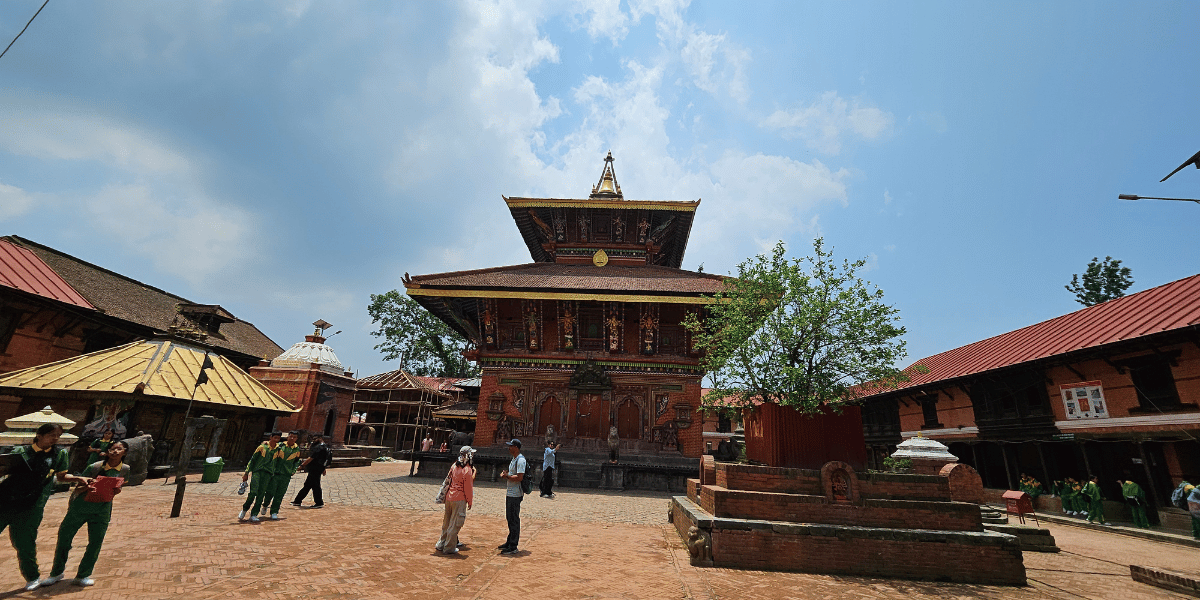
The primary temple structure is mainly constructed from brick and timber, while its roofs are made of gilded copper (meaning plated with gold).
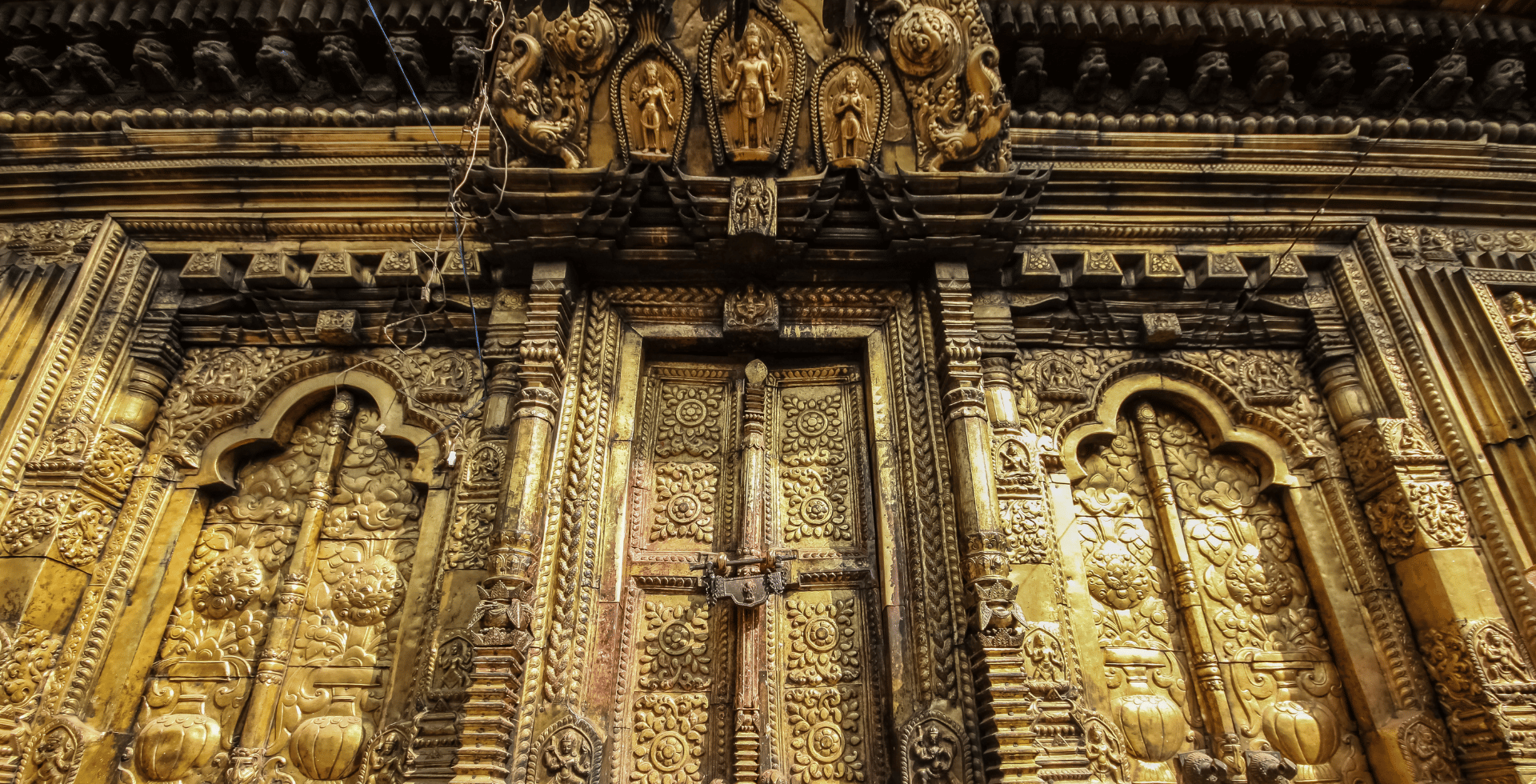
Likewise, the entrances on all four sides are decorated with beautifully carved wooden doors and decorative toranas.
Clearly, the temple complex is a beautiful fusion of the artistic traditions of the Lichhavi and Malla periods. On the pillars in the temple courtyard, there are four divine belongings of Lord Vishnu: the Sankha (conch), Chakra (disc), Gadaa (mace), and Padma (Lotus).
Moreover, the temple is surrounded by smaller shrines, sculptures, stone inscriptions, and rest houses (Pati or Falcha).
The Main Shrine of Vishnu
The main deity, Lord Changu Narayan (Vishnu), is housed in the sanctum (garbhagriha). Note that Garbhagriha is accessible only to authorised Hindu priests during religious rituals, so no visitor is allowed to enter!
This sanctum is entered through four gilded doors, one on each cardinal point: East, West, North, and South. And the famous 5th-century statue of Garuda in a devotional pose at the western entrance guards the shrine inside.
Additionally, Changu Narayan is one of the most important and oldest living centres of Vaishnavism in Nepal.
Sacred Rice Grain
Just above the main entrance of Changu Narayan Temple (First tier, in between the struts on the left side), on the wall, you can see half of a rice grain, which is believed to be from Satya Yuga.
It is believed that during Satya Yug, Chamal (Rice Grain) without husk used to grow, and one piece was enough for a number of people. Those rice grains during that time used to be six inches in diameter and one foot in length.
According to a local legend, one day, a woman was alone, and when she was cooking, she thought that one grain would be more than enough for her and felt greedy, thinking she would save it for later. So, she cut the grain into pieces. Since then, chamal didn't grow directly; instead, it grew with husks.
Many consider the rice grain seen on the wall of the temple to be the same one that the woman cut.
Roofs, Struts, and Carvings
The roof of the temple is two-tiered and constructed with timber framing and covered with small overlapping terracotta tiles. Likewise, the roof edges and spouts are decorated with gilded brass ornamentation.
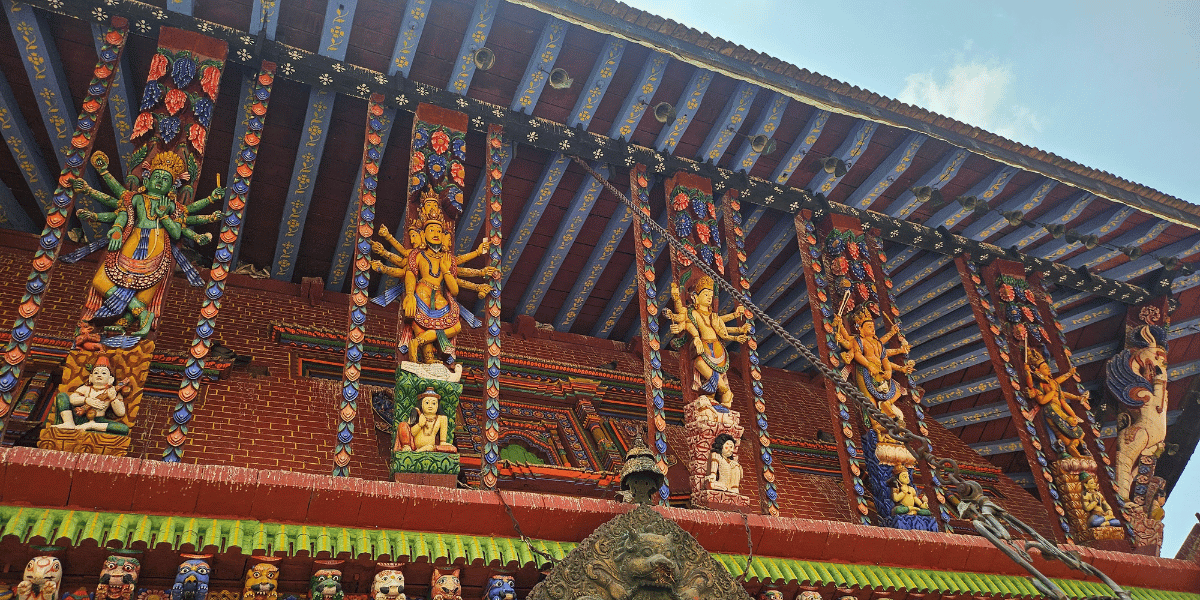
The overhanging edges are held up by beautifully carved wooden struts (tundals), which are one of the most famous artistic features of the temple. These struts portray multi-armed Tantric deities, various versions of Lord Vishnu, and other holy Hindu deities.
Some of them are: Matsya (Fish Avatar of Vishnu), Kurma (Tortoise Avatar), Varaha (Boar Avatar), Narasimha (Man-Lion Avatar), Vamana (Dwarf Avatar), Parashurama, Rama, Krishna, Buddha, Kalki, Manjushri, Brahma, griffins, etc.
Moving forward, even the temple’s windows, doorways, toranas (ornamental pediments), and roof struts are richly decorated with elaborate carvings of deities, mythical creatures, floral designs, and sacred symbols.
All of these show the extraordinary artistry of the Nepalese craftsmanship!
Restricted Areas and Access
Being an active Hindu place of worship, Changu Narayan Temple’s certain parts are governed by long-established religious customs. Here’s what you should know:
- Firstly, only Hindus are allowed in the main temple for worship.
- The Garbhagriha (sanctum) is the most sacred part of the temple and is accessible only to the temple priests who perform the daily worship and rituals. It contains the main idol of Lord Changu Narayan (Vishnu). Even Hindu visitors are not allowed to enter that holy space (so, getting a blessing from afar is the only option).
- If you are non-Hindu, then you’re permitted to walk around the temple courtyard and explore ancient sculptures, inscriptions, and shrines, and appreciate the architectural plus artistic legacy of the site.
- You are urged to keep the traditional practices of a sacred Hindu site, such as removing shoes plus leather items before stepping on the temple plinth, respecting restricted areas, and listening to the guidance of temple officials.
Other Temples and Shrines in the Complex
Besides the main Changu Narayan shrine, the complex contains a number of additional temples and shrines dedicated to Hindu deities, such as Shiva, Shakti, and Vishnu.
In these shrines, we can see the centuries-old religious harmony where various Hindu traditions coexist.
Chhinnamasta Temple
Chhinnamasta Temple is dedicated to the Goddess Chhinnamasta (“the beheaded one”), one of the ten Mahavidyas (Great Wisdom Goddesses) of the Shakti tradition.
She is regarded as a powerful, fierce goddess of self-sacrifice, transformation, and the embrace of life and death. People of Changu honour her as a local manifestation of Goddess Kali.
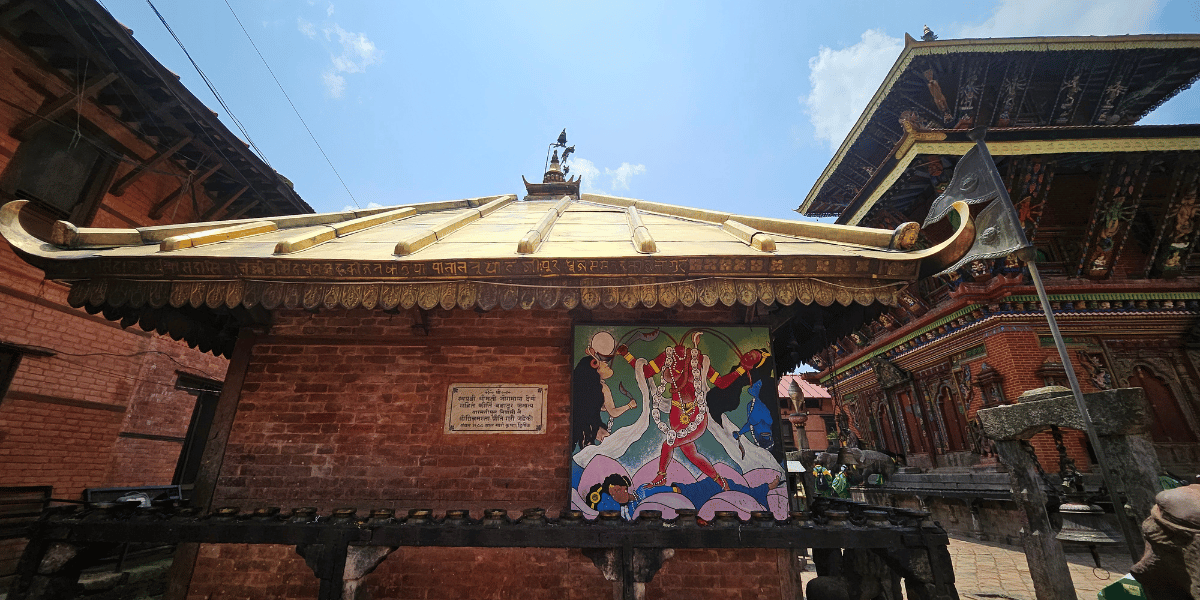
The goddess earned the name “Chhinnamasta” after beheading herself with a scimitar (called Kartrika) and offering her own blood to feed hungry devotees, Dakini and Varnini (and herself). You can even find a painting hung on one of the temple walls that depicts this legend:
- She’s seen wearing a serpent as the sacred thread (yajnopavita) as well as a mundamala (a garland made of human skulls).
- Her breasts are covered by lotus flowers and strings of beads.
- She holds Kartrika in one hand and her head in the other.
- And you’ll see blood flow from her decapitated head in three jets. The middle jet flows into the mouth of her own, while the other two jets fall into the mouths of Dakini and Varnini.
Vaikuntha Vishnu
A 16th-century sculpture of Vaikuntha Vishnu at the Changu Narayan Temple is a masterpiece of the Malla era.
It portrays Vaikuntha Vishnu with multiple arms and heads, seated in Lalitasana position on top of a six-armed Garuda (his divine vehicle/vahana). You can also see that Goddess Lakshmi (Laxmi) is seated on Vishnu’s lap, providing him with the essential female energy.
Vishworup
There is a remarkable sculptural representation of Vishnu in his Vishwarupa form. This beautiful sculpture portrays the scene from the Bhagavad Gita where Lord Krishna displays his universal form to Arjuna.
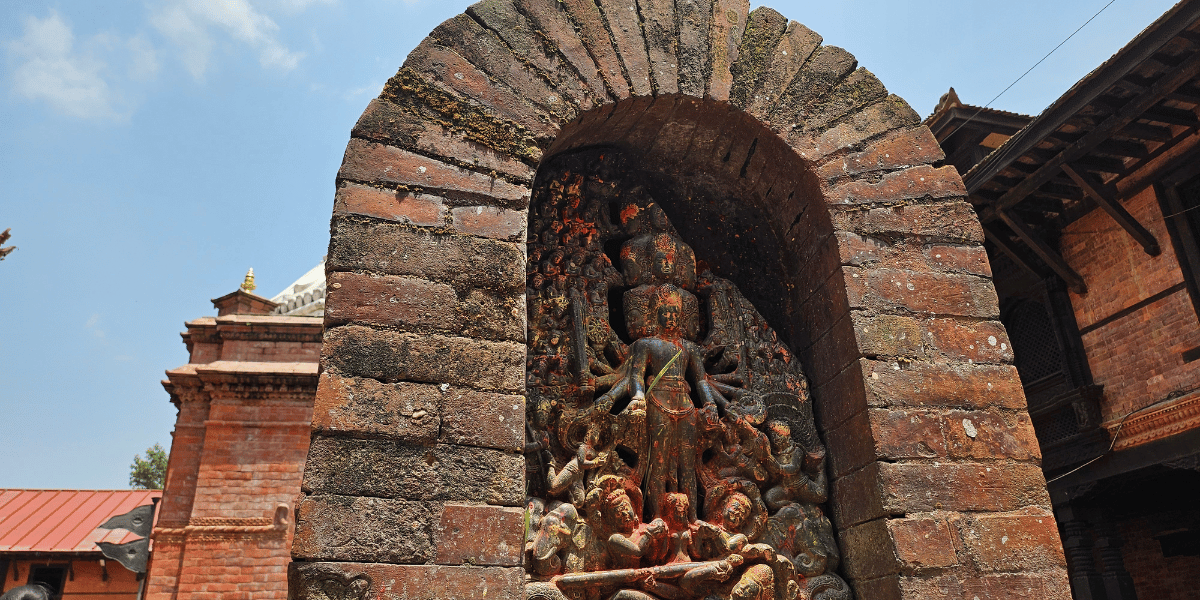
Vishnu, the principal figure, stands firmly in the centre of the composition. Similarly, the sculpture is divided into three levels: the netherworld (hell or Narka), the terrestrial world (human realm or Bhu Lok), and heaven (god realm or Baikuntha or Sworga).
Likewise, this is a figure of the 7th century, unmatched in beauty and theme. There is not a single Licchavi sculpture that can be compared to this one.
Reportedly, it was attempted to be stolen several times from the temple in 1981.
Vishnu Vikrant
Vishnu Vikrant is another magnificent work in Changu Narayan and is widely referred to as “Trivikrama Vishnu”.
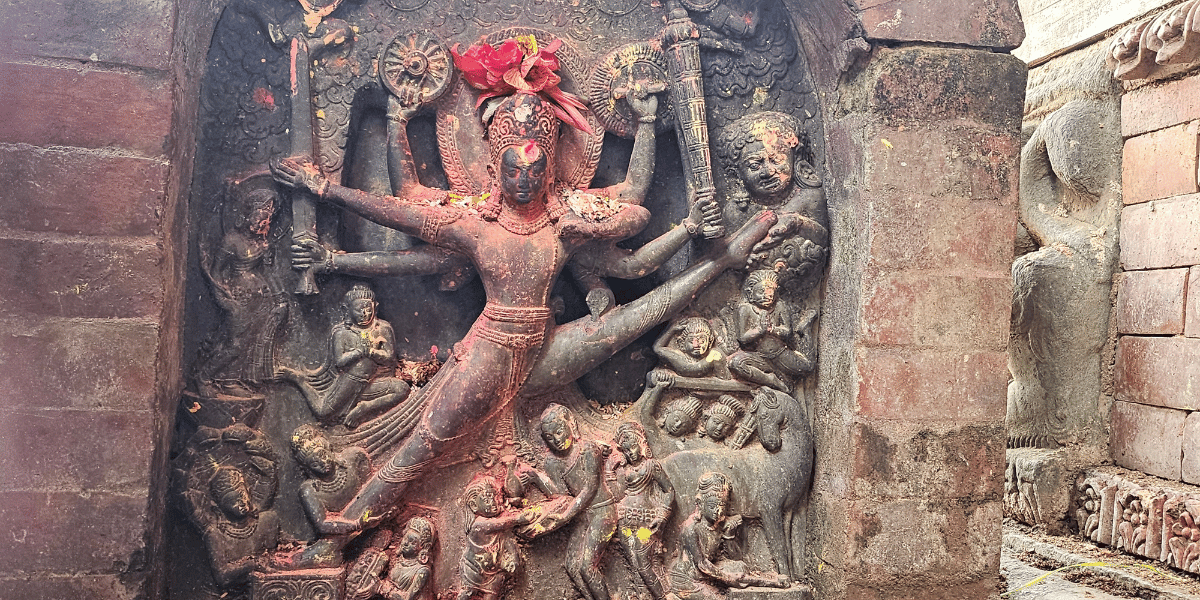
This sculpture is also from the 7th century, and in the lower panel of the statue, you can see offerings made by King Bali to Vishnu.
Narasimha
There are so many 7th-century sculptures in Changu Narayan that will awe you. Moving forward, the idol of Narasimha is also from the same century.
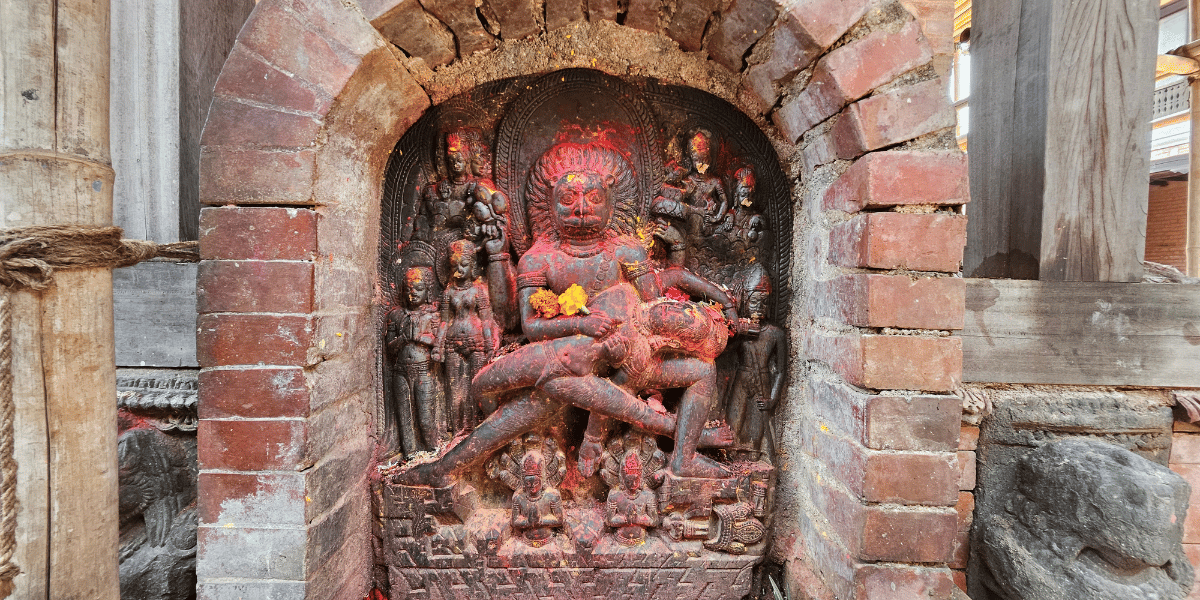
This sculpture depicts the fierce half-man, half-lion avatar of Vishnu in the act of killing the demon king, Hiranyakashyapa.
Likewise, the image symbolizes the victory of cosmic righteousness (Dharma) over evil. It is a lively ancient depiction of the Narasimha avatar, carved in bas-relief style in the Licchavi era.
Kileshwor Mahadev Temple
Kileshwor, a small, two-storied traditional temple, is the main Shiva shrine in the complex of Changu Naryan. The temple houses a Chaturmukha Lingam (four-faced like the one in Pashupatinath Temple) with human faces looking towards the four cardinal directions and one invisible face (Ishan) towards heaven.
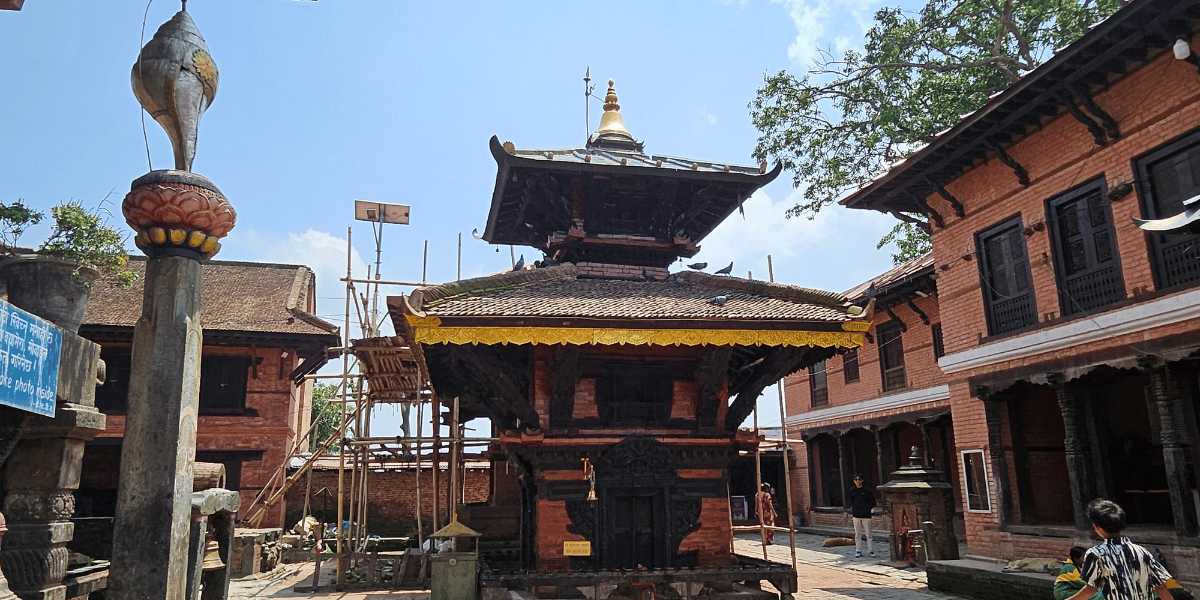
You can see an impressive collection of carved wooden struts supporting its double roofs with incarnations of Shiva and some interesting erotic images here.
There are four doors, and they are modelled on those of the main temple. The main entrance is gilded in metal, and the other three are carved in wood.
It is believed that there was a war for so long that the Dolagiri (Changu) hill started to move as if an earthquake had occurred. So, Lord Vishnu prayed to Lord Shiva for the protection of this place. As a result, Lord Shiva established himself as a shiv linga (killa), and this form was named Kileshwor Mahadev.
As if honoring its legendary name, the temple suffered from the earthquake in 2015 (with its base having major damage), but surprisingly, it did not collapse!
Statue of Malla King and Queen
You can see the statue of King Bhupalendra Malla and his wife, Bhuvanlaxmi, in a gilded cage in front of the main entrance of Changu Narayan Temple.
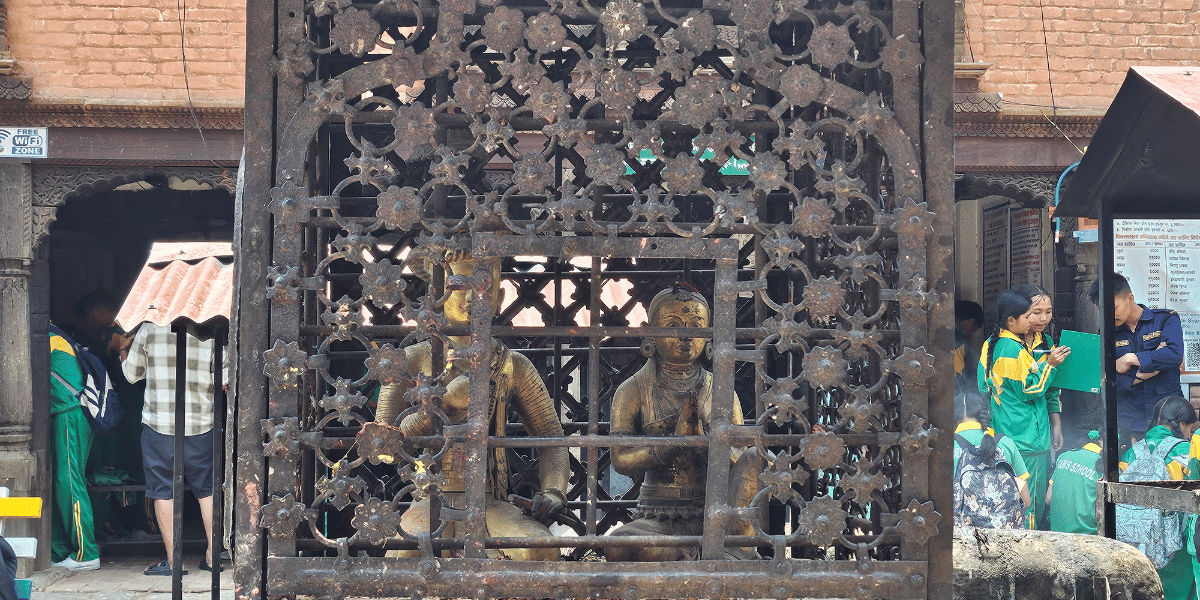
Bupalendra Malla was the eleventh king of Kantipur, and he was the one who renovated the temple of Changu Naryan in the 17th century AD. Later, he established the enthroned statue of himself and his queen in front of the temple.
Historical 464 AD Inscription Pillar
Now, let me take you to one of the proud collections of the Changu Narayan complex. Yes, this historical stone pillar with an inscription is antique to Changu Narayan.
In fact, this inscription is one of the oldest and most significant epigraphic records in Nepal’s history that was engraved in the Licchavi period. It was established by Mandev in 464 AD and is also termed the “464 stone pillar”.
Garuda
At exactly the front of the temple, there is a beautiful statue of Garuda, dating back to the 5th century Licchavi period. This was built by King Mandev again. After winning battles in the eastern and western parts of his kingdom, he donated this Garuda Statue to the Changu Narayan Temple.
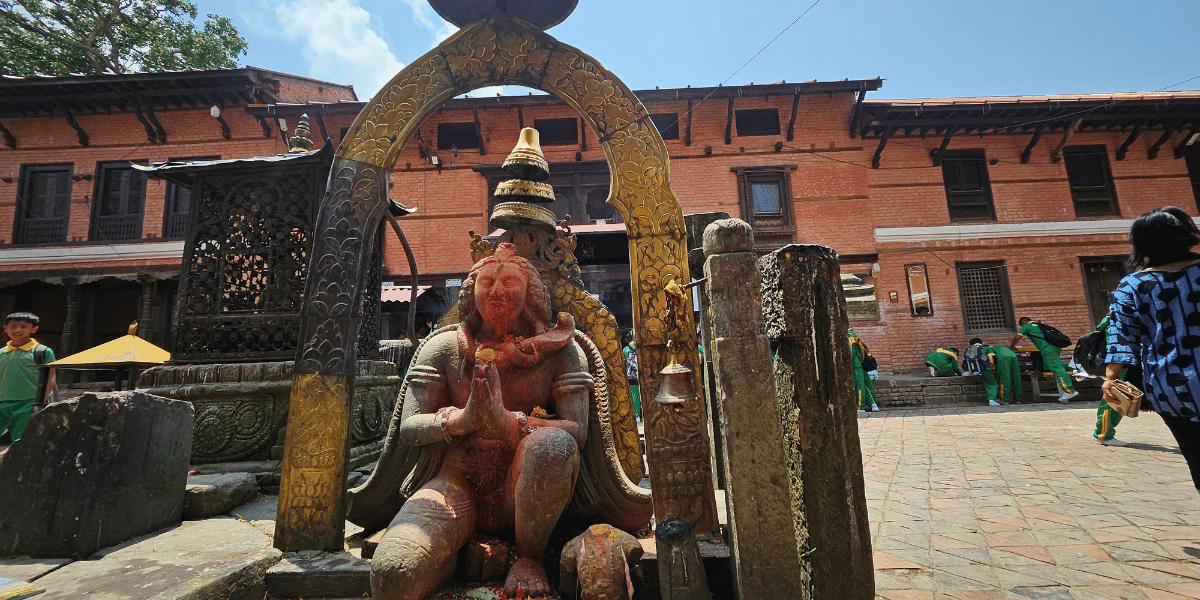
It is also believed that Mandev himself was the inspiration for the human figure of the Grand Sculpture. Garuda is the flying vehicle of Lord Vishnu, and this human-faced Garuda that looks like ‘Mandev’ shows that he was a great devotee of Vishnu.
Chanda Narayan (Garuda Narayan)
It is another exquisite 7th-century stone sculpture inside the Changu Narayan Temple premises. This sculpture depicts Lord Vishnu riding his celestial mount, Garuda.
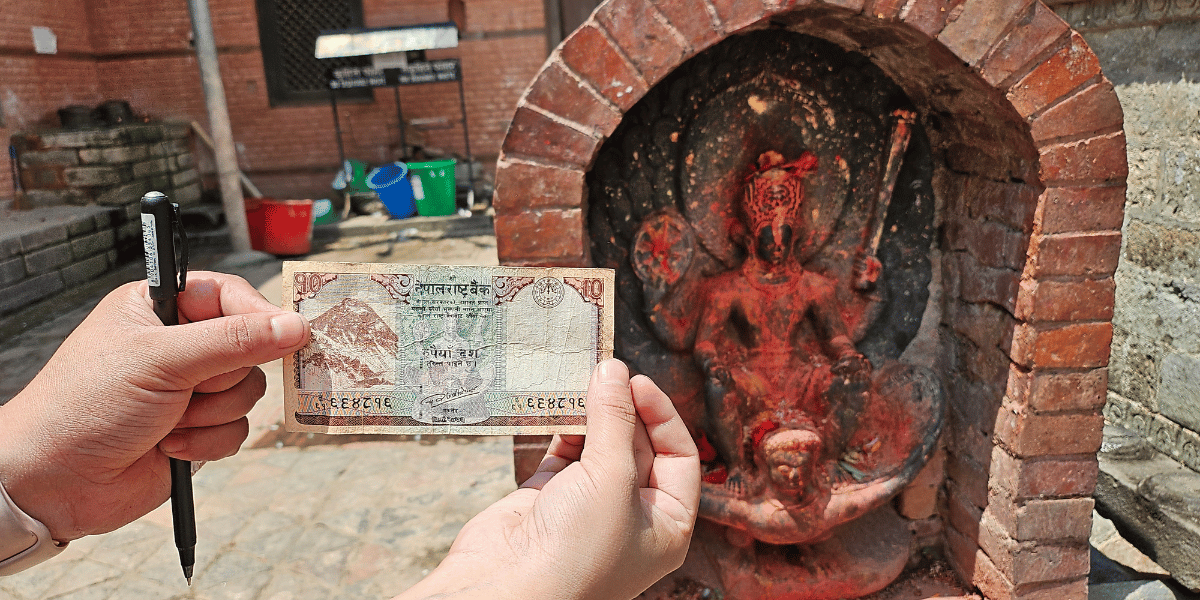
The sculpture is carved with exceptional quality and a brilliant, imaginative aptitude. The cultural importance of Chanda Narayan is so high that this exact sculpture is depicted on the Nepali 10-rupee paper note too!
Sridhar Vishnu
Built in the 9th century AD, this sculpture of Sridhar Vishnu is a magnificent stone masterpiece.
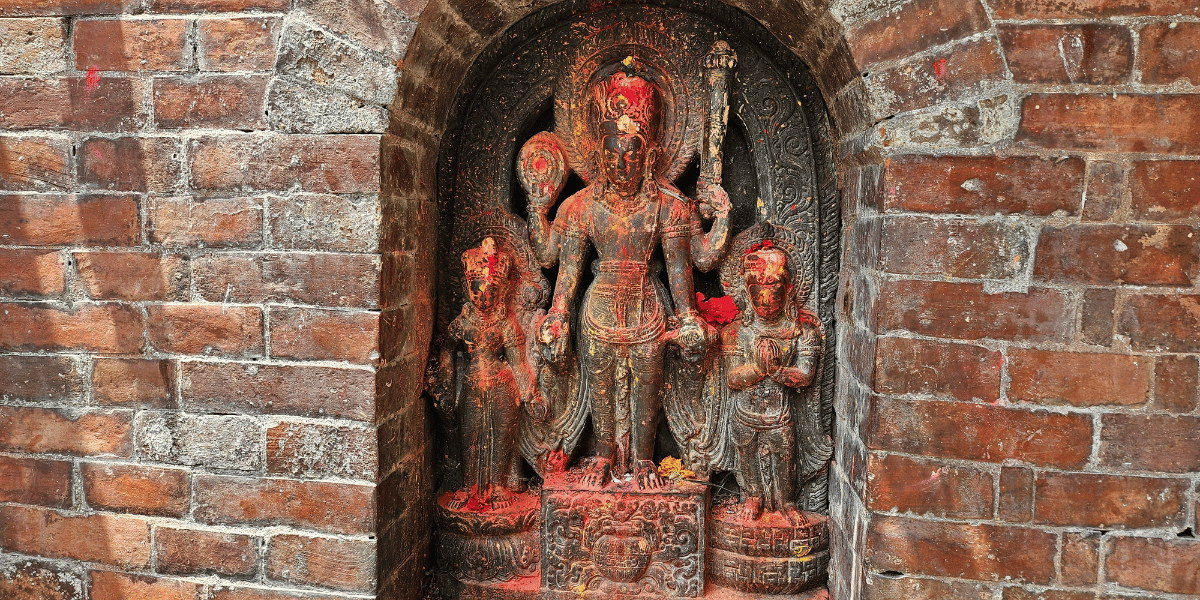
Located just north of the main entrance of the temple, it features Lord Vishnu with Goddess Lakshmi and his celestial mount, Garuda, showcasing Nepal’s rich ancient artistry.
Badeshwar Mahadev Temple
Badeshwar Mahadev is next to Chinnamasta Temple and is considered one of the different forms of Lord Shiva. Symbolically, “Badh” in Sanskrit means to kill or destroy, and “Ishwor” means God.
And if you know, Lord Shiva is also called the “God of Destruction”, one who has the power to kill and destroy everything! He takes different forms as per the need to protect his devotees.
A Mysterious Unfinished Stone Elephant Sculpture
Just beside the Chhinnamasta shrine, there is a mysterious unfinished stone elephant sculpture. According to local legends, while the artist was carving the statue, blood started to flow from the stone.
After this, the artist was scared and didn’t attempt to touch or finish the statue. As a result, the statue remained incomplete.
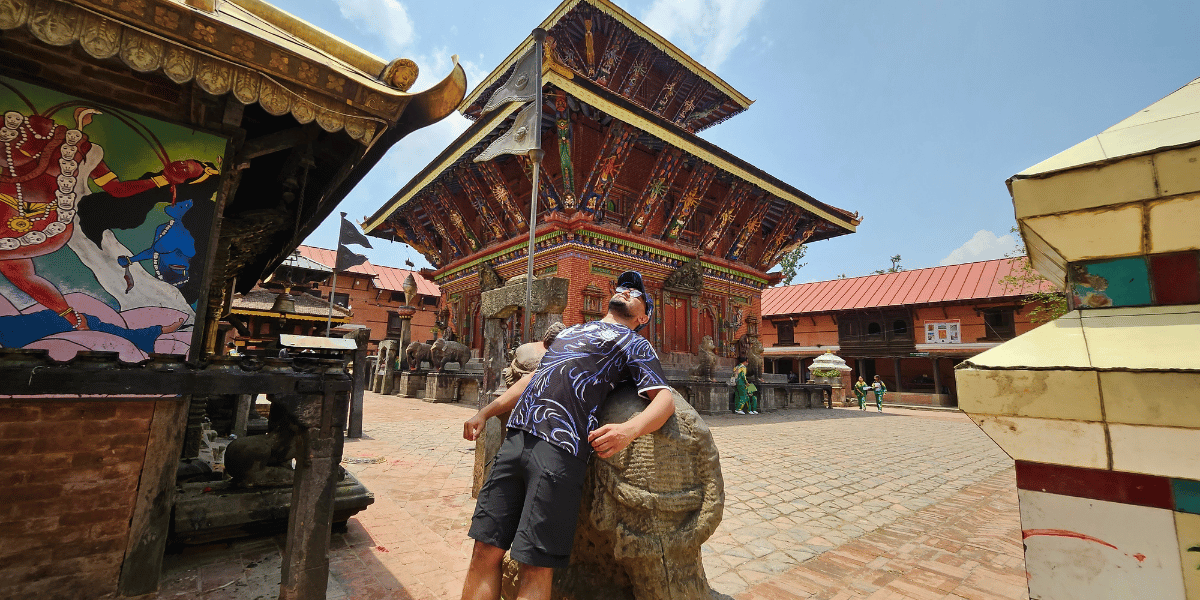
Interestingly, it is also believed that if people with back pain lie back on the statue of the elephant, then their backache gets relieved. So, if you see someone doing this, don't be surprised. Even on our visit, my team and I tried this to be a part of this unique local tradition.
Other Shrines and Temples to Visit Inside the Grounds
Besides the main temple, the Changu complex includes a number of small shrines and temples, each with a history and importance of its own:
- Ganesha: There are holy shrines to Lord Ganesha in and around the complex. Ganesha, the God of Wisdom and Good Fortune, is believed to be the lord who removes obstacles.
- Somalingeshwor Mahadev: Somalingeshwor Mahadev temple is situated near Changu temple, where Lord Shiva is adored for peace, security, and spiritual well-being.
- Natyeshwor Temple: Natyeshwor or Nateshwor is a form of Lord Shiva associated with dance, music, and art performances. And you can find his idol inside the premises too.
- Kanti Bhairav: Kanti Bhairav is a fierce form of Lord Bhairav (a manifestation of Shiva). It is in the western entrance and is dedicated to Lord Shiva.
- Krishana Temple: This is a small temple dedicated to Lord Krishna as the divine protector and incarnation of Lord Vishnu.
- Madhab Narayan: It is a temple of Madhab Narayan, a form of Lord Vishnu, who is worshipped for protection, prosperity and preservation. It is also believed that Madhav Narayan was there from the time of Swasthani.
- Ashta Matrika Shrines: Ashta Matrika Shrines are a set of shrines dedicated to the Ashta Matrika, also known as the Eight Mother Goddesses, as they are considered powerful protectors in Hinduism.
- Bhimsen Pati: Bhimsen Pati is the largest pati in Changu Narayan. Located near Balampu Pati and made during the Malla Period, this Pati consists of statues of Bhimsen, Draupadi, Jaya, and Vijaya.
Cultural Exhibits and Museums
Popular for its ancient temple architecture and sculptures, Changu Narayan is also well known for its many museums, galleries, and traditional art collections dedicated to the preservation of Nepal’s cultural heritage.
Changu Museum: Private Museum
The Changu Museum is regarded as Nepal’s first private museum. Baishnav Raj Shrestha is the founder, and he established it in 2057 BS (2000 AD).
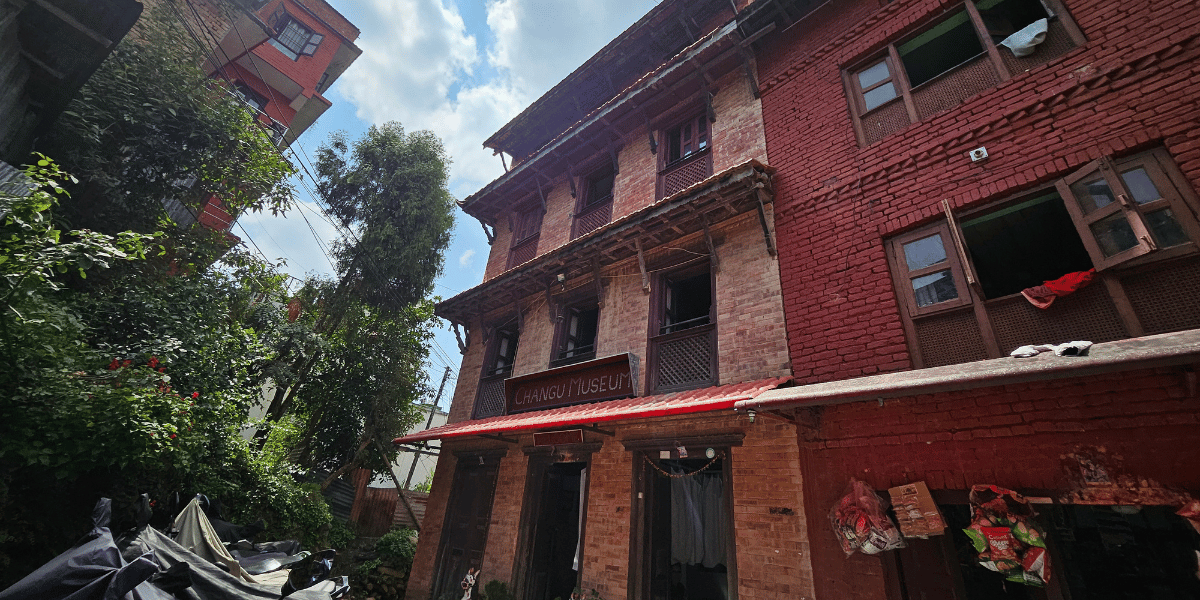
It is located on the main way to the Changu Narayan Temple, which mainly preserves archaeological objects. In addition, it is dedicated to the preservation of traditional village life, indigenous culture, historical tools, coins, agricultural equipment, and household objects that were once common among Nepali communities.
Furthermore, the museum was established to preserve the gradually disappearing parts of Nepal’s traditional way of life so that it remains accessible to coming generations.
The ticket price to enter this museum for Nepalese is NPR 100 and for tourists is NPR 300 (for both SAARC and non-SAARC nationals).
Here are the items that this museum preserves:
- Traditional Household Objects: Kasari, Kasaricha, Handi, Bhajan, Chabhajan, Karai, Spoons, Phosi, Phosicha, LohanBhu, Lohan Khola, Cha Khola, Wooden Plate Stand, Water Pots, Wooden Pots
- Traditional Weighing Instruments: Pathi, Chule Pathi, Pyang Pathi, Kule (Mana), ½ Mana, ¼ Mana, ⅛ Mana
- Traditional Musical Instruments: Dholak, Jhyalicha, Bhamara, Muhali, Gujarati, Dhime, Bhusyah, Jhyalee, Nayakhin, Khin, Harbin, Tamal, Baam, Bansuri
- Weapons and Military Objects: Khunda, Khadga, Tarwar, Dhal, Bhala, Khukuri, Karda, Trishul
- Traditional Agriculture Equipment: Chandya, Kakicha, Khurpa, Kukicha, Een, Pacha, Pa
- Coins and Rupee Notes Collection: Coins of King Gyanendra (2001–2008), Coins of King Birendra (1972–2001), Coins of King Tribhuvan (1911–1954), Coins of the Shah Kings (1768–1911), Coins of the Malla Kings (13th Century–1768 AD), Coins from the 12th Century, Paper Notes of King Mahendra, King Gyanendra, and King Tribhuvan.
- Paddy collection from more than 200 years old
- Other Items: Distillation Pots, Dhiki, Jaato, Traditional Nepali Caps, Lakhe Dance Costumes, Ritual Object, Ancient Manuscripts, Deer’s Skin, Fishing Net, Meteorites and Fulgurites, Navel of Musk Deer, Gallstone of Cow
Living Traditions Museum
The Living Traditions Museum (LTM) is one of the most important ethnographic museums in Nepal and is located inside the restored Amatya Sattal, just next to Changu Narayan Temple.
The museum was established by American citizen Judith Conant Chase to preserve Nepal’s living heritage and officially opened in March 2012 in collaboration with the Department of Archaeology and the Guthi Sansthan Local Community.
This museum is different than other museums of Bhaktapur and is dedicated to the living cultural practices of Nepal’s many ethnic communities.
The museum features artefacts and displays on ethnic groups from the Kathmandu Valley, the Terai, the Middle Hills, and the Himalayan Highlands. Furthermore, it also makes an effort to preserve customs that are still in practice today.
History of the Museum
The museum contains a private and impressive collection of Judith Chase (the founding director), which she collected over 35 years in Nepal. She first visited Nepal in 1974 and became very interested in Nepal’s traditional arts and crafts.
Judith was particularly inspired after finding a handwoven bamboo umbrella during her trek in Ghandruk. Later, she returned to Nepal on a research visa to study traditional art.
For the next 18 years, she travelled across the country, learned different practices and traditions, documented disappearing traditions from local communities, and collected objects that depicted Nepal’s cultural diversity.
Rather than keeping her collection of these handicrafts private, she made it public with the help of the US Ambassadors Fund for Cultural Preservation and Guthisanstha, with support from the Department of Archaeology.
Although this museum was destroyed in the 2015 earthquake, it was later reopened to the public after 8 years.
Museum Showcasing Nepal’s Cultural Diversity
The collection includes Himalayan bamboo butter tea churns, various Newari brass pitchers from the Kathmandu Valley, and Mithila ceremonial murals.
Looking at these objects helps you imagine how they were used in the past. These are everyday objects that feel special because they have a sense of life and history, from years of use in homes and rituals.
Moreover, the collection of objects has been divided into four sections based on the three major geographic regions of Nepal: the Terai, the Mid-Hills, the High Himalayas, and one section is dedicated to the Kathmandu Valley.
Each area has a variety of objects that portray the different traditions and practices there, including religious objects, cooking implements, paintings, tools, and clothing.
When walking through the museum, you will feel like looking at an artwork of Nepali culture that cannot exist anywhere.
Here’s what each section features:
- Himalayan Region: Butter tea churns, Yak equipment, Woollen clothing, Household tools, Religious objects
- Middle Hills: Farming Tools, Clothing, Musical Instruments, Ritual Objects
- Kathmandu Valley: Newari Utensils, Metal Crafts, Festival Objects, Traditional architecture, Religious Artefacts
- Terai Region: Mithila Ceremonial Paintings, Agricultural Tools, Household Utensils, Indigenous Cultural Objects
Note: The name of the Open Sky Museum is mentioned in some brochures and maps. This museum is located in Changu Narayan near Bhimsenthan. But, currently, it is closed to visitors as conflicts are going on related to the ownership of certain museum objects. This has led to limitations in public access; the matter is being figured out, and hopefully, we get to visit the Open Sky Museum soon.
Crystal and Coin Collection Gallery
Within the historic premises of Changu Narayan, you can also visit several galleries and souvenir shops.
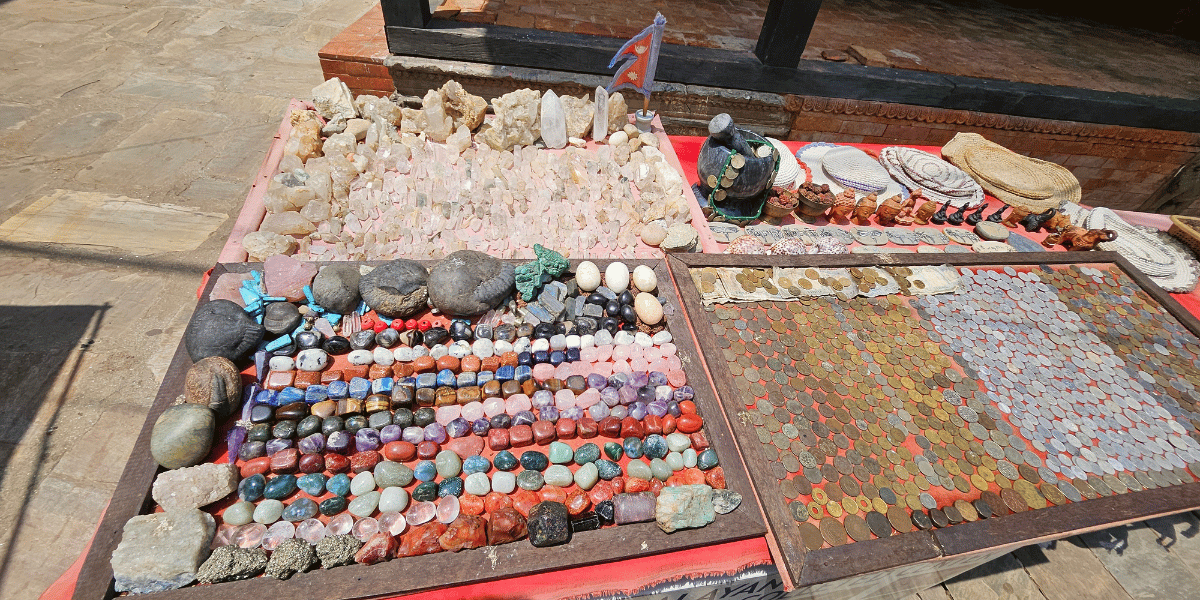
These shops offer a fascinating and amazing variety of Himalayan Crystals, Antique Collections, Old Coins, Rare Paper Notes, Tiger Stones (Tiger’s Eye), Moon Stones, Healing Stones, Black Agate, Labradorite Stones, along with other crystals and gemstones.
Thangka Painting Schools and Galleries
If you are thinking that your visit to the Changu Narayan temple is all about exploring the historical monuments, then prepare your mind for something distinct and extra.
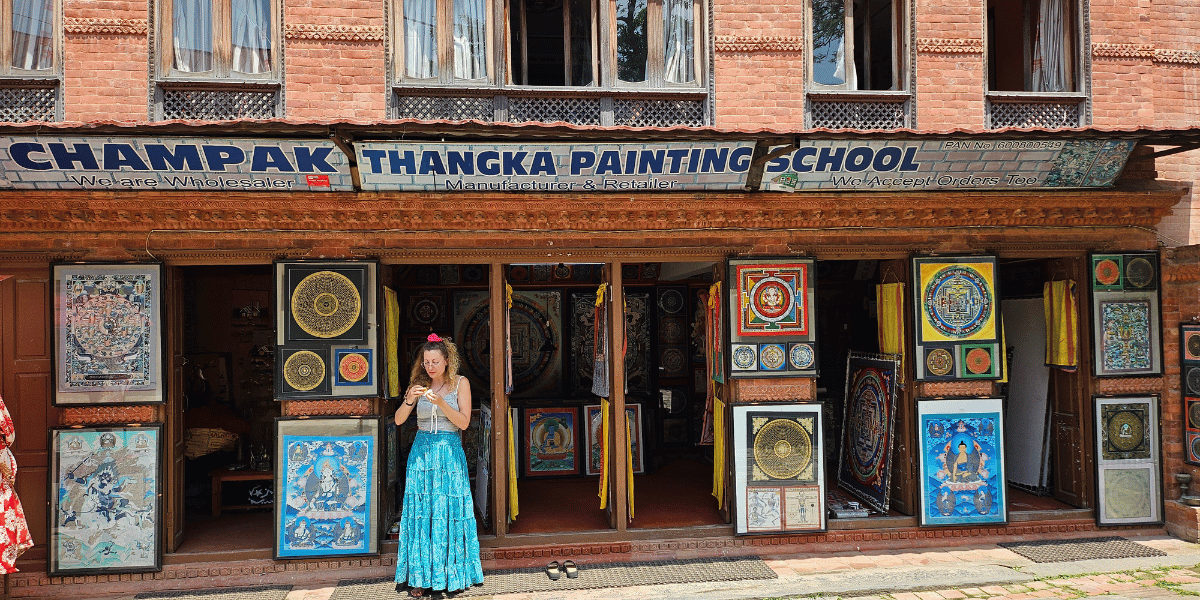
The temple offers more than monuments; there are several traditional art galleries, including Thangka painting schools and handicraft shops. These shops and galleries have contributed a lot to keeping the art of thangka painting alive for centuries.
Here, you can witness skillful artists who are busy painting thangkas with hand detailing, Newar Paubha paintings, along with Hindu and Buddhist Mandalas. These techniques are passed down through generations, so if you like any of the paintings there, you can purchase them at an affordable price that helps the local economy!
Note that the price for Thangka paintings in Changu Narayan may vary as per the vendor, difficulty, and materials used while painting.
Additionally, the schools/stores here give you the opportunity to let you meet the local Thangka artists, interact with them, and learn about these paintings. So, when you’re here, be sure to ask them about the meaning and symbolism of the paintings they are making.
Moreover, if you are interested in Thangka and want to experience it yourself, you can also join the sessions and workshops they provide. You can get options like an introductory session and extended courses that last 3-4 days to even a week!
Other Attractions in Changu Narayan Municipality
Apart from the ancient temples and UNESCO World Heritage Site status, the Changunarayan municipality has a number of cultural landmarks, charming villages, and natural trails that offer a deeper glimpse into the region’s history, spirituality, and traditional Newar lifestyle.
Four-Handed Bhimsen Temple
This is a small and important shrine dedicated to Lord Bhimsen. He is regarded as the god of trade and strength in Newar culture.
The temple is situated on the small hillock of Kapahity. You can reach it from a small trail from Magam Tol, which takes roughly 5 minutes on foot.
You can see the idol of Bhimsen in his rare four-armed (Chaturbahu) form. It signifies divine strength, courage, and protection.
This is only the four-handed Bhimsen in the valley and is also known as Chaturbahu Bhimsen. People worship him to be blessed with power, strength, and courage.
Magam Tole
Magam Tole/Tol, a traditional Newari village, is a peaceful heritage village area where tourists can experience the authentic Newari lifestyle, traditional brick houses, narrow lanes, and local courtyards.
You can find several shrines and resting places (Pati). Here, you can even visit the Magam Ganesh shrine. Ganesh is installed in the wall of the local house and worshipped by the local community daily!
Changu Narayan to Nagarkot Hiking Trail
This trail covers a distance of approx. 15 km and takes approximately 4 to 5 hours to complete. It is a lovely trail linking the ancient Changu Narayan Temple to the hill station of Nagarkot.
Through this trail, you can pass through traditional Newar villages, terrace farmlands, cultivated fields, and peaceful forests. Also, you can enjoy stone-paved paths, forest tracks, small settlements, and local tea shops along with panoramic views of the surrounding hills.
Furthermore, as you gradually climb up to Nagarkot, the views of the Himalayas from there become increasingly magnificent in clear weather. This trail is suitable for hikers with moderate fitness and even for beginners.
Now, if you have enough time and want to extend your adventure, you can even hike from Nagarkot to Chisapani. Or choose to do the exact opposite: from Chisapani to Changunarayan via Nagarkot.
Shree Pancha Mahalaxmi Temple
The Shree Pancha Mahalaxmi Temple is located in a quiet place on a hilltop in Chyabasti, Changunarayan Municipality.
The beautifully constructed temple is dedicated to the Goddess Mahalaxmi. She is the Hindu deity of wealth, prosperity, and well-being.
In reality, the temple is not as famous as Nagarkot and Changunarayan, but if you’re looking around, this is definitely worth visiting!
In the temple, you can see modern architecture with several deities carved on the walls, struts, prayer halls, and an ashram where regular religious activities, such as bhajans, are conducted.
Some of the main attractions of this temple are: Shree Panchamahalaxmi Temple, Muktinath Shrine, Goshala (Cow Shelter), Sheesh Mahal, Vidyashram, Hayagrib Cave, and statues (of elephant, Shiva, Deer, etc.).
Other Nearby Attractions From Changu Narayan Temple
There are several nearby attractions around Changu Narayan that are worth exploring.
Here are a few: Sarasoti Temple, Balampu Pati, Bhajan Pati, Bhairab Pati, Narayan Hiti Dhara, Nwahiti, Shankha Dha, Ancient Stone Water Spout, Gaon Dhoka Pokhari, Champakpur Ganesh, Sindurkhwa Pokhari, Nagarkot View Point, Madhyapur Thimi, Bhaktapur Durbar Square, Taumadhi Square, Dattatreya Square, Pottery Square, etc.
Beyond Attractions: People and Daily Life
Changu Narayan Municipality is all about living communities, traditions, livelihoods, and cultural practices.
Duwakot, Jhaukhel, Changunarayan, Chhaling, Nagarkot, Bageshwari, Sudal, and Tauthali are the towns/villages inside Changunarayan Municipality.
Ethnic Composition of Changu Narayan Municipality
According to the 2021 census, the three major ethnic groups in the municipality include:
- Kshetri: 23,209
- Newar: 22,759
- Brahmin: 16,552
Besides these, there are several other ethnic groups residing in the municipality, like Magar, Tharu, Tamang, Yadav, Rai, Musalman, Gurung, Thakuri, Pariyar, etc.
Main Sources of Income and Livelihood
In Changunarayan Municipality, there is a mixed economic structure. Some of the people are engaged in agriculture, some in tourism, while others are in service-oriented occupations.
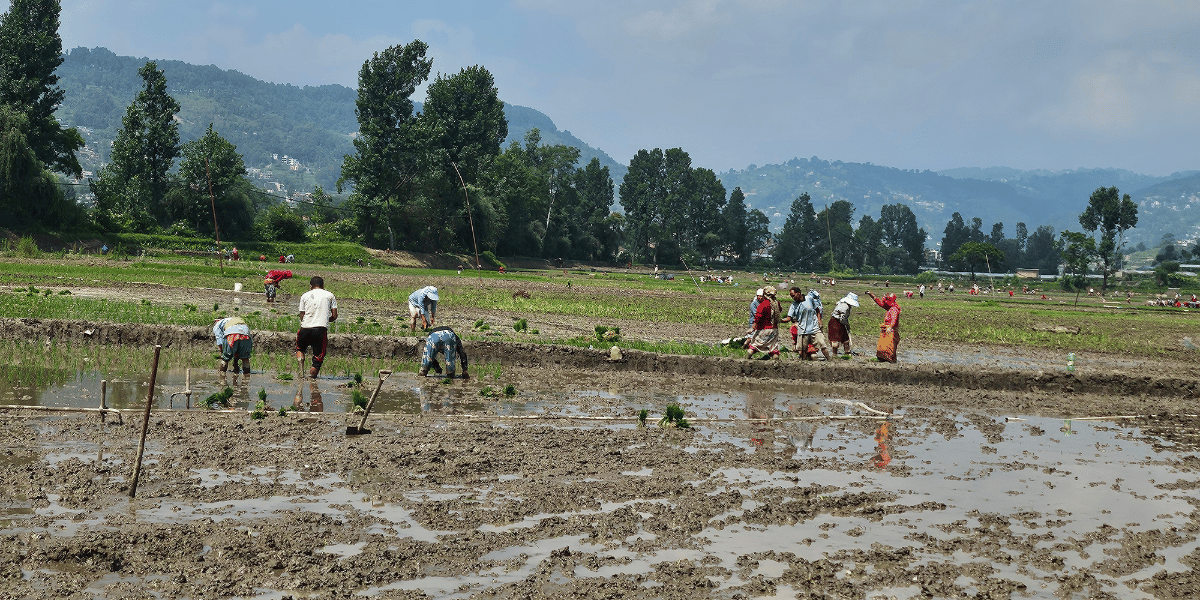
Many households are still engaged in farming, vegetable cultivation, and even animal husbandry.
Moving forward, the people from nearby areas of Changu Narayan and Nagarkot are engaged in the tourism sector, and it has become a growing source of income.
Some of them own their own hotels and restaurants and sell handicraft items and souvenirs, while others work as guides, inside handicraft factories, and in small local shops.
Moreover, many people are working in government services, education, small businesses, construction work, transportation, etc.
Festivals and Cultural Life
Festivals play a significant role in people’s lives, and they are deeply connected with cultural traditions. And just like how people vibrantly celebrate Bisket Jatra (over 9 days) or Gai Jatra in other parts of Bhaktapur, the municipality of Changunarayan has its own festival charms.
The main festivals celebrated in Changu Narayan are Harishayani Ekadashi, Haribodhani Ekadashi, Changu Narayan Jatra, Mahashanan, Jugadi Nawami, and Naag Panchami.
Haribodhani Ekadashi
Haribodhani Ekadashi carries great significance in the religious calendar all over Nepal, including the Changu Narayan region.
As we already discussed, Changu Narayan is a Vishnu temple, and Haribodhani Ekadashi is considered an auspicious day because it signifies the day as the end of the resting period of Vishnu. It is believed that this day is the end of the four-month resting period of Lord Vishnu, also called Chaturmas. On this day, Lord Vishnu is awakened from his cosmic sleep.
On this day, a large number of people, especially the devotees of Lord Vishnu, keep a fast and worship him. People believe that keeping a fast on this day and worshipping will bring blessings for well-being.
People from different places in the valley gather and worship with great dedication and enthusiasm. The temple resonates with the sounds of bhajans (hymns) on this day!
Harishayani Ekadashi
Harishayani Ekadashi is the beginning of Chaturmas. It is believed that Lord Vishnu goes to sleep in the cosmic ocean for four months. This day is also celebrated as Tulsi (Basil) Ropne Din.
Changu Narayan is filled with devotees on this day too. Similar to Haribodhani Ekadashi, devotees keep strict fasts, visit the temple, worship, and ask for prosperity and progress as blessings.
Changu Narayan Jatra
Changu Narayan Jatra is the main Newari festival in the Changu Narayan area and is celebrated in the month of Baisakh, on the day of Mother’s Day (Matatirtha Aunsi).
According to the locals, on this day, Vaat ko Deuta is worshipped and thus is also known as Vaat Jatra. This festival is celebrated for 7 days.
People take Bhairab of Changu to Bhairab Than on the way to Brahmakhel. They worship him there. Once the puja and hom are completed, he is again brought back to Changu Narayan and worshipped.
Bhairab Than is also known as the home (Maiti) of Chhinnamasta. During this Jatra, they also worship Chhinnamasta, Narayan, and Kileshwor on the temple premises.
Nag Panchami
Nag Panchami is a Hindu/Nepali festival dedicated to the serpent god, or Naag. It is observed on the fifth day of the bright half of the Nepali month of Shrawan in the lunar calendar.
The Basuki Naag deity in Changu Narayan is offered milk, ghee, and other items, and a huge number of devotees gather around Shankha Daha, near the main temple. It is believed that worshipping here during Nag Panchami brings blessings, fulfils wishes, and eradicates the problem of snakes in houses.
Mahashanan
Mahasnan, a major festival observed at Changu Narayan Temple, is celebrated on the 12th day of the waxing moon of Dhanya Purnima in the month of Mangsir. Mahasnan festival is interesting because it is celebrated for six days from Marga Sukla Ayakashi.
Here’s its day-by-day breakdown:
- On the first day, Guthi Sansthan performs an invitation puja to call gods and goddesses to begin the Mahsnan festival.
- Likewise, on the second day, a special puja is performed by the Guthi Sansthan, and the Changunarayan statue is cleansed with Panchamrit (a mixture of honey, ghee, milk, sugar, and yoghurt).
- On the third day, a feast is organized for Bhadel, a group of people at Changu Narayan.
- On the fourth day, Guthi Sansthan offers vegetarian food to thirty-six priests of the temple.
- Again, on the fifth day, rice pudding and animal sacrifices are offered to the gods and goddesses.
- Finally, the festival ends with Bida (Goodbye) Puja on the sixth day.
Kalash Jatra Festival
Kalash Jatra is one of the major annual festivals of Changu Narayan. It is celebrated twice a year:
- Shrawan Shukla Dwadashi (12th lunar day), three days before Janai Purnima in the month of Shrawan/Bhadra or August/September.
- During Poush Shukla Purnima, in the month of Poush (December/January).
During this festival, three sacred silver Kalash symbolizing Lord Changu Narayan are carried on foot from Changu Narayan Temple to Hanuman Dhoka in Kathmandu.
Three members of the Bhadel clan (helpers of Rajopadhyayas) carry kalashes (two small and one large), containing holy water from the Bagmati River. These silver kalashes are regarded as forms of the deity.
The procession is carried with the traditional Guruju Ko Paltan, classical musical instruments, and religious rituals performed at the Taleju Temple in the presence of the Living Goddess Kumari accompanying the procession.
During the procession, locals of Makkhan gather and smash the pots. It is because they believe that when a traveler sees smashed pots, they do not continue their journey and consider it an Apasakun (bad omen). Therefore, to stop the deity from going back to the Changunarayan Temple, they perform the ritual.
Tips for Visitors
If you take time to experience the local culture, cuisine, and traditions as well as the whole of the Changu Narayan Temple area, then your visit will be really rewarding.
After our personal visit to the Changu Narayan and nearby areas, we have prepared some tips to help you make your visit memorable and convenient. Here are a few:
- Plan a visit during the autumn season for colorful flowers and clear skies, but if you want to experience something unique and different, then plan your visit during monsoon season (June-August). During this time, you can witness paddy plantation and even participate with some locals in the area.
- Visit the temple early in the morning if you prefer fewer crowds; otherwise, you can visit anytime until 7 PM.
- If you are interested in participating in festivals and witnessing the local traditions, then visit during festivals like Haribodhan Ekadashi (November), Dashain (September/October), and Tihar (October/November).
- As this is a historical and cultural area, dress modestly.
- Follow the rules and regulations of the temple.
- Carry a hat, sunglasses, sunscreen, and a bottle of water.
- Do not touch ancient sculptures and monuments without permission.
- Do not litter. Dispose of the litter responsibly.
- Ask permission before taking photographs.
- Wear comfortable walking shoes.
- Carry NPR cash.
Local Food and Drinks to Try in Changu Narayan
When visiting Changu Narayan, you must try some authentic Newari cuisine. You can find these dishes in local shops or cafes/restaurants around the area.
Some of the dishes you can try in this part of Bhaktapur are:
- Chatamari
- Yomari
- Chhoila
- Bara
- Titaura (Sour Candy)
- Newari Khaja Set (Samay Baji)
- Juju Dhau
- Bakery Items
- Aila (Local Rice Wine)
- Nepali Thakali Khana
- Mo: Mo
Final Thoughts
In conclusion, the Changu Narayan Temple is a historical site that carries religious, spiritual, cultural, and traditional significance. It is the oldest surviving temple with beautiful wood carvings, ancient sculptures, and artifacts that is also connected with the country’s cultural identity.
Furthermore, every corner of the temple is filled with Nepal’s rich culture, arts, faiths, and beliefs of the people. Whether you are a history enthusiast, an architecture admirer, a pilgrim, or a traveler, Changu Narayan rewards you with all of these.
Hence, Changu Narayan is not simply a trip to an ancient site; it is an opportunity to connect with traditions, artistry, and history that are shaping Nepal’s cultural identity.
If you’re interested in visiting Changu Narayan, definitely check out these packages from our team at Altitude Himalaya: Kathmandu Photography Tour, 7 World Heritage Sites in 1 Day, and Kathmandu Cultural Tour.


 Garima Bhandari