Have you ever tried a food that has its own festival? Yes, I’m talking about Yomari! This traditional rice dumpling is prepared especially during Yomari Punhi. It’s a dish famous for its sweet flavor, connecting you with the traditions of the Newar Community.
Yomari is made uniquely, pointed at one end and hollow on the other. It resembles a teardrop or a fishtail and represents prosperity. The burst of sweetness coming from its fillings is a mark of celebration that gathers families and relatives.
This festival began centuries ago, but its importance and significance have remained the same to this day. One of the interesting things about the food is that every Newar gets to taste the delicious food at the age of just two! There is a traditional reason behind this, which I’ve mentioned in the latter part of this blog.
Along with that, I’ve covered all the necessary information about this unique and delicious food of the Newari Cuisine, Yomari. We’ll also get into its history, cultural significance, preparation, and health benefits. So, make sure to read until the very end!
What Is Yomari? Meaning and Origin
There are many chronicles and beliefs that surround the story of this sweet delicacy.
There are historical records found in Pashupati that date back to 1440, which state that this Newari sweet was initially called “Irhamadhe”. By the late 17th century, the name changed to “Elamādhe” and later evolved into its current name, Yomari.
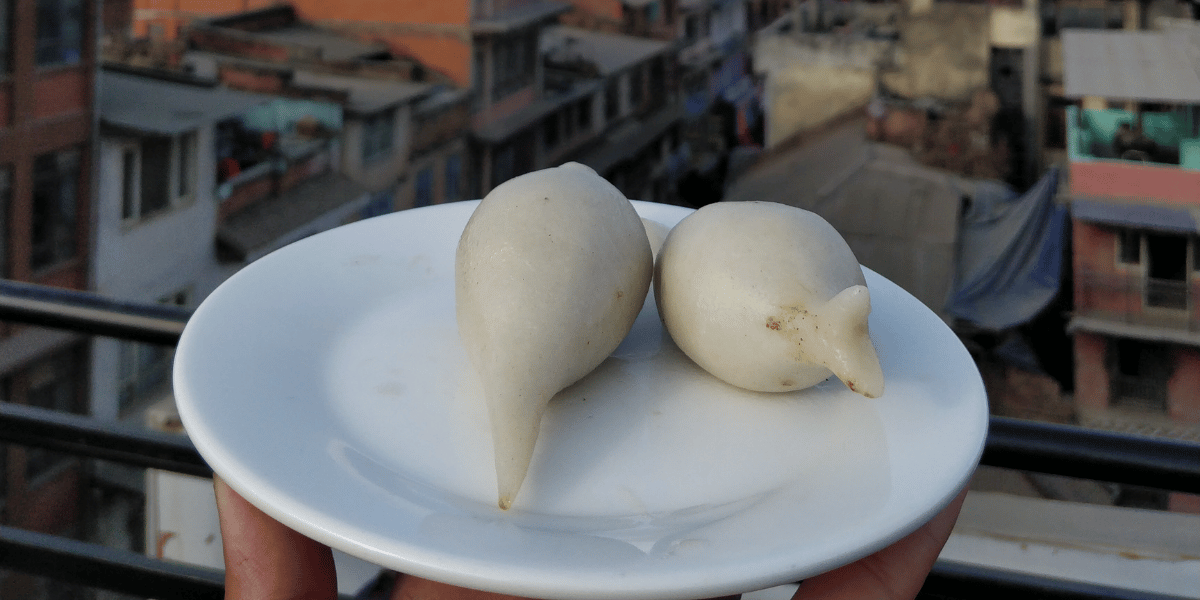
In the Newari language, “Yo” means “favourite” and “Mari” means “Bread”. As this dish was a favourite amongst everyone, it became popular by the name “Yomari”, meaning “favourite bread”.
The centuries-old Newari tradition of making this sweet delicacy is still being practised today. Many even represent Yomari’s two ends as the north and south poles of the earth.
What Is Yomari Punhi Festival? Beliefs Explained
Yomari Punhi marks the end of the rice harvest season on the New Moon Day of Mangsir (Purnima). This festival is also dedicated to Goddess Annapurna and is celebrated by consuming the delicious Yomari by the Newar community.
According to ancient scripts in Changunarayan and records in Bhasha Bansawali, the Yomari Punhi festival started in Panauti during the reign of Lichhivi king Amshuvarma, around 605 to 621 CE.
But here’s more to it…
How It All Began: The Story of Suchandra and Krita
There’s a popular legend surrounding Suchandra and Krita, a couple who were highly regarded for their generosity in their community. During one of the harvest periods, their field yielded an abundant crop of rice, from which the couple made a new and unique food dough filled with chaku (molasses) and sesame seeds.
They shared their new delicacy with the villagers, who appreciated this warm food and later named it ‘Yomari’. It was sweet, delicious, and perfect for the winter season.
One day, the couple’s generosity reached the ears of the god of wealth, Kubera. To see if the rumors were true, he decided to test their kindness. Kubera disguised himself as a beggar and visited the couple, asking for something to eat. The couple didn't disappoint the beggar and served him with their new dish, Yomari.
Kubera felt very pleased by the couple’s gesture and their hospitality. He transformed into his real identity to appreciate their hard work and helping mentality. Before leaving, Kubera told them that whoever made their dish (yomari) in the shape of gods and goddesses from then on would be blessed with wealth and prosperity.
It was since then that the Newa community had started celebrating Yomari Punhi. Even today, people make yomaris of different shapes resembling gods and goddesses, such as Kumar, Ganesh, Lakshmi, Kubera, along with Nayo and Bayo (who represent the eldest and the second eldest member of the family).
The prepared yomaris are first kept in Bhakari and only taken out and eaten after 4 days of performing rituals.
When is Yomari Punhi Celebrated?
Yomari Punhi has now become one of the most exciting festivals in the Nepali Festival Calendar and is widely popular as a harvest celebration that holds significant cultural importance among the Newar community.
The festival falls in early December, the beginning of the winter season (on the full moon day of Marga Shukla Punhima). There is a strong belief that eating Yomari on this day keeps your body warm for the entirety of the winter season and even gets you rid of poverty.
Other Festivals During Yomari Punhi in Nepal
On the same day as Yomari Punhi, Dhanya Purnima is also celebrated in Nepal. Apart from just Newar, all other Hindu ethnic groups worship Annapurna, the goddess of food and nourishment.
The Kirati tribes celebrate this day as Udhauli Parba, where they thank nature for the harvest. Their festival also marks the seasonal migration of people, animals, and birds to warmer regions for the winter.
There is no traditional connection between the two festivals, but some Kirati people do enjoy eating and preparing Yomari on this day with their Newari friends.
How is Yomari Punhi celebrated?
The main day of Yomari Punhi falls at a similar timeframe to the longest night of the year (on December 21).
The festival is traditionally celebrated over four days. However, this is rarely the case in modern times. These days, people have shortened the rituals and only celebrate the festival on the main day marked on the calendar (the Full Moon Day) and also eat Yomari the same day.
Below, I’m going to share the actual traditional way of celebrating this Newari festival over four days:
Day 1: Full Moon Day (Yomari Punhi)
On the first day of the festival, Yomari Punhi, all the family members gather to make fresh Yomari from the newly harvested rice. The filling is either Chaku (Molasses) or Khuwa (dried milk solids). The first batch of the Yomari is separated to be used in the worship of Goddess Annapurna. Yes, even the Newa community celebrates the Dhanya Punhi!
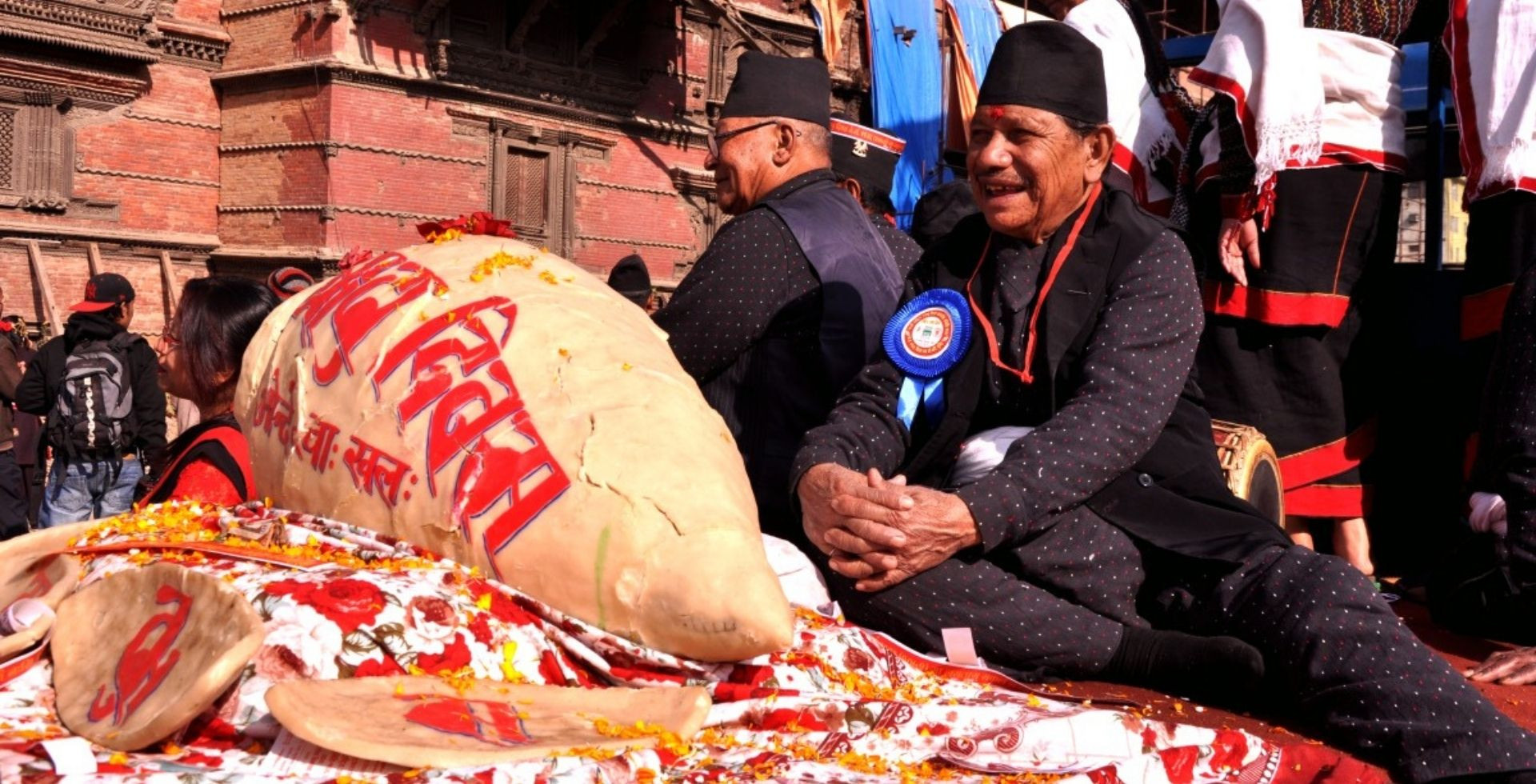
For the celebration of Yomari Punhi, various street rallies are organized by the local Newar communities. People play traditional instruments like the Dhime, Bhushyah, and Chushyah. Devotees walk around the streets of Tengal, Chhetrapati, Thahiti, Ason, Indra Chowk, Ombahal, Lagan, and Maru with joy!
You can even find stalls that prepare and serve Yomari. You can hop into any of the stalls to get the live experience of how Yomari is made and even try this delicious delicacy yourself.
There are other Newari foods available on the stalls too, such as Chatamari, Bara, and Samay Baji.
In other parts of the Newari cities, such as in Harisidhi, the locals also perform a special mask dance, “Jala Pyakhan”. Along with that, the Brahmayani, Balkumari, Bhairab, and Nava Durga Jatra also take place on this day.
Likewise, in Sankhu, the festival is celebrated by taking out a procession for Lord Ganesh.
Day 2: Divine Offering and Yomari Preservation
The first batch of the Yomari prepared on the previous day is separated along with different variations, such as “Lhocha Mari”, “Mutu Mari”, and “Bara Mari”. These are prepared for god, wishing for wealth, health, and prosperity.
The yomaris are then kept in the Bhakari, which is a traditional structure with a large, round or cylindrical container. It’s an integral part of the cultural and economic life of rural Nepal and serves as a family's safety net during difficult times.
Day 3: Devotion Day
The Yomari stored in the Bhakari remain untouched, as the day is only dedicated to devotion towards the deities. There’s no significant celebration on this day, but still, families and relatives gather together.
Day 4: Yomari Feast
This day, the Yomari that are kept in Bhakari as offerings are finally removed, and family members enjoy them as prasad (a blessed food). It is believed that eating Yomari offered to the gods allows the deities to symbolically enter the body, spiritually keeping the consumers warm during the cold winter season.
In the evening, kids gather around the neighbourhood, singing songs and asking for Yomari. This act is called the “Yomari Phonegu” or “Tyachim Tya Phonegu”.
In modern days, Yomari Punhi is celebrated just one day, which is why even Yomari Phonegu is observed on the same day’s evening.
Here is one of the famous folk verses sung in Yomari Punhi:
योमरी च्वामु उकी दुने हाकु ।
Yomari chwamu uki duney haaku
[Yomari is pointed. Inside is black (because of molasses and black sesame seeds)]
ब्युसा ल्यासे मब्युस बुढी कुटी ।
Byusa Lyasey Mabyusa Budi Kuti
[One who gives Yomari is young and pretty; those who don’t are old and ugly]
I still remember when I was a kid, my cousins, friends, and I would visit our neighbours' houses singing songs and get two warm yomaris each. By the time we got back to our houses, the Yomari would eventually get cold. However, we would reheat the yomaris and enjoy eating them.
Following the day of Yomari Punhi, there is another day that is famous amongst the youngsters. The day of love, Newari Valentine’s Day, is known as Matina Paru. “Matina” means “Love”, and “Paru” refers to “Pratipada”, the first day of the lunar waning cycle.
Cultural Significance of Yomari Beyond Yomari Punhi
For the Newar community, Yomari has much more significance than just the day of Marga Shukla Punhima. It plays a vital part in different stages of a Newar’s life, from birth to old age. Allow me to explain.
Celebration of Even-Numbered Birthdays
Before even a child is born, pregnant mothers are given Yomari, which is believed to have proper nutrients. And after the child’s birth, the entire family prepares the delicacy time and again to celebrate his/her even-numbered birthdays until they turn 12 years old.
These birthdays are celebrated traditionally, in which the child has to wear a Newari cultural dress and a garland made with Yomari around their neck. The garland here is made quite interestingly. It consists of the exact number of Yomari equivalent to their age.
In particular, the second birthday is considered the first major cultural milestone in the child’s life. The garland is made with two yomaris that the child has to wear around their neck. The day is celebrated as Nirbuni, aka Nirpunhi (which simply means the second year of life).
On each of the milestones, family members and relatives gather together and celebrate the child’s birthday with great happiness, providing blessings and gifts.
Janko: Milestone Celebrations for Newar Elders
In the Newar culture, even reaching different stages of old age is marked by significant milestone celebrations called Janko or Janku. On each occasion, they are gifted Yomari with respect, blessings, and a well-wishing gesture for their continued long life.
The first Janko is observed when a person reaches the age of 77 years, 7 months, and 7 days. This continues when the person reaches the ages of 83, 88, 99, and 105.
As a part of the Janko ritual, the elder person is even carried in a chariot through the community as an act of honor, and it is also believed that they have reached a divine state.
But do note that Janko is only observed during a person’s lifetime and not after death.
Eaten as a Dessert and Breakfast
Yomari is regarded as a dessert, and anyone can enjoy it after finishing lunch or dinner.
Moreover, these rice dumplings can even be enjoyed for breakfast. For instance, in my own household, we prepare plenty of Yomaris that often stay as leftovers. Instead of giving or throwing them away, they become our morning snack for the next few days!
But one thing is for sure. They won't have the same taste after reheating, as the dough gets a little harder. Regardless, this version of Yomari has been my personal favorite.
Also, Yomari is widely included in the famous Newari food platter, Samay Baji. To learn more about what it really is, be sure to check my blog out!
How is Yomari made? Ingredients and Preparation
The traditional way of making Yomari is by hand. You need to gently fold the dough to make one end pointed and keep the other end hollow. Seriously, if you’re thinking of making Yomari, you need to hone this skill to make perfect shapes!
Ingredients Required
Now let's talk in detail about how this Newari sweet dish is made. Yomari is prepared with rice flour and different flavorful ingredients.
Generally, four types of Yomari fillings are used:
- Chaku: a mixture of molasses, jaggery, and sesame seeds.
- Khuwa: Khuwa (dried milk solids) is stuffed inside.
- Pulse: a paste of Pulse (Maas ko daal) with a mixture of sesame seeds.
- Aakhe: These are Yomari without fillings, but a few unhusked rice (Aakhe) are stuck to them; they are specially made to offer to gods and goddesses and taken as Prasad.
Nowadays, people are experimenting with new fillings too, such as chocolate, different veggies, sweet creams, etc. You can try them out in the best Newari restaurants in Kathmandu Valley.
Preparation of Yomari
Traditionally, Yomari used to be made in a steamer basket. But these days, any kind of steamer can be used to prepare this delicacy. And it’s best to use newly harvested rice for Yomari preparation.
Here’s the step-by-step guide to prepare Yomari (try it yourself):
- With a mixture of rice flour and water, make a big ball of dough.
- From the dough, take out a small portion.
- Carefully shape it like a cone by hand.
- Once the dough takes the form of a pointed shape at one end and a hollow opening on the other, start loading the nutritious fillings.
- After filling the Yomari with one of the desired stuffings, carefully seal the hollow part, giving it the shape of a fishtail.
- Now, steam for 10-15 minutes, and your delicious Yomari is ready to be served!
Note: These days, even wheat flour is mixed with rice flour to give yomari a smoother texture.
Sharing My Secret to Eating Yomari the Right Way!
Ever since I was a kid, I have loved Khuwa Yomari, as it’s sweet and tasty.
Even the Chaku Yomari is extremely popular, which has a sweet but slightly bitter taste. If not eaten properly, it may fall on your hand and become sticky. In my household, we have a technique to avoid this spillage.
All you have to do is bite the pointed end first. Then, slowly enjoy the hot chaku filling. Some may find the taste too strong, but it definitely avoids the spill. In the end, just eat off the dough part with flavors that still remain.
Is Yomari Healthy? Benefits You Should Know
Yes, Yomari is indeed healthy to consume! It’s rich in nutrients and can bring positive effects on the body, like boosting immunity, aiding digestion, and promoting heart health.
Here’s the breakdown:
- Rice Flour: The base ingredient, full of complex carbohydrates, is perfect for giving energy.
- Jaggery: A Natural sweetener loaded with minerals and nutrients, particularly iron, which makes it a good food to produce red blood cells.
- Khuwa: The Riboflavin present here is the major source of Vitamin B, which is good for improving your immune system, along with supporting healthy hair and skin.
- Sesame Seeds: A good source of protein and monounsaturated and polyunsaturated fats.
A study conducted by students of Tribhuvan University analyzed the nutritional composition of Yomari filled with jaggery and sesame seeds and found the following results:
- Moisture: 45.5 %
- Crude Protein: 6.49 %
- Crude Fat: 1.6 %
- Ash: 0.83%
- Crude fiber: 0.75%
- Carbohydrate: 44.81
- Calcium: 274.3 mg per 100 g
Clearly, this shows that Yomari is not just rich culturally but also nutritionally beneficial!
Final Thoughts on Yomari Punhi
Anyone can taste this Newari delicacy from local pubs known as “Bhatti” to high-end Newari restaurants. No matter where you try it, Yomari tastes delicious in every place!
If you happen to go sightseeing across Kathmandu during the festive season, you’re in for a treat! Unique food like Yomari can be found freshly made in an open kitchen. So, be sure to taste them!
As mentioned earlier, the traditional fillings of the yomari are generally Khuwa and Chaku. But these days, you’ll find yomaris with new fillings such as chocolates, minced chicken meat, and other kinds of veggies in different restaurants.
Along with locals, Yomari has now been a major food attraction for many foreign tourists too.
In Altitude chronicles, we post similar kinds of blogs related to food, culture, and informative guides that might interest you. Do check them out, and we’d love to serve you on your next visit to Nepal!














 Rijen Manandhar