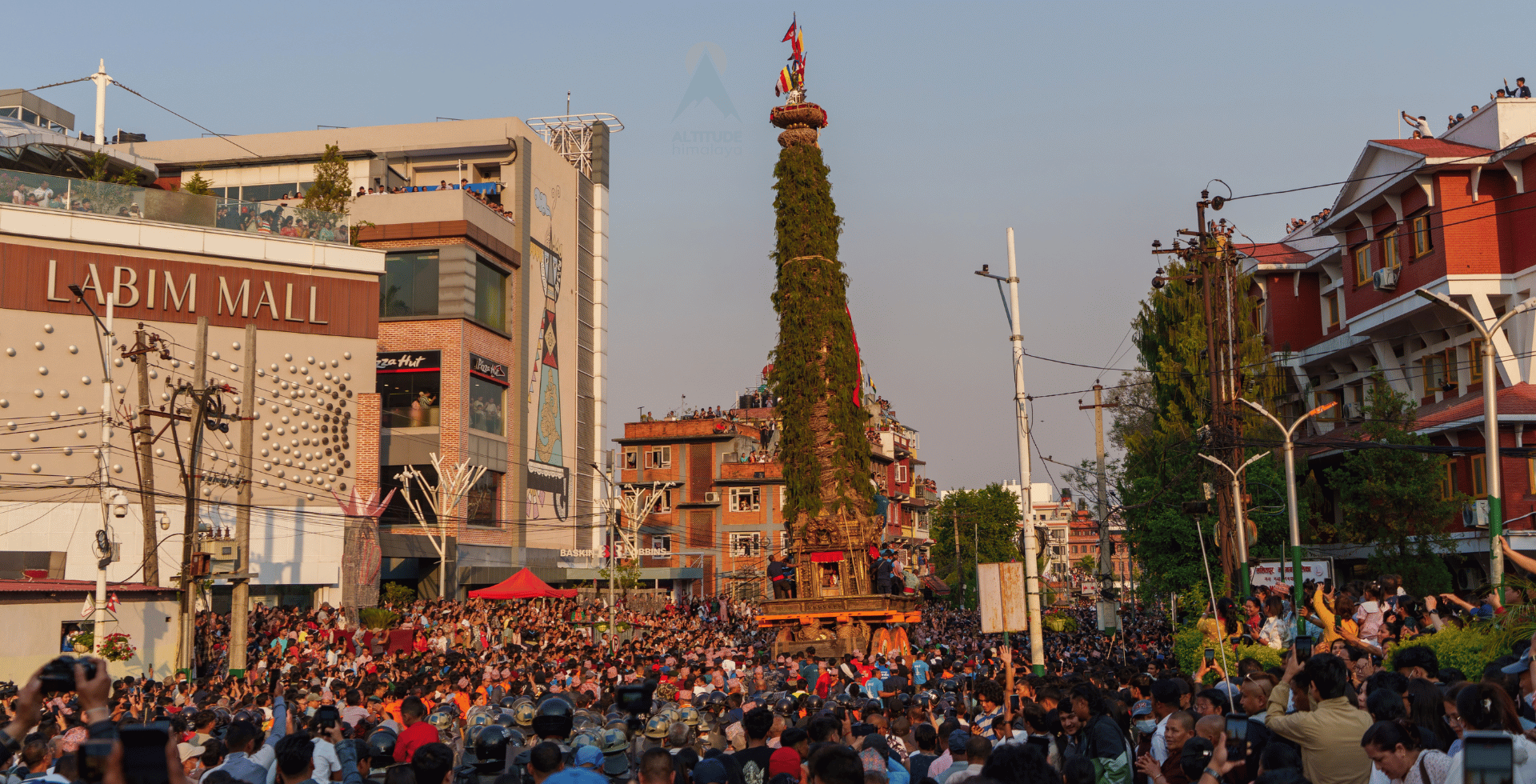
The surrounding is alive: with loud snares of the dhime baja and roars of the many devotees lined up to watch the full spectacle. But perhaps the loudest of all cheers is probably from the ones pulling the massive chariot forward. They grunt as they tug the huge rope, doing their best to keep an eye on the chariot, hoping it doesn’t lose its balance and keeping pace with everyone around them.
This is the scene you see when you go visit the Rato Machhindranath Jatra, one of the longest and oldest festivals in Nepal that lasts more than a month. The festival celebrates Rato Machhindranath, whom Buddhists worship as Avalokiteshvara (Karunamaya) and Hindus revere as an incarnation of Lord Shiva and some as Lord Vishnu, who is regarded as the rain and harvest god.
This newari festival takes place every year in Lalitpur (Patan), from mid-April to early June, although the exact dates vary as they are based on special dates according to the lunar calendar.
The highlight of the festival is its long, 32 Hat (about 52 foot) tall wooden chariot built without using any iron nails. This rath (chariot) is pulled slowly through the streets of Patan and thousands of devotees participate in the festival over the weeks.
This massive chariot is following a slightly smaller one, with an idol of Lord Minnath seated inside. The procession of the machhindranath’s rath starts from Pulchowk in Lalitpur, moving through Ga: Bahal, before which it meets with the chariot of Minnath, stopping by a few places before finally reaching Jawalakhel, where the festival ends with the Bhoto Jatra ceremony.
This blog covers who Rato Machhindranath is, the legends behind the festival, how the chariot is built, the full route of the rath and how the festival has evolved over the years. Keep reading to find out more, including tips for visitors.
Rato Machhindranath Jatra Facts
|
Fact
|
Details
|
|
Name of Festival
|
Rato Machhindranath Jatra
|
|
Location
|
Lalitpur (Patan), Nepal
|
|
When it happens
|
Mid-April to early June (dates because they are based on the lunar calendar)
|
|
Start Date
|
Fourth day of the bright fortnight of Bachhala
|
|
Duration
|
Over a month (one of the longest in Nepal)
|
|
Deity
|
Rato Machhindranath (also called Bunga Dyah, Karunamaya, Avalokiteshvara)
|
|
What he is god of
|
Rain, Harvest, Crops, Compassion
|
|
Main route of procession
|
Damkal Chowk (Pulchowk) → Ga: Bahal → Sundhara → Lagankhel → Iti Tole → Jawalakhel
|
|
Concludes with
|
Bhoto Jatra (display of a jeweled vest)
|
|
Special year
|
Every 12 years (upcoming in 2027) as it completes a full cycle
|
|
Other chariot in procession
|
Minnath at the front, guiding Rato Machhindranath
|
Who is Rato Machhindranath?
Rato Machhindranath, also written as Matsyendranath or Matsyanath or Machendranath, is an important deity of rain, harvest and crops, worshipped primarily in the Kathmandu valley.
He is also known as Karunamaya and originally named Bunga Dyah in the Newa language. As a kind and compassionate deity who can control the natural elements, Rato Machhindranath is also the guru (teacher) of sage Gorakhnath. What makes him special is his dual identity in both Buddhist and Hindu traditions.
While the Hindus worship him as Rato Machhindranath, an incarnation of Lord Shiva and sometimes Lord Vishnu, Buddhists worship him as a form of the Bodhisattva Avalokiteswara, Karunamaya.
His Features
Visually, the idol of Rato Machhindranath has distinct features that are markings of his identity and legends related to him. The idol is a wooden figure of roughly three feet height who is standing.
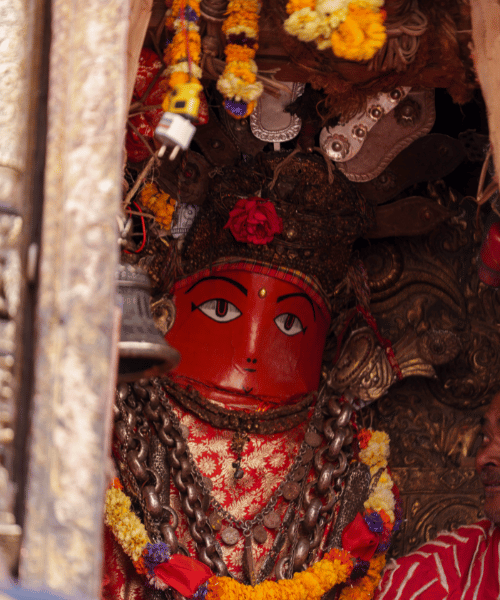
It is bright red in colour and painted that way every year after the grand bath or mahasnan ritual before the jatra begins. This is what gives the deity his name, as ‘rato’ means red in Nepali.
The face of Rato Machhindranath has very human-like features with compassionate looks, but his nose isn’t very visible, and we will explain why later.
He has big eyes and is usually draped in red garments and adorned with elaborate jewelry.
Where does he reside?
In most cases there is only one temple for one idol, but one unique thing about Rato Machhindranath is that he is housed in two different locations throughout the year.
The idol of Rato Machhindranath is kept at the Bungamati Temple (about 7 km from Patan) for first six months after the jatra and at the temple in Ta: Bahal in Patan for the next six months.
The reason why he has two temples is because initially when he was brought from present day Assam, his temple was made in Bungamati. Later in 17th century, he was taken to the temple in Ta: Bahal.
The temple in Patan is visually remarkable. The Machhindranath Temple in Ta: Bahal is a tall Newa-style pagoda with three tiers of slightly shrinking roofs, covered with metal, which is probably copper. This is held up by 20 struts on the first two storeys and 12 for the top most.
The figure of Avalokiteswara (usually with extra arms) portrays different poses on every strut. Beneath them are torture scenes, possibly from Buddhist hell, as well as depictions of other deities supporting the pedestal of Avalokiteswara.
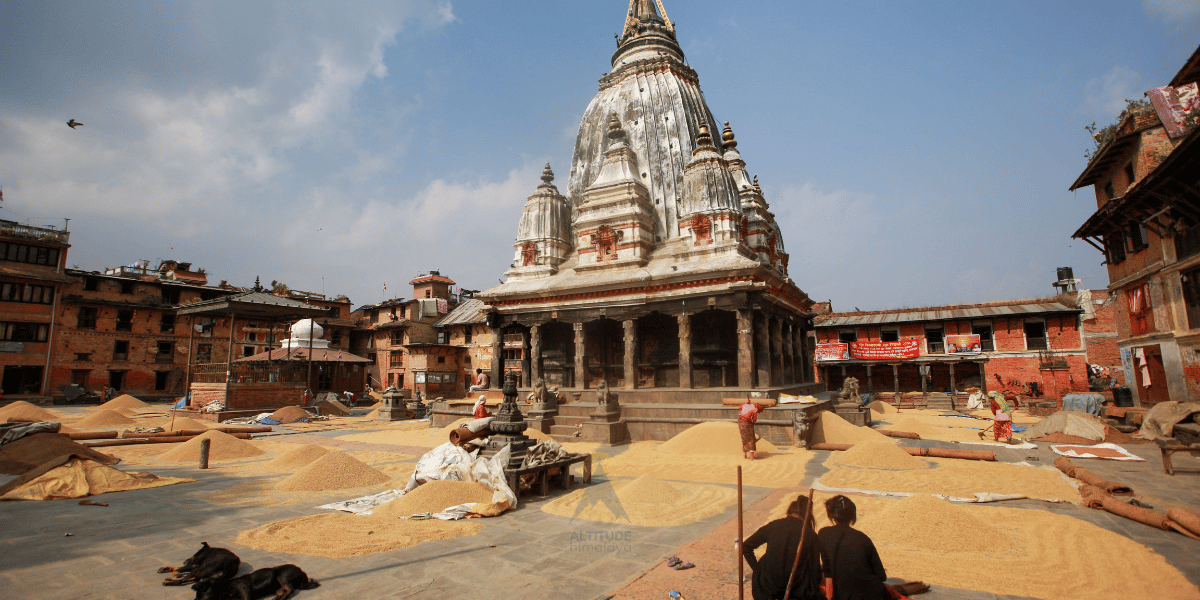
Likewise, the temple in Bungamati, made in the Shikhara Style, is about 3 stories tall and has 9 spires, with the middle one being the tallest. This temple was completely destroyed during the 2015 earthquake and was later rebuilt in the same architectural style.
Historical Origin, Myths and Legends
There are many legends on the origin of the Rato Machhindranath jatra. These ancient legends mix history and folklore and explain why the festival is celebrated. They also reflect the strong cultural and religious beliefs of the Newa community in Kathmandu valley.
The most popular and widely accepted legend links the festival’s origins to a severe 12-year drought during the 7th century AD that plagued the valley.
How did Rato Machhindranath Jatra begin?
Sage Gorakhnath, who was upset with the inhabitants of Kathmandu valley–specifically, inhabitants of Patan–who were disrespectful towards him and refused to give him alms, gathered the 9 nagas (the serpent gods, deemed to be the harbingers of rain in the local lore) in Mrigasthali behind Pashupatinath Temple and sat atop them in meditation.
With the nagas captured, the valley did not see a drop of rain on its premises for over a decade.
The then king of Nepal Mandala, Narendra Deva, consulted some wise gurus who advised him to bring Gorakhnath’s guru (teacher), Machhindranath, to bring the sage out of his intense meditation and free the nagas.
After searching for some time, king Narenda Deva found out that Machhindranath had been born as the youngest son of the king of Kamakhya in Kamarupa (present-day Assam in India).
Initially, he gathered a team that included the tantric (shaman) Guru Bandhudatta Vajracharya from Kathmandu, a Newa local porter from Lalitpur (named Lalit Jyafu or Ratna Chakra in some stories), and himself, and then they started off towards Assam.
Later, Karkotak Nagraj (king of the serpents) also joined the group. There are various legends behind him joining the group; among them, in one story, he somehow knew the group’s motive and asked them to tag along with them for this auspicious deed. In another instance, he was tricked and captured by Bandhudatta while causing trouble during the group's journey.
After reaching Kamakhya, they persuaded Machhindranath’s father to let his son go to Kathmandu to solve the drought problem; but his mother (who is believed to be a daitya, a demoness, in some stories) did not want her son to embark on this journey and created multiple obstacles.
According to local tales, she would sleep outside the door every night to ensure her son stayed inside, as a son couldn’t step over their mother. Machhindranath, however, decided to go to Kathmandu to help with the drought problem and carefully moved his mother’s hair out of the way.
Unfortunately, he missed a single strand of her hair and stepped over it. This act of sin is considered to have caused his nose to fall off. This incident is why the Machhindranath idol is believed to not have a prominent nose.
It is also said that Machhindranath had to be transformed into a bee and placed in an auspicious vessel (Ashtamangala Kalasha) and four Bhairavas of the Kathmandu valley were called to safely take the god to Kathmandu. These four Bhairavas make up the wheels of the chariot.
When Machhindranath arrived, Gorakhnath stood up from his meditation to greet his guru and the nagas were freed, which ultimately brought rain back to Kathmandu valley. The festival is celebrated every year to commemorate this very event.
Other Myths Related to Rato Machhindranath
Where to keep the deity?
When King Narendra Deva and the team with him were able to bring the deity to Kathmandu Valley, a big debate arose among them on where Rato Machhindranath’s temple should be established.
There are two famous local legends about this incident:
- The first one goes like this: after the group brought Machhindranath to the Kathmandu valley, an internal conflict arose within the team about where the deity’s temple was to be constructed. Narendradev wanted to make the temple around Bhadgaon (today’s Bhaktapur city); Bandhudatta wanted it around today’s Kathmandu city, while the porter Lalit wanted to make it around his hometown Yala, which is believed to be today’s Lalitpur area.
To solve this predicament, Lalit proposed to consult the oldest person in all of Lalitpur, which the rest of the group members agreed upon. The porter went to the oldest person in Yala (Lalitpur) carrying curd as an invitation. Being a clever person, he mixed salt into the curd, which the old guy ate.
In Newa culture (and many Asian traditions), you are bound by loyalty to the person who feeds you salt. Having unknowingly eaten the bowl of salty curd, the old man was resigned to state that Lalitpur would be the most appropriate abode for Rato Machhindranath.
- Another common lore as told by Prem Maharjan, a Yewal involved in making the rath, talks about the legend of how this was resolved.
Although it does not match the timeframe, he stated that the then king of Lalitpur summoned the oldest living man in the valley to answer this question with the wisdom he has gained over his lifetime. However, before calling the man over, the king had offered him a bowl of curd to eat, with a pinch of salt mixed in it and the same story follows as above.
These are the most popular tales on why the temple of Rato Machhindranath was established in Lalitpur.
Sankata and Rato Machhindranath
According to legend, when King Narendra Deva and his team brought the deity in the form of a beetle and placed it inside a pot, Machhindranath’s family followed them. At Katuwal Daha, a quarrel broke out between them and during it, the pot fell into the water.
As the beetle pot neared the water's surface, a right hand palm appeared out of the water and caught the pot. That deity was Sankata. For this reason, he is also called, ‘Pa: Lha’ (palm deity).
When Guru Bandhudatta Vajracharya finally sent the family away, Lord Sankata asked to come along. When the guru said he could not, Sankata asked him to take a portion of his power, make an idol and establish it in Kathmandu instead.
As Sankata’s power could not be taken without Sri Yogini’s help, the guru meditated on Sri Yogini and brought along the two more pots containing the spirits of the two deities.
When they reached Kathmandu, the guru established temples for Sankata and Yogini in Kathmandu, too. Even today, the temple of Sankata in Kathmandu also has an idol of Machhindranath on the ground floor.
Manakamana Mai and Aaju Aji Jatra
Most of us think of Gorkha temple as the only abode of Goddess Manakamana. But did you know that Manakamana also resides in Bungamati for a few days every year?
A popular belief among locals is that Bungamati is the original home of Shri Manakamana. The goddess, also known as Ajima Dyah, is considered the wife of Nandikandi Bhairava (Nannekunne Bhail) located there.
So, every year during Dashain, she comes to Bungmati and celebrates the festival in the company of the Bhairava and Rato Machhindranath. In fact, the Gorkha temple of Manakamana Mai closes during the last three days of Dashain: Aasthami, Navami, and Dashami.
The locals celebrate her return to Bungmati with the Aaju Aiji Jatra or Manakamana Jatra.
Mishaps, consequences and warnings
It is believed that in 1680 A.D., Machhindranath lost some paint off his face and the same day, King Nipendra Malla died. Similarly, in 1817, when there was some trouble with the paint again, a big earthquake shook the valley.
Another incident of note involves King Viswajit Malla, who thought the deity had turned its back to him while he was attending the chariot festival. He was murdered the very same day.
Bhoto Jatra, the final day of the festival, has its own legend. Read more to find out.
The Chariot of Rato Machhindranath
Did you know that it is commonly believed that the chariot of Machhindranath is still constructed following the same method originally adopted by Tantric Guru Bandhudatta Vajracharya?
Parts of the Chariot and their Significance
The chariot of Rato Machhindranath has many distinct parts.
|
Parts of the Rath
|
It’s Representation
|
|
4 Wheels
|
4 Bhairavas (protectors of the Kathmandu Valley)
|
|
Beam
|
Karkotak Naga (serpent king)
|
|
Front of the Beam
|
Hayagriva Bhairava (charioteer)
|
|
First Level
|
Sanctum of Rato Machendranath, White Tara and Arya Tara
|
|
Spire (13 Tiers, 32 Hat Long)
|
13 Celestial Realms and 32 characters of Rato Machhindranath
|
|
Ropes
|
Vasuki Naga (right) and Shesha Naga (left)
|
The Wheels
Firstly, the four wheels, which are called gha: chaa in Newa, are big wooden circles, strong enough to withstand the weight of the tall rath.
Some locals of Iti Tole in Lalitpur that we spoke to said the chariot moves a distance of 12 cubits when the wheel completes a full turn.
The wheels are representations of gods too. They are considered symbolic of the four Bhairavas that protect Kathmandu, with Hayagriva Bhairava being the charioteer on the front end of the Rato Machhindranath chariot. The four wheels of the chariot are worshipped as Bhairavas too.
The four Bhairavas are commonly considered to be Harisiddhi Bhairava at the front right wheel, Luptasamhar Lubhu Bhairava at the rear right wheel, Tyanka Bhairava or Tika Bhairava at the front left wheel and Kundi Bhairava or Nandikunda Bhairava at the rear left wheel by the locals.
The Long Beam
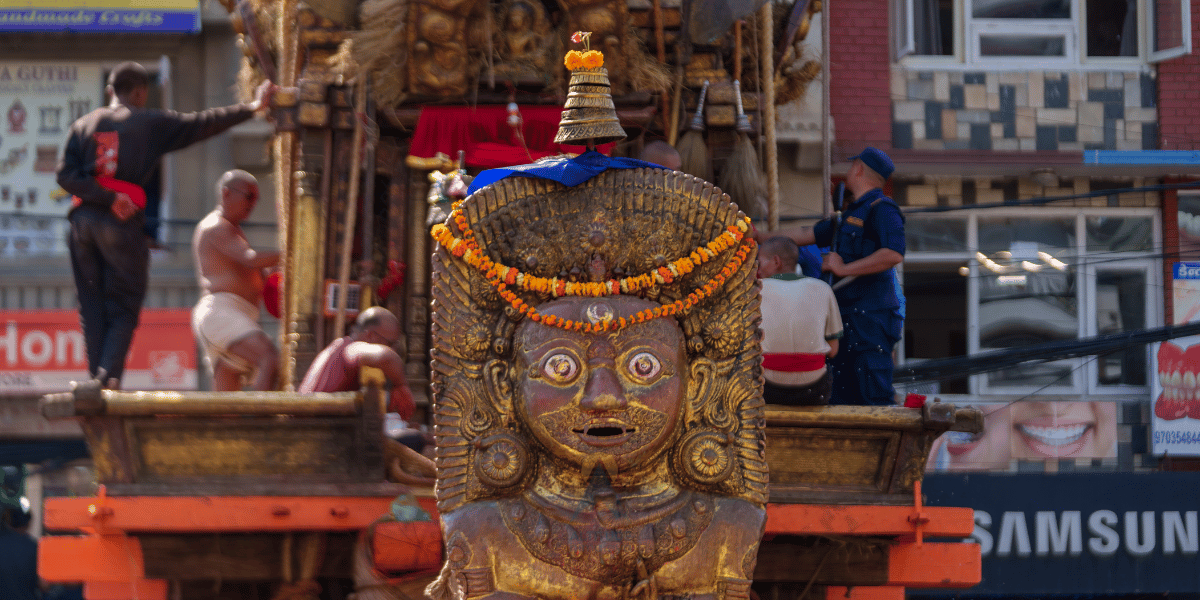
The beam of the chariot, called dha: maa or gha: maa in Newa, which is placed beneath its main structure, leads to the front-most part of the rath where the head of the Hayagriva Bhairava is installed. According to the locals, it is a representation of the Karkotak Naga.
At the head there is also a painting of Kal Bhairav which is covered by the mask of Hayagriva Bhairava.
The 32 Hat Spire
The chariot’s spire is famously tall and is what primarily contributes to its height. Despite its immense height, nails and screws aren’t used to hold the rath. Instead, they are supported with bamboo canes and enveloped with pine (salla) leaves.
Vines of bet (what locals call them), soaked in water for many days to make them more pliant and strong, are used to hold the spire together too. They are used for weaving and lashing the wooden beams, bamboo poles and tiers together.
These vines are flexible enough that they can hold the spire even if it bends quite a bit when the rath moves through the narrow streets of Patan but they are very strong.
Machindranath’s chariot is spire-shaped, with the circumference becoming smaller toward the top, like an inverted cone. The spire is composed of thirteen talas (tiers), which symbolises the thirteen celestial realms and is 32 hat (converts to about 52 feet) long which represents 32 characters of the deity. The chariot is believed to possess thirty-two lakshanas (auspicious marks).
The Ropes
Ropes, khi: paa in Newa, are used to pull and balance the chariot as well as move it around the valley. A timber leaver, or gha: ku, is used as the brake of the chariot.
To prevent the chariot from having any problems while being pulled, the sikha (crest) of Karkotak Naga is invoked as Vighnataka Bhairava. Ropes are tightened on either side as needed to straighten the spine of the chariot and to stop the chariot from tilting left or right.
These ropes are seen as representations of serpents too: Vasuki Naga on the right and Shesha Naga on the left.
The Sanctum
It is the level with the balcony where the idol of the deity is placed on the rath. It is also where the panejus (priests) are, attending to the god.
Behind Machhindranath in the chariot is the rakta-varna (red-colored) Bodhisattva, which represents Mahadeva (Shiva).
Besides the Bodhisattva, on the main floor of the rath (around the central sanctum), two other idols are also kept of the White Tara (also called Shwet Tara) and the Arya Tara. They are considered to be guarding or watching over Machhindranath from the four directions.
Construction of the Chariot
The festival is another one of Kathmandu’s community based celebrations where the entire procession and preparation are done by the local communities. For Rato Machhindranath, the tasks are divided based on lineage and community. Many groups and guthis (trusts) are also involved in its operation.
When the preparations for chariot construction are complete, a procession is done around Patan from Ta: Bahal. It is accompanied by musical instruments and the sounding of the narsinga (a type of horn), parading the wood, cane and bamboo for chariot construction.
Individuals from 4 clans are responsible for scouring materials and building the chariot.
|
Name of the Clan
|
Responsibility
|
|
Bosi
|
Gather wood for chariot construction
|
|
Barahi
|
Turn wood into timber of various size and shapes needed for the chariot
|
|
Yewal
|
Actual construction and rope work of the chariot
|
|
Chitrakar
|
Drawing and coloring the wheels and different parts of the chariot
|
A dozen individuals from the Bosi clan bring in wood from Godavari forest. About 24 individuals from the Barahi clan primarily turn this wood into timber, which readies it for further woodwork.
The wheels are worshipped before the construction of the chariot begins. Around 12 builders from the Yewal (or Yangwa) clan construct the actual chariot, making the tiers and making the cane, ropes and lasi (16 long pieces of wood in Nepal Bhasa or Newa) as well as tying them around the joints.
The Chitrakar clan is tasked with applying colors to the chariot, which includes painting the wheels with Bhairava's eyes and painting Bhairava's face on the front end of the beam.
Rato Machhindranath Chariot Procession
The Rato Machhindranath Jatra is Nepal’s longest chariot festival that goes on for several weeks. The grand procession sees thousands of devotees pulling the towering chariot through the streets of Lalitpur. The rath’s journey has a pre-determined traditional route and it all ends with the famous Bhoto Jatra ceremony in Jawalakhel.
The Main Procession, Route and Major Stops
The chariot procession begins from Pulchowk on an auspicious day following the Ratharohan ceremony. It moves slowly over many days through Patan’s narrow streets. Minnath’s chariot joins early and accompanies him throughout the rest of the journey.
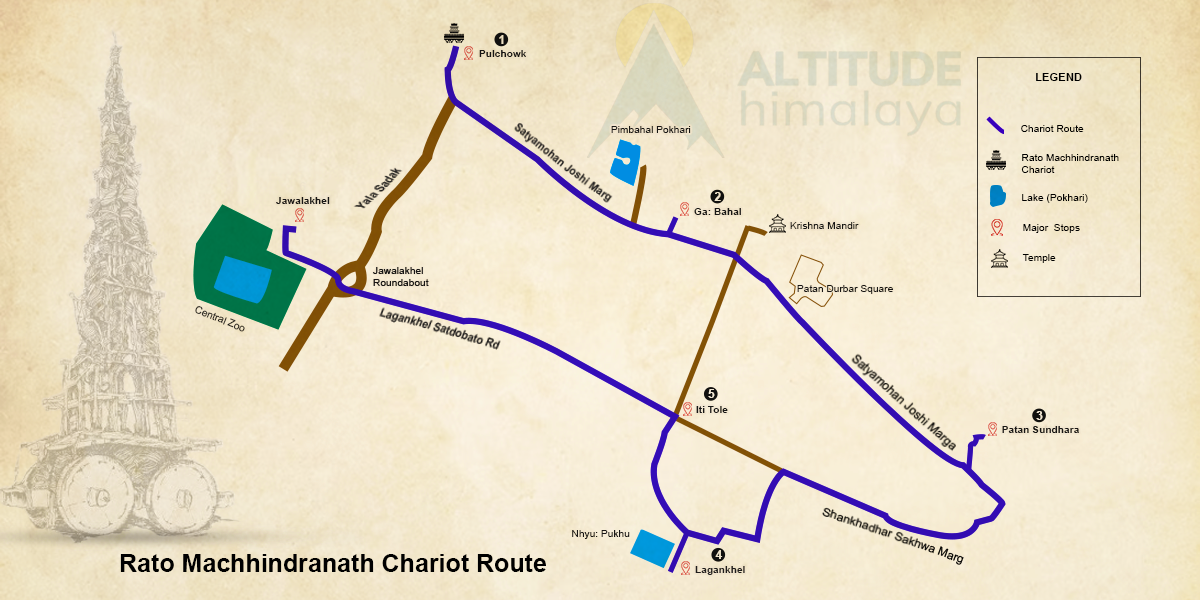
Here are the major route, key stops and rituals.
|
Location
|
Key Events and Rituals
|
Significance
|
|
Pulchowk (Damkal Chowk)
|
Ratharohan (installation of idol)
|
Official start of the Jatra
|
|
Pulchowk to Ga: Bahal
|
- First major pull
- Minnath Joins
|
Minnath leads the way
|
|
Ga: Bahal to Sundhara
|
First Major Stop
|
Community worship and celebration
|
|
Sundhara to Lagankhel
|
- Circumambulation of Maju Sima tree
- Mahabali Puja
- Coconut throwing
|
Respect to mother and prosperity rituals
|
|
Lagankhel to Iti Tole
|
- Yakah Misaya Bhujya (women pull the chariot)
- Finalising the date of Bhoto Jatra
|
Honouring the woman who found the deity
|
|
Iti Tole to Jawalakhel
|
- Final Procession
- Bhoto Jatra
|
End of the festival
|
The rath starts from Damkal Chowk (Pulchowk) to Ga: Bahal and then it goes to Sundhara. From Sundhara it moves to Lagankhel, then Iti Tole and finally ends at Jawalakhel with the Bhoto Jatra ritual.
As the festival days are based on tithis (astrologically auspicious days) of the Nepal Samvat lunar calendar, the days do not occur on pre-determined dates. They are set by a meeting of astrologers every year, with the Panchanga Nirnayak Samiti, local Guthi, and the Jyapu Samaj’s involvement.
Daily aaratis and pujas happen every single day—in fact, multiple times a day—throughout the jatra. However, the major events of the jatra mostly happen when the rath is taken to Lagankhel, Iti Tole and Jawalakhel.
Major Events Before Jatra Begins
The preparations for the Jatra begin several weeks earlier, among which are the following events to look after:
Chariot Construction
After collecting all the required materials, the respective individuals commence building the chariot. Usually the chariot is constructed at Rath khel, present day Pulchowk, whereas every 12 years it is constructed in Bungmati.
Mahasnan (The ritualistic Bathing Ceremony)
Approximately one month before the Machhindranath Jatra begins, he is given a mahasnan (grand bath), where a gubhaju (priest in a Newa community) begins the worship and members of the Neku: clan have to pour water from all four sides. Water from the Bagmati river, which is considered pure, is brought for the bath.
It is believed by the pujaris that this event attracts many mythical watchers, including nagas (serpent deities) like Satya Naga and Garuda (mount of Lord Vishnu). The pujaris also say the bath is a transformative ritual where the deity supposedly "dies" in the evening after the bath.
During this, the life force of the deity is extracted via tantric methods by the priests and stored in a kalasha (sacred vessel). The idol is then brought to the temple in a manner similar to a funeral procession and kept secluded for about a week, during which the old paint is removed and the body is carefully repainted and restored using a fresh clay base prepared using soil from Mhepido (present day Mhepi Hill).
The life force is again later returned to the idol through tantric rituals. The idol cannot be seen after the bath and puja, so it is covered with cloth and kept in the temple of Ta: Bahal until the deity is ready to be taken out for Ratharohan.
Various offerings like jaggery in 24 palas (containers) as well as ghee, water, honey and milk in another 24 palas are presented to the deity during this time.
Ratharohan Parva
The idol of Rato Machhindranath is taken in a palanquin from the deity’s temple in Ta: Bahal to the chariot that is constructed in Pulchowk. Then it is carefully placed inside the chariot’s sanctum by the priests. The same day, the idol of Minnath is also taken from Chakrabahi to Ga: Bahal.
The deity is placed on the chariot on the day of Baisakh Shukla Paksha Pratipada (mid to late April in the Western calendar).
Gurju ko Paltan and Raaj Khadga Showing Ritual
Whenever there is a big festival in Nepal, there will be a group of men in black called the Gurju ko Paltan (platoon), some playing musical instruments (such as fulte, dhol, jhyali, tammal, naumati, etc.) and some carrying rifles (don’t worry, there won’t be any bullets inside them) with gunpowder, which they fire to signal commencement or the end.
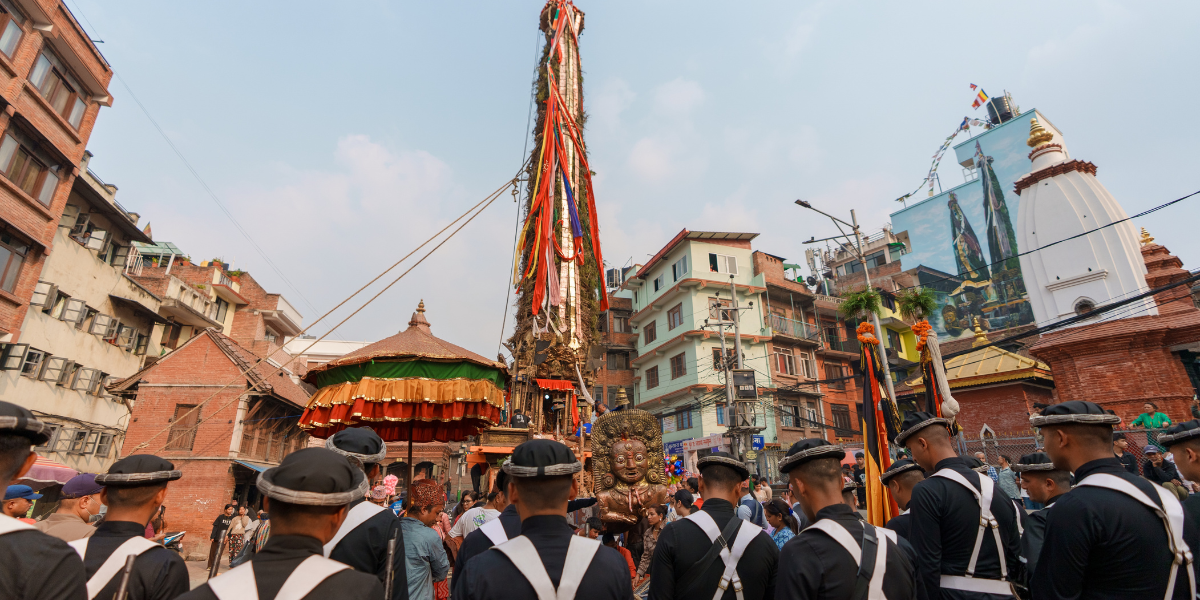
Along with them will be a differently dressed group; one will carry the Raaj Khadga (royal sword, believed by some to be Narendradev's), one with an umbrella and another with an oil lamp rod. They are there to represent the presence of the king in the form of his royal sword.
Both of these groups have to be present on several occasions throughout the festival.
Major Events During the Festival
During the over a month long festival, there are multiple local and some famous events one should look after:
Maju Sima Circumambulation
When the chariot gets to Lagankhel, it goes around the Maju Sima tree at the bus park. The tree represents Bunga Dya’s mother and this act of circumambulation is him showing his respect towards his loving mother. The Kumari of Patan also comes to watch this procession.
Mahabali Puja
Another important event that also happens when the chariot is in Lagankhel is the Mahabali Puja. As the name explains, ‘Maha’ means grand, and ‘Bali’ is an offering or sacrifice given to a deity as gratitude.
Often performed early in the morning during this puja, three ranga (he-buffalo), two thuma (male lamb) and 7 boka (he-goats) are sacrificed and an offering of 84 duck eggs is made for the bhairavs installed in the chariot.
Nariwal Khasalney Din
On an auspicious day after the mahabali puja, the coconut throwing ceremony (also known as Naikala Lwigu Jatra) done when a coconut is dropped from the top of the rath by a high ranking person of yawal community (the chariot builders).
Catching it is believed to bring prosperity and good fortune—which in older times often meant giving birth to a son as the first child.
Before throwing the coconut, the person on top engages the crowd by throwing flowers and grains that are blessed by machhindranath and sometimes teases the crowd below by faking the coconut throw.
As he gets ready to throw the coconut, he shows it to the crowd below so they can prepare. There will be police individuals involved during this ceremony, as fights breaking out is a common occurrence.
Once a person gets a hold of the coconut, the police gather around him and escort him to the chariot, where he presents the coconut to the priest and gets blessed.
A similar coconut-throwing ceremony is also performed from the Minnath chariot sometime after it is done from the Rato Machhindranath Rath.
One thing many don't know about this event is that it happens twice during the festival, the first in Lagankhel and the second in Thati Tole.
Yakah Misaya Bhujya - When only women pull the rath
Some day after the coconut throwing day, women devotees pull the rath from Lagankhel until it reaches Iti Tole. This is where the deity spends the next few days. The ritual, called Yakah Misaya Bhujya, honors the legend in which a woman found and returned the deity.
According to a legend, Machhindranath was once lost while being shown around Lalitpur; he got lost and a woman found him and returned him to the temple.
Previously, only widowed women pulled the chariot during this day, but nowadays all women participate in this event.
Bhoto Jatra and The end
After the chariot reaches Iti Tole, astrologers, priests and individuals from related guthis gather at Mangal Bazar to decide on the auspicious date for the Bhoto Jatra and end the festival.
And after the chariot reaches Jawalakhel, the Bhoto Jatra ceremony is performed and the weeks long festival comes to an end.
The Minnath Chariot Procession
One thing you’ll notice when you observe the Rato Machhindranath Jatra is that there isn't just one, but two chariots moving through the streets during the procession. The other chariot is of Lord Minnath.
Who is Minnath?
Minnath, who is also known as Chakkubaha Dyo in Nepal Bhasa and Jatadhari Lokeshwor (the one who wears dreadlocks), is a deity who has been worshipped for longer than Machhindranath has. Hindus worship Minnath as a form of Lord Shiva.
Legend has it that King Balachandra Deva’s father, who was known for being kind and religious, dreamt of being dead and heading to Yama Loka (land of the dead). Along the way, as he was passing high mountains, he saw a throng of people—some sick, some disfigured, others despondent—beside a lake.
A figure with long dreadlocks was in the lake, wetting his hair, and then he poured the water from his hair onto the crowd, and magically, all of them appeared cured of their plight. Believing the dreadlocked man to be a god, the King asked the deity to accompany him back to his kingdom.
The deity agreed and told the king that he would appear as a chakhu (bird in Nepal Bhasa) the next day. The king had to follow the bird, mark the place it lands on and build him a temple there.
The bird is believed to have landed in two places: the Chakravarna Mahavihar and Jestha Varna Mahavihar. The latter is where the king actually established the temple of the deity.
Why does Minnath have a separate procession?
Before the Rato Machhindranath Jatra was established as a regular/yearly celebration, Lalitpur had other jatras (seven different ones) that were celebrated on a smaller scale and lasted less than the month (sometimes multiple months) long Bunga Dyo Jatra.
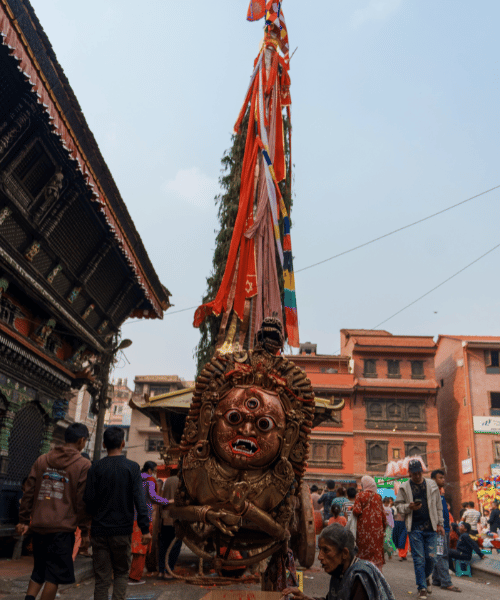
It is believed that one of the Lichhavi kings, likely King Narendra Dev himself, decided to integrate all of them into the grandly celebrated Rato Machhindranath Jatra to have a unified celebration in Lalitpur.
It is also believed by the locals that all the other deities agreed for their jatra to be incorporated into the larger Rato Machhindranath one, even joining Bunga Dyo in his rath during the procession. The deities in the area also step aside to make way for the rath and to avoid having anything take away from its rituals.
Minnath, however, was not so happy with this development and is said to have destroyed a chaitya in anger as well as caused other misfortunes among the locals. Reading these signs, Minnath’s rath procession continued.
In fact, the Minnath rath is the one at the front, showing the way to the Rato Machhindranath chariot. This, according to the Minnath priests, is because Minnath is the local of Patan, who has been living here for longer than Machhindranath. So, he is the one guiding the younger deity around the valley.
Route of the Minnath chariot
Minnath’s chariot has the same route as the Machhindranath chariot for the most part. The chariot travels from Ga: Bahal and meets Rato Machhindranath’s chariot a little further than Pulchowk.
Minnath’s rath is at the front until Iti Tole and then lets the bigger chariot go ahead for the bhoto jatra in Jawalakhel, after which his idol returns to his temple in Tangal (Patan).
Bhoto Jatra, the end of the Rato Machindranath Jatra
While it is the last day of the Rato Machhindranath Jatra, Bhoto Jatra has a well-known backstory of its own. The legend is linked to the Karkatoga Naga (the king of the serpents) couple that lived in Taudaha.
Legend behind Bhoto Jatra
A Newa farmer (believed to be from the Jyapu clan) is said to have received the bejeweled bhoto (vest) from a naga (serpent) king as a reward for helping the queen with her eye-related illness. The farmer would parade the beautiful jacket around and someone (sometimes believed to be a ghost) would eye the gem-studded jacket with envy.
The farmer lost it after some time (some believe the ghost stole it when the farmer took it off to work on his field one day) and as he was visiting the annual chariot festival, he saw another person (or the ghost) wearing the same bhoto. The two began arguing over who the bhoto belonged to.
King Gunakamadeva, who had also come there for the festival, was asked to decided who should get the vest. As neither could prove their ownership, it was decided that the bhoto would be displayed at the end of the festival every year until someone could establish ownership with sufficient evidence.
Till then, the bhoto would be under the trusteeship of the Rato Machhindaranath priests. This is also the reason the bhoto is showcased on the last day of the Jatra to this day.
How is Bhoto Jatra celebrated?
The day of the Bhoto Jatra is declared a holiday in the Kathmandu Valley. Huge number of devotees gather to view the procession. It is also attended by Kumari of Patan, the living Goddess of Nepal; many high ranking officials; and the President of the country. Previously, when Nepal was still a monarchy, the King would also be present alongside the Royal Family.
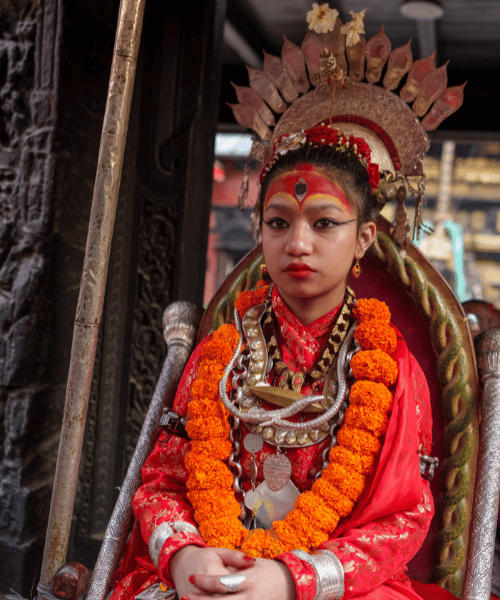
A high ranking official of the Guthi Sansthan Lalitpur, usually the chairperson, displays the bhoto in all four directions, honouring the tradition of trying to find the bhoto’s original owner.
Role of Guthi in Rato Machhindranath Jatra
Guthis are Newa social organisations, often translated as 'trusts,' but are slightly different than regular trusts, which are involved in many cultural and traditional events in the society. Guthi has a big hand in the Rato Machhindranath Jatra too.
Besides the Lalitpur Guthi Sansthan, which oversees the organisation of the entire Jatra, many clan-based guthis are involved in the Rato Machhindranath Jatra. The responsibilities the individuals in these guthis have to fulfill are taught and passed down from one generation to the next.
To name such guthis that participate in the festivities, these include the Barahi, Chitrakar and Yewal guthis, who work on chariot construction and painting; the Paneju guthi, or the guthi of the priests; and the Jyapu guthi, who primarily pull the chariot, among others.
The Guthi Sansthan Lalitpur is responsible for the overall budget allocation of the festival too. This includes the cost for construction of the rath as well as any extra costs they might have to bear for bishesh puja (special worship rituals). The Sansthan was established in 1967 (2024 B.S.) and has been the primary organisation responsible for the jatra ever since.
The Rato Machindranath Jatra this year (2026)
The Rato Machhindranath Jatra proceedings were a little different than usual this year. While 2026 isn’t a 12th year celebration, some interesting things happened this year.
The major one is that the jatra was prolonged by about a month longer than usual. While there are no fixed dates and schedules for the jatra, it usually ends in about a month or two. This year it will take longer.
The ratharohan or installation of the idol to the chariot happened on April 18. It reached Iti Tole on April 29 after Yakah Misaya Bhujya, when the women pulled the chariot, and will only leave the place and move forwards on June 17.
This break is a result of the mala masa or adhik masa in Hindu calendars, which is an extra thirteenth month that occurs every three years of the lunar calendar. The entire month is considered inauspicious for starting new things or doing anything that is religiously inclined, this includes any celebrations or festivals.
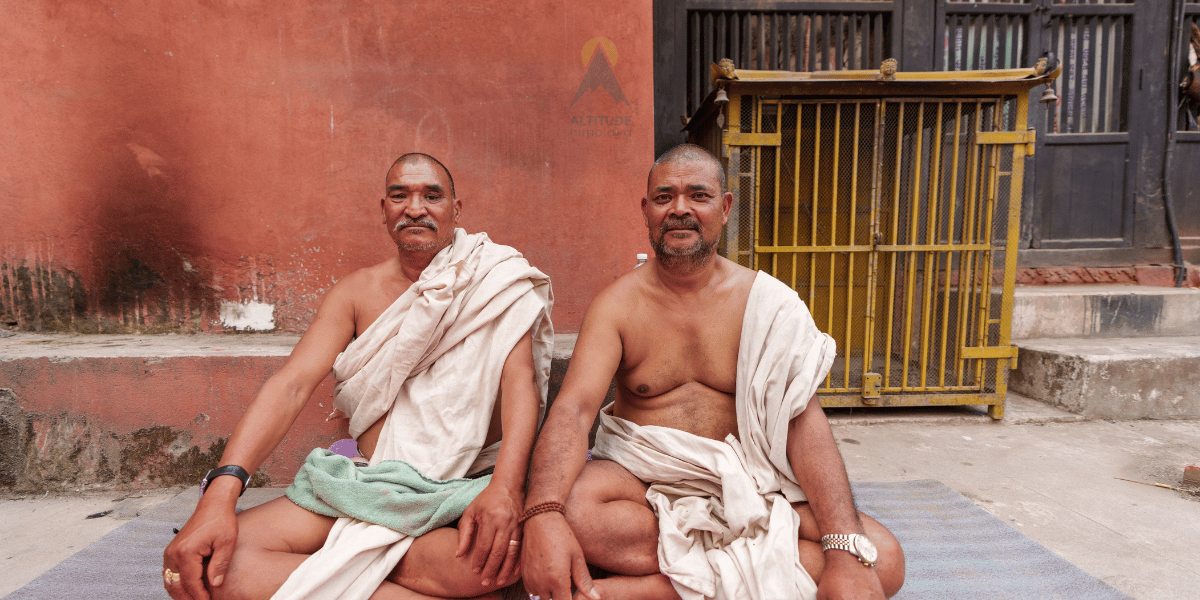
So, the priests and astrologers involved in Rato Machhindranath Jatra decided to only resume the procession when the mala maas ends on June 15-16.
Another thing of note that happened this year is the construction of the new wheels of the chariot, which only happens in the 12th year. The previous wheels were accidentally destroyed in a fire during the September gen-z movement of Nepal.
So, this year on Saraswati Puja (January 26), the construction for the wheels began.
As for the budget for this year’s jatra, Lachhuna Sharma Kafle, the head of Guthi Sansthan Lalitpur, revealed that one crore Nepalese rupees had been allocated by the government. “If we need more by the end of the festival, we can ask for it. But if we end the festival without using all of the budget, we have to return whatever is left,” she said.
The 12 year Rato Machindranath Jatra
Twelve is a special number for Rato Machhindranath because the god was originally invited to the Kathmandu Valley to end a 12-year-long drought. So every 12 years, to honour this very fact, the chariot is constructed from scratch.
The four new wheels of the chariot are taken to Bungamati during the 12th year by the head of the Guthi Sansthan Lalitpur from Pulchowk. Wheels are worshipped as usual and the construction for the other parts of the chariot begin.
The route taken by the chariot during this 12th year procession is also slightly different. It moves through Bhaisepati, Nakkhu, Bhanimandal and Jhamsikhel before resuming the regular route in Patan. The jatra also starts and ends at Bungmati in these special years.
The last 12 year cycle was in 2015, so we are due for a new 12th year procession next year, 2027.
Evolution of the Festival Over Time
The Rato Machhindranath Jatra has been a thing for centuries. As such, it is only natural that some aspects of it have evolved with the changing tides of time. For one, the season when the festival happens has changed.
- Culture expert Hariram Joshi also mentioned to Gorakha Patra in 2022 that the festival used to be held in autumn and it was King Jayasthiti Malla who established the tradition of holding this festival in the spring in the 14th century.
- Similarly, what the devotees offered to the god has changed. Originally, people presented what they grew in their fields and farms. These days, most people offer cash and crops they buy from the market.
- Kalam Weekly also reported recently that sourcing the wood for chariot construction has been getting harder over the years. On the other hand, new technology has made it easier to build the chariot.
- On the contrary, one thing that has gotten more difficult with the Valley modernising is navigating the rath along the roads flanked by tall buildings and electricity poles with messy and haphazardly placed wires that disrupt and block the movement of the chariot.
- Additionally, as more and more youths move abroad for higher studies and better job opportunities, it is getting difficult for the guthis and clans tasked with different aspects of the festival organisation, to teach and handover their skills and responsibilities to a younger generation.
Rato Machindranath Vs Other Chariot Festivals
The Kathmandu Valley celebrates multiple Jatras throughout the year. The Rato Machhindranath Jatra is among the most anticipated, participated and biggest ones. Other prominent jatras include Seto Machhindranath Jatra, Bisket Jatra, Indra Jatra, Ghode Jatra and Gai Jatra.
Major Chariot Festivals in Kathmandu Valley
|
Festival
|
Location
|
Duration
|
Main Deity/Deities
|
Chariot Height and Features
|
Key Highlights
|
Time of Year
|
|
Rato Machhindranath
|
Lalitpur (Patan)
|
Over 1 month
|
Rato Machhindranath (Avalokiteshvara) + Minnath
|
about 52 ft tall, 13 tiers
|
Longest Jatra, Bhoto Jatra, women pulling day
|
Mid-April to June
|
|
Seto Machhindranath
|
Kathmandu
|
3–5 days
|
Seto Machhindranath (White Avalokiteshvara)
|
Much smaller (about 30 ft)
|
Shorter procession, peaceful
|
March–April
|
|
Bisket Jatra
|
Bhaktapur
|
9 days
|
Bhairava and Bhadrakali
|
Two chariots, heavy and energetic
|
Chariot collision, Lingo raising, tug-of-war
|
Mid-April
|
|
Indra Jatra
|
Kathmandu
|
8 days
|
Indra, Kumari, Ganesh, Bhairava
|
Three chariots (Kumari is biggest)
|
Night dances, Kumari procession
|
September (Autumn)
|
|
Ghode Jatra
|
Kathmandu
|
1 day
|
No chariot (Horse Parade)
|
No chariot
|
Military horse parade by Nepal Army
|
March–April
|
|
Gai Jatra
|
Kathmandu Valley
|
1–2 days
|
No chariot
(cosplay parade)
|
No chariot
|
Satire, comedy, tribute to the dead
|
August
|
Seto Machhindranath
While almost all of these jatras have the chariot procession in common, Rato Machhindranath Jatra is most common to the Seto Machhindranath Jatra, as both deities are forms of the Avalokiteshvara, with just the idols being in different colors: red and white, respectively. (‘Rato’ is red in Nepalese and ‘seto’ is white.)
As for the jatra itself, the Seto Machhindranath Jatra is much shorter, lasting only 3 to 5 days and happens in Kathmandu, not Lalitpur. The overall scale of the Seto Machhindranath Jatra is also much smaller compared to Rato Machhindranath—the chariot is half the size and the number of guthis involved is also way less.
The Seto Machhindranath Jatra always happens right before the Rato Machhindranath too. It usually takes places during the month of Chaitra (March-April), while Rato Machhindranath starts in Baisakh (April-May).
Bisket Jatra
Bhaktapur’s Bisket Jatra (also called Biska Jatra) is another important festival the Rato Machhindranath Jatra can be compared to. This nine days long jatra also takes place right before the Rato Machhindranath one, occurring from late Chaitra to early Baisakh (April).
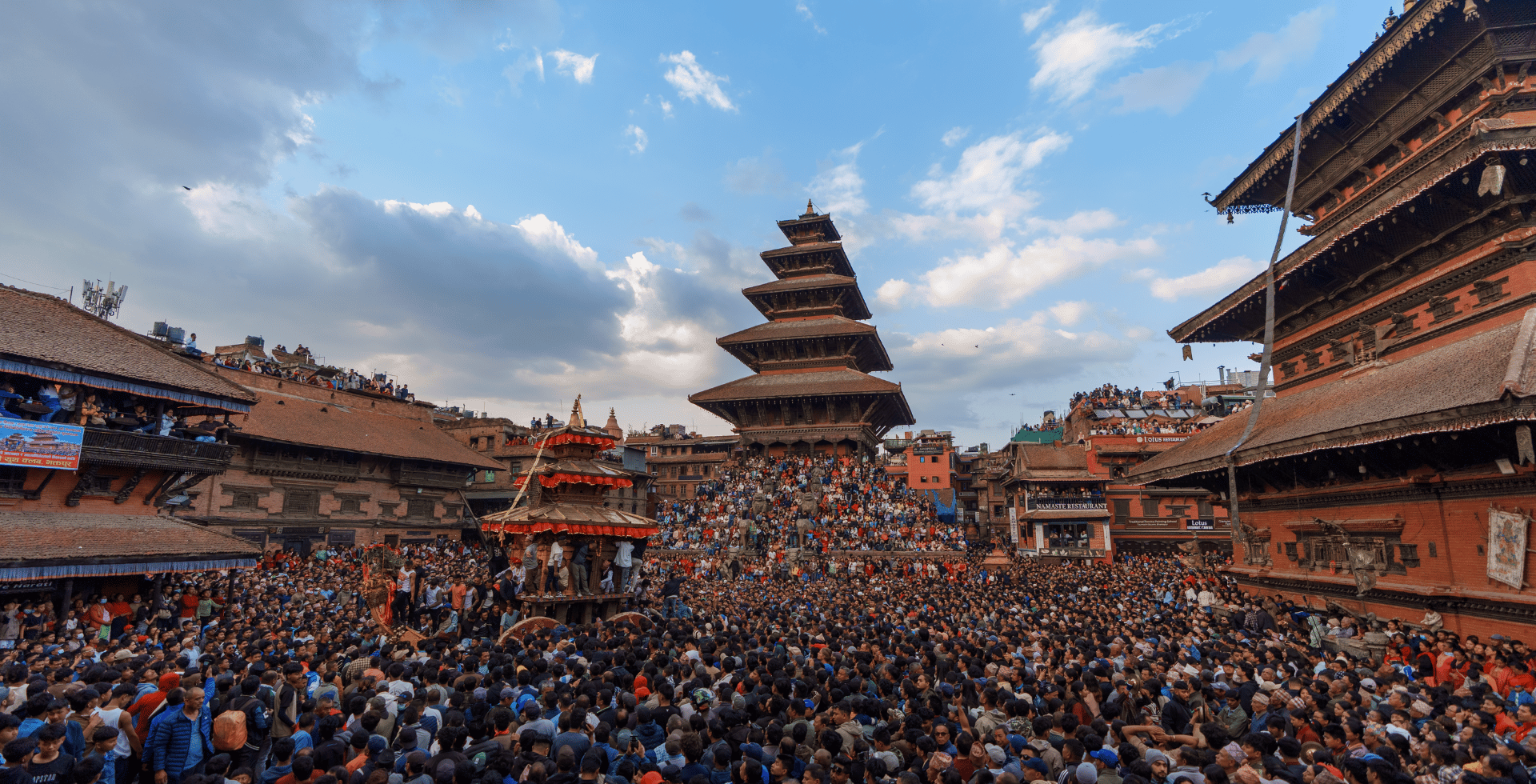
Like the Rato Machhindranath Jatra, two chariots are tugged around the city during Bisket Jatra, but the deities sitting on those chariots are very different from Rato Machhindranath. Lord Bhairava and Bhadrakali Mata occupy these chariots.
Usually, the crowd at Bisket Jatra is more energetic and the atmosphere is more chaotic there due to the almost tug-of-war like nature of pulling the rope to move the chariot forward. Sindur jatra, chariot collision and lingo raising are among the most important events of Bisket Jatra.
Indra Jatra
Indra Jatra is another festival of Kathmandu that honors Lord Indra. Other deities important to the festival include Kumari, Bhairava and Ganesh. The festival is celebrated over 8 days in autumn during the month of Ashwin (usually late September). Through all this, we can see how this festival is very different from the Rato Machhindranath Jatra.

However, one major similarity between the two is that both are celebrated to bring rain to the city. Indra, the king of the gods, is also known as the god of rainfall. So locals of Kathmandu conduct Indra Jatra to thank the god for rainfall that year.
As for the chariots, three separate chariots circumambulate the city during Indra Jatra: the biggest one for Goddess Kumari and Lord Ganesh and Lord Bhairava in the other two. Night dances and lively atmosphere are the biggest pulls of the Jatra.
Ghode Jatra and Gai Jatra
Both Ghode Jatra and Gai Jatra are very different compared to other jatras of Kathmandu, including the Rato Machhindranath Jatra. For one, neither has a chariot procession and both are considered more of a cultural festival than a religious one.
Gai Jatra is celebrated in Bhadra (August) to honour the dead and ease the grief of families through comedic and political satire.
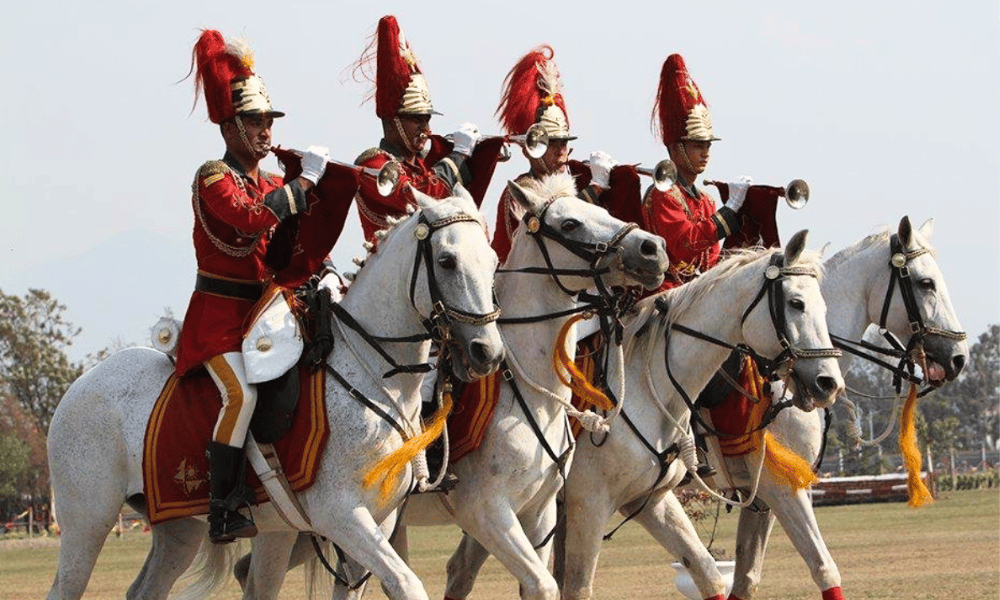
Ghode Jatra, on the other hand, is a horse parade and military display done at Tundikhel by the Nepal Army in Chaitra (March).
Experiencing/Participating The Festival
Participating in the Rato Machhindranath Jatra is a very fun experience. The vibes on one of the chariot pull days are so energetic and charged, you get a boost of energy from the sight alone. This is especially true on the Yaka Misa Bhuya day. It is great to see so many women vivaciously pulling the rath.
Even during the other days, the overall atmosphere around the chariot is very lively. You see devotees visit the chariots every few minutes and a bazaar of sorts always forms around the chariot. Some locals linger nearby, watching the spectacle.
If you have some time, explore the surrounding area, have some local delicacies and take note of the many temples you see all around you. Lalitpur is bursting with culture all around.
The last day of the festival, Bhoto Jatra, is an event you shouldn’t miss. The proceeding lasts hours and the festivity in the air is exhilarating.
Visitor’s Guide
If you want to experience Rato Machhindranath Jatra yourself, you should time your visit to Nepal around Spring–specifically during the months of April to June. As the official dates change every year, be sure to confirm the dates before you book your trip.
The festival is over a month long, so the procession isn’t hastily done. The chariot stays in the same spot for days on end, so if you are already in Nepal (more so Kathmandu) during this time, you shouldn’t worry too much about missing the festival.
Here are some tips for you to enjoy the festival further:
- Visit during chariot pulling days. Those are the most fun and energy filled days. Alternatively, you could also visit during days of coconut throwing day or Bhoto Jatra.
- Make sure you explore the surroundings and don’t just view the chariot and leave. The spots chosen to rest the chariot aren’t random. They are usually nearby the temple of a deity that is important to the festival. Ask around and see what you can find.
- Explore further. We want to emphasise this because Patan and the wider Lalitpur are embodiments of the local Newa culture. You will see and experience so many things here that are unique to the place. So exploring some more is fruitful even if you don’t come across a temple—which is rare, because there are at least a few temples in every neighborhood.
- Try the local delicacies. Lalitpur has so many local eateries run by families for decades. You will get to taste authentic Newa food that isn’t even expensive here. The Patan Durbar Square area, in particular, has a ton of local eateries. Bara, chhoila, chatamari, samay baji and yomari are among the most eaten Newa dishes.
- Time your visit during the aarati (light worship ritual) hours. Aarati happens four times everyday: in the morning, at noon, around sunset and at midnight. During days when the chariot is resting, these are the busiest times as devotees come to see the puja and get tika from the pujaris afterwards. Tika is a coloured mark applied on the forehead as a blessing from the gods.
- Be prepared to face the rain. The festival honours the arrival of rainfall and it occurs during the early monsoon season in Nepal. So bring along an umbrella or a raincoat and wear comfortable shoes with good grip so that you don’t slip if the road gets wet.
- Ask for consent and permission before taking photos or videos. Many temples in Nepal don’t allow you to take photos and videos on their premises. So it's always better to confirm this before you start shooting.
- Respect the culture. You are here to experience the rich local culture of Patan. Do not insult the locals, the festival or the activities, regardless of how strange or novel you think something is. It might not be familiar to you but it is a part of the local lifestyle. Honour that.
Conclusion
The Rato Machhindranath Jatra is a festival you must experience when you are in Nepal. The festival has a long run time (usually more than a month), so if you plan your trip to Nepal well, you can definitely fit this into your schedule.
For a more immersive experience, try a guided tour of the festival. You already know the festival inside out after this blog, but your guide can show you specific places and things you might otherwise miss while observing the festival.
If that sounds like something you would like to try, check out our Kathmandu Photography Tour. While the existing package is Bisket Jatra centric, we can customise it to fit your needs and as per the days of the Rato Machhindranath celebrations.


 Kiran Neupane