



With an area of 38,394 sq. km, Bhutan is known as the Last Shangri-La of the world. Unlike the rest of the countries in the world, which rely on urbanization and industrialization for development, Bhutan’s policy is entirely different, focusing on environmental preservation and sustainability.
This is why about 71% of the country’s land is covered with lush green forests, making Bhutan the first and only carbon negative country in the world. Short walk around the town will show you how people there live in harmony with nature.
Known as the Dragon Kingdom, Bhutan was one of the most isolated countries, like Tibet, before the 20th century. Because of their chosen isolation, Bhutan has been able to maintain sovereignty and protect its age-old traditions in the face of westernization.
Our 10-day All Bhutan Tour Package takes you to the major towns all around Bhutan, where you can engage in the Bhutanese culture and tradition. Visit the ancient Dzongs and temples while you are surrounded by snowcapped mountains.
Tachogang Lhakhang - Built by the Tibetan Saint
On the way from Paro to Thimphu, you will see an ancient structure known as Tachogang Lhakhang right above the Paro River. The temple was built by the Tibetan Saint Thangtong Gyalpo in the early 1400s.
The saint is popularly known as the Iron Bridge Maker in Bhutan. His iron suspension bridges have lasted for centuries and many are still in use throughout Bhutan. You can see one of his bridges near the temple.
However, that bridge was destroyed by the flood in 1969. Later, some of the original chains were recovered, and using those chains, a new iron bridge was made following the original structure. Today, the iron bridge has been adorned with prayer flags.
This historical site used to be the seat of the Lam Kha Nga, an alliance of five learned Tibetan scholars from different sects of Buddhism. The Lamas were later defeated by Ngawang Namgyal, who founded the theocratic nation of Bhutan.
Tashichho Dzong by the Wang Chhu River
Dzongs are the fortified monasteries that were built in ancient times by influential figures to claim authority over the region. Built strategically on hillocks centuries ago, these structures continue to fascinate visitors to this day.
Tashichho Dzong (more than 2,300 m above sea level) is one of the many Dzongs in Bhutan that will leave you fascinated. Built in 1216 by Lama Gyalwa Lhanangpa, it houses the current administrative offices of the King, the secretariat, and the Ministers of Home Affairs and Finance.
When translated, the name means ‘Fortress of the Glorious Religion’. Buddhism is the driving force behind governance in Bhutan, so the Central Monastic Body’s head office is also located in the same structure along with the King’s.
The whitewashed walls and the golden roofs look more alive during the national festival Thimphu Tsechu. Tashichho Dzong is the venue for this annual festival that is celebrated for 3 days. If you visit the dzong during the festival, you will have the opportunity to watch masked dances and traditional folklore performances.
Kuensel Phodrang and Buddha Dordenma
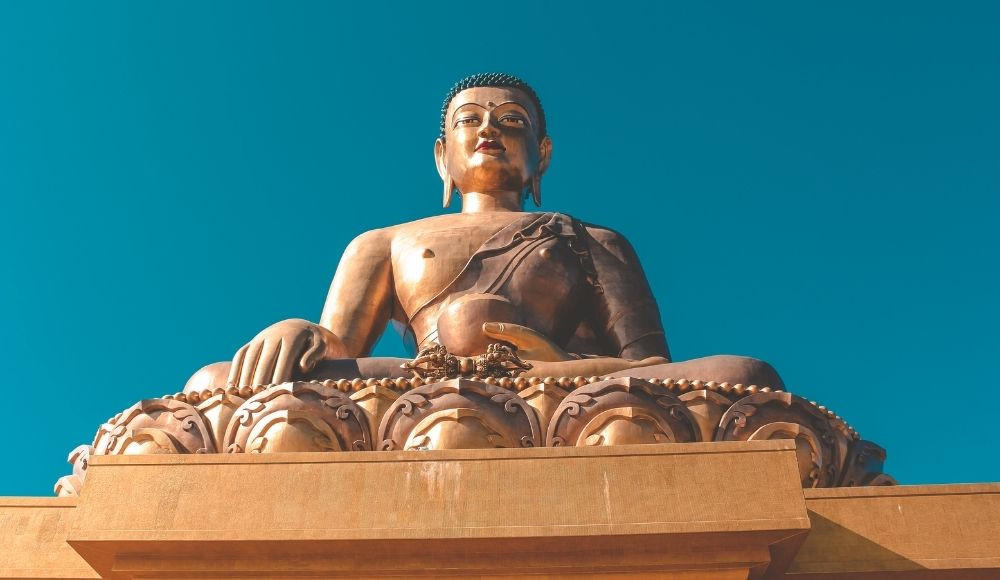
At the elevation above 2,500 m above sea level, Kuensel Phodrang is famously known for the Buddha Dordenma Statue. About 10 minutes away from Thimphu city, the largest statue of Dordenma Buddha can be easily noticed from the city.
It is said that the site was mentioned in one of the prophecies by Padmasambhava, commonly known as Guru Rinpoche in Bhutan, during the 8th century. Based on the prophecy, the site was built by the 13th Druk Desi, Sherab Wangchuk.
With over $100 million spent for the construction of the statue, the structure is iconic and bewitching. What's more surprising is the fact that this gold plated statue of Buddha contains 125,000 mini copper statues of Buddha inside its own copper body.
About 169 ft tall, this statue was built as a symbol of peace and reminds the Bhutanese people of their veneration to Lord Buddha. If you take a close look at the statue, you will notice that the Buddha’s hand is folded into Bhumisparsha Mudra.
The mudra is a reminder of the time Lord Buddha got enlightened and was victorious over temptation. While the monastery was already built in the 18th century, the statue was built to celebrate the 60th birthday of Bhutan’s Fourth King, Jigme Singye Wangchuk.
National Memorial Chorten - Third King’s Legacy
Built in the memory of Bhutan’s beloved Third King, King Jigme Dorji Wangchuk, the National Memorial Chorten is located at the heart of Thimphu.
Known as the Father of Modern Bhutan, the Third King of Bhutan passed away at a very young age in Kenya. The construction of this Chorten was initiated by his mother, Ashi Phutsho Choegron.
Unlike other Chortens which contain human remains, this Chorten is a different one. It contains Buddhist scriptures, images, and relics. The structure itself is decorated with intricate Bhutanese carvings and mandalas.
The National Memorial Chorten was built to remember the Third King’s legacy and as a symbol of peace and faith. Inside the Chorten’s compound, you can also find well-kept gardens and other smaller stupas.
If you visit the site today, you can see Bhutanese people doing kora around the structure and understand the depth of love and respect that the Bhutanese people still have for him.
Motithang Takin Preserve by the Great Fourth
The Fourth King of Bhutan, also known as the ‘Great Fourth’, former King Jigme Singye Wangchuk, made major reforms during his reign.
Apart from initiating major developments across Bhutan, the Fourth King also introduced the concept of Gross National Happiness as a part of the constitution. But he did not just look after the happiness of his people; in fact, he cared about the happiness of wildlife and made major contributions for their wellbeing.
Previously a zoo, the Great Fourth converted the small zoo into a wildlife preserve because he could not settle with the idea of animals living in captivity. To ensure the animals could move freely, he turned the small zoo into a semi-wild sanctuary of roughly 8.4 hectares.
Today, this reserve area is known as the Motithang Takin Preserve, where Takin, the national animal of Bhutan, is preserved along with other animals like sambar and barking deer. This preserve is an example of Bhutan’s commitment to preserving the country’s unique biodiversity.
Punakha Dzong - The Palace of Bliss
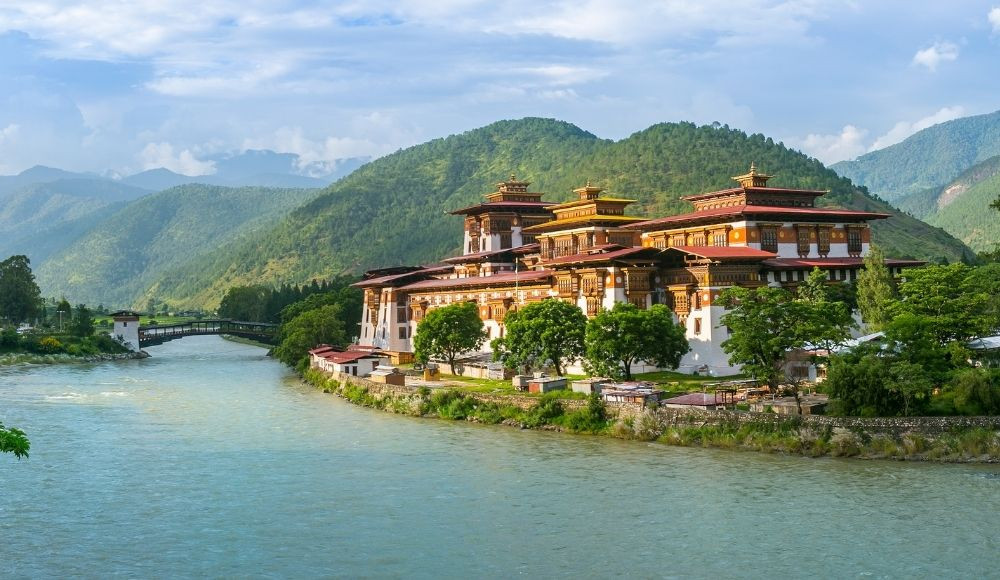
The second oldest dzong of Bhutan, Punakha Dzong, is located in the Punakha district of Bhutan. Compared to other dzongs, this one is situated at a lower altitude of about 1,200 m above sea level.
At the confluence of Pho Chhu river and Mo Chhu river in the Punakha Valley, Punakha Dzong now serves as the administrative center of the city of Punakha. However, similar to other dzongs throughout Bhutan, this structure serves religious purposes as well.
Housing the sacred remains of Ngawang Namgyal (the founder) and Tertoen Pema Lingpa, Punakha Dzong is a site of worship for the locals. The entire southern part of the dzong is used for monastic purposes and is known as the most sacred part of the dzong.
Centuries old statues of Buddha and Guru Rinpoche have been preserved in the main corner of the 100-Pillar Hall of the South Courtyard. Even some parts of the central quarter are used as living residences by the monks.
This dzong is also regarded as the Winter Capital of Bhutan, as it has milder weather compared to Thimphu and other cities of Bhutan.
It is said that this dzong’s construction was also a part of Guru Rinpoche’s prophecy. One of the most important statues you can see in this complex is the statue of Avalokiteshvara, which is said to be self-made.
Chendebji Chorten Inspired by Boudhanath
At the highway connecting Wangdue Phodrang and Trongsa district in Bhutan, there is a beautiful Nepalese-styled Stupa called Chendebji Chorten.
More than 2,400 m above sea level, this structure was built in the 18th century by Lama Shida. It was modeled after the Boudhanath Stupa located in Kathmandu and hints at the close historical and religious friendship between Nepal and Bhutan.
Similar to Nepalese stupas, this chorten has Buddha’s Wisdom Eyes facing all four cardinal directions. Since that area was said to have been under the power of evil spirits, the wisdom eyes look out and ward off the evil spirits from the surrounding areas.
The most important festival celebrated in Chendebji Chorten is Chendebji Tsechu, which is to celebrate the birthday of Guru Rinpoche. Devotees also gather here for Sampa Lhundrup prayers, praying to Guru Rinpoche to fulfill their wishes.
You can also watch the masked dances and religious rituals performed at the chorten during Chendebji Tsechu. Make sure to check out the long prayer wall with Buddhist scriptures near the chorten.
Trongsa Dzong for Bhutan’s Crown Prince
Before the crown prince of Bhutan ascends to the throne, he performs the role of the Governor of Trongsa and is referred to as Trongsa Penlop. He stays at the Trongsa Dzong to learn about his royal duties and responsibilities.
His residence, Trongsa Dzong, stands over the Mangde Chhu river and is one of the most tranquil places in Bhutan. While the main temple was built by Lama Ngagi Wangchuck, the dzong was constructed in 1647 by Ngawang Namgyal, popularly known as the unifier of Bhutan.
As you explore the site, you will come across 25 temples within the dzong. These temples are dedicated to different Tantric deities. If you have time, please take your time at the museum, which was built to honor the Wangchuk Dynasty.
There is also a watchtower (an important part of the dzongs), which was constructed in 1652. Make sure to see the ancient printing shop in the palace where religious texts were printed using centuries-old methods.
The Sacred Jambay Lhakhang
The reach of the Tibetan King, King Songtsen Gampo, in the 7th century can be seen by the structures he built in Bhutan. Jambay Lhakhang is one of the two temples he built in his effort to subjugate the demoness who was hindering the spread of Buddhism.
Located in Bhumthang at an elevation higher than 2,400 m above sea level, Jambay Lhakhang is one of the oldest temples in Bhutan. Even Guru Rinpoche was said to have visited this site and called it an exceptionally sacred site.
Of all the relics in this temple, the most revered one is that of Maitreya Buddha and the hundred statues of the Gods of Kalachakra. These statues date back to the 7th century and act like the first historical record of Buddhism in Bhutan.
The main festival celebrated in Jambay Lhakhang is Jambay Lhakhang Drup, which lasts for 4 to 5 days. It is celebrated to honor the temple and Guru Rinpoche. Visiting the temple around this time will let you witness some of the most spectacular cultural performances.
Two of the most well-known performances are Tercham and Mewang. Tercham is a ritualistic naked dance and Mewang is a dance performed to bless infertile women with children.
Kurjey Lhakhang - Temples by the Royals
In 1652, when Minjur Tenpa served as a Trongsa Penlop, he built a temple, which is known to be sacred for many reasons. One of the main reasons was the imprint of Guru Rinpoche’s body that was left after he meditated in the temple.
That temple is called Kurjey Lhakhang and it is located in Jakar, Choko Valley. About 2450m above sea level, Kurjey Lhakhang has 108 stupas in its lining. The number 108 represents different things in Buddhism.
The second temple was added in 1900 and is the second most important structure in the area. It is known as Sampa Lhundrup, and it was built by the First King of Bhutan, Ugyen Wangchuk, as a Trongsa Penlop. You can find a large statue of Guru Rinpoche in this temple.
The structure was built by Queen Ashi Kesang Wangchuk, who was the wife of the Third King of Bhutan. The temple is known as Ka Gon Phur Sum Lhakhang.
Lhodrak Karchu Monastery
In a forested hill of Chamkhar Town in Bhutan, the beautiful Lhodrak Karchu Monastery overlooks the Jakar Dzong.
Built by the respected incarnation of Tibetan Buddhism, Namkhai Nyingpo Rinpoche, this structure was constructed in the 1970s. Located above the Chamkhar River, this monastery is a house to about 400 monks.
Some of the most important parts of this monastery are the Great Assembly Hall, the meditation centers, the library and the courtyard where the daily monks' debates are held.
The Main Assembly Hall has the main idols of the monastery. One can find the statues of the Padmasambhava, Chenrezig, and Sakyamuni upon entering the hall.
Nyingma School’s Gangtey Monastery
Gangtey Monastery, built in 1613, belongs to the Nyingma School of Buddhism and was built by Pema Thinley. Built on top of a hill is Phobjikha Valley; the monastery looks over the city.
Like most of the dzongs in Bhutan, the heart of this monastery is its tower, which was built on a mandala form. However, unlike typical dzongs, this structure does not have any defensive elements in its architecture.
When you enter the ground floor of the utse, you will be graced by the presence of 3 beautiful idols of Buddha. The 3 statues are the representation of Buddha’s past, present, and future selves.
On the second floor, you will find 3 elegant shrine rooms and the temple’s treasury. The remaining parts of this floor are used as the residential wing. The third floor is used for other functions of the monastery.
The north wing is sacred for another reason. The Machen Lhakhang situated on that side contains the embalmed body of the Sixth Gangteng Tulku, a respected figure of Buddhism who introduced dances in the monastery.
Phobjikha Valley and the Crane Festival
At an altitude of 3000m above sea level, there is a serene U-shaped glacial valley in Bhutan’s Wangdue Phodrang district, called Phobjikha Valley.
About 4 to 5 hours away from Thimphu, this beautiful valley has numerous popular hiking trails that are ideal for birdwatching and visiting monasteries.
Being a wetland in a high-altitude region, this valley is home to the endangered black-necked crane, which explains why birdwatching is a popular activity here. The cranes are welcomed every year with the Crane Festival at Gangtey Monastery.
Visiting Phobjikha Valley is one of the best ways to observe the Himalayan life. Rich in biodiversity, this valley is home to nomadic shepherds, potato farmers, and yak herders.
Simtokha Dzong
Simtokha Dzong was built in 1629 by Ngawang Namgyal, the unifier of Bhutan. It is located in Thimphu and can be seen on the way to Punakha. This fortress played a major role in helping him win against his major rival Tsang Desi and the group of 5 Lamas who had power over different regions of Bhutan.
Simtokha Dzong is built on a small hill of Thimphu over a rough shape of a mandala. There is a large utse in the center of the dzong. The tower has a temple and the other parts are used for ancillary functions.
The courtyards are close by the temple which makes circumambulation and other ritual functions easy to carry out. The exterior part of the dzong is used by the monks as their residential quarters.
Taktsang Monastery
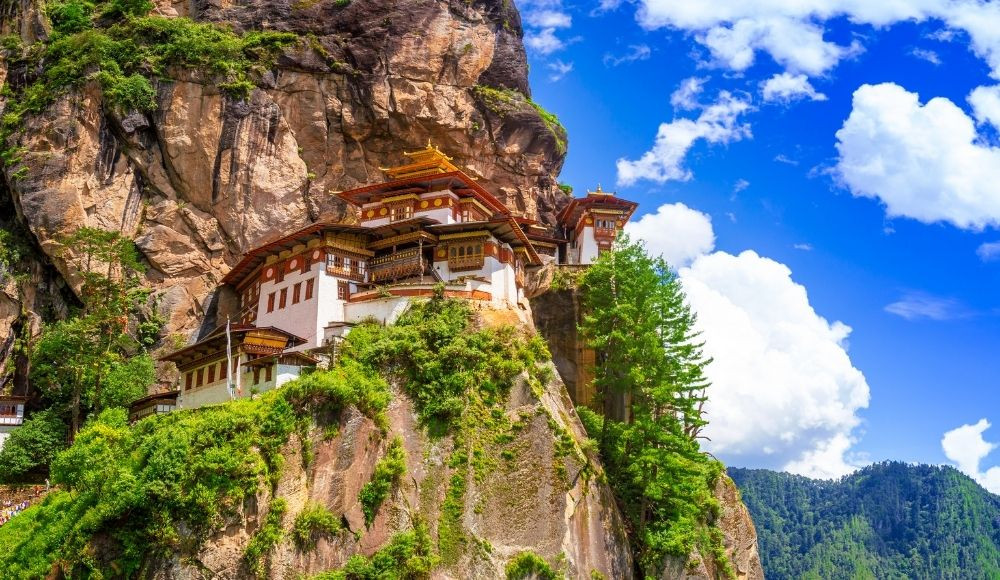
Of all the monasteries in Bhutan, Paro’s Taktsang Monastery has been declared as the most iconic, owing to its architecture and backstory. The monastery is also known as Taktsang Palphug and Tiger’s Nest Monastery.
It is claimed to be one of the most sacred sites, as Guru Rinpoche was said to have meditated on the cliffside of the monastery. What’s more interesting is the way he reached there.
Legends say that Guru Rinpoche travelled all the way here on the back of a pregnant tigress. On his way here, he was disguised as Dorje Drolo, his wrathful manifestation. After that, he meditated on this site for the next 4 years.
About 3,120 m above sea level, this monastery is located in the Upper Paro Valley. From the monastery, you can see the enchanting view of the mountains and the green valleys below the monastery.
The most important festival celebrated in Taktsang Monastery is the Paro Tsechu Festival, which is celebrated grandly for 5 whole days. On the final day, a beautiful thangka is revealed for the people to see.
Kyichu Lhakhang
Also known as Kyerchu or Kitchu Lhakhang, Kyichu Lhakhang is located on the flatlands of Paro Valley, about 2,200 m above sea level. This was another one of the 108 temples that King Songtsen Gampo built and one of the 2 temples that falls within the territory of present-day Bhutan.
Throughout the years, the temple has been expanded and restored for various reasons. In the 1830s, the 25th Je Khenpo, Sherab Gyaltsen, restored the temple. Then in 1971, Bhutan’s Queen Mother Ashi Kesang Choden Wangchuk initiated the construction of Guru Temple, the last addition to the Monastery.
Being one of the oldest structures in Bhutan, the main temple here is the Jowo Lhakhang, which dates back to the 7th century. It is the original structure built by King Songtsen Gampo.
Inside the temple, there is a statue of Jowo Sakyamuni. The statue also dates back to the 7th century, and it is believed that it was made around the same time as the Jowo Sakyamuni of Jokhang Temple in Lhasa, Tibet.
Visiting Kyichu Lhakhang and Jambay Lhakhang is a great way to learn about the ancient ties between Bhutan and Tibet.
Jangtsa Dumsteg Lhakhang
The Iron Bridge Maker’s legacy is not limited to Tachigang Lhakhang. While searching for raw materials to build more bridges, it is said that Thangtong Gyalpo reached all the way to the site where Jangtsa Dumsteg Lhakhang stands today.
After reaching this place, he came across a demon who was responsible for diseases and calamities in the said region. So after Thangtong Gyalpo defeated the demon, he built a chorten on top of it.
This explains why the Jangstel Dumsteg Lhakhang is built like a chorten. The temple is built in the shape of a mandala and its structure represents Mt. Meru, an important site in Buddhist cosmology.
There are 108 prayer wheels at the base of the temple and there is a large altar on the temple’s ground floor. On the second floor of the temple, you will find many statues, including those of Vajradhara and Milarepa, placed irregularly.
Throughout its opening hours, you can watch devotees and pilgrims walk the kora around this sacred site. The temple is approximately 2,285 m above sea level.
Rinpung Dzong and the National Museum
There is a large limestone promontory situated above the Paro River, and at the top of the cape you will find Rinpung Dzong. It is said that this beautiful site was also visited by Guru Rinpoche during his time there.
It was built in the 1600s by Ngawang Namgyal to defend against the Tibetan invasion. It is one of the largest dzongs in Bhutan today and also has Ta Dzong, the National Museum of Bhutan, nearby.
There is a Lhakhang located near the tower of the monastery that is dedicated to Chuchizhey, a revered form of Avalokiteshvara. On top of the tower, there are two temples, both of the temples are dedicated to Dorje Chang, commonly known as Vajradhara.
The most important festival of this dzong is the Paro Tshechu Festival, which lasts for 5 days and is celebrated with cultural performances and folk dances.
As you can see, our 10-day itinerary for the All Bhutan Tour Package takes you across numerous regions of Bhutan. It takes you across the major monasteries, fortresses, and temples across the country, where you can learn how deep the history, faith, and traditions of Bhutan are.
It is time for you to take that shot and explore the paradise that Asia has kept in store for you. Life is all about balance, and every now and then, the idea of monasteries on top of a hillock certainly seems like a wonderful exchange for the concrete jungles we are surrounded by.