If you've been doing research on Biska Jatra, you've probably come across the same short explanation repeated everywhere: the festival of the dead serpents, celebrated in memory of a prince who killed two snakes that emerged from a princess's nose.
While these stories are very real, very compelling, and very much a part of Bhaktapur's oral tradition, it is not the full picture.
Bisket Jatra is actually one of the most layered, most misunderstood, and frankly most underestimated festivals in all of Nepal. And once you understand what is actually being celebrated here, your experience on the ground becomes ten times richer.
Note that Biska Jatra is as prominent as the Gai Jatra festival of Bhaktapur. Now, let me walk you through all of it properly!
Who Started Bisket Jatra?
The festival's core lingo-raising tradition dates back to the Licchavi period, roughly the 5th to 8th century CE. But the festival in its current nine-day form was formalised by King Bhupatindra Malla of Bhaktapur in the 17th to 18th century CE. 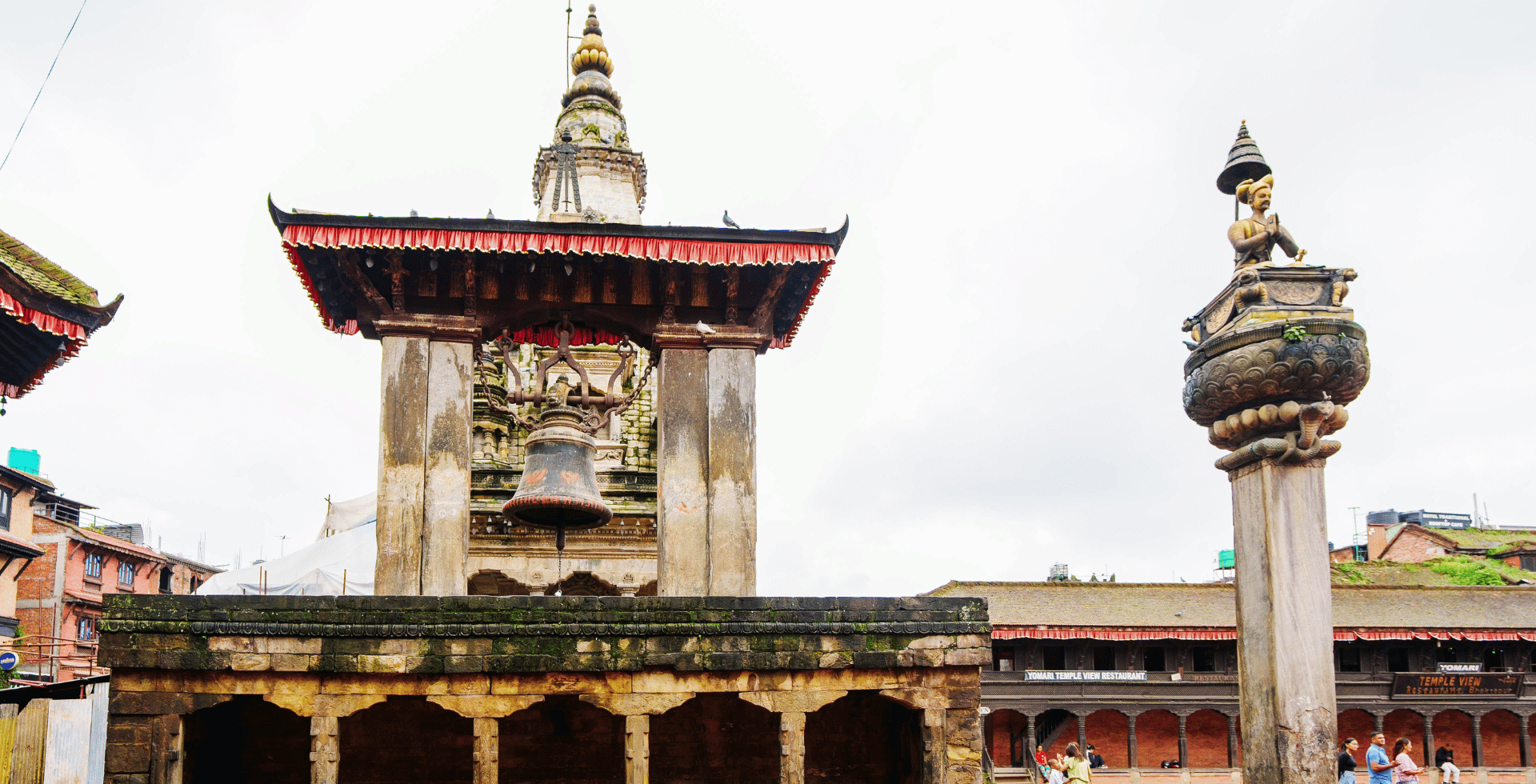
The Bhairav and Bhadrakali chariot procession was added by Malla kings, including Vishwamalla and Jagajyoti Malla, as a way to give Bhaktapur its own grand cultural identity after the Kathmandu Valley split into three rival kingdoms.
Why Was it Started? Myths vs Reality
The festival marks the solar new year (Baisakh Sankranti), honours Bhairav and Bhadrakali as Bhaktapur's main city-deities, and prays for agricultural abundance, protection from disease, and cosmic balance.
The lingo raising is fundamentally a cosmic act: it symbolises Bhairav (sky) uniting with Bhadrakali (earth), a tantric ritual of creation that the community enacts every year at the peak of spring.
Mythological Stories
The first legend tells of a powerful tantric master named Shekhar Acharya who saved Bhaktapur from Kirant raiders during the reign of Licchavi King Shivadeva II.
He later became trapped in python form alongside his wife due to a tragic mishap with magical rice grains. Both died at Lyosingkhel, and a memorial lingo was erected in their honour.
The second, more popular legend tells of a princess whose snake-born curse killed every husband until a brave young man from outside Bhaktapur stayed awake through the night.
This young man killed the two serpents emerging from her nostrils, and broke the curse. The king celebrated by mounting the dead serpents on a tall pole for all to see.
What Historical Records Say
But here is something that most articles on the web about Bisket Jatra will not tell you. And it is arguably the most important thing to understand before your participation in one of the vibrant festivals of Nepal.
As per the previous mythological stories, Bisket Jatra is commonly described as "the festival of the dead serpents," and its name is widely explained as coming from the Newari words bi (meaning, ‘serpent’) and syaku (meaning, ‘killed’).
Honestly, I found this explanation repeated everywhere when I was first researching the festival. But when you dig into the actual historical evidence, things get far more interesting!
The earliest written reference to this festival, according to Dr. Balaram Kayastha's comprehensive research, found in a Yaksha Malla-era inscription at Taumadhi Square from Nepal Sambat 561, does not use the word "Bisket" at all. It uses the word Vishwoyatra (which translates to ‘World Festival’).
Multiple other Malla-era inscriptions and manuscripts call it Vishwajatra, Vishwadhwaja Jatra, and Vishwaketu. The tantric almanacs (Panchanga Patro) consistently refer to the lingo-raising event as Vishwadhwajotthana (meaning: the raising of the World Banner).
As far as we know, not a single early inscription calls it the "Festival of the Killed Serpents."
That raises the question about where the word "Bisket" comes from. Let us tell you:
- In Sanskrit and Classical Newari, the sun is called Vishwa (the universal one).
- And ‘ketu’ means a banner or standard.
- The lingo, raised at the solar new year when the sun enters Aries, is the Vishwaketu.
- Over centuries, Vishwaketu evolved through Bisiketu to Bisikat and eventually to Bisket in spoken Nepali (Newars call it ‘Biska’ in Nepal Bhasa).
- The serpent interpretation looks like a folk etymology (which is the case with many other Nepali festivals, too). When people no longer remembered the Sanskrit origin of "Bisket," they found a plausible explanation using familiar Newari root words, and that explanation is what got stuck and spread!
Meanwhile, the hanging banners on the lingo, which flutter in the wind and do resemble snakes from a distance, and that perhaps made the serpent interpretation even easier to believe.
Now, we’re not saying the serpent legends are false or unimportant. They are cherished stories embedded deep in Bhaktapur's cultural memory, and what we believe gives ‘life’ to the festival.
But the festival itself, at its historical and theological core, is something more! It’s a cosmic celebration of the sun's annual journey and the divine protection of Bhaktapur's city-deity, Aakash Bhairav.
Symbolism and Deeper Meaning of Bisket Jatra
Once you understand the historical background, the symbolism in Bisket Jatra starts making complete sense:
- The lingo is not just a pole. In tantric symbolism, it represents Bhairav himself, which is why the idol is wrapped in dark blue cloth.
- The socket in the ground at Lyosingkhel, into which the lingo is raised, represents Bhadrakali.
- When the lingo is raised into the socket on the evening of Chaitra 30 (last day of the year), it symbolises the sacred union of Bhairav and Bhadrakali. Meaning, when masculine sky and the feminine earth (the cosmic couple) are joined, this brings fertility, rain, and life to the world!
- The tug-of-war over the chariot (on the first day) represents more than neighbourhood rivalry. The upper (Thane) and lower (Kwone) halves of Bhaktapur compete to bring Bhairav's chariot to their side, because having the deity in your neighbourhood is believed to bring blessings and good fortune for the coming year. It is devotion expressed as competition!
- The two banners (Bir Dhwaja and Vishwa Dhwaja) on the lingo are the deity's flags (not actually ‘serpents’). Both an 1854 BS banner inscription from King Rana Bahadur Shah and a 2004 BS inscription from King Tribhuvan explicitly address the lingo as "Aakash Bhairav" and describe the banners as "Bir Dhwaja" (Victory Banner).
- The midnight collision of the two chariots on New Year's night is the festival's most intimate ritual moment. When the Bhairav chariot and Bhadrakali chariot are brought face to face at Gahiti and made to collide three times, the local Newari term for this is ‘Kha Lwakegu’. And it is interpreted as the symbolic mating of the two deities, which is a cosmic act of creation that is believed to bless people in the coming year!
Primary Deities of Bisket Jatra and Their Roles
First of all, here are the main deities of this 9-day Bisket Jatra Festival. While quite a lot of gods and goddesses are worshipped by the Bhaktapurians, the following are the prominent ones:
Lord Bhairavnath (Bhairav)
Bhairav is the central deity of the festival and the main protector of Bhaktapur. He's actually a fierce manifestation of Lord Shiva's terrifying Raudra form that is associated with cosmic destruction and protection.
His iconography shows eight arms carrying weapons, a fanged face, a skull garland, and a distinctive dark blue complexion.
What makes Bhaktapur's Bhairav particularly remarkable is his theological identification. In the tantric tradition of Bhaktapur, Bhairav is the local deity who is identified with the sun (Surya), with Indra (the sky-god), and even with the universal lord (Vishwanath or Vishweshvar)!
The lingo raised during Bisket Jatra is referred to directly as "Sri Akasha Bhairav" (Sky Bhairav). And this festival is in fact celebrated to honour and propitiate Lord Bhariavnath in the solar new year.
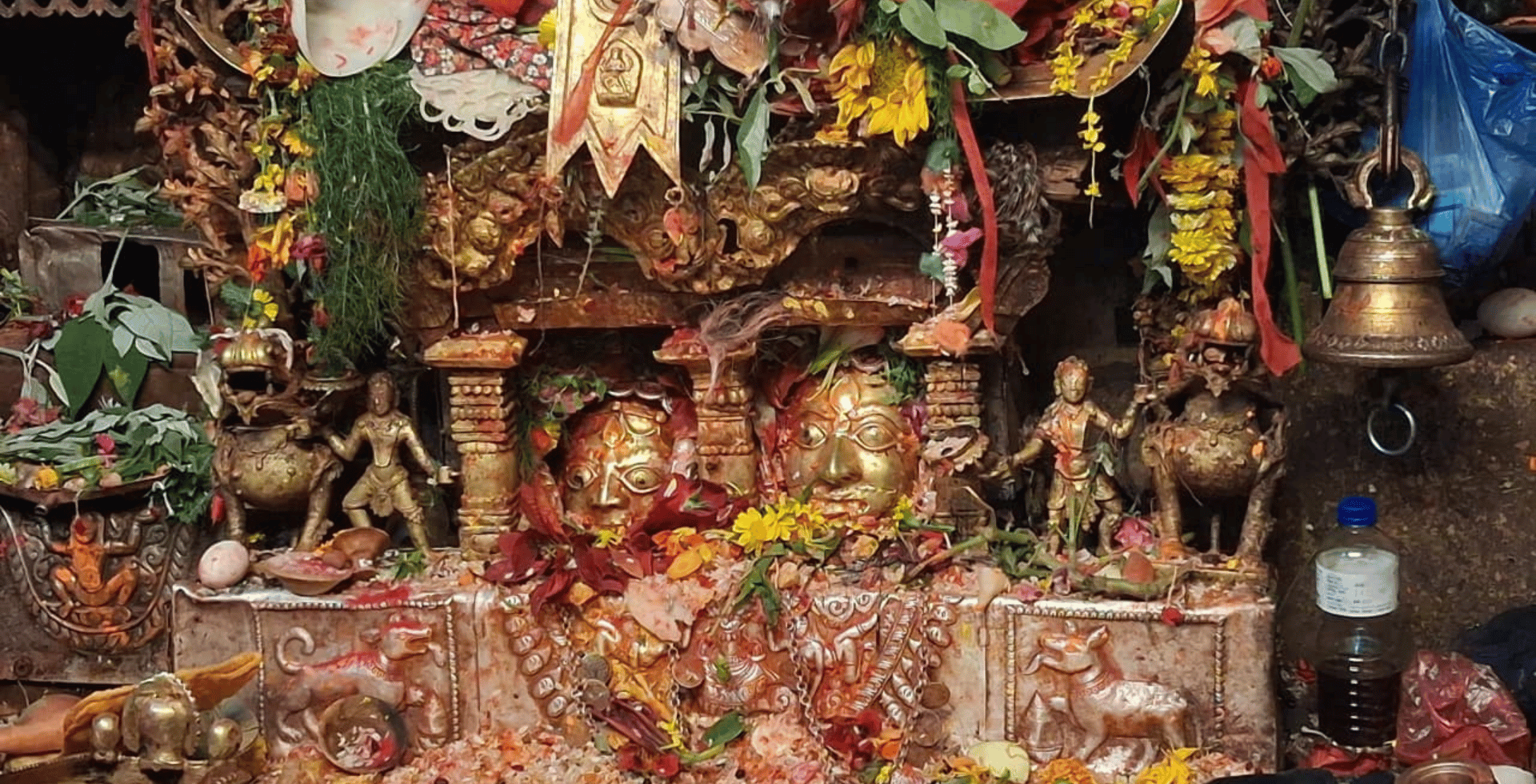
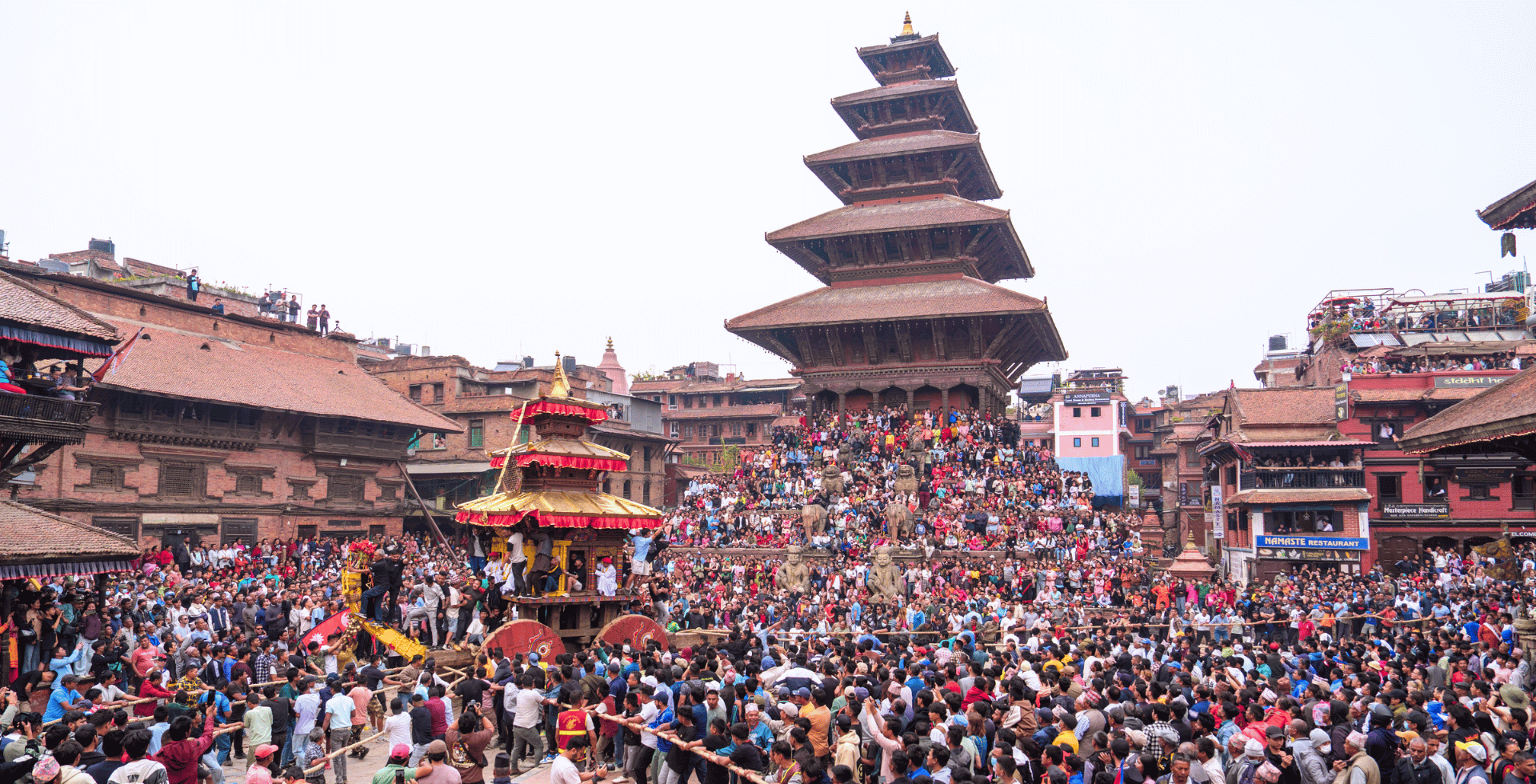
On the first day, Bhairav’s idol is housed in a three-story pagoda-style temple at Taumadhi Tole, right in front of the five-story Nyatapola Temple and Bhairavnath Temple. And his idol is taken out once a year: during Bisket Jatra.
This annual emergence of Bhairav is called ‘Dya Kwaha Bijyagu’ in Newari, meaning "the god descends to the public." And when this is happening, the entire city (with all the ones coming to watch the jatra) explodes with joy!
There’s also an interesting local story claiming that Vishwanath Bhairav of Kashi (Varanasi, India) once visited Bhaktapur Durbar Square in human form to witness the festival.
When a priest recognised him, Vishwanath Bhairav started vanishing into the ground. But the priest didn’t let go and cut his head. The head was then ritually established in the Bhairavnath Temple at Taumadhi Square.
Goddess Bhadrakali
Bhadrakali is Bhairav's consort (partner) and equally central to the festival, though she receives somewhat less popular attention than Bhairav. She is a fierce manifestation of the goddess Kali, associated with time, transformation, and the feminine creative force.
Her role in the festival is significant in a way most visitors don't realise.
In fact, if you didn’t know, the original Bisket Jatra was not a Bhairav festival at all. It was a Bhadrakali (Nakiñju Ajima) festival! The goddess's shrine at Lyosingkhel was the original festival ground.
The lingo is erected in a socket that symbolically represents her creative feminine power. Bhairav's chariot procession was added to the festival only later by the Malla kings, centuries after the core tradition was established.
Her chariot, called Nakinju Kha in Newari, is a two-story structure, slightly smaller than Bhairav's three-story Bhaila Kha. She participates in the chariot procession symbolically, making her own journey through the city, and meets Bhairav for the most intimate ritual of the entire festival.
Betaal (or Betal Bhairav)
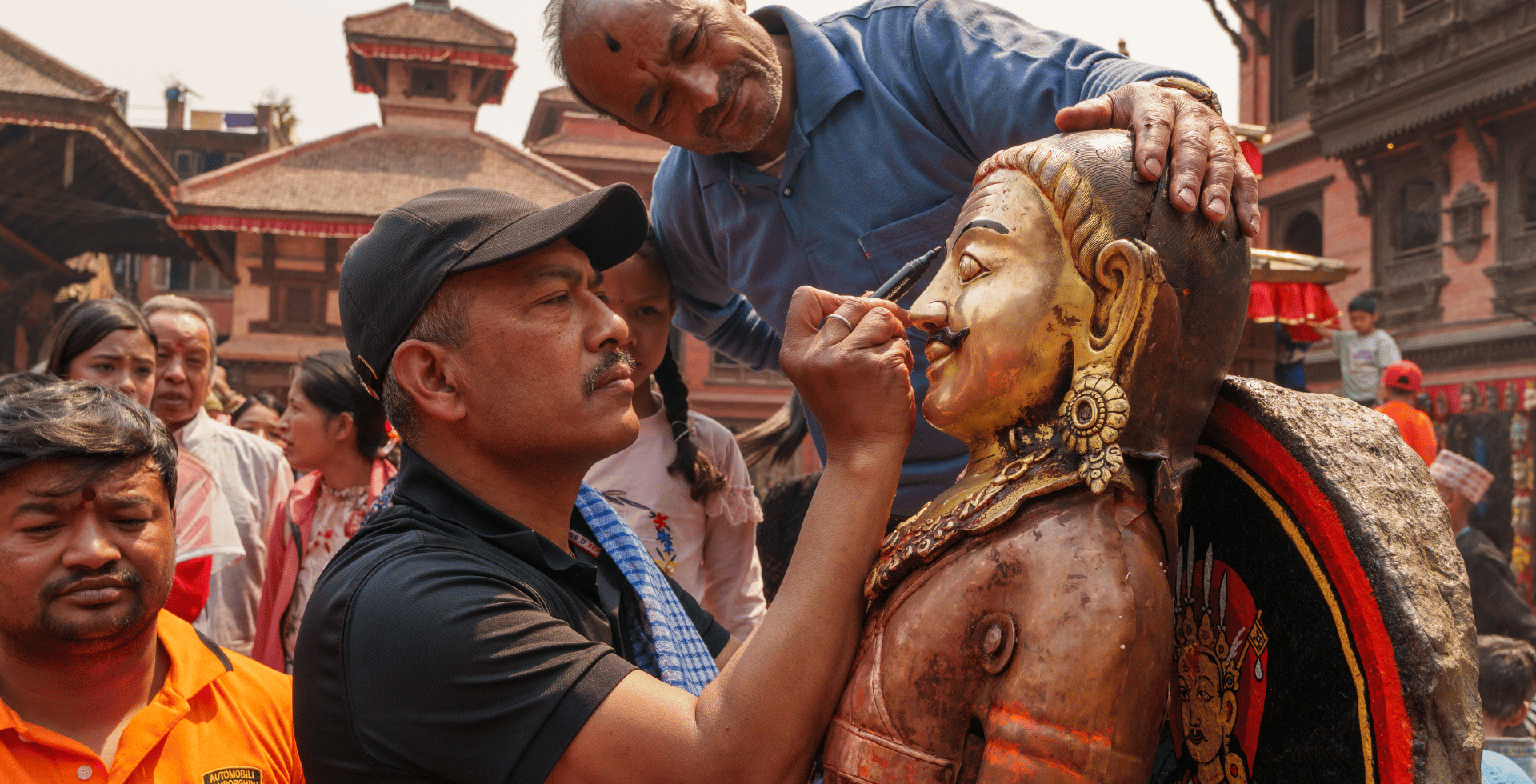
Betal is the vahana (divine vehicle/attendant) of Bhairav. You will see his carved wooden form prominently displayed at the front-top projection of the Bhairav chariot, where his image sits above the chariot like a figurehead.
In local Newari, this carved projection is called Betasin, and it resembles a raised cobra head. His presence on the chariot reinforces the fierce, protective character of the procession.
Other Deities
During the nine days, Bisket Jatra draws in virtually the entire divine population of Bhaktapur!
Ganesh (multiple forms, including Bhaktapur's extraordinarily important Chhuma Ganesh), Mahalaxmi, Mahakali, Brahmayani, Maheshvari, Indrayani, the Ashta Matrika (eight mother goddesses), Dumaju, and the Navadurga all participate in their own neighbourhood processions (Khajatras) during the 9-day festival window.
Bisket Jatra runs for nine days and eight nights, starting on Chaitra 27/28 and ending on Baisakh 5. Let me walk you through what actually happens on each day.
Before getting into the day-by-day specifics, kindly note that Bisket Jatra begins based on Nepali calendar dates. While it’s usually Chaira 27 (when the month has 30 days), but some years, it can start from Chaira 28 (when the month has 31 days).
The corresponding Gregorian calendar dates shift slightly every year.
In 2026, the festival ran from April 10 (Chaitra 27) to April 18 (Baisakh 5), with the Nepali New Year falling on April 14.
Here’s a quick reference table to the Bisket Jatra day-by-day breakdown (which is explained in detail later):
|
Day
|
Nepali Date
|
Approx. Gregorian
|
Key Events
|
Main Location(s)
|
|
1
|
Chaitra 27/28
|
April 9/10
|
Dyo Kwa Bijyayegu, Bhairav chariot tug-of-war, Bhadrakali chariot procession
|
Taumadhi Square, Gahiti
|
|
2
|
Chaitra 28/29
|
April 10/11
|
Kalabha purification ritual, personal puja at the chariots
|
Gahiti
|
|
3
|
Chaitra 29/30
|
April 11/12
|
Syako Tyako, Lakophe Tu Sait (buffalo sacrifice)
|
Gahiti
|
|
4
|
Chaitra 30/31
|
April 12/13
|
Handless lingo raised (Pottery Square), lingo raised in Bode and fasting begins for Jibro Chedne Jatra, Kumari chariot to Lahi Tole, Main lingo raised at Lyosingkhel, Indrayani Tipwa Jatra (Khauma), Sunga Dyo Jatra (Thimi), Barahi Ajima Tipwa Jatra, Chanhesiya all-night torch festival (Thimi)
|
Kumale Tole, Lyosingkhel, Khauma, Bode, Thimi
|
|
5
|
Baisakh 1
|
April 13/14 (Nepali New Year)
|
Ghasapalu/Jogicha Puja (Taleju), Bishnuvir Jatra (Thimi), Charkhandi Mela (Dadhikot), Satruhanta Jatra, lingo falls (4-6 PM), Siddhikali/Bya-li-siya Jatra (Thimi evening), Barahi Tipwo Jatra, Dumaju Devi Jatra (Taleju, night), Kha Lwakegu (midnight, Gahiti)
|
Lyosingkhel, Taleju, Thimi, Dadhikot, Gahiti
|
|
6
|
Baisakh 2
|
April 14/15
|
Sutha-Siya / Main Sindoor Jatra (Balkumari), Jibro Chedne (Bode), Jyatha Ganesh and Batuk Bhairav Rath Yatra (Bolachhen), Mahalaxmi and Mahakali Jatra (Bholache Chowk), Brahmayani Jatra begins
|
Madhyapur Thimi, Bode, Bolachhen, Bhaktapur
|
|
7
|
Baisakh 3
|
April 15/16
|
Brahmayani and Maheshwari Jatra, chariot collision at Dattatreya Square, Batuk Bhairav and Jyatha Ganesh Sindoor Jatra (Talako), Khatajatra of Pardeshi Bhimsen (Khanla)
|
Dattatreya Square, Talako, Khanla
|
|
8
|
Baisakh 4
|
April 16/17
|
Dya Swogan Begu (all day), Chhuma Ganesh Jatra (Chochhen Tole)
|
All of Bhaktapur, Chochhen Tole
|
|
9
|
Baisakh 5
|
April 17/18
|
Handless lingo lowered (Pottery Square); Final chariot tug-of-war, Dya Thaha Bijyagy, Chhuma Ganesh returns home
|
Pottery Square, Taumadhi Square, Chochhen Tole
|
Day 1: Chaitra 27/28 (April 9/10)
Event: Dyo Kwa Bijyayegu (Deity comes out of the temple)
Time: Morning to evening, from around 9 AM
Location: Taumadhi Square
Significance: Bhairav's presence in the chariot (moving through the streets) is a direct darshan (divine vision) for the entire neighbourhood he passes. Bringing him to your side first is a matter of genuine community devotion.
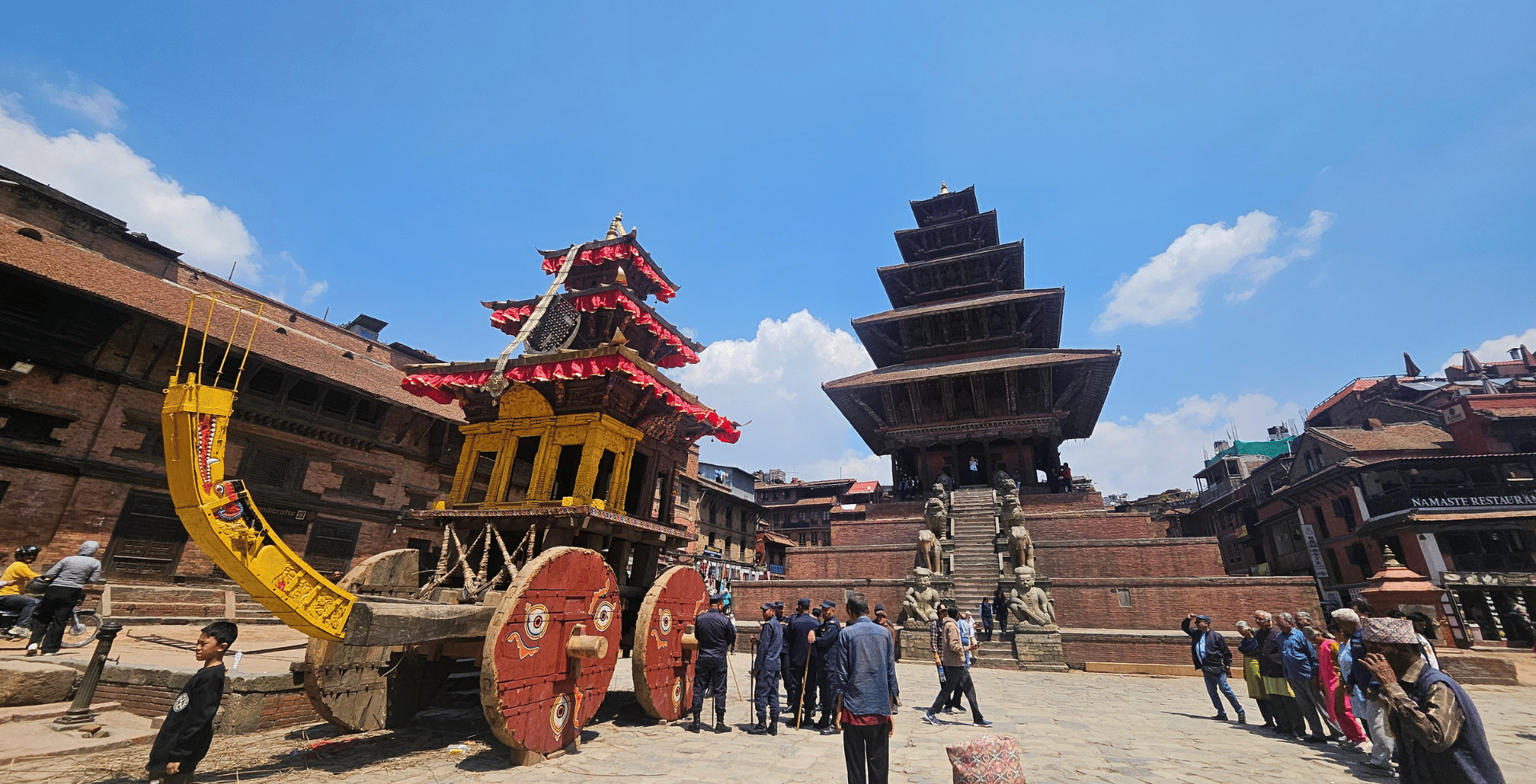
The festival opens with the single most anticipated moment as Bhairav leaves his temple, which happens only once a year.
After goat sacrifices in the morning, tantric pujas by the Karmacharya priests, tying of Betal idol onto the frontal part of the Bhairav chariot, and playing Dhime and Bhusya, the deity is placed in the three-story wooden chariot (Bhaila Kha) at Taumadhi Square (one of the four squares of Bhaktapur Durbar Square).
But the chariot does not move until the royal sword (khada) arrives from the Taleju Palace in the Layaku compound.
Then comes the great tug-of-war. Thick ropes are pulled simultaneously by the upper town (Thane) team and the lower town (Kwone) team, with hundreds of men on each side.
The shout is "Hose Haisse Haaa!" Whichever team wins gets Bhairav's chariot through their neighbourhood first. The chariot finally rests at Gahiti (the designated courtyard between Taumadhi and Lyosingkhel) for the night.
The Bhadrakali chariot also begins its procession from Taumadhi on this day and is taken to Gahiti.
Note: For security reasons, the idol of Bhairavnath is removed from the chariot and transferred to a safe location each day. It’s placed back the next morning with proper rituals.
Day 2: Chaitra 28/29 (April 10/11)
Event: Rest Day (no major event, only general pooja)
Both chariots stay at their temporary rest points. No procession is held today.
This is the best day to get close to the chariots and the deities without the massive crowds as of Day 1. Without a doubt, it’s worth visiting if you are already in Bhaktapur!
The Bhairav Naike performs the morning kalabha ritual (holy water purification) before allowing general devotees to visit.
People come throughout the day for a quiet personal puja, offering flowers and prayers directly to the deity in a more intimate setting than the festival crowds permit.
Day 3: Chaitra 29/30 (April 11/12)
Event: Syako Tyako (The Great Sacrifice Day)
Time: Morning
Location: Gahiti
The term Syakot Tyako translates roughly as "however much you can offer is the merit you receive." It is the same phrase used for Maha Navami during Dashain, which tells you how seriously this day is treated.
The main event is the Lakophe Tu Sait: a large buffalo sourced from the Guthi is sacrificed to Bhairav using a method specific to this occasion.
The meat is distributed as ‘prasad’ or ‘Syakwatyakwah’ to the eligible Bhairav Naike household members (Gchemoh, Chawala, Suwal, and Chhukang lineages) in prescribed quantities: 8 pieces per male, 4 pieces per female. Outside these lineages, the prasad does not go.
Ordinary devotees also visit throughout the day to offer chickens, ducks, and eggs to the deity.
Day 4: Chaitra 30/31 (April 12/13)
Event 1: Lha Maru Yosin Thanegu
Time: Morning
Location: Kumale Tole, Pottery Square
The "handless lingo" (without pegi, the handle extensions that other lingos have) is raised at Kumale Tole in Pottery Square. This smaller preparatory lingo goes up first, activating the festival atmosphere all in the Bhaktapur Durbar Square premises!
Event 2: Lingo Raising and Fasting Ceremony in Bode
Time: Morning to Evening
Location: Mahalaxmi Temple, Bode
Also on this day, in Bode (Madhyapur Thimi), the lingo is raised in front of the Mahalaxmi Temple, and this is the auspicious signal that officially sets the date for the upcoming tongue-piercing ceremony.
Also, in the afternoon, the Kumari's chariot is taken to Lahi Tole as part of the festival's royal ceremonial sequence.
The volunteer who will undergo the tongue-piercing ceremony on Day 6 begins his formal fast this evening. The ritual commences with firewood brought specifically from the Nilbarahi forest.
From this moment onward, the volunteer must abstain from food, must not speak to or touch women, and must avoid contact with animals (including dogs, chickens, and cats). The fast itself is considered a sacred act, not just a preparation.
Note: In 2026, for the Bode’s Tongue-piercing festival, Sujan Bagh Shrestha was a participant, which was his fourth consecutive participation.
Event 3: Yosin Dyo Thanegu
Time: Evening (around 5 to 7 PM)
Location: Lyosingkhel / Bhelukhel
Significance: This is the festival's most visually powerful moment before Day 5. The lingo is Bhairav, and its raising marks the completion of the old year's cycle.
This is the main event of Day 4. Both Bhairav and Bhadrakali chariots are pulled from Gahiti to Lyosingkhel in the afternoon.
Then, using eight thick ropes symbolising the eight Ashta Matrika goddesses, teams of men raise the 25-metre lingo (from Chitapol Nala forest) into its socket in the ground.
The top is already prepared: wrapped in dark blue cloth (Bhairav's colour), with the Bir Dhwaja and Vishwa Dhwaja banners attached.
As the lingo reaches vertical, the crowd roars. The Navadurga goddesses are believed to descend and reside in the pole through the night. Special tantric rituals are performed at the Taleju Temple too!
Event 4: Indrayani Tipwa Jatra
Time: Evening
Location: Khauma
Following the lingo raising, the Indrayani Tipwa Jatra begins at Khauma.
The Indrayani deity's palanquin is taken out in procession through this neighbourhood as part of the evening's parallel ceremonial activity across the city. This is one of several simultaneous jatras that take place in Bhaktapur's outer toles on the same evening.
Event 5: Sunga Dyo Jatra
Time: Evening
Location: Bishnubir, Thimi
In Thimi, the Bishnubir (Vishnuvir) deity is taken out in an evening procession through its designated neighbourhood route.
This is the opening movement of Thimi's own Bisket cycle, which runs parallel to Bhaktapur's main chariot events and culminates the following morning.
Event 6: Barahi Ajima Tipwa Jatra
Time: Evening (after the lingo is raised)
Location: Bansa Gopal to Barahi Ajima shrine, Suryabinayak
This is a procession event in which the Barahi khat (palanquin) is carried on the arms of devotees from Barahi Dya Chhen in Bansa Gopal all the way to the Barahi Ajima shrine at Suryabinayak. A part of the route, even a river is crossed!
The palanquin is circumambulated around the Barahi Ajima shrine and kept there overnight before returning the following day.
Event 7: Chanhesiya Jatra (The All-Night Torch Festival)
Time: Evening through the night until Baisakh 1 morning
Location: Madhyapur Thimi (Balkumari Temple area, Kwache, Shankhadhar Chowk, Dakshin Barahi Temple)
This is one of the most underreported events of the entire Bisket Jatra window, and it happens almost entirely at night.
The Balkumari deity is brought from the Layaku Palace to the Balkumari Temple to begin proceedings. The Digu Bhairav from Digu Tole is first brought to Layaku from the Acharya Karmacharya's house.
Then, the Balkumari deity, carried in a basket covered with cloth, is taken to the front of Layaku before being placed in the temple. Throughout the night, Dakshin Barahi, Harisiddhi, and Ajima are also brought into the procession.
The procession moves from Balkumari through Shankhadhar Chowk to the Dakshin Barahi Temple in Kwache.
It then circumambulates Tachutole and the Bishnuvir Temple before returning to the Balkumari Temple, where it circles five times before the chariots are placed in their final positions.
In most Thimi households, residents light torches and play Dhimay music through the night.
The Chanhesiya Jatra is a genuinely atmospheric event that almost no foreign visitor knows about, and it runs parallel to the lingo ceremony across in Bhaktapur. So, if you’re interested, definitely don’t miss this event, especially if you’re visiting Nepal to witness Bisket Jatra to the fullest.
Day 5: Baisakh 1 (April 13/14)
Event 1: Ghasapalu / Jogicha Puja
Time: Early morning
Location: Taleju Temple, Mul Chowk
The Yogi-chakra Puja for Dumaju Devi is conducted at the Taleju temple's main courtyard.
This is a tantric ritual performed on behalf of the sovereign authority. The Indrayani deity is then taken in procession to the golden gate (Layaku Swarna Dwar).
Event 2: Yosin Dyo Kothegu
Time: Morning, from dawn onwards
Location: Lyosingkhel and Chupinghat
Tens of thousands gather. People come dressed in traditional Newari attire, with Dhimay music playing throughout.
Offerings are brought to Bhairav, Bhadrakali, Betal, and the lingo. A cock is specifically sacrificed to Betal. This is the most crowded morning of the entire festival!
Event 3: Bishnuvir Jatra
Time: Morning
Location: Sunga Tole, Tachutole, and Balkumari Temple area, Madhyapur Thimi
The Bishnuvir deity is taken on procession through Sunga Tole, Tachutole, and surrounding areas of Thimi, accompanied by various deities.
The procession finally circumambulates the Balkumari Temple.
A remarkable tradition here is when the Bishnuvir deity moves from Sunga Tole to Pangu Tole, the Si instrument (normally used during funerals) is played. This is what makes the event deeply intentional and deeply Newar!
Event 4: Charkhandi Mela
Time: From 5 AM
Location: Charkhandi Temple, Dadhikot
A three-chariot procession is conducted since 5 AM after circumambulating various areas of Dadhikot. The chariots are returned to the temple for worship.
Young men sit in the temple premises with lamps lit on their bodies, a practice believed to destroy accumulated sins and generate merit. This is a lesser-known but active celebration happening simultaneously with the main Bisket events.
Event 5: Satruhanta Jatra (The Lingo Falls)
Time: Late afternoon/evening, typically 4 to 6 PM
Location: Lyosingkhel
After final rituals by the Bhairav priests, the lingo is ceremonially lowered. This is what is called the Satruhanta Jatra, the Festival of the Enemy's Fall.
The moment the pole touches the ground, the New Year is officially begun. Whoever witnesses the fall believes their enemies will face the same fate in the year ahead.
Event 6: Siddhikali Jatra / Bya-li-siya Jatra
Time: Evening, starting around 5 PM
Location: Siddhikali Temple area, Madhyapur Thimi
On New Year's evening, the Jatra shifts to the Siddhikali Temple in Thimi.
Palanquins and deities process through the area with Dhimay music. This is specifically called Bya-li-siya Jatra in the local Newari tradition.
Event 7: Barahi Tipwo Jatra
Time: Evening
Location: Barahisthan (Bansa Gopal tole area)
The Barahi Devi palanquin, which had been kept overnight at the Barahi Ajima shrine since the previous evening, is brought back in procession to Barahisthan.
This closing movement of the Barahi Tipwa cycle, known as the Thimpwa Jatra of Barahi Devi in Bansa Gopal tole, marks the deity's return after her overnight stay at Suryabinayak.
Event 8: Dumaju Devi Jatra at Taleju
Time: Night
Location: Taleju Temple
The Dumaju Devi chariot festival is observed at Taleju as a parallel event to the main chariot activities. This is a palace-level ritual tied to the royal ceremonial calendar.
Event 9: Kha Lwakegu
Time: Late Evening to Midnight
Location: Gahiti
Significance: This is the most intimate ritual of the entire festival. Do not miss it!
After the lingo falls, both Bhairav and Bhadrakali chariots are pulled from Lyosingkhel to Gahiti. At midnight, they are brought face to face and made to collide three times.
Red abir powder, flowers, and chatamari offerings fill the air. This is the symbolic sacred union of Bhairav (sky) and Bhadrakali (earth): the cosmic act that inaugurates the new year's abundance.
Day 6: Baisakh 2 (April 14/15)
Event 1: Sutha-Siya Jatra / Main Sindoor Jatra
Time: Early morning, 7 AM to around 11 AM
Location: Balkumari Temple, Layaku, Madhyapur Thimi
This is the single most visually spectacular morning of the entire Bisket Jatra window.
From every neighbourhood of Thimi, Nagadesh, and surrounding areas, people arrive carrying khats (palanquins) with 32 different deities on their shoulders (reportedly reduced to 26 in recent years).
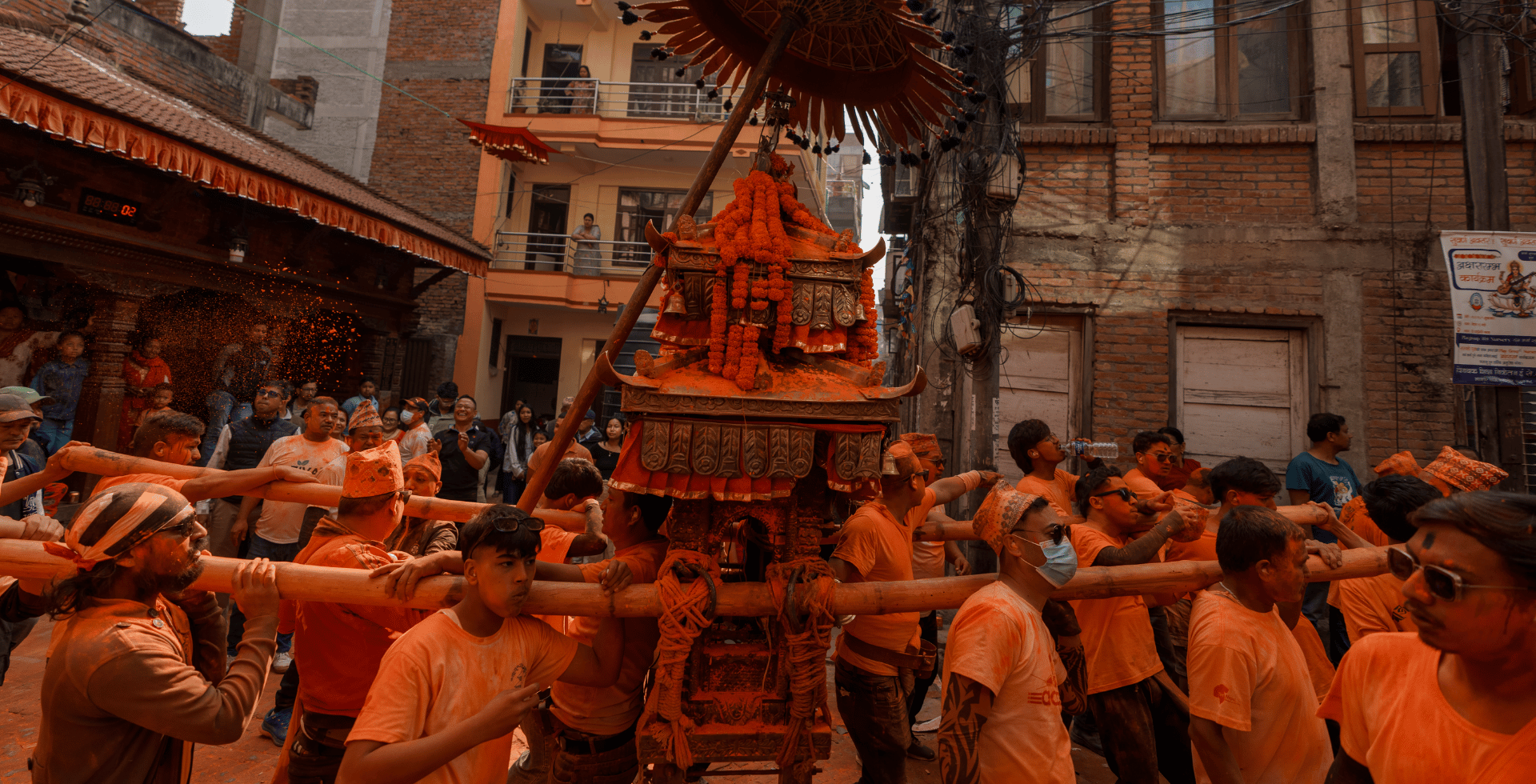
All khats converge at the Balkumari Temple premises. As they arrive and begin circling the temple, orange sindoor (vermilion powder) is hurled by the hundreds into the air and over everything and everyone (similar to how Holi is celebrated). Even Dhimay drums pound from every direction!
A particularly charged moment here is the khat bearing Ganesh from the village of Nagadesh arrives late in the proceedings. When it finally appears, the whole crowd surges toward it.
Other khats attempt to "catch" the Nagadesh Ganesh as it tries to make its departure. If they manage it, the festival continues longer. Eventually Ganesh departs, and the procession moves toward the Taleju Temple area to conclude.
This three-day Thimi celebration is also called Sutha-Siya Jatra (the closing phase) on this morning, distinguishing it from the Bya-li-siya Jatra of the previous evening.
Event 2: Jibro Chedne Jara (Tongue-Piercing Ceremony)
Time: Morning
Location: Bhangu Tole and throughout Bode village, Madhyapur Thimi
On Baisakh 2 morning, the volunteer from the Shrestha caste of Bode (Sujan Bagh Shrestha in 2026) has their tongue pierced with an iron spike.
The participant then spends the entire day walking through Bode carrying a large round bamboo rack with multiple Mahadip (flaming torches) on their shoulders. He maintains complete silence, eat nothing, and show no pain through the whole day. At the end, the spike is removed.
The belief is that this act of devotion protects Bode from drought, flooding, food scarcity, and disease for the coming year. Only members of the Shrestha lineage of Bode may volunteer.
Event 3: Jyatha Ganesh and Batuk Bhairav Rath Yatra
Time: Morning
Location: Bolachhen
The chariots of Jyatha Ganesh and Batuk Bhairav are taken out in a rath procession through Bolachhen.
This is a neighbourhood-specific chariot event that runs alongside the larger Thimi celebrations, drawing local devotees who attend both the sindoor festivities and this simultaneous chariot jatra.
Event 4: Mahalaxmi and Mahakali Jatra
Time: Afternoon, around 4 to 5 PM
Location: Thalache and Bholache Toles
The Mahalaxmi and Mahakali palanquins process from their respective shrines toward each other and collide three times at Bholache Chowk.
The legend behind this is that both goddess-sisters were on their way to a feast at their brother Yache Ganesh's home. They arrived late, found him already gone inside, and began quarrelling along the road.
Neighbourhood residents pacified them by throwing flowers and abir from their windows and doorways. This reenactment now happens every single year!
Event 5: Brahmayani Jatra
Time: Evening
Location: Brahmayani shrine to Chyamasingh
The Brahmayani palanquin begins its own procession route from its shrine toward Chyamasingh, establishing the ceremonial movement that will continue and conclude more elaborately the following day at Dattatreya Square.
Day 7: Baisakh 3 (April 15/16)
Event 1: Brahmayani and Maheshwari Jatra
Time: Afternoon
Location: Thalache, Inacho, and Dattatreya Square area (Tachapal)
The Brahmayani palanquin from Thalache and the Maheshvari palanquin from Inacho Tole both process toward Dattatreya Square, where they collide three times: the same symbolic narrative as the previous day's Mahalaxmi-Mahakali event, just different goddess-sisters, different route.
During the Brahmayani procession, every household in Thalache Tole sends someone to the street with an oil lamp, creating a corridor of flickering light on both sides of the narrow lanes as the palanquin passes through. It is one of the more quietly beautiful moments of the entire 9-day Bisket Jatra festival!
Event 2: Batuk Bhairav and Jyatha Ganesh Sindoor Jatra
Time: Afternoon to evening
Location: Talako area
A local sindoor (vermilion) throwing ceremony for Batuk Bhairav and Jyatha Ganesh is held in the Talako neighbourhood.
This is just a smaller-scale version of the Thimi Sindoor Jatra, but is held in the main UNESCO World Heritage site.
Event 3: Khatajatra of Pardeshi Bhimsen
Time: Afternoon/evening
Location: Khanla area
A palanquin procession for the Pardeshi Bhimsen deity is conducted through Khanla. This is a neighbourhood-level jatra with deep local significance but limited outside visibility.
Day 8: Baisakh 4 (April 16/17)
Event 1: Dya Swogan Begu (Sagun Offering Day)
Time: All Day
Location: All of Bhaktapur
Every deity who has been "out" from their shrine during the festival placed temporarily in courtyards, pati (rest houses), and dabali (raised platforms) around the city receives the Sagun offering from the community.
The sagun comes with a full auspicious food plate including yogurt, flowers, sweets, and various delicacies, collectively called Dyo Swogan Begu.
Bhaktapur residents who have moved to Kathmandu and other cities make a specific point of returning home on this day.
Families invite relatives, daughters-in-law, and friends. And processions of people moving from shrine to shrine fill every street! The entire city smells of incense, marigold, and mustard oil.
Event 2: Chhuma Ganesh Jatra
Time: Evening
Location: Chochhen Tole
The most powerful Ganesh of Bhaktapur, Chhuma Ganesh, takes his own palanquin procession.
His origin story is connected to the founding of the city: when King Anandadeva was laying out Bhaktapur's boundaries, he witnessed a cat playing with a mouse at this very spot, then Ganesh himself appeared. The king built the city here!
Chhuma Ganesh receives his Sagun offering and then, importantly, he does not go back to his home shrine tonight. He stays out. The festival is not over until he returns.
Day 9: Baisakh 5 (April 17/18)
Event 1: Lha Maruma Yoshindyo Kothaigu
Time: Morning
Location: Talako, Pottery Square
The small "handless lingo" that was raised on Day 4 is ceremonially lowered and dissolved. The lingo season officially closes after this.
Event 2: Final Chariot Procession and Tug-of-War
Time: Afternoon
Location: Gahiti to Taumadhi Square
The Bhairav chariot makes its final journey. Both Thane and Kwone teams pull one last time, with the Guthi officials riding the chariot and calling "Johal Pal!"
Even a specific song composed by King Ranajit Malla is sung during this final pull. The tug-of-war is as intense as Day 1!
The chariot is eventually brought back to Taumadhi Square, the starting point, completing the full circuit!
Event 3: Dya Thaha Bijyagu (Bhairav Returns Home)
Time: Late afternoon/evening
Location: Bhairavnath Temple, Taumadhi Square
This is the most intimate ritual of the entire festival. The Bhairav image is guided back toward its inner shrine, but the chief Acharya priest blocks the door and formally scolds the deity: "You went out, ate wherever you wanted, slept wherever you wanted for eight nights, and now you want to simply walk back in?"
After an appropriate time, the priest relents and admits Bhairav home. The festival is essentially complete at this moment (until one final part is left).
Event 4: Chhuma Ganesh Returns Home (True End of Bisket Jatra!)
Time: Evening
Location: Chochhen Tole
Chhuma Ganesh, who was taken out on procession the previous evening and stayed overnight, now performs his own Dya Thaha Bijyagu: a final palanquin procession through his neighbourhood before returning to his main shrine.
This is the moment the festival truly ends! Until and unless Chhuma Ganesh is back in his home shrine, the nine-day Bisket Jatra is not considered complete.
According to the ritual order, every other deity must return to their shrine first. Only then can Chhuma Ganesh, the last to go home, complete the circle.
Note from Altitude Himalaya Content Team:
During the nine days of Bisket Jatra, the entire city becomes a living ceremonial calendar. Every tole has its own deity, its own guthi, and its own ritual obligations, which means jatras are happening simultaneously across neighbourhoods, many of them deeply local and rarely documented outside the community.
We have done our best to cover the major events across Bhaktapur, Madhyapur Thimi, Bode, Nagadesh, and Dadhikot, but it is almost certain that some neighbourhood-level jatras, smaller tipwa processions, and tole-specific rituals may be missing here.
If you are a Bhaktapur Newar reading this and you know of a jatra (big or small) that belongs in this breakdown, please reach out to us directly. We would genuinely love to learn about it and update this guide accordingly.
Bisket Jatra deserves to be documented as completely as possible, and the people who carry it forward know it better than anyone. And that’s the reason we urge you to come visit Bhaktapur for a more immersive experience of the 9-day Biska Jatra festival.
We have been to Bhaktapur many times over the years, as it sits as one of the top tourist spots to visit in Nepal. But experiencing Bisket Jatra from the inside, not as a cultural observer but to genuinely understand what was happening, was something else entirely!
We arrived at Taumadhi Square at around 11 AM. The chariot was already there, stationed in front of the five-story Nyatapola Temple, exactly as it had stood on every Chaitra 27 for centuries.
The crowd was slowly building but not yet overwhelming. We went to check in at the rooftop cafe spot we had booked in advance (strongly recommend doing this early; those spots go fast), dropped our things, and went straight back down to the Taumadhi Square.
Note: The tug-of-war of Bisket Jatra on Day 1 and Sindoor Jatra on Day 6 are the main events to experience this vibrant festival.
Ritual Sacrifice and Bhairavnath Temple Exploration
Right away, we noticed the ground near the Bhairavnath Temple entrance was wet with red. Turns out a goat sacrifice had just been completed as part of the pre-procession ritual feast for the Bhairav Naikes. We followed the blood trail that led us directly inside the temple!
Inside the Bhairavnath Temple, we found ourselves standing before the same idol that would be placed in the chariot a few hours later. We offered our respects and stepped back outside.
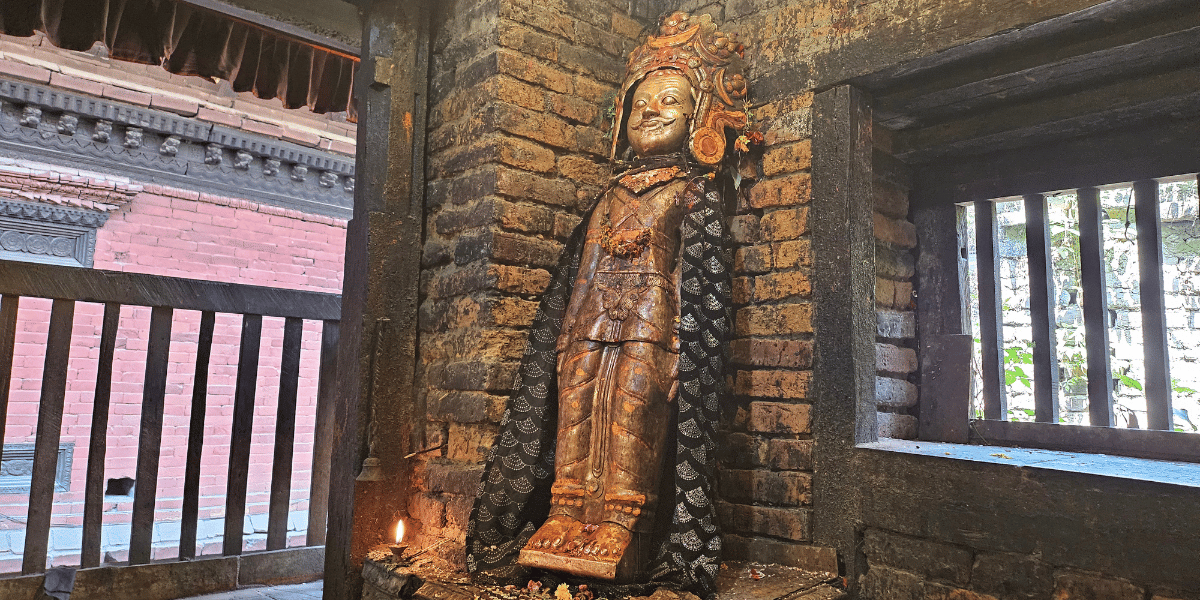
Right next to the Bhairavnath temple entrance, we went upstairs to get a glimpse of the Betal Bhairav (aka Bir Betaal) shrine placed somewhere in the corner. Just so you know: Betal is Bhairav's divine vehicle, the deity seated at the very front projection of the chariot.
Following the blood trail outside (a genuinely useful navigation tool, as it turned out) led us straight to a butcher's shop at the lane's end. We looked at each other, laughed, and carried on toward Dattatreya Square.
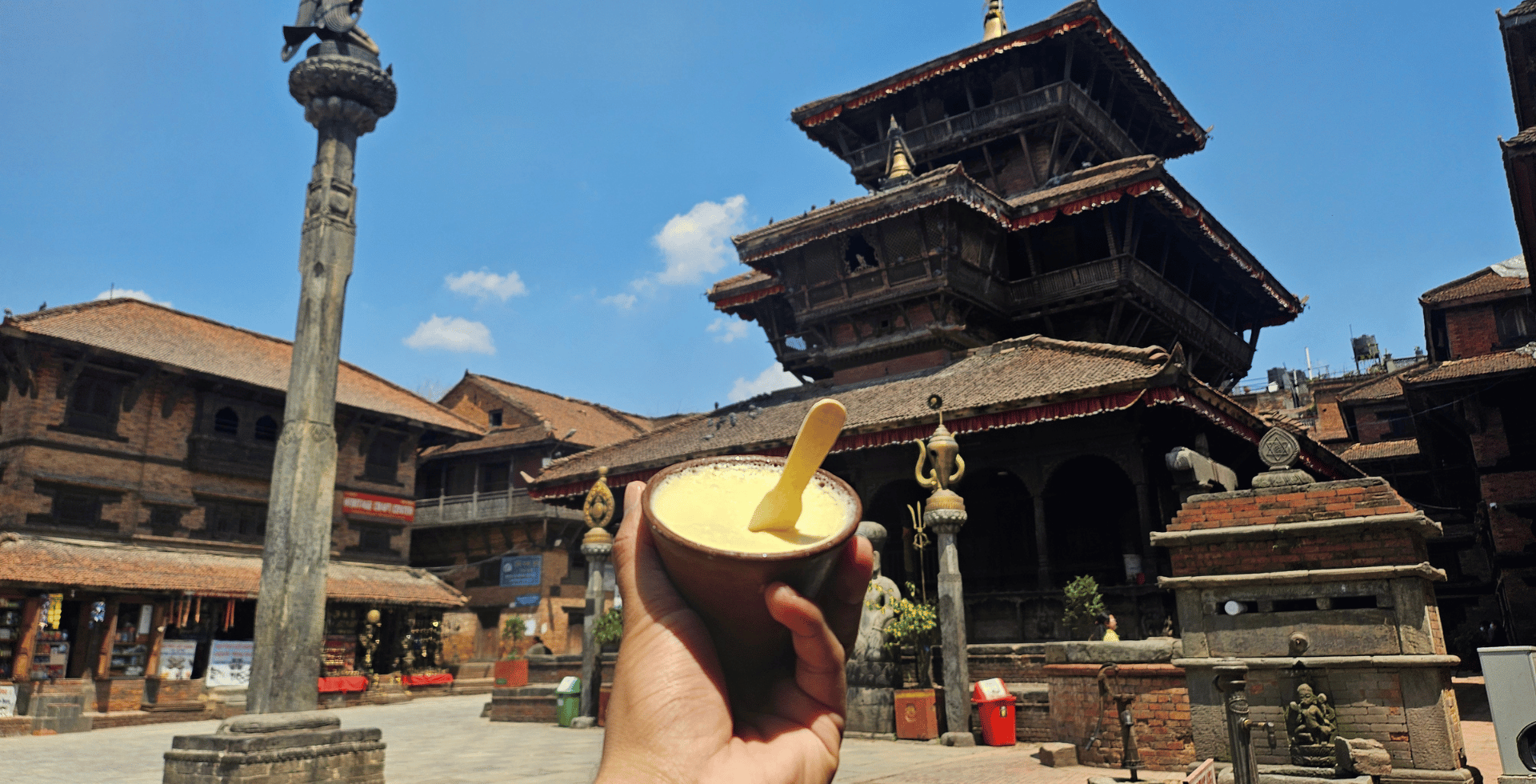
We stopped at Dattatreya Square for Juju Dhau. If you have not had it, Bhaktapur's famous king of yoghurt (served in clay pots) is one of the best things to try here.
The square itself was quieter than Taumadhi, making it one of the more beautiful spots in Bhaktapur's four main squares. During Bisket Jatra, Dattatreya is also significant because the Brahmin and Karmacharya puja officials use this area as part of the festival's royal ceremonial sequence.
While here, be sure to explore the unique arts and thangka paintings too!
Watching the Chariot Preparations and Trying Local Newari Food
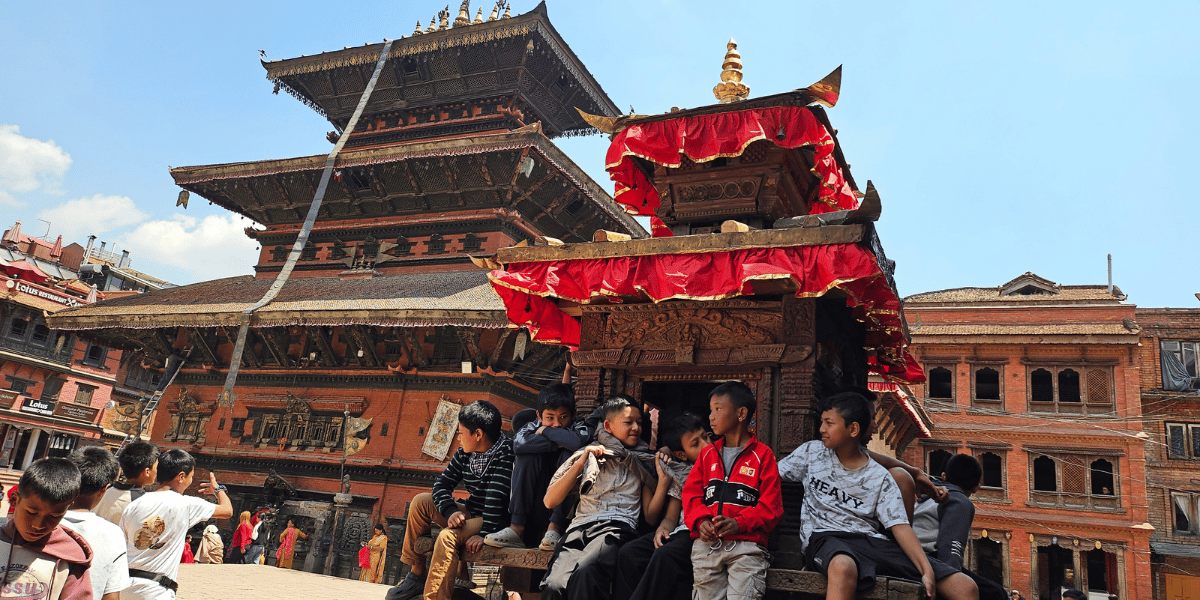
We came back to Taumadhi around 1 PM. The crowd had doubled. The Bhadrakali chariot, smaller and two-storied, had already been pulled without its deity idol inside. Children were crawling under it, playing around its wheels.
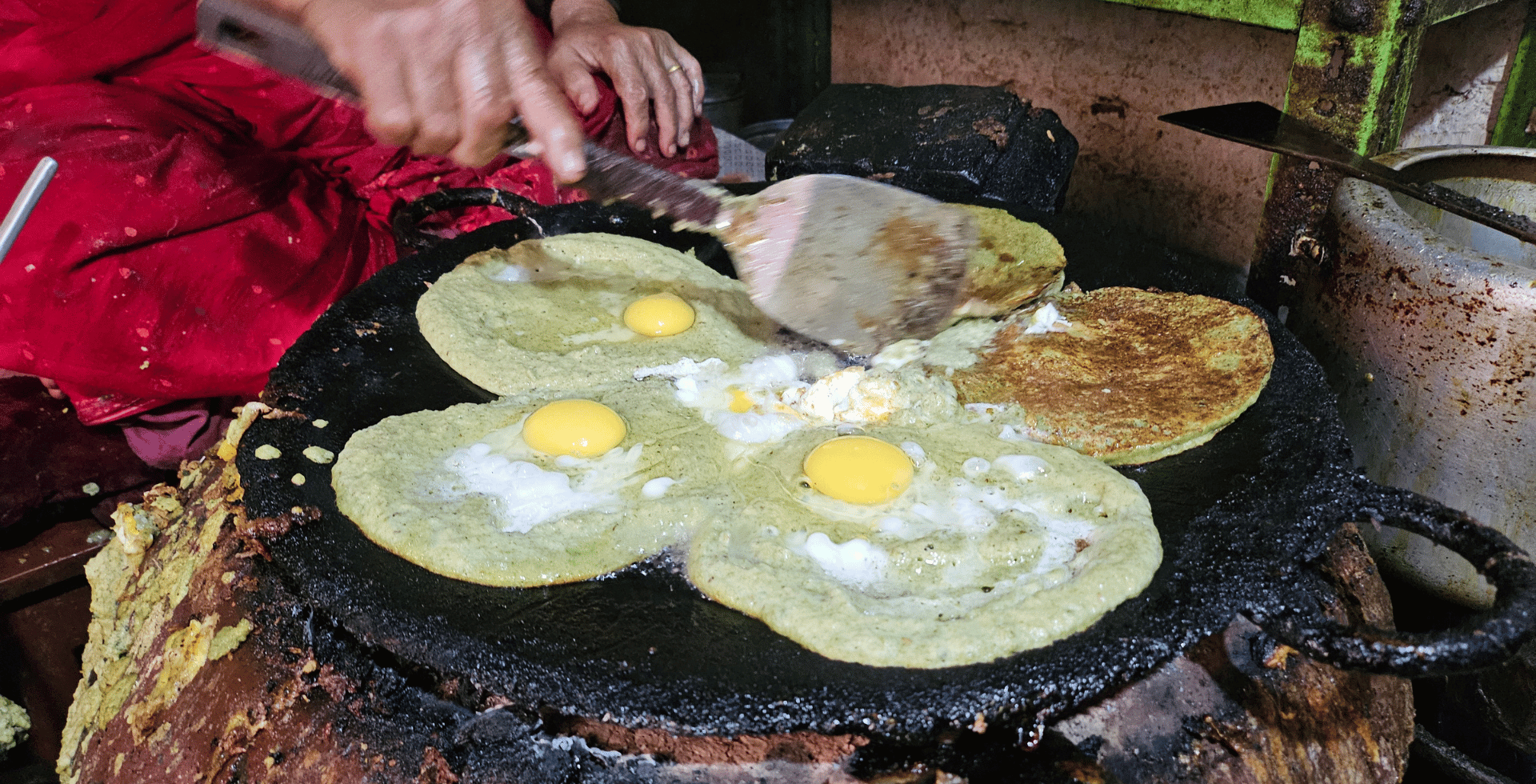
We then headed towards a local eatery (quite famous) in all of Bhaktapur, where we tasted Piro Aloo and Mixed Bara! (You can even try Samay Baji, which many locals offer in temple areas).
Then, we came back to watch the Manandhars involved in the ritual of rope-binding of the Betal deity to the chariot's front projection.
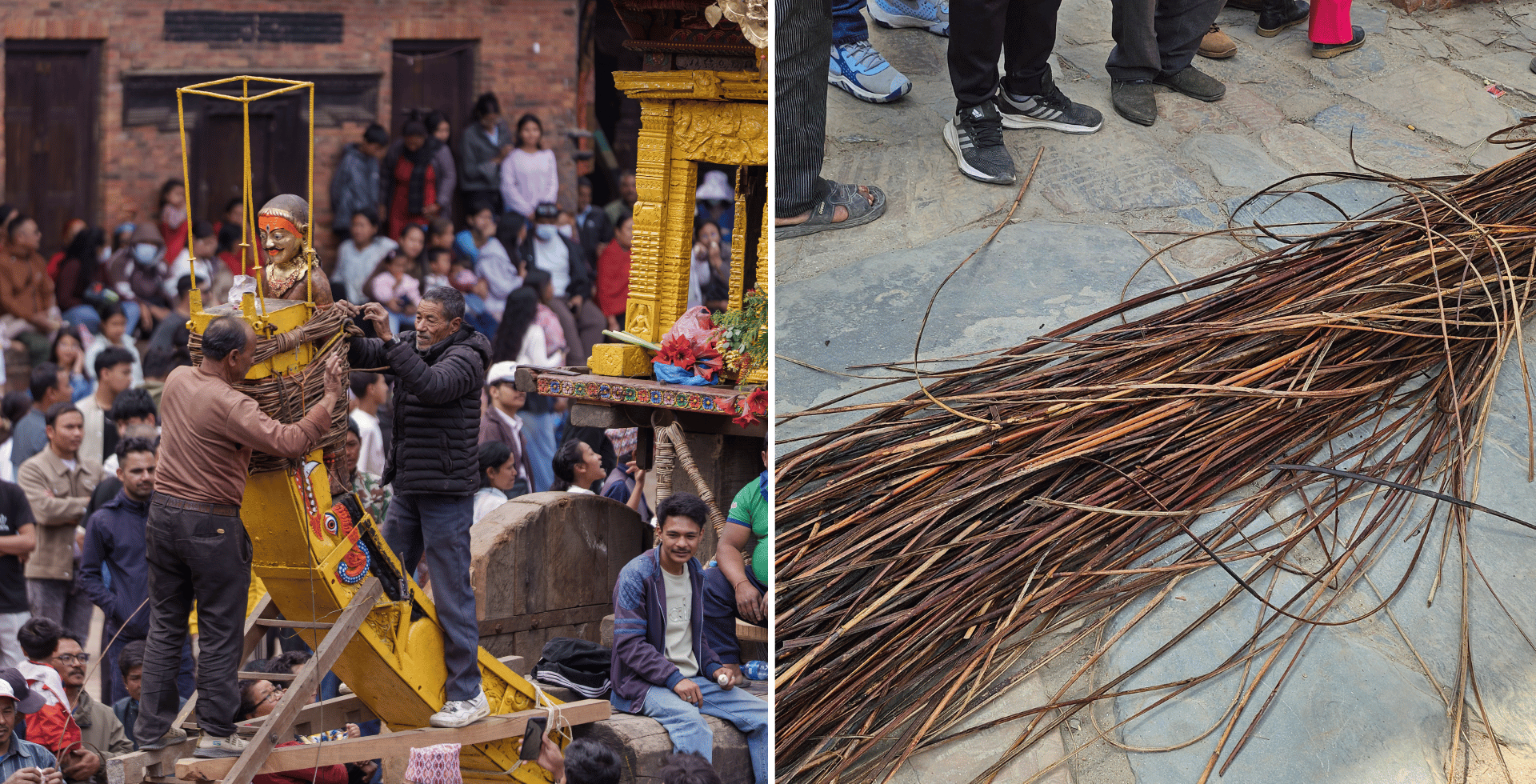
The material used is locally called "bet", which is first soaked in water the day before. By the tying day, it becomes dry and tight enough. There is no prescribed number of wraps. The criterion is simply: is it strong enough?
This is where we came to know about how each caste is doing the specific thing they have always done. Shilpakars are responsible for chariot construction, Manandhars tie the Betal Bhairav, Jyapus tie the ropes for tug-of-war, Chitrakars decorate the chariots, and so on.
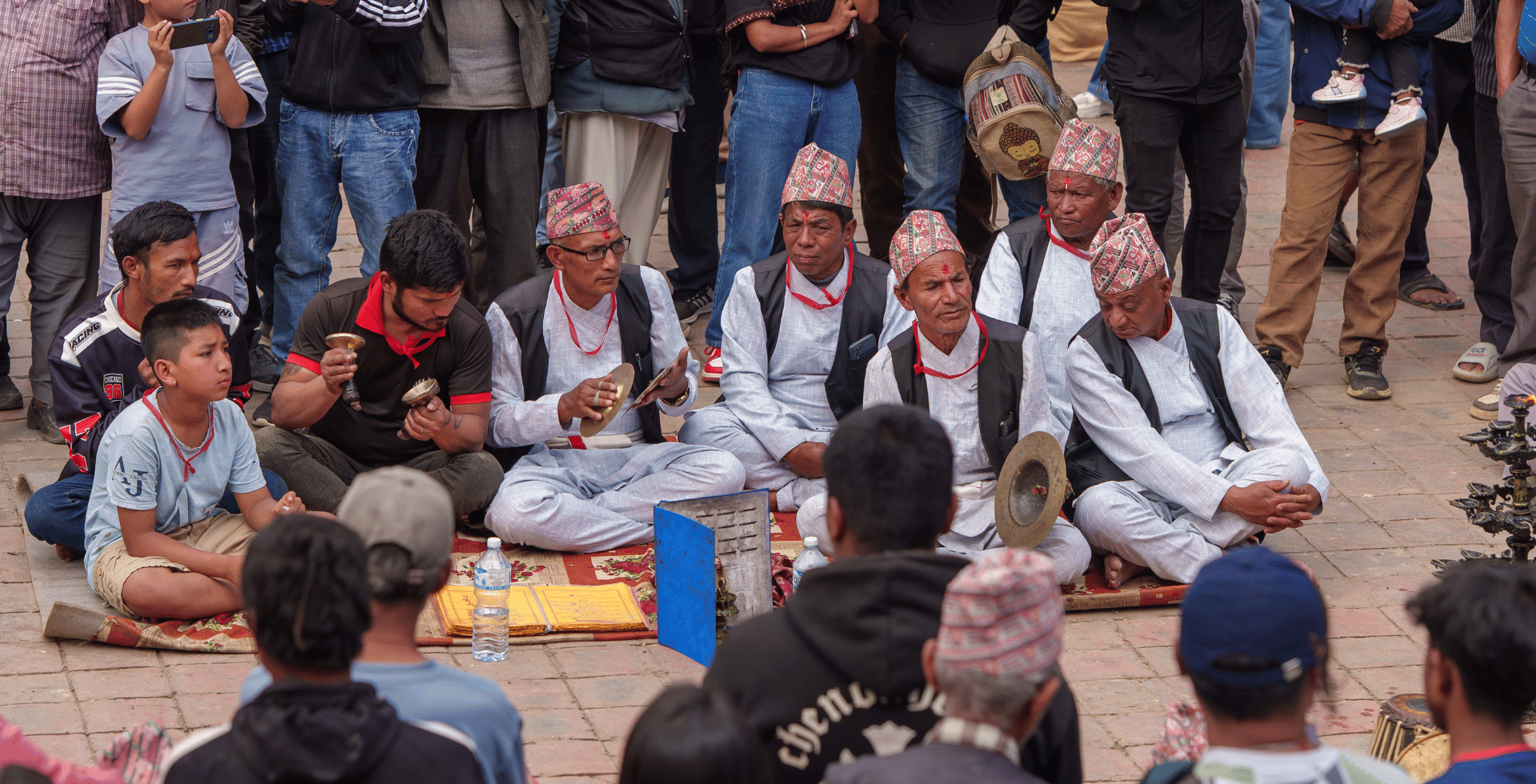
On another side of Taumadhi, a Dafa bhajan group had begun their ritual music. Basically, Dafa is Bhaktapur's own bhajan tradition, played with traditional instruments.
This is not background music for atmosphere. It is a ritual prerequisite, and it must be completed before the formal procession begins!
Experiencing Bisket Jatra From Rooftop
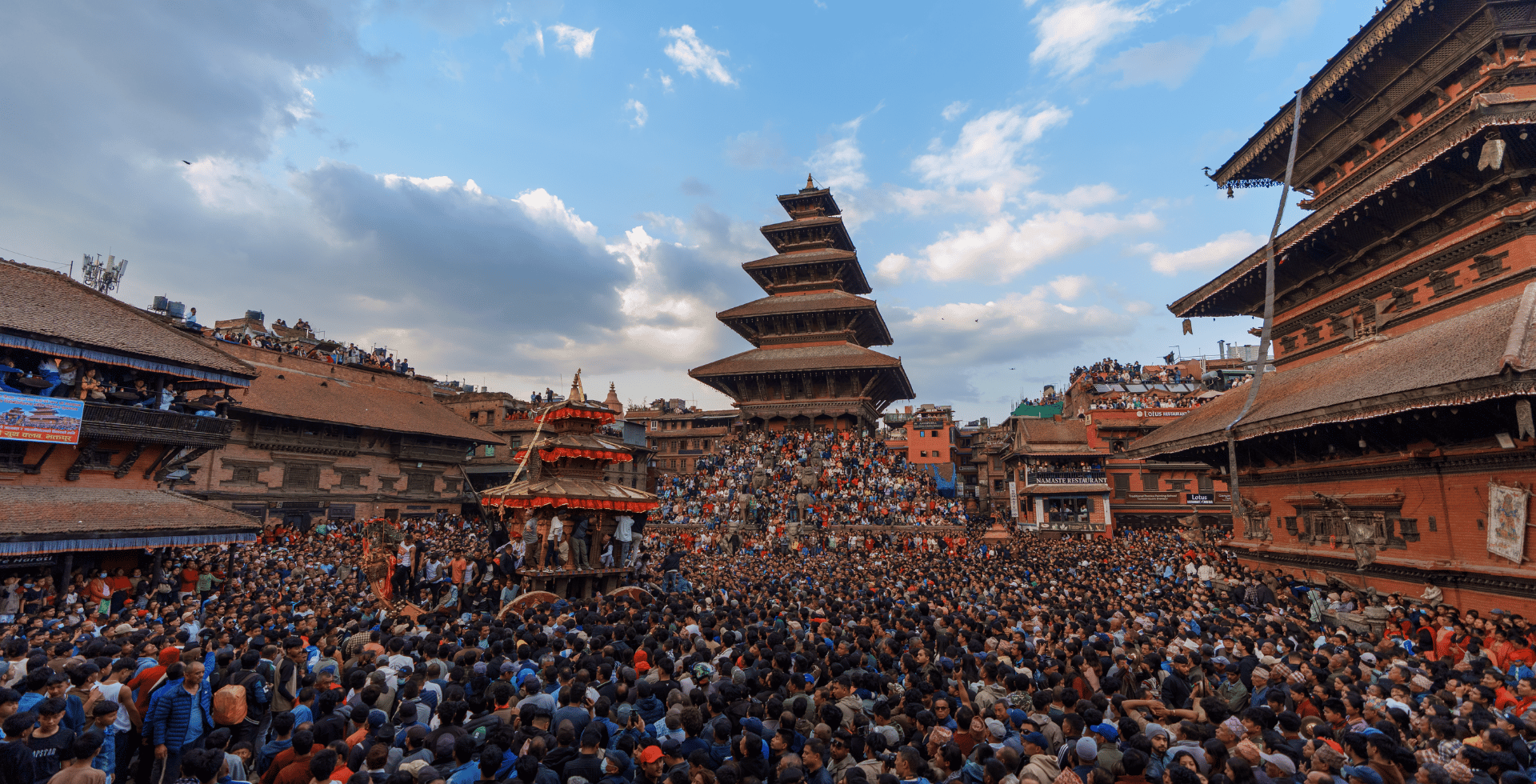
By 3 PM, we had moved up to the rooftop. The sword had been escorted from the Taleju Palace by the Hazilam-Guzilam delegation and was now inside the Bhairavnath temple.
And the Bhairav idol was also being prepared for its journey to the chariot. The crowd gathered in Taumadhi was now so dense it moved as a single body!
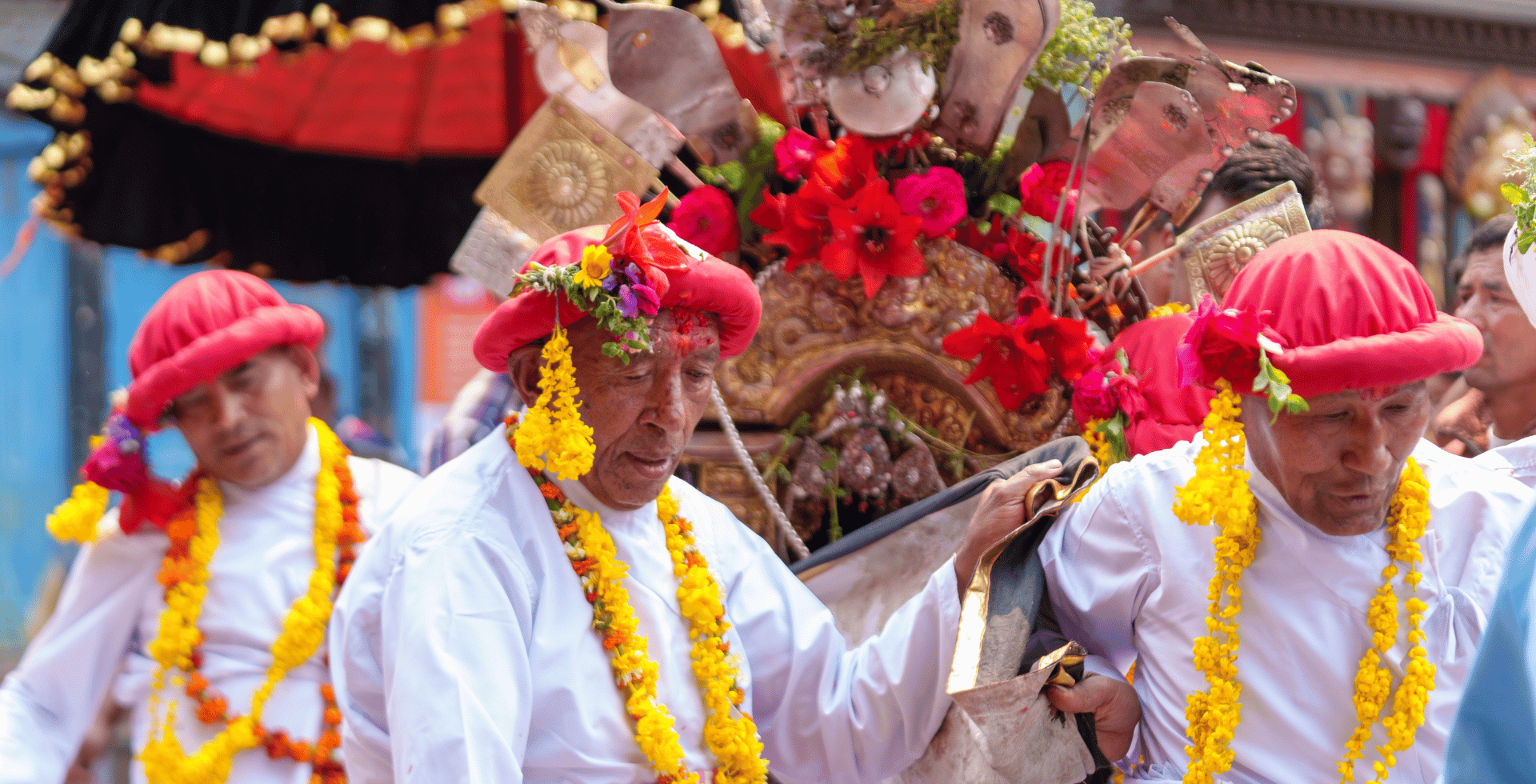
Then they took out the Bhairav. Escorted by the Naike members, the idol was carried from the temple through the crowd to the chariot. The crowd erupted (even our Altitude Himalaya team cheered from the top!).
It was a specific kind of eruption, one part devotion and one part excitement, in a ratio you never quite find anywhere else!
Once the idol was installed, the tug-of-war began in front of the five-storied Nyatapola Temple. Without a doubt, watching it from the rooftop was spectacular!
We could see the whole square, both rope lines, the chariot oscillating between the two forces. The Thane side won the pull and the chariot started moving up the alley toward Kwachen.
Experiencing Bisket Jatra Tug-of-War From the Ground
Then, we made a decision to head to the same alley that we had walked earlier to get to Dattatraya Square (quite a coincidence)! And watching the chariot move through the narrow lanes of Bhaktapur from street level felt a completely different experience than watching it from a rooftop.
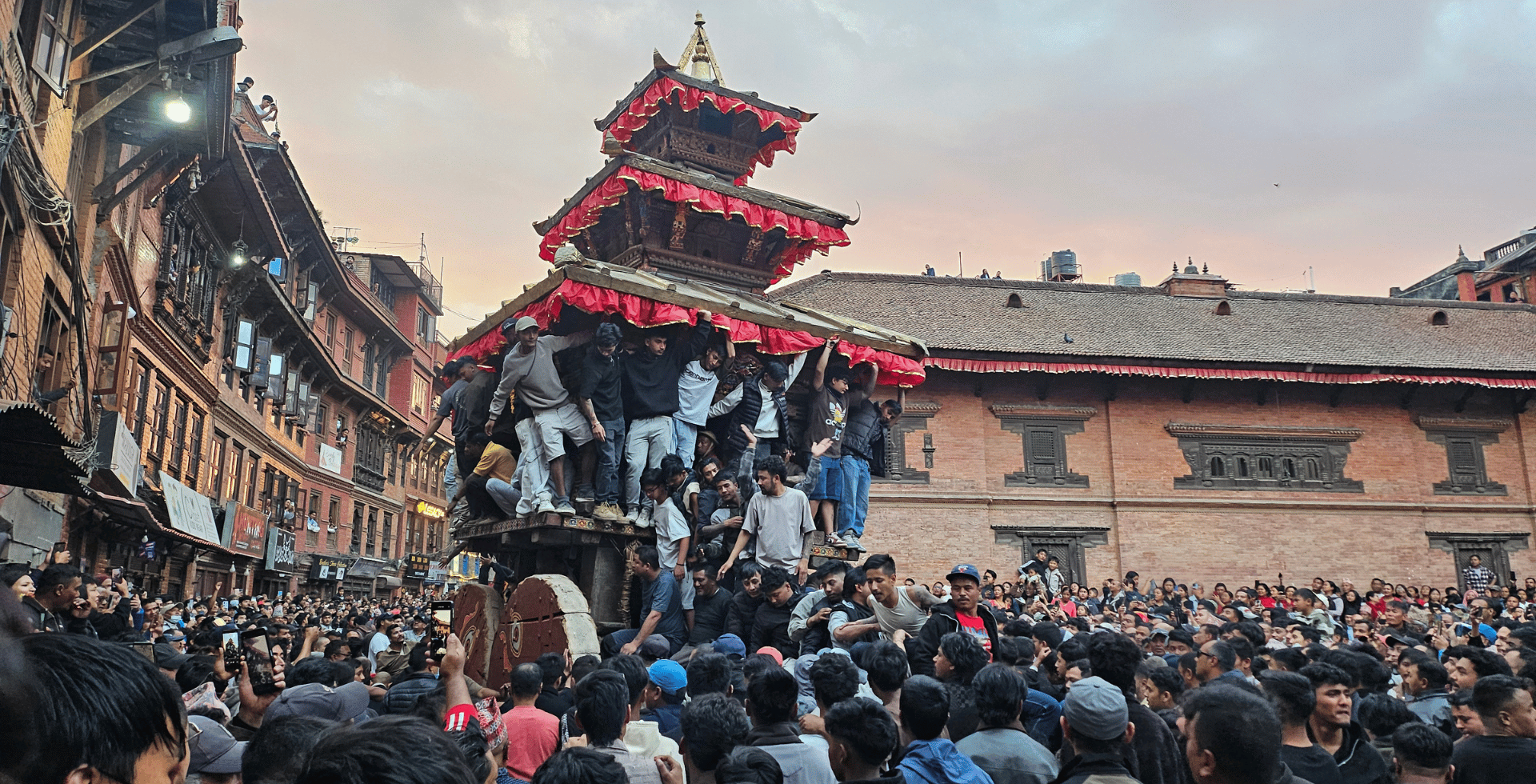
As we were approaching towards chariot, the uphill sections slowed both teams. We had to run back a few times just to keep ourselves safe.
The chariot scraped against building walls. An electric pole along the route also got knocked during the pull!
At one point, the chariot went all the way and made forceful contact with a house wall, a collision that left a visible mark on the building but did not stop the procession.
A few of our team members even went on to pull the rope from the losing side. That’s when we learned how tired you can get even within a few minutes of pulling the rope!
The entire Newar community has been doing this for generations and the physical conditioning required is real (hats off to them)!
Every time one side's group gets exhausted and releases their grip, the rope goes loose and the other side gets a momentary advantage. That is actually the tactical reality of this Bhairav’s tug-of-war.
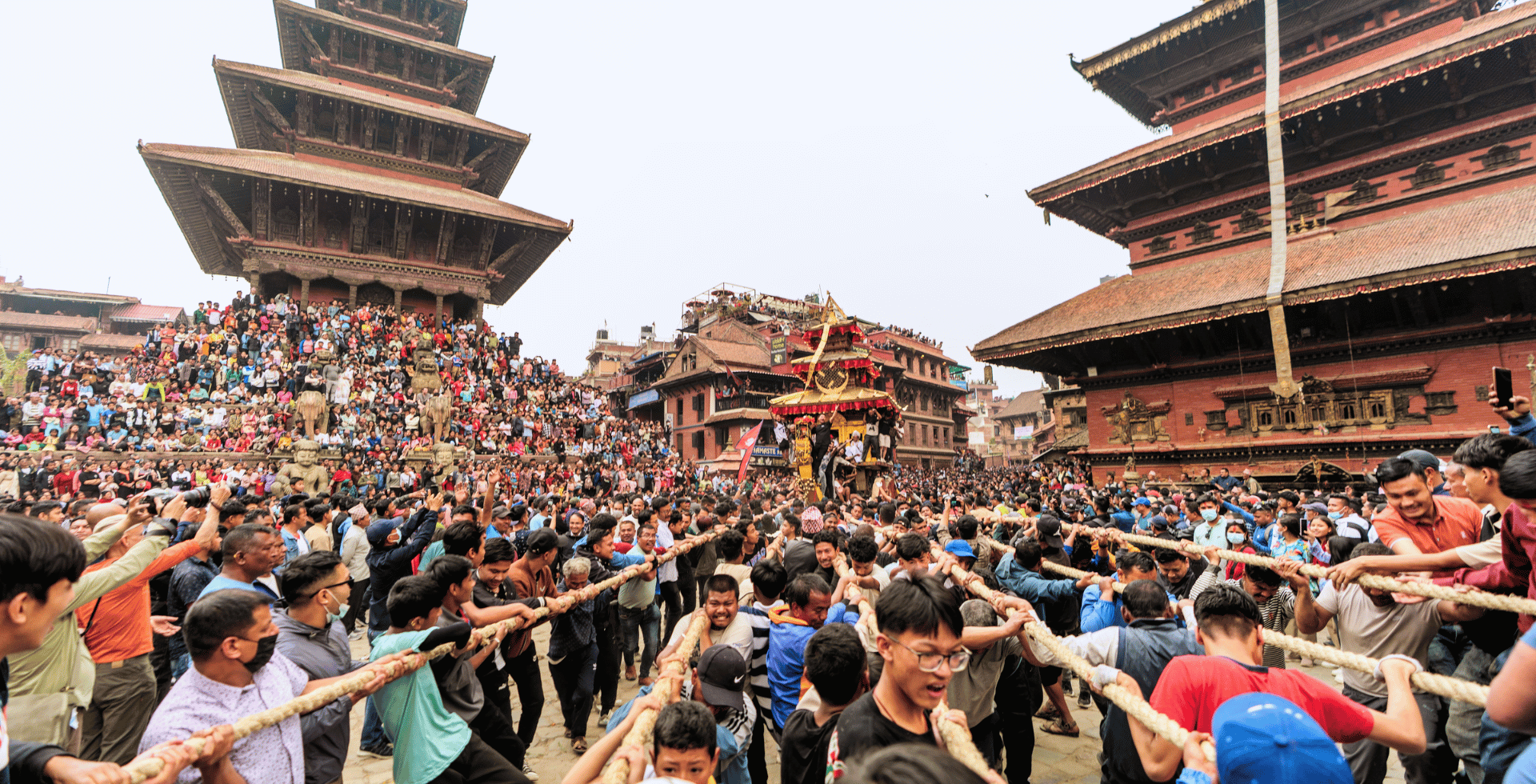
"Haise! Hoise! Haaa!" That was the chant the participants made when pulling the rope from one side to the other.
Day 1 Wrap-Up and Practical Notes
We had been on our feet for nearly six hours, and were exhausted in the best possible way!
We had witnessed a tug-of-war that had been happening in this exact form since before the 17th century, pulled the ropes ourselves, and eaten some of the best Newari food along the way (check out the best restaurants to try Newari food here)
A few things worth noting for anyone planning to attend: the chariot procession started properly around 4:30 PM in 2026 but the preparatory rituals from morning were equally worth our time.
So, if you’re thinking to experience Bisket Jatra, please do allocate your entire day. At times, the tug-of-war can go through the night and into the following morning if the competition is close.
And one more thing: Bisket Jatra is a chaotic festival and can be dangerous. I’m not making this thing up. Check it out:
- In April 2025, 36-year-old Sushil Tamkhu of Bhaktapur was fatally crushed by the Bhairav chariot wheel when it was being pulled from Gahiti to Lyosingkhel on the evening of Day 4. (Source: Setopati)
- In April 2022, 71-year-old Durgaman Kasapal died after the chariot crushed him while it was being pulled toward Bansagopal from Gahiti. (Source: The Annapurna Express)
Such chariot-related injuries, from rope burns to people falling under wheels, are documented every year (thankfully, none in 2026!). So, please stay safe and book with a reliable operator (like Altitude Himalaya) so you don’t have to worry about these factors.



 Bhishu Acharya