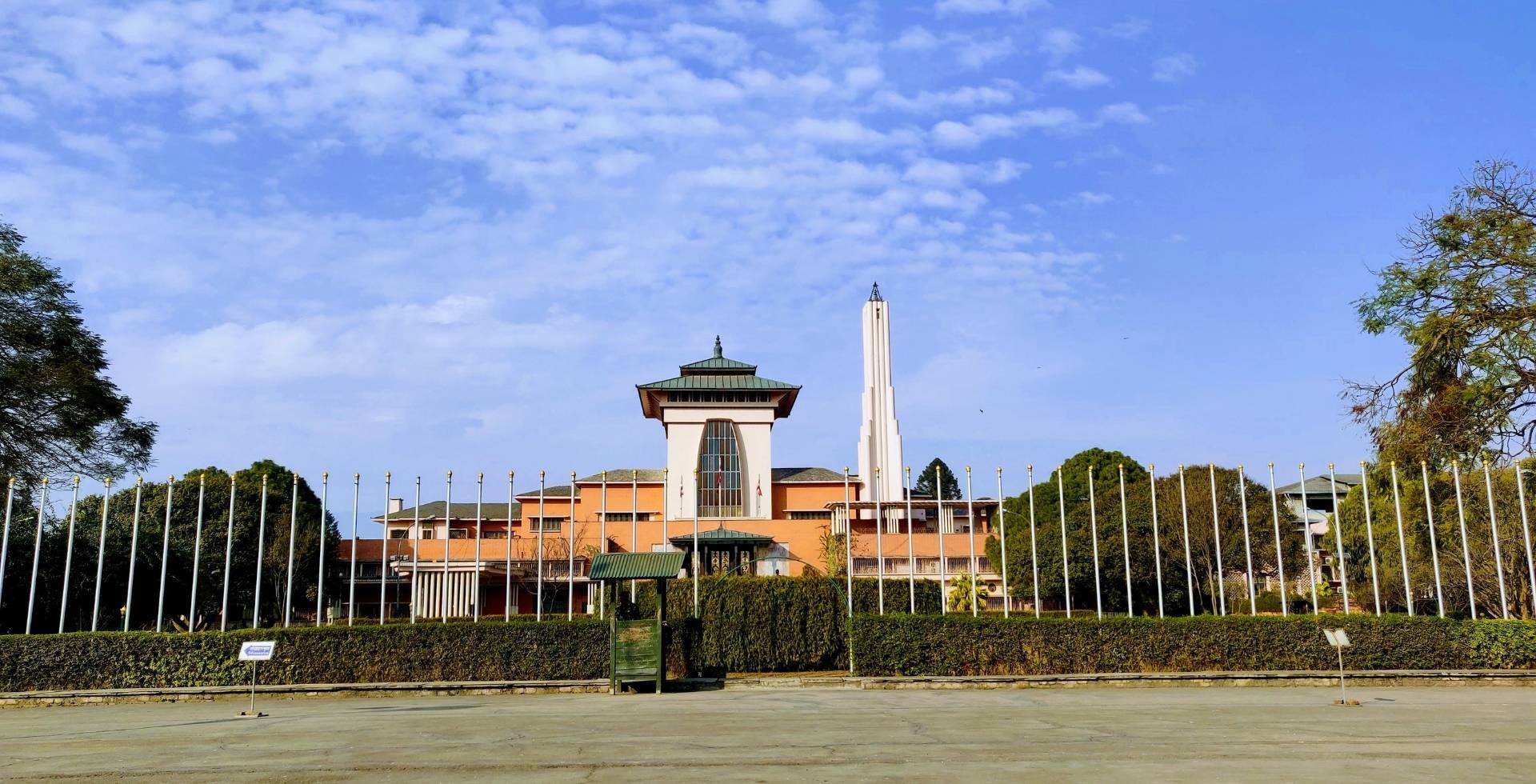
Once a royal palace, Narayanhiti Palace has been converted into a museum and is recorded to have welcomed 4.77 million visitors between 2008 and 2025.
Around Narayanhiti Palace, there are several cafes, shops, and a lot of traffic. But just as you walk on the sidewalk of Durbarmarg, one thing that immediately mesmerizes you is the amazing architecture of this palace!
Narayanhiti’s literal interpretation is of two words ‘Narayan’ and ‘Hiti’. Narayan is a form of the Hindu god “Lord Vishnu'' whose temple is located opposite the palace and ‘hiti’ means “water spout” which is also located to the east of the main entrance in the precincts of the palace.
Once the home of the Shah monarchs, Narayanhiti Palace has seen various historical events of modern Nepal, including the Royal Massacre and the People's Movement II of 2006.
After exploring Narayanhiti myself (from the main palace and Phohora Garden to Tribhuvan Sadan and Shree Sadan), I discovered several facts and stories that might completely change your view on the palace.
Narayanhiti Palace Museum Quick Facts
|
Name Origin
|
Narayan (Lord Vishnu) and Hiti (water sprout)
|
|
Location
|
Durbarmarg, Kathmandu, Bagmati Province
|
|
Coordinates
|
Latitude: 27.7123° N
Longitude: 85.3206° E
|
|
Construction Year (current building)
|
1963 A.D. to 1969 A.D.
|
|
Total Land Area
|
383,850 sq. m
|
|
Palace Built-up Area
|
Approximately 383,000 m² 40,820 sq. ft. (3,792 sq. m)
|
|
Founder (current building)
|
Late King Mahendra
|
|
Governing Body
|
Government of Nepal
|
|
Architect (current building)
|
American Architect Benjamin Polk
|
|
Architectural Style
|
Pagoda-style with local terracotta-toned materials
|
|
Museum Established by
|
Former Prime Minister Girija Prasad Koirala
|
|
Opened to Public
|
15th June, 2008
|
History of Narayanhiti Palace
From the day of Kaji Dhokal Singh Basnet to the present-day museum, Narayanhiti Palace has been witness to the parva, assassination, earthquake, coup, massacre, and political revolution.
Before we move on with the history details, check this timeline for quick reference:
|
1793 A.D.
|
Land gifted by King Rana Bahadur Shah to Kaji Dhokal Singh Basnet, where he built his own palace named “Kirti Mandir”
|
|
After the Kot Massacre (1846 A.D.)
|
Kaji Dhokal Singh Basnet's property confiscated by the Ranas
|
|
Mid-1800s
|
Colonel Ranodip used the property as his private residence
|
|
1885 A.D.
|
Assassination of Colonel Ranodip. Bir Shumsher seized the property and built a new palace
|
|
1890s
|
Shah Monarch shifted to Narayanhiti Palace after Prithvi Bir Bikram Shah married Bir Shumsher’s two daughters
|
|
1934 A.D.
|
Narayanhiti Palace was partially damaged after the Nepal-Bihar Earthquake
|
|
1936 A.D.
|
King Tribhuvan built Tribhuvan Sadan, designed by Surya Jung Thapa
|
|
1963–1969 A.D.
|
King Mahendra commissioned the new Narayanhiti Palace (current), designed by Benjamin Polk
|
|
June 1, 2001 A.D.
|
A tragic royal massacre took place in Tribhuvan Sadhan
|
|
May 28, 2008 A.D.
|
Nepal declared a Federal Democratic Republic
|
|
June 15, 2008 A.D.
|
Prime Minister Girija Prasad Koirala inaugurated the Narayanhiti Palace Museum
|
|
February 26, 2009 A.D.
|
Prime Minister Pushpakamal Dahal officially opened the museum to public
|
Early Days
Dating back to 1793 A.D, the land where the present-day Narayanhiti Palace Museum is built was gifted to Kaji Dhokal Singh Basnet by King Rana Bahadur Shah. Right here, Kaji built his own palace known as Kriti Mandir.
Then, following the Kot Parva (Kot Massacre), the power and influence of noble families like the Basnets were destroyed. And the Rana elites' political takeover resulted in the confiscation of this property.
As a result, Colonel Ranodip Singh used the property for his private residence after a few renovations. After his assassination in 1885 A.D., Bir Shumsher became prime minister, during which he rebuilt this palace and was designed by Jogbir Sthapit.
Bir Shumsher established a close alliance with the royal family by arranging the marriage of his two daughters to King Prithivi Bir Bikram Shah. The Shah Monarch, who had resided in Hanuman Dhoka Durbar Square, then shifted to Narayanhiti Palace.
Design and Construction of the Modern Palace
The previously built palace was partially damaged in the Bihar-Nepal earthquake of 1934 A.D. Moreover, King Tribhuvan lost his two baby princesses in this tragic event.
Under the order of King Tribhuvan (designed by Nepali Architect Surya Jung Thapa), Tribhuvan Sadan was built in 1936 A.D. with a new Portico and Grand Staircase. This is where the royal family started to reside!
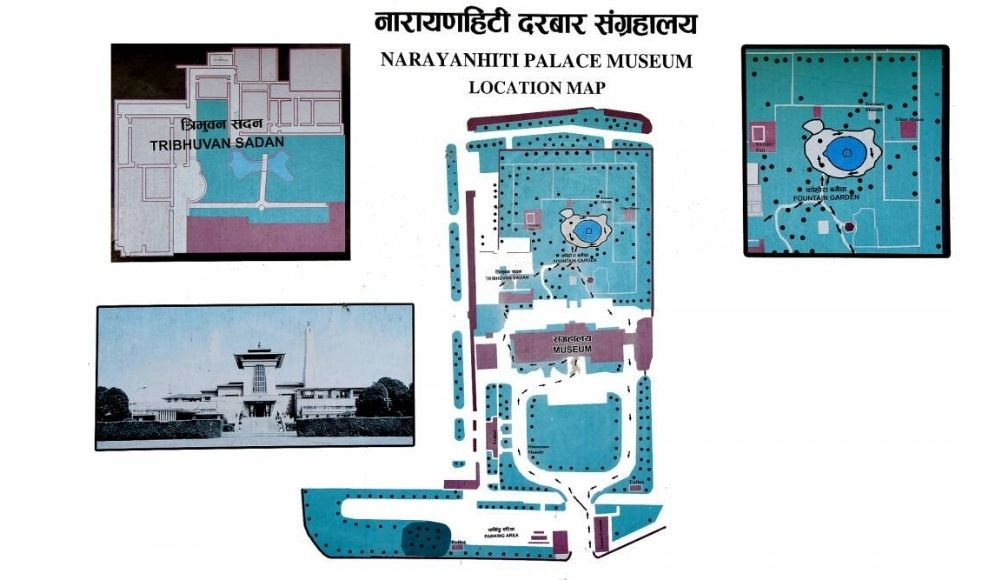
After King Mahendra ascended the throne on March 13, 1955, he ordered the modernization of the previous palace and some other Rana palaces, making way for a grand boulevard now popularly known as Durbarmarg (King's Way).
With the design of American Architect Benjamin Polk, King Mahendra started the construction of the new Narayanhiti Palace in 1963 A.D, which was completed in 1969 A.D. This palace served as the official royal residence until the abolishment of the 240-year-old monarchy in 2008 A.D.
The Royal Massacre
On the night of June 1, 2001 A.D., the tragic royal massacre occured during the family dinner time. King Birendra, Queen Aishwarya, Prince Nirajan, Prince Dhirendra, Princess Shruti, Princess Sharada, Kumar Kahadga, and other members of the royal family lost their lives.
Prince Dipendra had a gunshot wound to his head and had fallen into a coma. Shortly after being declared king of Nepal, Dipendra died on June 4, 2001 A.D.
While many conspiracy theories revolve around the royal massacre, none of these theories has been legally proved. These theories are based on political motives, inside-palace conspiracies, and external assassination theories.
Recently, Home Minister Sudan Gurung officially declared the reopening of the investigation into the 2001 Royal Massacre. Hopefully, this new inquiry will provide a definitive understanding and bring final closure to what really happened on what was the black day for this country!
Present Day Narayanhiti Palace Museum
After the success of the People's Movement II of 2006 A.D., Nepal officially became a Federal Democratic Republic in 2008 A.D., abolishing Nepal’s monarchy. King Gyanendra was the last king of Nepal and had to vacate Narayanhiti Palace on June 11, 2008 A.D.
After being declared as the Federal Democratic Republic of Nepal, Narayanhiti Palace was converted into the Narayanhiti Palace Museum. The then-Prime Minister Girija Prasad Koirala inaugurated the transition of the palace into a museum on June 15, 2008 A.D.
Later, Prime Minister Pushpa Kamal Dahal officially opened the museum for public display on February 26, 2009 A.D.
Opening Time and Entry Fee
Feeling curious about how to visit the Narayanhiti Palace Museum and witness the history of Nepal's Shah Kings?
Before stepping into the Narayanhiti Palace Museum, the ticket counter is going to be your first checkpoint. After a brief interaction with the counter attendant, the ticket is issued, and quick guidance is provided.
Ticket payment can be done through both cash and online methods as per one’s convenience.
And if you seek a proper guided exploration of Narayanhiti Palace Museum, you can always contact our team at Altitude Himalaya! We promise to arrange an experienced government-licensed guide for you who will stay with you throughout this Narayanhiti visit for a deeper and more insightful experience.
About the entry fee for the museum:
|
Visitor Category
|
Entry Fee (per person)
|
|
Foreign Nationals
|
NRs. 1,000
|
|
SAARC & Chinese Nationals
|
NRs. 500
|
|
Nepalese Citizens
|
NRs. 200
|
|
Nepalese Students (be sure to carry your identity card)
|
NRs. 50
|
Note: For children under 9 years and senior citizens above 70 years of Nepalese nationality, the entrance fee is free.
About the opening and closing times for the museum:
|
Period
|
Museum Visiting Hours
|
Ticket Counter Hours
|
|
Jan 29 – Oct 31 (Thur-Mon)
|
10:00 AM – 5:00 PM
|
10:30 AM – 3:30 PM
|
|
Nov 1 – Jan 28 (Thur-Mon)
|
10:00 AM – 4:00 PM
|
10:30 AM – 2:30 PM
|
Note: The Narayanhiti Museum Palace remains closed on Tuesday and Wednesday and during other public holidays.
Specialty About Narayanhiti Palace Museum Architecture
I used to see Narayanhiti Palace Museum every day when drinking coffee from different rooftop restaurants in Durbarmarg. The idea of visiting the palace always crossed my mind until one day, when I finally got the chance to enter here.
As I walked past the security gate, the noise from the busy street and heavy traffic slowly faded. I was amazed by the well-groomed garden and the Gaurishankar Gate, carved with stone masonry combined with decorative metalwork.
Exterior Features and Architectural Aesthetics
Designed by American architect Benjamin Polk, Narayanhiti Palace is a unique blend of traditional Nepali and modern styles. King Mahendra built this palace, rejecting the European neoclassicism favored by the preceding Rana regime.
The pink terracotta architecture of the Narayanhiti Palace Museum itself is a political statement. The rich texture of local brick and stone cladding used in the palace blends with the Kathmandu Valley landscapes.
Arriving at the Narayanhiti Palace, the 45-foot-wide staircase welcomes you with the stone sculptures of fish, dancing peacocks, horses, elephants, and tigers. These sculptures represent swiftness, wisdom, endurance, reliability, and royalty, respectively.
Designed by Shankarnath Rimal, the Gaurishankar Gate, characterized by wooden carvings, motifs, and design, symbolizes good luck. This 20-foot-high gate is the only entrance to the palace.
Interior Design and Royal Decor
As I walked through the Gaurishankar Gate, I was surprised by the interior of the palace. It was influenced by the late Victorian architecture, leaving a remarkable impression.
The palace interior is still in preserved condition, so I got to visualize what life was like for the monarch who used to live here.
The inside of the palace is filled with wild animal taxidermy, for example, the Bengal tigers that are displayed here as trophies! There are also portraits of kings and beautiful chandeliers around.
Each room contains diplomatic gifts and timeless artifacts from different dignitaries. Such gifts and artifacts represent Nepal's rich culture and heritage.
Narayanhiti Palace is divided into three wings:
- A private wing (eastern part)
- A state wing (central part)
- A guest wing (western part)
Each room is named after a district of Nepal, such as Sadan or Baithak, representing the country’s unique topography.
Visiting the Narayanhiti Palace, I realized that its exterior architecture is not the only factor that makes this landmark so special. But the interior design, which is equally captivating, makes this palace a national identity.
Major Attractions of Narayanhiti Palace Museum
During my visit, I continued admiring the architecture of Narayanhiti Palace and it felt as if the palace had frozen in time. Observing each corner of the palace, I kept getting impressed by its striking details.
Well, the main attractions of this place are its various rooms, artifacts, and buildings. Each holds its own designated meaning and significance. Allow me to explain about them, and I’ll also share my own personal story of my recent visit here.
Rooms and Their Significance
Within the Narayanhiti Palace, there are 52 rooms called ‘Sadan’ or 'Baithak.'
Sadan refers to a hall or palace wing, while Baithak refers to a meeting room or reception room.
These rooms are uniquely named after districts of Nepal. While the palace contains 52 rooms, only some rooms are available for public viewing as of now.
|
Kaski
|
The reception hall served for receiving the visiting Heads of State, oath-taking ceremonies for the Prime Minister and Chief of Justice, and conduction of other important functions.
|
|
Myagdi
|
Served as a tea room for the Prime Minister, Chief of Justice, and Ambassadors.
|
|
Parbat
|
This room was used for signing the visitor’s book after the oath-taking ceremony and credential-receiving ceremony took place.
|
|
Rukum
|
Dignitaries used this hall as a waiting room who came to visit the Head of the State.
|
|
Rolpa
|
Used as a meeting room between the Head of State and the dignitaries on various important matters.
|
|
Dailekh
|
Bedroom for the visiting Head of State.
|
|
Baitadi
|
A bedroom for the first lady of the visiting Head of State.
|
|
Achham
|
This room served as a bedroom for the rest of the family members of the visiting Head of State.
|
|
Bajura
|
Dining hall for the visiting Head of State.
|
|
Jumla
|
The Head of State used this as a leisure room before and after meals.
|
|
Dolpa
|
Viewing chamber for members of the royal family to spectate at different events organized at the Gorkha Baithak.
|
|
Tanahu
|
The council of ministers, high-ranking royal officials, and the Secretaries of Ministers used this room to spectate the event organized at the Gorkha Baithak.
|
|
Gorkha
|
The hall was used for the coronation ceremony of the king, and is currently where the great throne is placed.
|
|
Mugu
|
Personal material of the late King Tribhuvan is stored in this room.
|
|
Lamjung
|
This hall is used for special state banquets and other dinner parties on special occasions associated with the King and Queen.
|
|
Gulmi
|
A chamber used for the private workplace of the king.
|
|
Dhading
|
A resting room for the king.
|
|
Dhankuta
|
This room was used as the king's bedroom.
|
|
Sindhuli
|
A chamber that served for the queen's makeup.
|
|
Jhapa
|
Important personnel used this room as a waiting room before visiting the King.
|
|
Ilam
|
This room served as a meeting room for the King with the Prime Minister and other important officials.
|
|
Sunsari
|
The royal family used this room to celebrate Janai Purnima and Rakshabandhan.
|
|
Saptari
|
This room was used to host the birthday party of the queen mother and the prince.
|
|
Siraha
|
The queen used this chamber for meetings with special guests. The king and queen also offered tika to family and relatives on the occasion of Vijaya Dashami.
|
|
Dhanusha
|
Hall used for offering tika during Vijaya Dashami to royal and high-ranking officials. This room was used for honoring medals to government employees and officials on different occasions too.
|
|
Parsa
|
This room was used by the personal secretary of the visiting Head of State as a bedroom.
|
|
Kapilvastu
|
The personal security officials of the visiting Head of State used this room as a bedroom.
|
|
Chitwan
|
Bedroom for the private doctors of the visiting Head of State.
|
|
Surkhet
|
The private doctor, personal officer, and security of the visiting Head of State used this room before and after the meal
|
|
Rupandehi
|
This hall is where the Royal Crown, along with the queen's tiara and ceremonial mace, is kept
|
As I continued to explore the museum, I realized each room in this palace had its own story to tell. But among all the rooms, I’ll now get into those that stand out as major attractions of this palace.
Kaski Sadan
As you walk through the Gaurishankar Gate, Kaski Sadan comes into view, the hall that once served as the palace’s primary reception.
During my own visit, the two full-sized stuffed Bengal tigers (hunted by Kings Mahendra and Birendra) and life-sized portraits of the Shah Monarchs (painted by artist Amar Chitrakar) left me with lasting impressions.
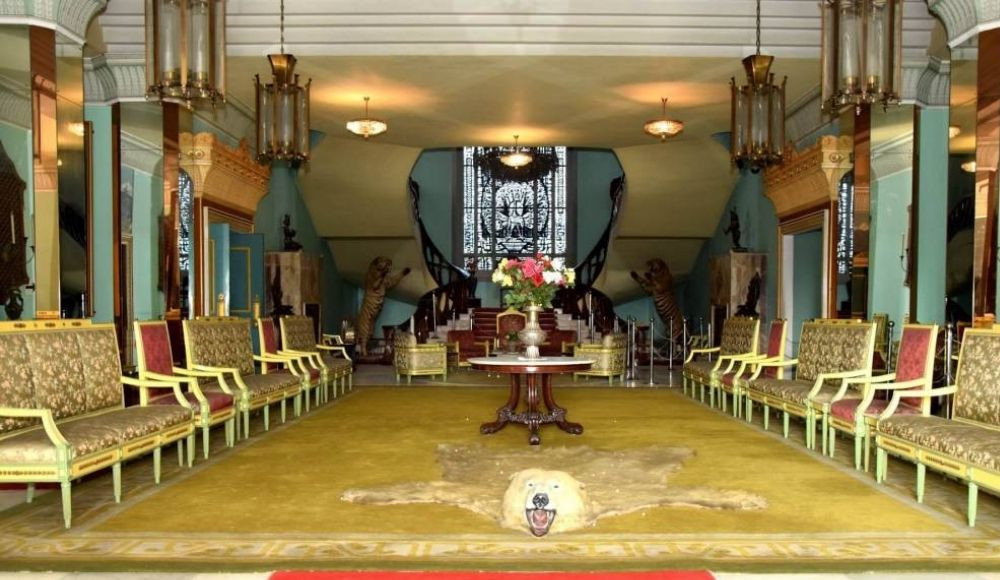
Kaski Sadan served as the receiving place for the visiting Heads of State and for the oath-taking ceremonies of the Prime Minister and the Chief of Justice. The Shah Monarch also used this hall as a formal meeting room with the politicians.
Gorkha Baithak
Another masterpiece of the palace, Gorkha Baithak, stands out for its unique architecture. The remarkable aesthetic and decorative chandelier elevates the beauty of this Baithak.
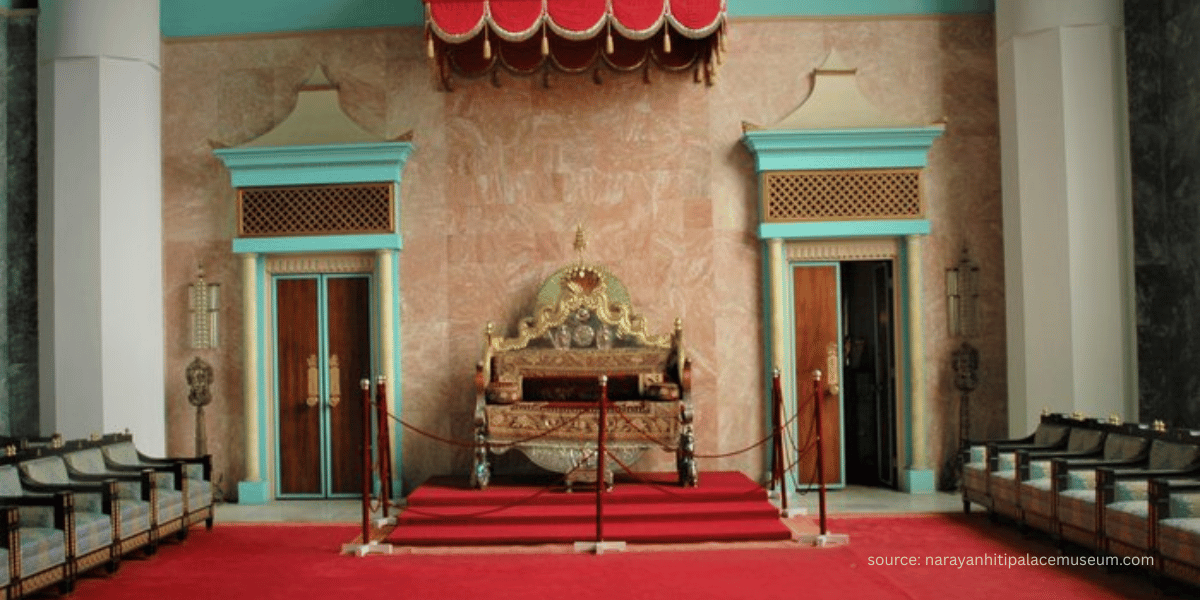
The 60-foot-high pagoda ceiling, supported by four concrete columns, represents Nagas. The columns are decorated with paintings of Hindu guardian demigods, the Asta Matrikas and Asta Bhairavas.
Another major artifact of the palace is the Royal Throne, which is 8 feet tall, 4 feet wide, and 6 feet in length. The king was seated on the royal throne at the center, and the royal family and the government officials were seated opposite the king.
Furthermore, Gorkha Sadan was used for the coronation ceremony, presentation of credentials, national celebrations, and royal ceremonies.
Dhanusha Baithak
After exploring various sadans, you can enter Dhanusha Baithak, which is located on the ground floor, and it’s another mesmerizing room of the palace.
You’ll even see a collection of medals displayed inside the Dhanusa Baithak that represent royal honor. Alongside these medals, you get to see portraits of the Queen in their official attire, elevating the elegance of the Baithak.
As far as I’ve learned, the attire of the Queens shows changes in Nepal’s culture and royal traditions over time.
During Vijaya Dashami, Dhanusha Baithak used to serve as a venue for offering tika to high-ranking government and military officials. The king used to present medals in this room, honoring their services and dedication.
Moreover, the hallway from Rolpa Sadan to Baitiadi Sadan features various photographs of historical personalities. These photographs include King Mahendra and King Birendra with visiting heads of state and their families.
Tribhuvan Sadan
Passing through the palace exit and following the passage, I arrived at Tribhuvan Sadan, which was once known as Happy Cottage.
I peeked through the window of the Billiard Baithak and felt a cold breeze running down my spine. The sadan, filled with silence, felt horrifying as it marked the place where King Birendra and his family had lost their lives.
The room is dark, and you can see a pool table and marks of bullets from the infamous Royal Massacre (or Durbar Hatyakanda).
To give you more context: Queen Mother Ratna Rajya Lakshmi ordered the demolition of Tribhuvan Sadan, as it reminded her of the tragic night of June 1. However, this sparked a massive backlash as it fueled another conspiracy that the monarch had deliberately destroyed the key evidence.
For years, the site was just an open ground with brick foundations and outline markers. But today, major foundations have been partially rebuilt using old blueprints, and it’s open to visitors who wish to witness the memories of that tragic night.
The Royal Crown
The moment I walked into Rupandehi Sadan, it was the Royal Crown, aka 'Shreepech', that caught my attention immediately!
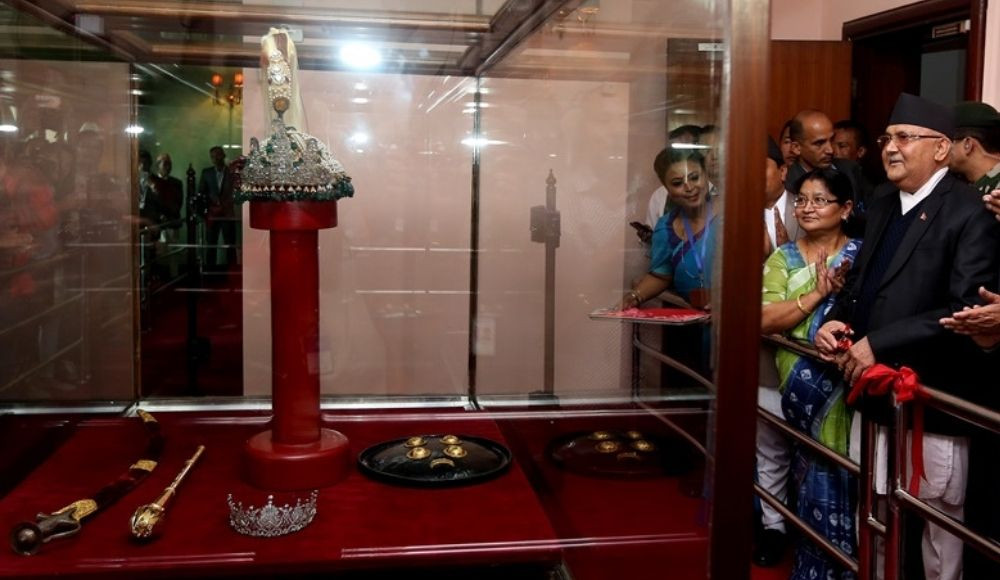
The Royal Crown, along with the Queen's Tiara, Ceremonial Mace, and Royal Sword, is displayed inside bulletproof glass. These artifacts stun and impress every visitor when they enter the room.
The crown is decorated with beautiful feathers of the “bird of paradise”. The Shreepech was thought to have been worn since the time of King Rajendra. It was more than a ceremonial ornament that symbolizes monarchy and royal authority.
With the small detail that I noticed, the royal crown is covered with precious gemstones such as diamonds, pearls, emeralds, and rubies. The base of the crown is made up of pure gold and silver, showing the perfect result of craftsmanship.
Following the abolition of the monarchy in 2008, the royal crown is now state property and preserved under the care of the government of Nepal.
The Golden State Coach
Another major attraction within the palace compound is the Golden State Coach, which is a remarkable royal carriage.
I was amazed to see a fleet of cars, including the baby cars of Dipendra and Nirajan, along with a Mercedes-Benz, an Austin Princess, and a Ford, before my eyes fell upon the Golden State Coach.
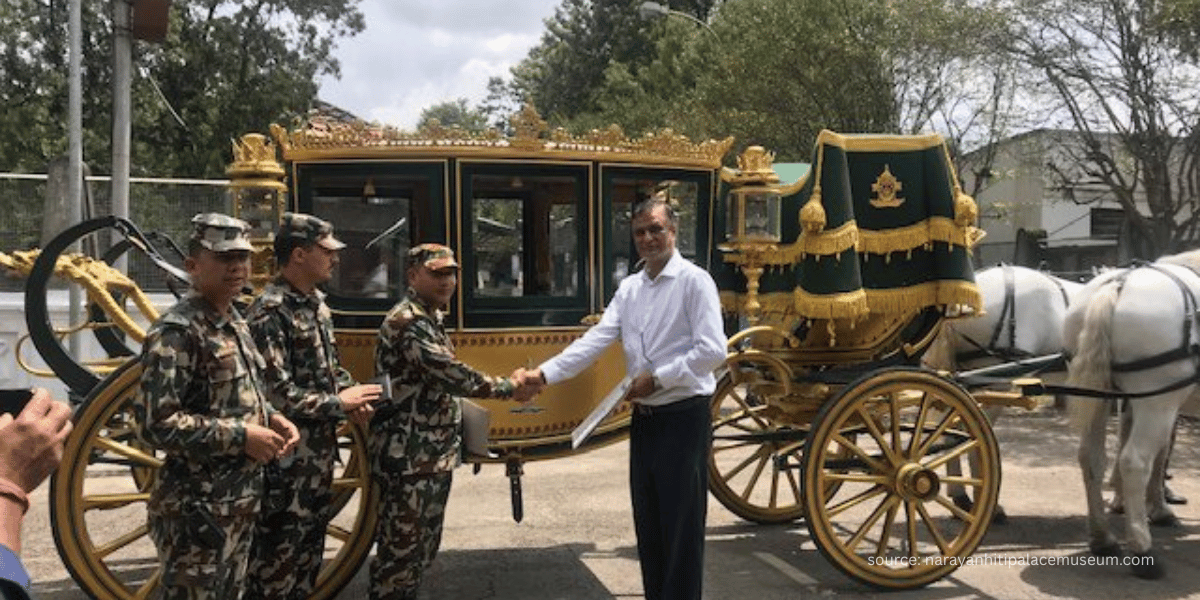
The Golden State Coach was gifted by Queen Elizabeth II to King Mahendra. The same coach was first used during King Birendra’s coronation ceremony and later in the transportation of Queen Elizabeth II from Basantapur to Narayanhiti Palace.
This rare masterpiece was only recently opened for exhibition. The first coach is displayed here in Nepal, while the second coach remains at Buckingham Palace, where it continues to be used on state occasions.
Shree Sadan
Shree Sadan was open to the general public after nearly 20 years of a tragic royal massacre in 2020 A.D.
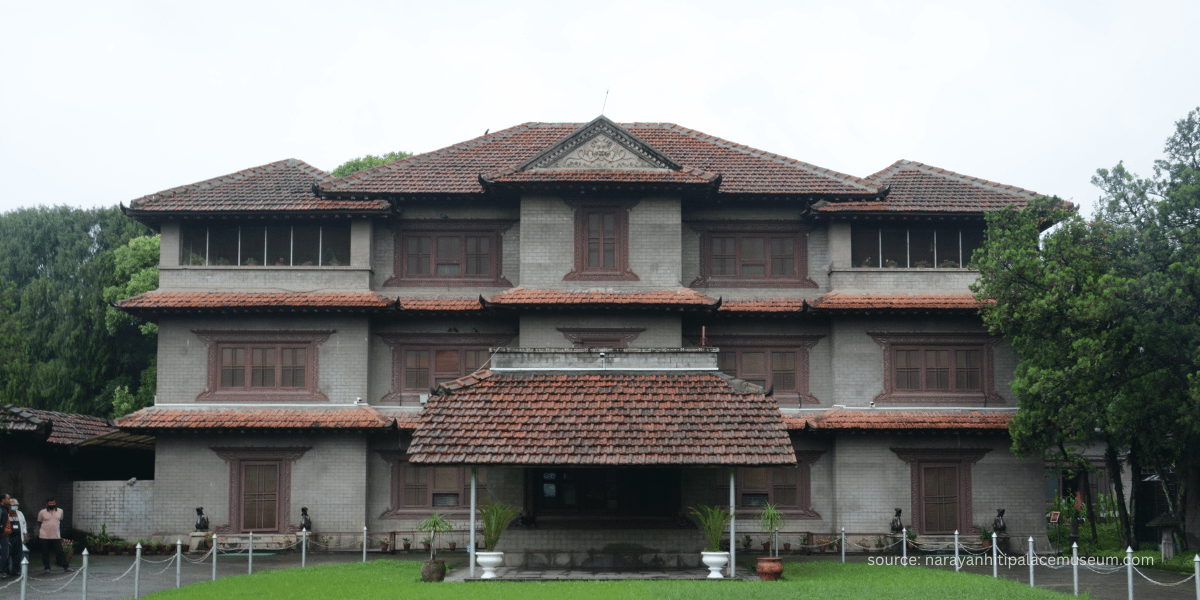
As the last monument of the palace, Shree Sadan appears different from the main palace. Blending Chinese and Nepali multi-roof temple styles, Shree Sadan’s architecture immediately caught my attention as I walked the paved path.
Despite being built for royalty, the simple appearance of Shree Sadan represents the simple lifestyle of King Birendra and his family. Drawings by Princess Shruti in the hallway and exercise room of Prince Nirajan reflect that this family was no different from ordinary families.
Following the royal tradition, the king and crown prince could not reside under the same roof. Thus, Birendra, after being declared crown prince, had built Shree Sadan as his private residence.
Tips For Visitors
Visiting the Narayanhiti Palace Museum can make one feel like you’re witnessing different chapters of Nepal’s modern history. Now, based on my experiences, here are some tips I’d like to share with you so you can explore this museum even more meaningfully:
- Since cameras and smartphones are strictly prohibited, keep them safely in the designated locker.
- Exploring the museum can take from 3-4 hours to an entire day. So, wear comfortable footwear, which will make your visit easier and smoother.
- Carry a bottle of water to stay hydrated, as the trip can feel long.
- Pause at each artifact inside the palace. I spent most of my time exploring Tribhuvan Sadan, the private garden of Queen Aishwarya, and the Republic Monument, so these are the places I recommend too!
- Enter the palace right at the first opening hour. This helps avoid the crowd of visitors (mostly students who are taken here for excursions). This also gives you more time to explore the museum.
Final Thoughts
If you are planning Kathmandu sightseeing, then adding Narayanhiti Palace Museum to your itinerary is highly recommended. I assure you that your visit is going to be worth every second!
You get to step into the historical landmark with unique architecture that preserves a record of 240 years of Nepal's history.
Aside from sightseeing, your visit to Narayanhiti Palace Museum offers a meaningful understanding of Nepal’s culture, tradition, and history. Each step in this palace takes you to a different phase of modern Nepalese history.
So, plan your visit to Narayanhiti Palace Museum today and walk through the diverse chapters of Nepal’s history. And let us know if you’d like us to include this tourist destination in one of our Kathmandu-focused packages, and we assure you that our guide shall clarify all your doubts!


 Altitude Himalaya